





1.6T OSFP224 Modules: Enabling 800G to 1.6T Migration in Modern Data Centers
 Jun 16, 2026|
 You already run 800G in production, and your switch ASICs are the real question mark. Before the first live 1.6T OSFP224 link comes up, three procurement decisions stand in the way, and none of them print "OSFP224" on the purchase order: the switch SerDes generation, the module housing, and the lane rate hiding behind a familiar variant name. This walks through which parts you actually swap, which "backward compatible" claims hold, and the part-number traps that surface only when a link refuses to come up.

The migration window is tighter than any upgrade before it
The 800G-to-1.6T transition is tracking nearly twice as fast as prior Ethernet speed jumps, and the volume curve is steeper than anything that came before. Past speed transitions gave network teams years of overlap to plan around; this one won't. Industry analysts at Dell'Oro have noted the move from 800G to 1.6T is running close to double the pace of the front-end network transitions teams are used to, and a 1.6T OSFP224 transceiver class is expected to reach ten million units in annual shipments within roughly four years, a level that took 100G modules about a decade to hit (LightCounting).
The pressure comes straight from AI back-end fabrics, and the buying behavior shows it. 1.6T module pricing climbed from roughly $1,200 to $2,000 through 2025, close to a 67% increase that runs against the deflation curve optics normally follow, with backlogs on some configurations stretching well past their usual lead times. That inversion is a useful signal: when a category gets more expensive while shipping in volume, supply is the constraint, not demand. We unpack what that means for procurement timing in our broader look at where optical transceiver demand is heading.
The variable those ramp numbers don't address is switch generation. A fast industry ramp doesn't become a fast migration for your fabric until your SerDes generation is confirmed compatible, which is the layer the next section opens up.
What you're actually buying when a module says OSFP224
OSFP224, also written as OSFP1600, delivers 1.6 Tbps across eight electrical lanes running at 200G PAM4 each, and it is mechanically backward compatible with the 400G and 800G OSFP modules already in your switches(OSFP MSA) . That single design choice is why the 8x200G OSFP224 module is the pragmatic migration carrier inside the NVIDIA Quantum-X800 and ConnectX-8 world, rather than a parallel form factor that forces new cages.
The distinction the market keeps blurring is worth settling by scenario, because it decides which path is even relevant to you. If your switching tier already sits on a 100G-SerDes ecosystem and you want 1.6T without changing electrical lanes, OSFP-XD, sixteen lanes at 100G, is the path built for you. If you're standardizing on XDR-generation switches and 200G-per-lane silicon, the 1.6T OSFP224 path keeps your cage, breakout, and copper investments intact, and OSFP-XD is the wrong bet on the wrong SerDes lineage. This article serves the second case only: the NVIDIA InfiniBand XDR ecosystem, where OSFP224 is the migration carrier. Once you've committed to a 200G-lane platform, "both are fine, pick either" stops being honest advice.

Migration is a four-layer swap, not a module swap
A 1.6T OSFP224 migration delivers bandwidth only when the switch generation, NIC topology, and fiber plant were specified together; the optic is the last thing you choose, not the first.
Treating 800G-to-1.6T as "pull the optic, push the new optic" is the single most expensive misread we see, because a clean migration touches four layers and skipping any one turns into a stalled link or a returned shipment.
The switch ASIC comes first, because it sets the SerDes generation. A 1.6T OSFP224 optic expects 200G-class electrical lanes; a switch built for 8x100G SerDes cannot drive it, no matter how new the module is. The network interface side matters too: a twin-port OSFP224 module presents one physical 1.6T cage as two independent 800G links, which is exactly how the NVIDIA Quantum-X800 (Q3400-RA) builds 144 ports from 72 physical cages, and that topology has to match what your NICs expect. Fiber is the layer most teams under-budget. A parallel DR8 plan needs eight fibers per link, while a wavelength-multiplexed 2xFR4 design over CWDM4 can cut fiber count by about 75% (eight parallel single-mode strands collapse to two LC fibers each carrying four multiplexed wavelengths), which on a ten-thousand-link facility is the difference between thirty thousand strands installed or not. If you're scoping the starting point of that fiber math, our 800G OSFP and QSFP-DD800 overview lays out the baseline you're migrating from.
Choosing a variant changes with the deployment, not the datasheet
For GPU-to-switch links inside a single hall, the dominant case in dense AI pods, a DR-class OSFP224 module at 500m of single-mode reach is the right call, and paying for longer reach is wasted budget. For switch-to-switch links that cross data halls or campus distances, an FR-class 1.6T OSFP224 variant at 2km earns its premium, and the CWDM4-based 2xFR4 design also collapses your fiber count on those longer runs. The third axis is thermal, and it is a hard physical fork rather than a preference: air-cooled fabrics take finned-top (IHS) housings, liquid-cooled switches take flat-top (RHS) housings, and on a Quantum-X800-class switch the IHS cage is the only one that physically accepts a module, making flat-top RHS the single wrong answer there.
| Selection axis | DR-class OSFP224 | FR-class OSFP224 (2xFR4) |
|---|---|---|
| Typical reach | 500m, intra-hall | 2km, hall-to-hall / campus |
| Optical scheme | 8 parallel single-mode lanes | CWDM4 wavelength-multiplexed |
| Connector | MPO (parallel) | Dual-duplex LC |
| Fiber count | Higher (parallel) | ~75% lower vs parallel DR8 |
| Best-fit link | GPU-to-switch | Switch-to-switch |
The compatibility traps that quietly stall a rollout
Most 1.6T OSFP224 deployment problems aren't performance failures; they're matching failures, ordered weeks earlier and discovered at install. These are the ones worth memorizing.
The naming trap
The housing trap
The SerDes trap is the same logic one layer up, where a switch built for 100G electrical lanes cannot drive a 200G-lane 1.6T OSFP224 transceiver, so "the module is brand new" is never the same as "the module will work here." Verify lane rate, housing type, and switch SerDes generation as three separate line items on every order, because each one fails silently and independently. The platform-by-platform exceptions only surface in real bring-up, which is exactly why a compatibility-tested supplier matters more here than at any prior speed.
Power and heat set the real ceiling
Bandwidth isn't the limit on a 1.6T migration; thermals are.
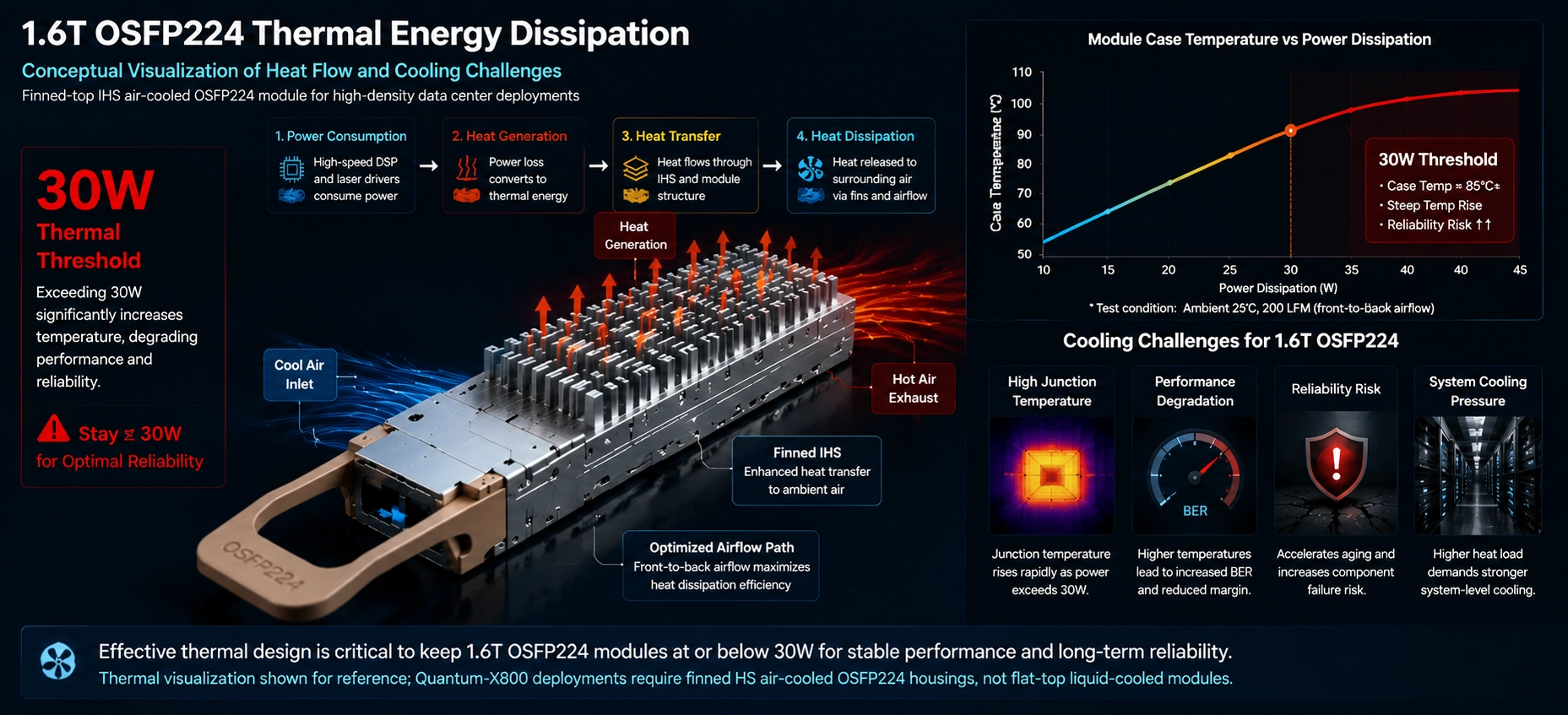
1.6T OSFP224 Power Consumption: The 30W Threshold
why 1.6T links strain high-capacity fabrics.
Three responses are running in parallel, and they are a spectrum rather than a winner. DSP process node is the near-term lever: moving a 1.6T OSFP224 module from a 5nm to a 3nm DSP cuts energy per bit and, the underrated part, improves link stability and lowers port failure rates across large clusters, a reliability story as much as a power one. Linear-drive pluggable optics (LPO) go further by removing the DSP for a meaningful module-level power reduction, but their interop validation is still concentrated in hyperscaler programs. Co-packaged optics sit beyond that horizon for most buyers. For most operators building production clusters in 2026, the 3nm DSP pluggable is the practical call: the reliability dividend over 5nm is real, and LPO de-risking isn't yet available to operators outside the hyperscale certification pipeline.
| Power approach | Relative energy/bit | Practical status for 1.6T |
|---|---|---|
| 5nm DSP pluggable | Baseline | Shipping, highest power |
| 3nm DSP pluggable | Lower than 5nm | Shipping, better reliability, recommended for 2026 builds |
| LPO (no DSP) | Lower than DSP | Early hyperscale adoption only |
Buying ahead of the standard
Here's a fact that makes risk-averse buyers uncomfortable: volume 1.6T OSFP224 modules are shipping today, but the governing Ethernet standard isn't finished. IEEE 802.3dj, which defines 200G through 1.6T at 200G per lane, is tracking to completion in late 2026 (
with the task force documentation maintained in the open by theIEEE 802.3 working group. Early 200G-per-lane products reaching the field before ratification is normal for this industry, but it shifts where the burden of proof sits.When the standard isn't sealed, multi-vendor interoperability rests on documented test campaigns rather than a compliance logo. That's the practical case for treating a 1.6T OSFP224 supplier's interoperability evidence, specific switches tested, measured bit-error performance, named NIC pairings, as a hard procurement requirement rather than a nice-to-have. A supplier who can't produce a dated bring-up log against a specific NVIDIA model isn't de-risked yet; the missing standard doesn't make that acceptable, it makes it riskier. The de-risking move isn't waiting for the standard, it's buying from whoever can show the bring-up data.
The proof that should sit behind any OSFP224 order
Before a single 1.6T OSFP224 order goes out, three things should be pinned against your platform, then matched to a specific tested part rather than a label. Use the left columns as the universal check; the right columns are where a supplier either has the evidence or doesn't.
| Confirm before ordering | Why it fails silently | NVIDIA target P/N | Availability |
|---|---|---|---|
| 200G-lane switch SerDes | A 100G-lane switch won't drive a 1.6T optic | MMS4A00-XM (1.6T 2xDR4, IHS) | Request current qualified P/N |
| IHS finned-top vs RHS flat-top | Wrong housing won't seat in the cage | MMS4A50-XM (1.6T 2xFR4, IHS) | Request current qualified P/N |
| Lane rate behind the variant name | "2xDR4" at 800G is not "2xDR4" at 1.6T | MMS4A20-XM800 (800G DR4, RHS) | Request current qualified P/N |
| Reach class: DR 500m vs FR 2km | Over- or under-buying reach wastes budget | -- | DR / FR per platform |
| Documented interoperability evidence | No ratified standard to fall back on | -- | Bring-up log on request |
For the NVIDIA target part numbers above, we publish the validated pairing instead of asking you to trust a label. Our applications team runs OSFP224 modules against the NVIDIA Quantum-X800 (Q3400-RA) and ConnectX-8 hosts and records each result the way an engineer would check it: host model and firmware, application mode, pre- and post-FEC BER per lane, eye-mask margin, DOM stability, and CMIS revision. That dated bring-up log ships with the qualified module, available the same way you would ask for a datasheet, so you can request the lane rate, the per-platform housing options, and the test record in one conversation, then browse the matched 1.6T and OSFP224 optical transceiver range against your own platform.
Where to start
The migration doesn't begin with the optic; it begins with an honest inventory of your switch generation, because that single fact decides whether 1.6T OSFP224 modules are a drop-in this cycle or a next-cycle project. Map your SerDes generation and cooling first, pick reach by scenario second, and let variant and housing fall out of those two answers. Get those right and the 800G-to-1.6T jump is an upgrade; get them wrong and it's a return shipment.
FAQ
Q: Can 800G 2xDR4 modules interconnect with 1.6T 2xDR4 OSFP224 modules?
A: No. The 800G version runs 100G PAM4 per lane and the 1.6T version runs 200G PAM4 per lane, so despite the near-identical name they cannot link.
Q: What's the difference between OSFP224 and OSFP-XD for 1.6T?
A: OSFP224 (OSFP1600) uses 8 lanes at 200G and stays backward compatible with 400G/800G OSFP cages, while OSFP-XD reaches 1.6T with 16 lanes at 100G on a different SerDes lineage.
Q: Can a flat-top (RHS) 1.6T module go into a Quantum-X800 switch?
A: No. That platform uses finned-top IHS cages, and flat-top RHS housings will not physically seat, so air-cooled switches must be ordered as IHS.
Q: How much power does a 1.6T OSFP224 module consume?
A: Typically more than 30W per module, which pushes dense AI switches toward liquid cooling, with 3nm DSP and LPO designs lowering energy per bit.
Q: When will the 1.6T (IEEE 802.3dj) standard be finalized?
A: IEEE 802.3dj is on track for completion in late 2026, although 1.6T OSFP224 products are already shipping in volume ahead of ratification.