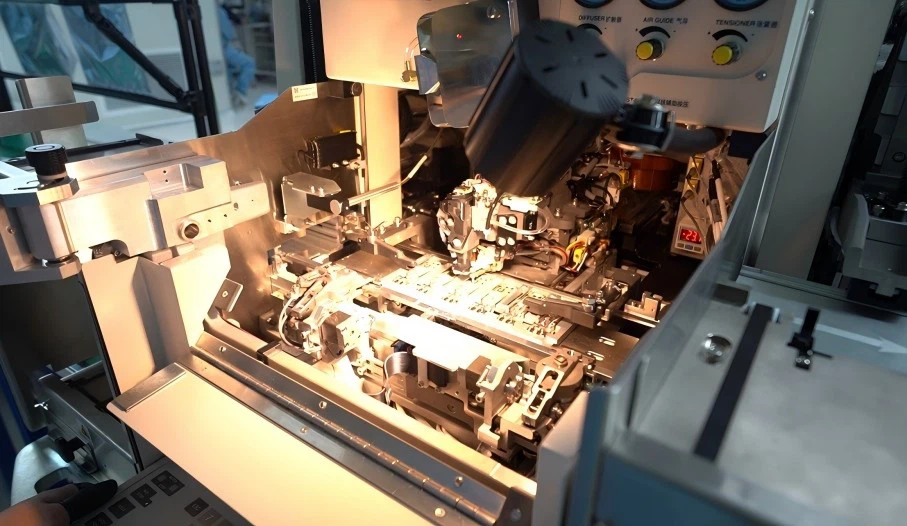
Optical, Thermal, And EMC Verification
ISO 9001:2015 Quality Management System
ISO 14001:2015 Environmental Management
CE, FCC, RoHS compliance
Telcordia GR-468-CORE qualified
Competitive wholesale rates direct from the manufacturer, eliminating middleman costs.
Tiered volume discounts, flexible payment options, and long-term price protection.
Optimized low power consumption and high reliability to minimize long-term operational costs.
Extended warranty coverage with free, lifetime technical assistance included.
100% verified via extensive optical, thermal, and reliability testing protocols.
Real-time inventory visibility
Express shipping options available
Buffer stock programs for critical deployments
99.5% on-time delivery rate
Expedited processing for urgent orders
Flexible shipping options (air, sea, courier)
Provide pre-sales technical support
Custom coding and configuration services
Compatibility verification and testing
Post-deployment optimization support
24/7 emergency technical assistance
Selecting the right 400G optical transceiver module depends on three primary factors: transmission distance, fiber infrastructure, and budget considerations. The table below summarizes common deployment scenarios to help guide your purchasing decision.
Intra-Rack and Top-of-Rack Connections (under 100m)
For server-to-leaf switch links within the same rack or row, 400G-SR8 multimode transceivers offer the most cost-effective solution. These modules operate at 850nm over OM4 multimode fiber and connect via MPO-16 patch cables. If your existing cabling uses OM3 fiber, transmission distance drops to approximately 70 meters—still adequate for most TOR deployments. For environments prioritizing fiber count reduction, consider 400G SRBD (BiDi) modules that achieve 400G over just 8 fibers.
Inter-Pod and Building Interconnects (500m to 2km)
When connecting leaf switches to spine or linking separate pods within a campus, single-mode fiber transceivers become necessary. The 400G QSFP-DD DR4 module is optimized for distances up to 500 meters using parallel single-mode fiber with MPO-12 connectors. For runs extending to 2 kilometers, 400G FR4 optical transceivers multiplex four 100G channels onto a single fiber pair, enabling use of standard duplex LC patch cords and simplifying cable plant management.
Metro and Extended Reach Applications (2km to 40km)
Enterprise customers connecting geographically distributed data centers or extending to colocation facilities typically require longer-reach 400G solutions. The 400G QSFP-DD LR4 transceiver supports links up to 10 kilometers, while 400G ER4 modules push reach to 40km for metro DCI applications. These CWDM-based transceivers use EML lasers and integrate wavelength multiplexing within the module, outputting a single duplex LC connection.
Coherent and Long-Haul Connectivity
For distances beyond 40 kilometers or integration with existing DWDM infrastructure, 400G ZR and OpenZR+ coherent pluggable transceivers bring advanced DSP technology into the compact QSFP-DD form factor. These modules support tunable wavelengths across the C-band, enabling deployment over amplified WDM networks spanning hundreds of kilometers. FB-LINK's 400G coherent QSFP-DD modules are ideal for carriers and enterprises seeking to converge routing and transport functions.

Built for NVIDIA GPU Clusters & AI Workloads
As AI models grow exponentially—from GPT to Llama to enterprise ML pipelines—the demand for ultra-high-bandwidth, low-latency interconnects has never been greater. FB-LINK's 400G transceivers are engineered to meet the rigorous requirements of modern AI data centers.
Why AI Clusters Need 400G:
Compatible with Leading AI Platforms:

Scenario 1: Hyperscale Data Center Expansion
Challenge: A leading cloud service provider needed to expand their data center capacity to support growing AI workloads, requiring 10x bandwidth increase within existing rack space.
Solution: FB-LINK deployed 400G QSFP-DD SR8 transceivers for spine-leaf interconnects and 400G DR4 modules for inter-pod connections.
Results:
4x reduction in transceiver count vs. 100G
60% reduction in power consumption per gigabit
40% savings in rack space
Seamless integration with existing Ethernet switches
Completed deployment 30% under budget
Scenario 2: Financial Services Network Upgrade
Challenge: A global financial institution required ultra-low latency connections between trading floors and data centers located 15km apart.
Solution: FB-LINK provided 400G QSFP-DD LR4 transceivers with optimized latency performance and 24/7 technical support.
Results:
Sub-75μs round-trip latency achieved
99.999% link availability over 12 months
50% reduction in fiber infrastructure costs
Zero unplanned downtime during deployment
Advanced monitoring capabilities enabled proactive maintenance


Scenario 3: Multi-Site Enterprise Campus
Challenge: A university campus needed to interconnect multiple buildings across 5km with room for future bandwidth growth.
Solution: FB-LINK implemented 400G QSFP-DD FR4 transceivers with bidirectional fiber pairs, preserving dark fiber for future expansion.
Results:
Future-proof infrastructure supporting 10+ years growth
Simplified cable management with LC duplex connectors
75% reduction in fiber count vs. parallel optics
Seamless support for multi-protocol traffic
Enhanced security through dedicated optical infrastructure
Scenario 4: Telecommunications Carrier Transport
Challenge: A tier-1 carrier required flexible, scalable transport between metro edge sites up to 80km apart with DWDM compatibility.
Solution: FB-LINK deployed 400G QSFP-DD DCO transceivers with tunable wavelengths and integrated monitoring.
Results:
40-wavelength DWDM system supporting 16Tbps capacity
Software-defined networking (SDN) integration
Remote configuration and monitoring capabilities
90% faster service activation vs. traditional systems
OpEx savings of $2M annually through automation

Enterprise-grade capabilities for mission-critical networks

Digital Diagnostics (DDM)
Real-time monitoring of optical power, temperature, and voltage across all lanes. Proactive alerts reduce downtime by 60%.

Zero-Touch Provisioning(ZTP)
Auto-discovery, remote configuration, and OTA firmware updates. Deploy at scale with minimal manual intervention.

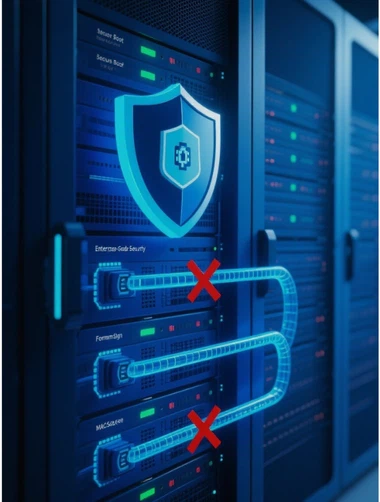
Enterprise Security
Secure boot, signed firmware, and MACsec support. Protection against counterfeit modules and unauthorized access.

Universal Compatibility
Tested with Cisco, Arista, Juniper, Dell, HPE platforms. Custom EEPROM coding available for seamless integration.
FB-LINK 400G QSFP-DD optical transceivers meet IEEE 802.3bs specifications and major industry certifications for reliable data center and enterprise deployment.
Technical Standards
IEEE & MSA Compliance
IEEE 802.3bs- 400 Gigabit Ethernet
QSFP-DD MSA- 8-lane form factor
CMIS 5.0- Management interface
400GBASE-DR4/FR4/LR4- Reach options
Regulatory Compliance
Global Certifications
CE Mark- EU compliance
FCC Part 15 Class B- EMC certified
RoHS 3.0 / REACH- Environmental
UL/cUL Listed- North America
Quality & Safety
Manufacturing Excellence
ISO 9001:2015- Quality management
ISO 14001:2015- Environmental
IEC 60825-1 Class 1- Laser safety
Telcordia GR-468- Reliability testing
FB-LINK 400G QSFP-DD transceivers feature 8x50G PAM4 signaling with KP4 FEC for error-free 400GbE transmission. Compatible with Cisco, Arista, Juniper, and other leading switches for hyperscale data center and cloud networking.
Enterprise-grade 400G optical modules engineered for hyperscale data centers, AI clusters, and telecom networks

Ultra-Low BER Performance for Mission-Critical Networks
FB-LINK 400G QSFP-DD transceivers deliver industry-leading Bit Error Rate (BER) < 10⁻¹² at maximum transmission distance, ensuring error-free data transfer for latency-sensitive applications like high-frequency trading, real-time AI inference, and cloud gaming infrastructure.
2+ Million Hours MTBF - Built for Long-Term Deployment
Designed for 10+ year operational lifespan in always-on data center environments. FB-LINK 400G optical transceivers undergo rigorous burn-in testing and accelerated life testing to ensure consistent performance throughout their service life.

Multi-Vendor Switch Compatibility
Plug-and-Play Integration
Cisco Nexus 9000/Catalyst 9000
Arista 7000/7500 Series
Juniper QFX5000/QFX10000
Dell EMC S5200/Z9500
HPE Aruba CX/FlexFabric
Huawei CloudEngine Series
Custom EEPROM Coding
OEM-Compatible Solutions
Vendor-specific part numbers
Custom branding available
Proprietary protocol support
MACsec/encryption enablement
Feature unlock programming
48-hour turnaround time
Future-Ready 800G Migration
Technology Roadmap
Next-gen DSP chipsets
RS-FEC/KP-FEC algorithms
AI-optimized signal processing
CPO development underway
OSFP-XD form factor ready
1.6T pathway planned
🔬 15%+ Annual R&D Investment
FB-LINK continuously invests in cutting-edge optical technology, ensuring our 400G QSFP-DD, 400G QSFP112, and 400G OSFP transceivers incorporate the latest advancements in PAM4 signaling, silicon photonics, and coherent DSP technology.
What sets FB-LINK 400G optical modules apart from generic alternatives
Broadcom PAM4 DSP ICs
Marvell/Inphi driver chips
Lumentum/II-VI laser sources
Certified EML/VCSEL arrays
Gold-wire bonding process
48-72 hour burn-in testing
8-lane optical power verification
BER testing with/without FEC
100+ insertion/extraction cycles
Multi-platform compatibility test
SR8: <10W typical power
DR4: <12W typical power
FR4: <14W typical power
8% lower vs OEM average
Optimized thermal design
Early access to new products
Beta testing opportunities
Feature request prioritization
Long-term EOL guarantees
Technology migration support
Optimized for high-bandwidth, low-latency enterprise and carrier deployments
🏢 Hyperscale Data Centers
🤖 AI/ML Training Clusters
📡 Telecom & 5G Networks
💹 Financial Services
Customer Success Stories

CTO
Global Cloud Service Provider
"After extensive testing of multiple vendors, FB-LINK's 400G LR4 modules outperformed even the OEM transceivers in several key metrics. The power consumption was 8% lower, thermal performance was better, and the price was less than half. The decision was easy. FB-LINK is now our preferred supplier for all optical transceivers."
"The technical expertise and responsiveness are unmatched."

Network Architect
Fortune 500 Financial Institution

Infrastructure Manager
Research University
Q: What power consumption should I expect from 400G QSFP-DD modules?
A: Power consumption varies by reach and optical technology. Short-range 400G-SR8 modules typically draw 8-10W, while 400G-DR4 and FR4 transceivers consume 10-12W. Longer-reach modules like 400G-LR4 may require up to 14W, and coherent 400G-ZR pluggables operate in the 15-18W range. Ensure your switch platform provides adequate per-port power budget before deployment—FB-LINK can verify compatibility with your specific equipment.
Q: Can 400G QSFP-DD modules break out to multiple lower-speed connections?
A: Yes, many 400G transceivers support breakout configurations. A 400G-SR8 module can operate as 2×200G-SR4 or 8×50G-SR links. Similarly, 400G-DR4 transceivers break out to 4×100G-DR connections via MPO-to-LC fanout cables. This capability is particularly useful during migration phases when connecting new 400G spine switches to existing 100G leaf infrastructure. Contact FB-LINK for specific breakout cable recommendations.
Q: How do I choose between QSFP-DD and OSFP for my 400G deployment?
A: Both form factors deliver identical 400G bandwidth using 8×50G PAM4 signaling. QSFP-DD offers direct backward compatibility with existing QSFP28 cages, simplifying upgrades. OSFP provides slightly better thermal management due to its larger footprint, making it preferable for high-power coherent optics or environments planning early adoption of 800G. FB-LINK supplies both form factors; our engineering team can recommend the optimal choice based on your switch platform and roadmap.
Q: What fiber connectors are used with different 400G transceiver types?
A: Connector type depends on the optical interface standard. Parallel optics (SR8, DR4) use MPO/MTP multi-fiber connectors—MPO-16 for SR8 and MPO-12 APC for DR4. Wavelength-multiplexed modules (FR4, LR4, ER4, ZR) use standard duplex LC connectors familiar from 100G deployments. Always verify connector polish type (PC vs. APC) as specified in the transceiver datasheet to prevent connector damage and ensure optimal return loss.
Q: Are FB-LINK 400G modules compatible with NVIDIA InfiniBand switches?
A: Yes. FB-LINK 400G OSFP and QSFP-DD transceivers are fully tested with NVIDIA Quantum-2 NDR InfiniBand switches and ConnectX-7 adapters. Our modules support both 400G Ethernet and InfiniBand NDR protocols. For AI training clusters using GPU-direct RDMA, we recommend our low-latency 400G-SR4 or DR4 modules optimized for consistent sub-microsecond jitter. Custom EEPROM coding for NVIDIA compatibility is available upon request.
Q: What is the difference between QSFP-DD and OSFP for 400G applications?
A: Both support 400G, but QSFP-DD (Double Density) maintains the same width as QSFP28/QSFP+ for backward compatibility, while OSFP (Octal Small Form Factor Pluggable) is wider with better thermal management. QSFP-DD is more common in current deployments; OSFP offers advantages for higher power applications and future 800G migration.
Q: Can I use 400G transceivers with existing 100G infrastructure?
A: Yes, with breakout cables. A 400G QSFP-DD port can connect to four 100G QSFP28 ports using appropriate breakout cables and transceivers (e.g., 400G-DR4 to 4x100G-DR). This enables gradual migration and investment protection.
Q: What is the typical lead time for FB-LINK 400G transceivers?
A: Standard models (SR8, DR4, FR4, LR4) are typically in stock for immediate shipment. Custom-coded versions require 7-10 business days. Large volume orders (1000+ units) may require 3-4 weeks for production. Contact us for specific lead times.
Q: Do you offer advance replacement for failed transceivers?
A: Yes, we offer advance replacement programs for qualified customers with annual purchase agreements. Failed units are replaced before returning the defective unit, minimizing network downtime.
Q: How do FB-LINK 400G transceivers compare to OEM products?
A: FB-LINK transceivers meet or exceed OEM specifications, undergo identical or more rigorous testing, and often use the same high-quality components from vendors like Broadcom and Inphi. The primary differences are price (typically 50-70% lower) and our superior customer service and flexibility.
Q: What warranty coverage do FB-LINK 400G transceivers include?
A: Standard 3-year warranty covering defects in materials and workmanship. Extended 5-year warranties available. Warranty includes free replacement, technical support, and firmware updates. Advance RMA service available.
Q: Can FB-LINK provide custom coding for my specific switches?
A: Absolutely. We provide custom EEPROM coding for virtually all major networking equipment brands. Provide your switch model and preferred part number, and we'll program transceivers to integrate seamlessly. Custom coding typically adds 1-2 days to lead time.
Q: What testing do you perform to ensure 400G transceiver quality?
A: Every transceiver undergoes: optical power measurement on all lanes, BER testing with and without FEC, temperature cycling (-40°C to +85°C), mechanical insertion/extraction cycling (minimum 100 cycles), burn-in testing (48-72 hours), and functional testing with major switch platforms.
As one of the leading 400g transceivers manufacturers and suppliers in China, we warmly welcome you to wholesale or buy discount 400g transceivers in stock here from our factory. All customized products are with high quality and competitive price. Contact us for quotation and free sample.