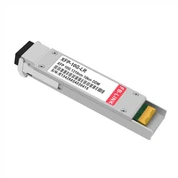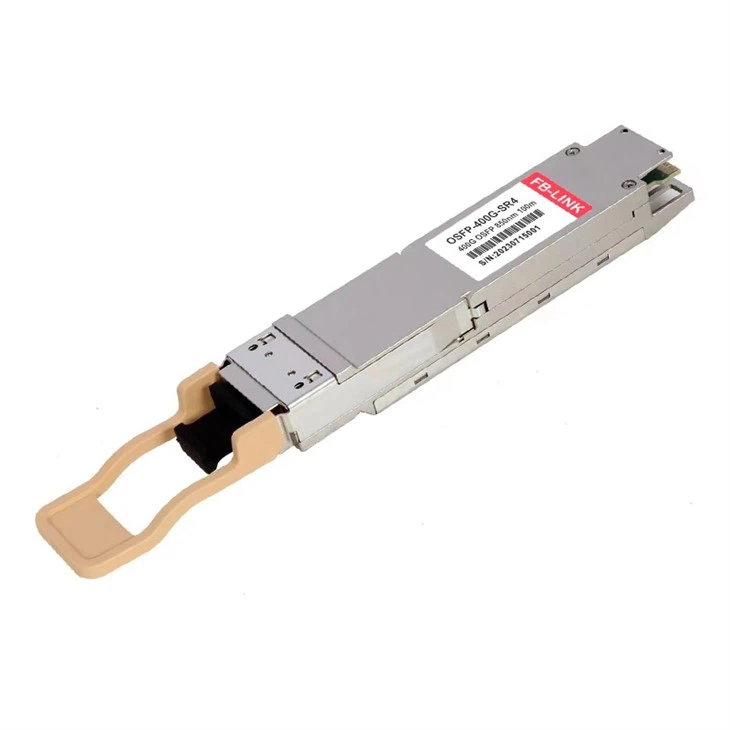
Compatible Mellanox 400G OSFP SR4
400G OSFP SR4 transceiver modules are designed for use in 400 Gigabit Ethernet links on up to 100m of Multimode fiber. They are compliant with the OSFP MSA and IEEE 802.3cd/cm.The optical transceiver is RoHS compliant.
Product Highlights
● Hot-pluggable OSFP form factor
● Supports 425Gb/s aggregate bit rate
● Power dissipation <10W
● Commercial case temperature range of 0°C to 70°C
● Single 3.3V power supply
● Maximum link length of 100m on Multi Mode Fiber (MMF)
● Aligned with IEEE 802.3cd/cm
● 8x50G PAM4 VCSEL-based 850nm transmitter
● 8x50G PAM4 retimed 400GAUI-8 electrical interface
● MPO-16 receptacles
● I2C management interface
● RoHS compliant

- Product Introduction
Products Description
| Data Rate | 425Gb/s | Distance | 100M |
| Case Temperature | 0~70℃ | Voltage Supply | 3.3V |
| Transmitter | Vcsel | Receiver | PIN |
| Wavelength | 850nm | Connector | MPO-16 |
| Power consumption | 10W | TX Power | -6.5~4dBm |
| Warranty | 5 Years | Receiver Sensitivity | <-8.4dBm |
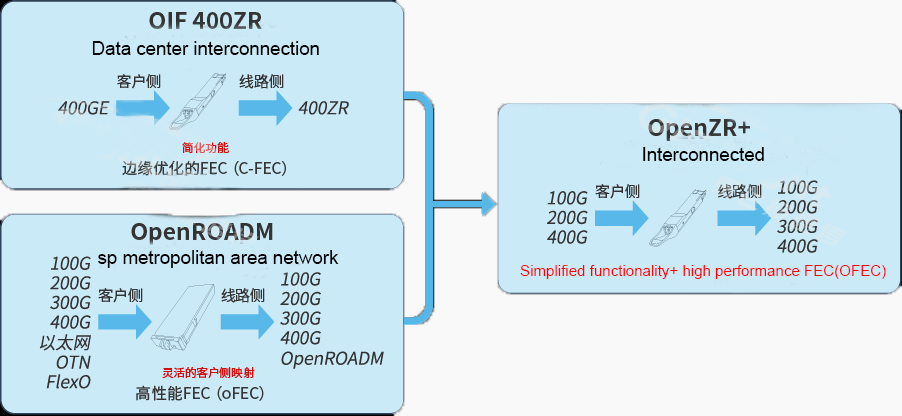
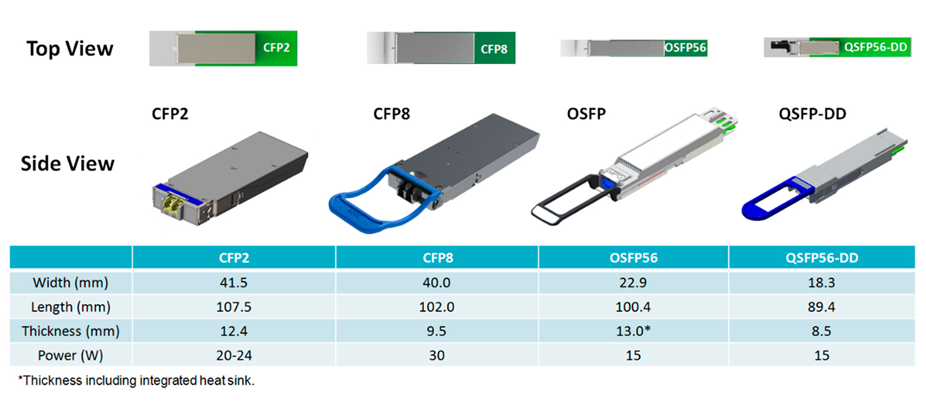
To compare the characteristics of these three packaging forms, please refer to the chart below:
| Parameter | CFP2 | QSFP-DD/OSFP |
| Power consumption | <24W | <12W/<15W |
| distance | Turning on HD-FEC can transmit 1000km |
When CFEC is turned on, the transmission range is 120km. When OFEC is turned on, the transmission range is 200km. |
| client side | 400GbE 100GbE (max 4) OTU4 (maximum 4) |
400GbE 100GbE (max 4) |
| Encryption function | support | No |
| Transmit power | 0dBm | -10dBm |
| Receive sensitivity | -23dBm | -21dBm |
| OSNR | 21dB | 24dB |
| Support OTN | support | Optional |
| In-band management (GCC) |
support | No |
High-bandwidth networking demands continue to surge as enterprises and data centers scale their infrastructure. Optical transceivers have become the backbone of modern network connectivity, with 400G technology leading the charge toward unprecedented data transmission speeds. Among these solutions, the 400GBASE SR4 OSFP module stands out as a critical component for short-reach multimode fiber applications.
What Makes 400G OSFP SR4 Optical Transceivers Essential?
The evolution from 100G to 400G represents more than just a speed increase-it's a fundamental shift in how data centers approach scalability. Optical transceivers operating at 400 gigabits per second utilize advanced modulation techniques to deliver four times the throughput of previous generation equipment while maintaining energy efficiency and cost-effectiveness.
The SR4 variant specifically addresses the need for high-density, short-reach connections within data center environments. Using 850nm VCSEL technology across multimode fiber, these modules provide reliable connectivity for distances up to 100 meters, making them ideal for rack-to-rack and intra-building network architectures.
Key Technological Advantages of Modern Optical Transceivers
PAM4 Modulation: Breaking Through Bandwidth Barriers
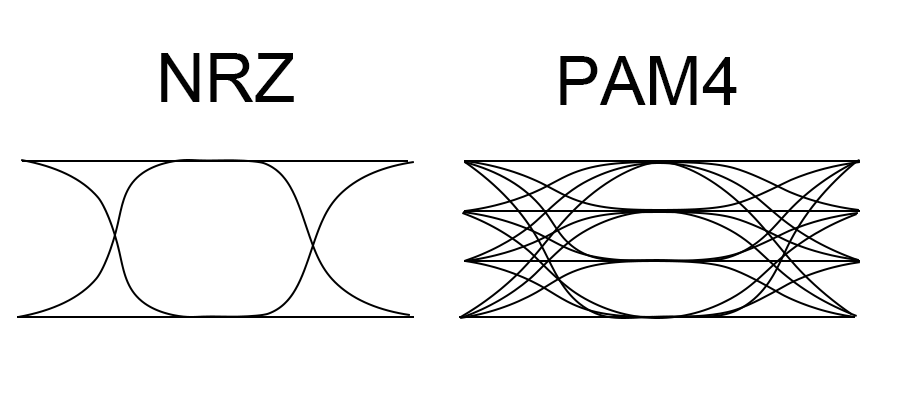
Traditional Non-Return-to-Zero (NRZ) modulation faces significant limitations at higher data rates. Optical transceivers employing Pulse Amplitude Modulation 4-level (PAM4) technology overcome these constraints by transmitting two bits per symbol using four distinct signal levels. This approach effectively doubles the data rate without requiring additional bandwidth, though it does demand more sophisticated signal processing to maintain integrity.
OSFP Form Factor Benefits
The Octal Small Form Factor Pluggable (OSFP) design offers an optimal balance between performance and practicality. Unlike larger CFP2 modules or more compact QSFP-DD alternatives, OSFP optical transceivers provide:
Enhanced thermal management with adequate surface area for heat dissipation
Power consumption typically under 15W for efficient operation
High-density port configurations supporting next-generation switching platforms
Future-proof architecture accommodating emerging transmission standards
Multimode Fiber Optimization
The MPO-16 APC connector interface enables parallel optics transmission, distributing the 400G data stream across multiple fiber channels. This parallel approach reduces the speed requirements per channel while maintaining aggregate throughput, resulting in lower signal loss and improved link reliability for optical transceivers in enterprise environments.
Implementation Considerations for 400G Optical Transceivers
When deploying 400GBASE SR4 optical transceivers, several factors influence optimal performance:
Temperature Management: Operating ranges from 0°C to 70°C require proper airflow design within equipment cabinets. Digital Optical Monitoring (DOM) capabilities provide real-time temperature feedback, enabling proactive thermal management.
Power Infrastructure: With 3.3V supply requirements and approximately 10W consumption per module, power delivery systems must account for aggregate draw across multiple ports, especially in high-density switching configurations.
Fiber Infrastructure: OM3 or OM4 multimode fiber provides the necessary modal bandwidth for 100-meter transmission distances. Proper fiber handling and cleaning procedures are essential to maintain the optical power budgets between -6.5dBm transmit power and -8.4dBm receiver sensitivity specifications.
The Role of Digital Signal Processing in Advanced Optical Transceivers
Digital Signal Processing (DSP) chipsets have revolutionized optical transceivers by enabling sophisticated error correction and signal compensation. These processors perform:
Clock data recovery beyond traditional CDR capabilities
Chromatic and polarization mode dispersion compensation
Adaptive equalization to counteract channel impairments
Forward Error Correction (FEC) for improved bit error rates
The integration of DSP technology allows optical transceivers to maintain multi-vendor interoperability while achieving performance levels previously unattainable with purely analog solutions.
Standards Compliance and Interoperability
IEEE 802.3cd and 802.3cm specifications define the physical layer requirements for 400G Ethernet, ensuring that optical transceivers from different manufacturers can operate together seamlessly. The OSFP Multi-Source Agreement (MSA) further standardizes mechanical, electrical, and thermal interfaces, promoting industry-wide compatibility.
This standards-based approach reduces vendor lock-in risks and provides flexibility in network design, allowing operators to select optical transceivers based on price, availability, or specific feature requirements while maintaining system-wide compatibility.
Environmental and Operational Benefits
Modern optical transceivers incorporate RoHS compliance for reduced environmental impact, eliminating hazardous substances from manufacturing processes. Five-year warranty coverage reflects the reliability improvements achieved through mature manufacturing processes and rigorous testing protocols.
The shift to higher-speed optical transceivers also delivers per-bit energy efficiency improvements. By consolidating multiple 100G connections into single 400G links, data centers reduce overall port count, switch fabric complexity, and total power consumption.
Frequently Asked Questions About 400G Optical Transceivers
Q: What is the difference between SR4 and other 400G optical transceiver variants?
A: SR4 specifically refers to Short Reach applications using multimode fiber over distances up to 100 meters. Other variants like DR4 use single-mode fiber for extended reach, while SR8 utilizes eight fiber pairs instead of four. The choice depends on your distance requirements and existing fiber infrastructure.
Q: Can I use 400G OSFP optical transceivers with existing 100G or 200G network equipment?
A: OSFP modules are not backward compatible with QSFP or QSFP28 ports due to different mechanical form factors. However, many 400G switches support breakout configurations, allowing a single 400G port to connect to multiple lower-speed devices using appropriate breakout cables and optical transceivers.
Q: How does PAM4 modulation in optical transceivers affect signal quality compared to NRZ?
A: PAM4 achieves higher data rates in the same bandwidth but has reduced signal-to-noise ratio compared to NRZ. This is why modern optical transceivers incorporate DSP and enhanced FEC-these technologies compensate for PAM4's noise sensitivity while maintaining excellent bit error rates.
Q: What maintenance do 400G optical transceivers require?
A: Regular fiber connector cleaning is crucial, as contamination significantly degrades performance at 400G speeds. Monitor DOM parameters through network management systems to detect degradation trends. Keep module firmware updated to benefit from performance optimizations and bug fixes.
Q: Are there power consumption differences between OSFP and QSFP-DD optical transceivers at 400G?
A: OSFP optical transceivers typically support up to 15W power consumption, while QSFP-DD modules are limited to approximately 12W due to their smaller form factor. For power-intensive applications like longer-reach coherent optics, OSFP provides better thermal headroom.
Q: What fiber types work best with 400GBASE SR4 optical transceivers?
A: OM4 multimode fiber is recommended for the full 100-meter distance specification. OM3 fiber can also be used but may limit reach to around 70 meters. Always verify your fiber's modal bandwidth rating matches the IEEE 802.3cm specifications for optimal optical transceivers performance.
Q: How do I troubleshoot connectivity issues with 400G optical transceivers?
A: Start by checking DOM values for transmit power and receive sensitivity within spec ranges. Verify fiber cleanliness and proper MPO connector polarity. Confirm that both ends support the same FEC mode, as mismatch will prevent link establishment. Use optical time-domain reflectometry to identify fiber path issues if basic checks pass.
Q: What is the expected lifespan of modern optical transceivers in data center environments?
A: Quality optical transceivers with proper thermal management typically provide 10-15 years of operational life. However, technology refresh cycles often replace them within 5-7 years as higher-speed standards emerge. The five-year warranty period represents the manufacturer's confidence in reliability during the most critical operational phase.
Hot Tags: Optical Transceivers
You Might Also Like