

10GBASE RJ45 SFP+ Copper
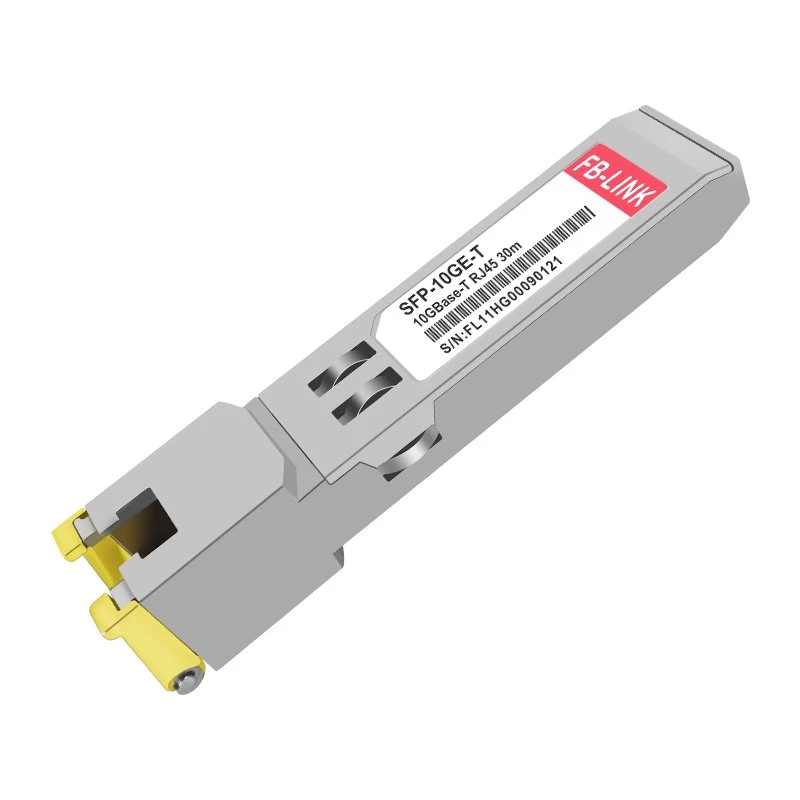
10GBASE RJ45 SFP+ Copper Small Form Pluggable (SFP) transceivers are high performance, cost effective module compliant with the 10G Ethernet and 10GBASE-T standards as specified in IEEE 802.3az, which supporting 10Gbps data- rate up to 30 meters reach over unshielded twisted-pair category 6a/7 cables.

- Product Introduction

Item Spotlights
● Built-in Marvell chip, Max. Power Consumption 2.3W
● Supports 10.3125Gb/s aggregate bit rate
● Commercial case temperature range of -40°C to 85°C
● Tested in Targeted Switches for Superior Performance, Quality, and Reliability
● Terminated RJ45 Connectors, Allowing 10G Bandwidth over Existing Infrastructure
● Hot Pluggable SFP+ MSA Compliant
● Optical Interoperability with 10GBASE X2 Interfaces On the Same Link
● RoHS Compliant
● 10G NRZ retimed electrical interface
● IEEE 802.3an and IEEE 802.3az Compliant


Description
|
Compatible |
SFP 10G Copper |
Vendor Name |
FB-LINK |
|
Form Factor |
SFP+ |
Max Data Rate |
10Gbps |
|
Wavelength |
NA |
Max Cable Distance |
30M |
|
Connector |
RJ45 |
Media |
/ |
|
Transmitter Type |
/ |
Receiver Type |
/ |
|
TX Power |
NA |
Receiver Sensitivity |
NA |
|
Power Consumption |
≤2.5W |
Extinction Ratio |
NA |
|
DDM/DOM |
No |
Commercial Temperature Range |
COM 0 to 70°C (32 to 158°F) |
|
Protocols |
SFP+ MSA Compliant, CPRI, eCPRI |
Warranty |
3 Years |
Production Process

Machine commissioning

Automatic threading

Visual inspection
Fully compatible

Network infrastructure demands continue to escalate as businesses push for faster data transmission and more reliable connectivity. At the heart of modern networking solutions lies a critical component that bridges the gap between different transmission media and speeds: the optical transceiver. These compact yet powerful devices have become indispensable in data centers, enterprise networks, and telecommunications environments worldwide.
What Makes Optical Transceivers Essential for Modern Networks?
An optical transceiver serves as a sophisticated interface module that converts electrical signals into optical signals and vice versa. These devices enable seamless communication between network equipment such as switches, routers, and servers. The technology has evolved significantly, with newer generations supporting unprecedented data rates while maintaining backward compatibility with legacy systems.
The versatility of optical transceivers extends beyond simple signal conversion. They accommodate various transmission distances, from short-reach connections within a single rack to long-haul communications spanning kilometers. This flexibility makes them suitable for diverse applications, whether connecting servers in a hyperscale data center or linking branch offices across metropolitan areas.
Key Technologies Behind Optical Transceivers
Modern optical transceivers incorporate advanced semiconductor technology and precision engineering. High-speed circuitry processes data at rates reaching 10Gbps and beyond, while sophisticated thermal management ensures stable operation across varying environmental conditions. The integration of standardized protocols, including IEEE 802.3 specifications, guarantees interoperability across equipment from different manufacturers.
Form factors have standardized around industry specifications like SFP+ (Small Form-factor Pluggable Plus), allowing hot-swappable installation without disrupting network operations. This modularity provides network administrators with unprecedented flexibility when designing or upgrading infrastructure. Whether deploying fiber optic connections or copper-based links, optical transceivers adapt to meet specific requirements.
Deployment Considerations for Optical Transceivers
Selecting appropriate optical transceivers requires careful evaluation of several factors. Transmission distance stands as a primary consideration-copper-based modules excel in short-reach scenarios, while fiber-based solutions handle longer distances efficiently. The choice between single-mode and multi-mode fiber impacts both performance and cost, with each option suited to particular use cases.
Power consumption has emerged as a critical factor, especially in large-scale deployments where hundreds or thousands of modules operate simultaneously. Energy-efficient designs reduce operational costs while minimizing heat generation, which can affect equipment reliability and lifespan. Industrial-grade variants offer extended temperature ranges, making them suitable for challenging environments where commercial-grade components might fail.
Compatibility verification ensures smooth integration with existing equipment. Leading optical transceivers support major networking brands and adhere to Multi-Source Agreement (MSA) standards, providing confidence that modules will function correctly across heterogeneous environments. This cross-platform compatibility protects infrastructure investments and simplifies inventory management.
The Role of Copper-Based Optical Transceivers
While fiber optics dominate long-distance applications, copper-based optical transceivers serve an important niche in short-reach connections. These modules terminate in standard RJ45 connectors, enabling 10-gigabit transmission over structured cabling systems already present in many facilities. This approach leverages existing infrastructure, reducing deployment costs and complexity.
Category 6a and Category 7 cables support these high-speed copper connections, typically over distances up to 30 meters. This range covers most rack-to-rack and some row-to-row connections within data centers. The ability to utilize copper cabling for 10-gigabit Ethernet provides a cost-effective migration path for organizations upgrading from gigabit infrastructure.
Performance Optimization with Optical Transceivers
Achieving optimal network performance requires more than simply installing optical transceivers. Proper cable management prevents physical stress on connectors, which can degrade signal quality or cause connection failures. Regular inspection and cleaning of optical interfaces maintain signal integrity, particularly important for fiber-based connections where dust or contamination severely impacts performance.
Monitoring capabilities built into many optical transceivers provide valuable diagnostic information. Digital Diagnostic Monitoring (DDM) features track parameters such as optical power levels, temperature, and voltage, enabling proactive identification of potential issues before they cause outages. This visibility supports predictive maintenance strategies that improve network reliability.
Network design should account for the aggregate bandwidth requirements and growth projections. Optical transceivers offering higher speeds than currently needed provide headroom for future expansion without requiring infrastructure replacement. This forward-thinking approach balances initial investment against long-term scalability needs.
Industry Applications of Optical Transceivers
Enterprise networks rely heavily on optical transceivers to interconnect switches, routers, and servers across multiple floors or buildings. The technology supports diverse topologies, from traditional star configurations to modern leaf-spine architectures prevalent in data centers. Redundant links utilizing optical transceivers enhance network resilience, ensuring business continuity even during equipment failures.
Telecommunications providers deploy optical transceivers extensively in access, aggregation, and core network layers. These modules enable the high-capacity links necessary for delivering internet, voice, and video services to millions of subscribers. The scalability of optical transceiver technology supports the exponential growth in bandwidth demand driven by streaming media, cloud computing, and mobile connectivity.
Educational institutions and research facilities leverage optical transceivers to build high-performance computing clusters and support data-intensive applications. Campus networks spanning multiple buildings benefit from the flexibility and performance these modules deliver, accommodating everything from administrative systems to cutting-edge research equipment.
Future Trends in Optical Transceiver Technology
Innovation continues to drive the evolution of optical transceivers toward higher speeds, lower power consumption, and greater integration. Next-generation modules will support 25G, 40G, 100G, and beyond, meeting the demands of artificial intelligence, machine learning, and big data applications. Coherent detection techniques and advanced modulation formats promise to extend transmission distances while maintaining signal quality.
Silicon photonics represents a transformative approach to optical transceiver design, potentially reducing costs and enabling greater component density. This technology integrates optical components directly onto silicon substrates, leveraging semiconductor manufacturing economies of scale. As silicon photonics matures, optical transceivers may become even more affordable and accessible.
Energy efficiency improvements will remain a priority as environmental concerns and operational costs drive innovation. New semiconductor materials, better thermal designs, and intelligent power management will reduce the energy footprint of optical transceivers, supporting sustainable infrastructure development.
Frequently Asked Questions
What cable types work with copper-based optical transceivers?
Copper-based optical transceivers designed for 10-gigabit transmission require Category 6a or Category 7 cables. Category 5e cables lack sufficient bandwidth for reliable 10Gbps operation. Using inadequate cabling results in high error rates, reduced throughput, or complete connection failure. Always verify cable specifications before deployment to ensure compatibility with high-speed optical transceivers.
Can optical transceivers of different speeds interconnect?
Many optical transceivers support auto-negotiation, allowing connections between devices operating at different speeds. A 10-gigabit module can typically communicate with a 1-gigabit module, with the connection establishing at the lower speed. However, this depends on both the optical transceiver specifications and the connected equipment capabilities. Consult technical documentation to verify interoperability before mixing speed grades.
Do optical transceivers require special configuration?
Most optical transceivers function as plug-and-play devices requiring no manual configuration. The modules contain embedded identification information that network equipment reads automatically. However, some advanced features like diagnostic monitoring may require enabling through switch or router configuration. Standard protocols ensure optical transceivers work seamlessly once physically installed.
How do temperature ratings affect optical transceiver selection?
Commercial-grade optical transceivers typically operate between 0°C and 70°C, suitable for climate-controlled environments like indoor data centers and offices. Industrial-grade variants function across extended ranges, often -40°C to 85°C, making them appropriate for outdoor installations, telecom cabinets, or facilities lacking environmental controls. Selecting the correct temperature rating ensures reliable operation and prevents premature failure.
What maintenance do optical transceivers require?
Optical transceivers are generally maintenance-free devices with no moving parts. For fiber-based modules, periodic inspection and cleaning of optical interfaces maintain signal quality. Use appropriate cleaning tools designed for fiber optics to avoid damage. Copper-based optical transceivers with RJ45 connectors require even less maintenance, though ensuring secure connections and avoiding cable stress remains important. Monitor diagnostic data when available to identify degradation trends.
Will optical transceivers improve existing network speeds?
Optical transceivers are interface modules that enable connectivity at specific speeds-they do not increase the data rate beyond what the connected equipment supports. If your switch supports only 1-gigabit speeds, installing a 10-gigabit optical transceiver will not provide 10-gigabit performance. Upgrading network speed requires compatible equipment at both ends of the connection along with appropriate optical transceivers for the desired data rate.
Are optical transceivers from different manufacturers compatible?
Industry standards and Multi-Source Agreements (MSA) promote interoperability among optical transceivers from different vendors. Most modules adhere to these specifications, allowing mixing and matching across brands. However, some equipment manufacturers implement proprietary checks that limit third-party module usage. Testing compatibility before large-scale deployment helps avoid unexpected issues, though standards-compliant optical transceivers typically work across diverse equipment.
How far can optical transceivers transmit data?
Transmission distance varies significantly based on optical transceiver type and medium. Copper-based modules typically reach 30 meters over Category 6a/7 cabling. Multi-mode fiber optical transceivers support distances from 300 meters to several kilometers depending on fiber type and wavelength. Single-mode fiber modules can transmit tens or even hundreds of kilometers. Application requirements determine the appropriate optical transceiver selection for distance needs.
The strategic deployment of optical transceivers forms the foundation of robust, scalable network infrastructure. Understanding their capabilities, limitations, and proper application ensures organizations build connectivity solutions that meet current demands while accommodating future growth. As technology advances, these versatile modules will continue enabling the high-speed, reliable communications that modern digital operations depend upon.
Hot Tags:
You Might Also Like