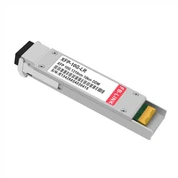
10GBASE-DWDM XFP
10GBASE DWDM XFP transceiver modules are designed for use in 10 Gigabit links on up to 80km of single mode fiber.

- Product Introduction
Item Spotlights
● Hot-pluggable XFP form factor
● Supports 9.95 to 11.3Gb/s bit rate
● Power dissipation <3.5W
● Commercial case temperature range of -40°C to 85°C
● 3.3V and 5V power supply
● Maximum link length of 80km on Single Mode Fiber (SMF)
● Aligned with SFF-INF-8077i
● Cooled 1550nm EML-based transmitter
● Duplex LC receptacles
● RoHS compliant
Description
|
Compatible |
10GBASE DWDM XFP |
|
|
Vendor Name |
FB-LINK |
|
|
Max Data Rate |
11.3Gbps |
|
|
Max Cable Distance |
40km |
80KM |
|
Form Factor |
XFP |
|
|
Wavelength |
C17-C61 |
|
|
Connector |
Duplex LC |
|
|
Media |
SMF |
|
|
Receiver Type |
PIN |
APD |
|
Transmitter Type |
EML |
EML |
|
TX Power |
-1~+4dBm |
0~+4dBm |
|
Receiver Sensitivity |
<-16dBm |
<-23dBm |
|
Power Consumption |
≤3.5W |
|
|
Commercial Temperature Range |
0 to 70°C (32 to 158°F) |
|
|
Warranty |
3 Years |
|
When network infrastructure demands reach critical levels, choosing the right optical transceivers becomes paramount to maintaining seamless data transmission. Dense Wavelength Division Multiplexing (DWDM) technology has revolutionized how enterprises manage bandwidth-intensive applications across extended distances, and XFP form factor modules continue to serve as reliable workhorses in this evolving landscape.
What Makes DWDM Technology Essential for Modern Networks
Dense Wavelength Division Multiplexing represents a quantum leap in fiber optic communication efficiency. By transmitting multiple optical signals simultaneously over a single fiber strand, DWDM-enabled optical transceivers dramatically increase network capacity without requiring additional physical infrastructure. This approach proves particularly valuable for organizations operating data centers, metropolitan area networks, and long-haul telecommunications systems where bandwidth scalability directly impacts operational costs.
The XFP platform emerged as an industry standard specifically engineered for 10 Gigabit Ethernet applications. Unlike its predecessors, this hot-pluggable module integrates critical signal processing functions while maintaining compact dimensions suitable for high-density networking environments. When combined with DWDM capabilities, these optical transceivers deliver unparalleled flexibility for network architects designing future-proof infrastructure.
Technical Architecture Behind Extended-Reach Connectivity
Achieving reliable data transmission across dozens of kilometers requires sophisticated engineering at both the transmitter and receiver stages. Electroabsorption Modulated Laser (EML) technology provides the foundation for DWDM transmitters, offering superior chirp performance compared to directly modulated lasers. This characteristic proves essential when signals must traverse long fiber spans without regeneration, as chromatic dispersion effects become increasingly problematic at extended distances.
On the receiving end, advanced photodetector designs extract optical signals even when power levels have diminished significantly during transmission. The integration of thermoelectric cooling mechanisms ensures wavelength stability across varying environmental conditions-a critical requirement for DWDM systems where channel spacing typically measures just 100 GHz or less. These optical transceivers maintain precise wavelength alignment within the ITU grid, preventing adjacent channel interference that would otherwise compromise network integrity.
Application Scenarios Where DWDM Excels
Metropolitan service providers frequently deploy DWDM optical transceivers to interconnect switching centers distributed throughout urban environments. The technology eliminates the need for electronic regeneration at intermediate sites, reducing both capital expenditure and ongoing maintenance requirements. Financial institutions leverage these capabilities to maintain low-latency connections between trading floors and co-location facilities, where microseconds can translate into significant competitive advantages.
Enterprise campus networks spanning multiple buildings benefit immensely from DWDM implementations. Rather than trenching additional fiber runs-a process that often requires permits, disrupts operations, and incurs substantial costs-network administrators can simply deploy additional wavelength channels over existing fiber infrastructure. This approach scales bandwidth economically while preserving physical plant investments made during initial construction phases.
Cloud service providers consistently rely on robust optical transceivers to build resilient interconnection fabrics between availability zones. DWDM technology enables efficient bandwidth aggregation while supporting diverse protocol types simultaneously. Whether handling storage replication traffic, live virtual machine migrations, or customer-facing application data, these modules maintain consistent performance characteristics across the entire operating envelope.
Evaluating Power Efficiency in Optical Transceivers
Thermal management considerations influence both operational expenses and equipment longevity in modern data centers. Lower power consumption directly translates to reduced cooling requirements-a factor that compounds across hundreds or thousands of network ports. XFP modules incorporating efficient power supply designs minimize heat dissipation while maintaining full performance specifications, allowing denser port configurations within existing rack infrastructure.
Environmental operating ranges deserve careful examination during equipment selection. Optical transceivers rated for extended temperature ranges accommodate deployment in uncontrolled environments such as outdoor cabinets, cell tower installations, or industrial facilities where HVAC systems may be absent or limited. This flexibility expands potential use cases beyond traditional climate-controlled networking closets.
Diagnostic Capabilities and Network Management
Modern optical transceivers incorporate digital diagnostic monitoring that provides real-time visibility into critical operating parameters. Network management systems can poll these modules to retrieve data about transmitted power levels, received signal strength, laser bias current, temperature, and supply voltage. This telemetry proves invaluable for proactive maintenance strategies, allowing administrators to identify degrading links before complete failure occurs.
Standards-based management interfaces ensure compatibility across multi-vendor environments. The two-wire serial protocol commonly implemented in these modules follows established specifications that major network equipment manufacturers support through their management platforms. This interoperability simplifies integration efforts and prevents vendor lock-in scenarios that constrain future upgrade paths.
Installation Best Practices for Maximum Reliability
Proper fiber optic connector maintenance directly impacts optical transceiver performance and service life. Before mating duplex LC connectors, technicians should inspect ferrule end-faces using appropriate microscopy equipment to identify contamination or physical damage. Even microscopic particles can create insertion loss that degrades link margins, particularly on extended-reach circuits where power budgets allow minimal degradation.
Maintaining appropriate bend radius throughout fiber routing prevents excessive attenuation that would otherwise compromise link performance. Single-mode fiber specifications typically mandate minimum bend radii of 30-40mm under no-load conditions, with more conservative values recommended in areas subject to vibration or movement. Cable management accessories designed specifically for optical transceivers help maintain these parameters while organizing connections efficiently.
Frequently Asked Questions
What distinguishes DWDM optical transceivers from standard single-channel modules?
DWDM modules operate at specific ITU grid wavelengths with tight tolerance requirements, enabling multiple channels to coexist on a single fiber pair. Standard single-channel optical transceivers use broader wavelength specifications that would cause interference in DWDM applications. The precision lasers and thermal control mechanisms in DWDM modules ensure wavelength stability across environmental variations.
Can XFP modules be mixed with other form factors in the same network?
Physical compatibility depends entirely on the host equipment's module slots. However, at the optical layer, properly configured optical transceivers of different form factors can interoperate successfully as long as they share compatible wavelengths, reach specifications, and protocol parameters. Network designers should verify both mechanical and optical compatibility during planning phases.
How do cooling requirements affect optical transceiver deployment?
Cooled transmitter designs maintain precise wavelength control essential for DWDM applications but consume more power than uncooled alternatives. This trade-off proves worthwhile in scenarios requiring extended reach or specific wavelength accuracy. Proper airflow through equipment chassis ensures these optical transceivers remain within specified temperature ranges during operation.
What factors determine maximum link distance capabilities?
Multiple variables influence reach specifications: transmitter output power, receiver sensitivity, fiber quality, connector insertion loss, and any intermediate passive components. DWDM optical transceivers designed for long-haul applications incorporate high-power transmitters and sensitive receivers that provide margin beyond the specified distance, accommodating real-world impairments encountered in deployed fiber plants.
Are there protocol restrictions when using DWDM modules?
These optical transceivers function at the physical layer and remain protocol-agnostic. Whether transporting SONET/SDH frames, Ethernet packets, Fibre Channel sequences, or other serial data streams, DWDM modules handle traffic transparently as long as bit rates fall within supported ranges. This versatility enables multi-protocol transport over shared fiber infrastructure.
How does RoHS compliance impact equipment selection?
Restriction of Hazardous Substances regulations limit specific materials in electronic equipment sold within certain jurisdictions. Compliant optical transceivers contain no prohibited levels of lead, mercury, cadmium, or other restricted substances. Organizations with environmental sustainability mandates or operating in regulated markets should verify compliance documentation during procurement.
What maintenance procedures extend optical transceiver service life?
Beyond connector cleanliness, maintaining appropriate environmental conditions proves most critical. Ensuring adequate cooling airflow, preventing dust accumulation, and avoiding mechanical stress on fiber connections all contribute to longevity. Monitoring diagnostic parameters allows early detection of degradation trends before they impact service delivery.
Future-Proofing Network Infrastructure
As bandwidth requirements continue escalating, the flexibility inherent in DWDM architectures provides a clear upgrade path without forklift replacements. Organizations initially deploying a subset of available wavelength channels can activate additional optical transceivers as demand grows, incrementally expanding capacity while leveraging existing fiber investments. This evolutionary approach aligns capital expenditures with actual growth patterns rather than forcing over-provisioning based on uncertain projections.
Selecting equipment from established manufacturers with proven track records ensures access to technical support resources and future product availability. While commodity pricing attracts budget-conscious buyers, the total cost of ownership encompasses factors beyond initial purchase price-including reliability metrics, warranty terms, and compatibility with existing management tools. Strategic sourcing decisions balance these considerations to optimize long-term value.
The convergence of high-performance optical transceivers with emerging software-defined networking paradigms creates opportunities for unprecedented network agility. As orchestration platforms gain sophistication in managing physical layer resources, DWDM infrastructure becomes increasingly programmable and responsive to dynamic application requirements. Forward-thinking network architects position their organizations to capitalize on these developments by establishing robust foundations built on proven transceiver technologies.
Hot Tags:
You Might Also Like