





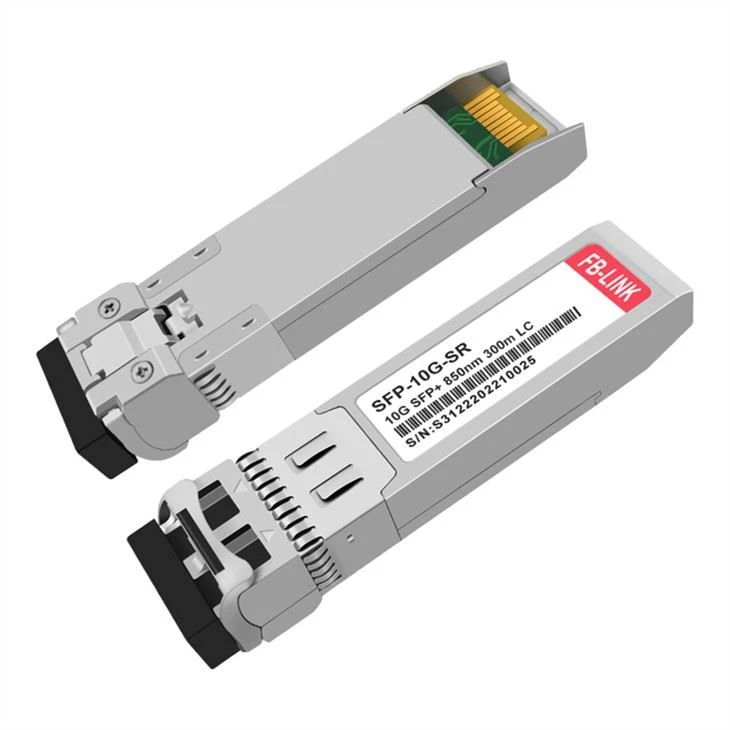

10GBASE SFP+ SR
10GBASE SFP+ SR is a very compact 10Gb/s optical transceiver module for serial optical communication applications at 10Gb/s.

- Product Introduction
Item Spotlights
● Support 10GBASE SR application
● Data links rate from 1.25G to 11.3Gbps
● Up to 400m transmission distance over OMA3 MMF
● 850nm transmitter with VCSEL laser
● 850nm receiver with PIN-TIA
● 2-wire interface for integrated digital diagnostic Monitoring
● SFP+ package with duplex LC/UPC receptacle optical interface and SFI electrical interface
● Single +3.3V power supply Operation case temperature 0~70°C for commercial
● RoHS compliance, and Class 1 laser safety
Description
|
Compatible |
10GBASE SFP+ SR |
Vendor Name |
FB-LINK |
|
Form Factor |
SFP+ |
Max Data Rate |
10.3125Gbps |
|
Wavelength |
850nm |
Max Cable Distance |
300m@OM3/400m@OM4 |
|
Connector |
Duplex LC |
Media |
MMF |
|
Transmitter Type |
VCSEL |
Receiver Type |
PIN |
|
TX Power |
-7.3~-1dBm |
Receiver Sensitivity |
<-11.1dBm |
|
Powerbudget |
3.8dB |
Receiver Overload |
0.5dBm |
|
Power Consumption |
≤0.6W |
Extinction Ratio |
>3dB |
|
DDM/DOM |
Supported |
Commercial Temperature Range |
0 to 70°C (32 to 158°F) |
|
Protocols |
IEEE 802.3ae, SFF-8472, SFF-8431, SFF-8432, SFP+ MSA Compliant, CPRI, eCPRI |
Warranty |
3 Years |
The demand for faster, more reliable data transmission continues to grow across enterprise networks, data centers, and telecommunications infrastructure. Optical transceivers have become the backbone of modern high-speed connectivity, enabling seamless data flow across complex network architectures. Among these critical components, the 10Gb/s SFP+ SR module stands out as a versatile solution for organizations seeking to upgrade their network capabilities without compromising on performance or reliability.
What Makes Modern Optical Transceivers Indispensable for Network Infrastructure
Network administrators and IT professionals face constant pressure to deliver faster data transmission speeds while maintaining cost-effectiveness. Optical transceivers serve as the bridge between electrical and optical signals, converting electrical data into light pulses that travel through fiber optic cables at extraordinary speeds. This conversion process enables networks to overcome the distance limitations and electromagnetic interference challenges inherent in traditional copper-based systems.
The evolution of optical transceivers has revolutionized how businesses handle data-intensive applications. From video conferencing and cloud computing to big data analytics and virtualization, these compact modules ensure that information flows smoothly across both short and long distances. The 10Gb/s speed tier represents a sweet spot for many organizations, offering substantial bandwidth improvements over legacy gigabit connections while remaining more accessible than higher-speed alternatives.
Key Advantages of SFP+ Short Range Solutions
When evaluating optical transceivers for your network infrastructure, several factors determine the optimal choice. Short-range solutions using 850nm wavelength technology offer specific benefits that align well with common enterprise and data center requirements.
Distance Optimization: Multi-mode fiber deployments benefit significantly from 850nm technology, supporting connections that span several hundred meters. This range perfectly accommodates typical data center row-to-row connections, building-to-building links within campus environments, and vertical riser applications in multi-story facilities.
Cost-Effective Fiber Infrastructure: Multi-mode fiber cables cost considerably less than single-mode alternatives, making them attractive for organizations building or expanding their fiber plant. When paired with appropriate optical transceivers, multi-mode infrastructure delivers excellent performance-to-cost ratios for short to medium distance applications.
Hot-Swappable Convenience: The SFP+ form factor provides exceptional flexibility through hot-pluggable operation. Network teams can replace modules, perform upgrades, or troubleshoot connectivity issues without powering down switches or disrupting adjacent ports, minimizing downtime and maintenance windows.
Enhanced Monitoring Capabilities: Digital diagnostic monitoring functions integrated into modern optical transceivers provide real-time visibility into operating parameters. Network administrators can track temperature, voltage, transmit power, receive power, and other critical metrics, enabling proactive maintenance and faster troubleshooting when issues arise.
Application Scenarios for High-Speed Optical Transceivers
The versatility of 10Gb/s optical transceivers extends across numerous deployment scenarios. Data center operators rely on these modules for server-to-switch connections, supporting virtualized environments and storage networks that demand consistent, low-latency performance. The combination of adequate bandwidth and manageable costs makes this technology ideal for top-of-rack switching architectures.
Enterprise campus networks leverage these modules to interconnect building distribution frames, creating high-capacity backbone connections that aggregate traffic from multiple access-layer switches. Educational institutions, corporate campuses, and government facilities benefit from the reliable, high-speed connectivity these optical transceivers enable.
Telecommunications providers and service providers deploy these modules in aggregation roles, combining multiple lower-speed circuits into higher-capacity uplinks. The technology supports various protocols beyond standard Ethernet, including CPRI for wireless fronthaul applications and other specialized communications systems.
Technical Considerations for Deployment Success
Successful implementation of optical transceivers requires attention to several technical factors. Fiber type compatibility stands as a primary consideration-OM3 and OM4 multi-mode fibers provide the bandwidth and modal characteristics necessary for optimal performance at 10Gb/s speeds. Organizations with existing OM2 fiber may face distance limitations that require infrastructure upgrades.
Power budget calculations ensure reliable operation across the intended distance. The difference between transmitter output power and receiver sensitivity determines the available power budget, which must exceed the sum of fiber attenuation, connector losses, and splice losses with appropriate margin for aging and environmental factors.
Proper connector maintenance prevents performance degradation. Fiber end-faces require regular inspection and cleaning to eliminate contamination that can increase insertion loss and back reflection. Quality LC connectors with UPC polish characteristics minimize optical return loss and ensure stable connections.
Selecting the Right Optical Transceivers for Your Network
Organizations evaluating optical transceivers should consider both immediate requirements and future growth potential. Compatibility verification with existing switch hardware ensures seamless integration-while most quality modules adhere to industry standards, confirming vendor compatibility lists prevents unexpected issues.
Temperature specifications matter significantly in challenging environments. Commercial-grade modules typically operate from 0 to 70 degrees Celsius, suitable for most controlled data center and office environments. Industrial applications may require extended temperature range options that withstand harsh conditions.
Warranty and support considerations influence long-term total cost of ownership. Quality manufacturers stand behind their optical transceivers with multi-year warranties and responsive technical support, providing peace of mind and protection for your infrastructure investment.
Frequently Asked Questions
What is the maximum distance I can achieve with OM3 fiber?
When using OM3 multi-mode fiber with 850nm optical transceivers, you can reliably transmit 10Gb/s data up to 300 meters. OM4 fiber extends this capability to approximately 400 meters. These distances accommodate the vast majority of data center and enterprise campus applications. If your installation requires greater distances, consider single-mode fiber solutions or fiber type upgrades.
How do optical transceivers differ from traditional network interface cards?
Traditional network interface cards provide electrical connectivity through copper cables, while optical transceivers convert electrical signals to light for transmission through fiber optic cables. This conversion enables much longer distance spans, immunity to electromagnetic interference, and higher bandwidth capabilities. The modular nature of optical transceivers also provides flexibility-you can change transmission characteristics by swapping modules rather than replacing entire network cards.
Can I mix different brands of optical transceivers in the same network?
Yes, you can typically mix different brands of optical transceivers as long as they comply with industry standards like IEEE 802.3ae and SFP+ MSA specifications. However, ensure that both ends of each fiber connection use compatible wavelengths and fiber types. Some network equipment vendors may void warranties or provide limited support when using third-party modules, so verify your vendor's policies.
What does DDM/DOM functionality provide?
Digital Diagnostic Monitoring (DDM), also called Digital Optical Monitoring (DOM), provides real-time access to critical operating parameters through the network management interface. You can monitor transmit power, receive power, temperature, voltage, and laser bias current without specialized test equipment. This visibility enables proactive identification of degrading modules, fiber issues, or environmental problems before they cause network outages.
How often should I clean fiber optic connectors?
Clean fiber connectors before every connection and inspect them regularly during routine maintenance. Even microscopic contamination can significantly impact optical performance. Use appropriate cleaning materials designed for fiber optics-never use general-purpose cleaners or compressed air. Develop a cleaning protocol that includes inspection with a fiber microscope to verify end-face cleanliness before completing connections.
What is the difference between multi-mode and single-mode optical transceivers?
Multi-mode optical transceivers use shorter wavelengths (typically 850nm) and are designed for multi-mode fiber with larger core diameters. They're ideal for shorter distances up to several hundred meters and are more cost-effective for campus and data center applications. Single-mode optical transceivers use longer wavelengths (1310nm or 1550nm) and work with single-mode fiber's smaller core, enabling transmission over many kilometers. Choose based on your distance requirements and existing fiber infrastructure.
Do I need to configure optical transceivers after installation?
Most optical transceivers operate as plug-and-play devices requiring no configuration. Once inserted into a compatible SFP+ port, they automatically negotiate with the host device and begin operation. However, you may need to configure the switch port itself for specific parameters like speed, duplex mode, or VLAN assignments. Some advanced features like setting alarm thresholds for DDM parameters may require configuration through the switch management interface.
What causes an optical transceiver to fail?
Several factors can lead to optical transceiver failure. Physical damage from improper handling, electrostatic discharge during installation, or excessive insertion/removal cycles can damage internal components. Environmental factors like operation outside specified temperature ranges, excessive humidity, or corrosive atmospheres accelerate degradation. Poor fiber connections causing back-reflection can damage laser transmitters over time. Quality modules from reputable manufacturers with proper operating conditions typically provide years of reliable service.
Hot Tags: Optical Transceivers


