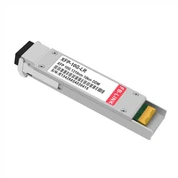
10GBASE SFP+ BIDI
10GBASE SFP+ BIDI Compatible SFP+ transceiver supports up to 80km over OS2 SMF via an LC simplex connector.

- Product Introduction
Item Spotlights
● Hot pluggable SFP+ MSA form package, SFP+ MSA compliant
● Compliant with SDH STM64/SONET OC-192/10G FC
● Support Multi Protocol from 9.9Gb/s to 11.3Gb/s
● Internal integrated 1270nm/1330nm, 1490/1550nm wavelength division multiplexer
● Duplex LC Connector
● 2-wire Interface for Management, Built-in digital diagnostic functions
● low power consumption
● Supports a variety of transmission distances from 10Km to 80Km
● RoHS compliant
● Operating temperature range: 0~70°C(Commercial) /-40~85℃(industrial)
Description
|
Compatible |
10GBASE SFP+ BIDI |
|||
|
Vendor Name |
FB-LINK |
|||
|
Max Data Rate |
10.3125Gbps |
|||
|
Wavelength |
1270/1330nm |
1270/1330nm |
1270/1330nm |
1490/1550nm |
|
Connector |
Duplex LC |
|||
|
Max Cable Distance |
10km |
40km |
60km |
80km |
|
Media |
SMF |
|||
|
Receiver Type |
PIN |
PIN |
APD |
APD |
|
Transmitter Type |
DFB |
DFB |
DFB |
EML |
|
TX Power |
-6~-1dBm |
0~+4dBm |
+1~+5dBm |
+2~+6dBm |
|
Receiver Sensitivity |
<-14dBm |
<-15dBm |
<-20dBm |
<-23dBm |
|
Commercial Temperature Range |
0 to 70°C (32 to 158°F) |
|||
|
DDM/DOM |
Supported |
|||
|
Warranty |
3 Years |
|||
The evolution of data center infrastructure has created an unprecedented demand for efficient, high-performance connectivity solutions. Bidirectional (BIDI) SFP+ modules represent a significant advancement in optical transceivers, offering network administrators a cost-effective way to achieve 10 gigabit speeds while reducing fiber infrastructure requirements.
What Makes BIDI Technology Revolutionary?
Traditional optical transceivers require two fiber strands-one for transmitting and one for receiving data. BIDI technology fundamentally changes this approach by utilizing wavelength division multiplexing (WDM) to transmit and receive signals simultaneously over a single fiber strand. This innovation makes optical transceivers more economical and practical for organizations looking to maximize their existing fiber infrastructure.
The technology employs different wavelengths for upstream and downstream traffic. By using wavelength pairs such as 1270nm/1330nm or 1490nm/1550nm, these optical transceivers can achieve full-duplex communication without interference, maintaining the same performance levels as traditional dual-fiber solutions.
Key Advantages for Network Infrastructure
Fiber Conservation
One of the most compelling benefits of BIDI optical transceivers is their ability to cut fiber usage in half. For organizations with limited fiber availability or those looking to extend connectivity to additional locations, this represents substantial cost savings on both infrastructure and installation.
Extended Reach Capabilities
Modern BIDI optical transceivers support transmission distances ranging from 10 kilometers to 80 kilometers over single-mode fiber. This flexibility makes them suitable for various deployment scenarios, from campus networks to metropolitan area connections.
Simplified Cable Management
Using simplex LC connectors instead of duplex configurations, these optical transceivers reduce cable bulk in high-density environments. This seemingly minor detail can significantly impact airflow and accessibility in crowded equipment racks.
Application Scenarios
Data Center Interconnection
BIDI optical transceivers excel in connecting data centers across metropolitan areas. The combination of high bandwidth and extended reach makes them ideal for disaster recovery configurations and distributed storage architectures.
Enterprise Campus Networks
Organizations with multiple buildings can leverage these optical transceivers to create high-speed backbone connections without exhausting their fiber resources. The hot-pluggable design allows for easy maintenance and upgrades without network downtime.
Telecommunications Infrastructure
Service providers utilize BIDI optical transceivers for SDH STM-64 and SONET OC-192 applications, where reliability and performance are paramount. The technology's compliance with industry standards ensures seamless integration into existing networks.
Storage Area Networks
Fiber Channel applications benefit from the multi-protocol support these optical transceivers offer, accommodating data rates from 9.9Gb/s to 11.3Gb/s. This flexibility supports various storage protocols while maintaining consistent performance.
Technical Considerations
When deploying BIDI optical transceivers, understanding the relationship between transmitter power and receiver sensitivity becomes crucial. Different distance requirements necessitate varying power budgets. Short-range applications may use PIN photodetectors, while longer distances require avalanche photodiode (APD) receivers for enhanced sensitivity.
The digital diagnostic monitoring capability built into modern optical transceivers provides real-time visibility into critical parameters including temperature, voltage, laser bias current, transmitted optical power, and received optical power. This functionality enables proactive network management and troubleshooting.
Operating temperature ranges deserve careful consideration. Commercial-grade optical transceivers typically operate between 0°C and 70°C, while industrial variants extend this range to -40°C through 85°C, accommodating harsh environmental conditions.
Frequently Asked Questions
What is the difference between BIDI and traditional SFP+ optical transceivers?
BIDI optical transceivers use a single fiber strand with different wavelengths for transmit and receive functions, while traditional modules require two separate fibers. This makes BIDI solutions more fiber-efficient and cost-effective, particularly when fiber resources are limited or expensive to install.
Can BIDI optical transceivers work with any network equipment?
These optical transceivers are designed to be hot-pluggable and MSA-compliant, meaning they work with standard SFP+ ports from major network equipment manufacturers. However, always verify compatibility with your specific hardware, and ensure both ends of the link use properly paired BIDI modules with matching wavelength configurations.
How do I choose the right distance rating for my application?
Select optical transceivers based on your actual fiber length plus a safety margin of 20-30%. Consider factors like fiber quality, number of connectors, and potential splices in your path. Overspecifying distance capability provides headroom for future moves or changes without requiring transceiver replacement.
What maintenance do BIDI optical transceivers require?
These optical transceivers are largely maintenance-free, but you should periodically clean LC connectors, monitor diagnostic parameters for degradation, and maintain proper operating temperatures. Digital diagnostics make it easy to spot issues before they cause failures, allowing for planned replacements rather than emergency interventions.
Are there any compatibility issues between different wavelength pairs?
BIDI optical transceivers must be deployed in matched pairs with complementary wavelengths. A 1270nm TX/1330nm RX module must connect to a 1330nm TX/1270nm RX module. Mismatched pairs will not communicate. Always verify wavelength specifications when ordering replacement transceivers.
How does APD differ from PIN receiver technology in optical transceivers?
PIN receivers work well for shorter distances where signal strength remains high, while APD (Avalanche Photodiode) receivers provide internal signal amplification necessary for detecting weaker signals over longer distances. APD-based optical transceivers typically support 60-80km ranges but consume slightly more power than PIN-based alternatives.
What does multi-protocol support mean for these optical transceivers?
Multi-protocol optical transceivers can operate across a range of data rates (typically 9.9Gb/s to 11.3Gb/s), supporting various standards including 10G Ethernet, Fiber Channel, SDH, and SONET. This flexibility allows the same hardware to serve different applications, simplifying inventory management and providing deployment versatility.
Future-Proofing Your Network Investment
Selecting quality optical transceivers with comprehensive digital diagnostic capabilities, extended temperature ratings, and solid warranty coverage protects your infrastructure investment. The three-year warranty period typical of enterprise-grade modules reflects manufacturer confidence in reliability and longevity.
As network demands continue growing, the efficiency advantages of BIDI technology become increasingly valuable. Organizations that adopt these advanced optical transceivers position themselves to scale bandwidth cost-effectively while maximizing existing physical infrastructure.
The combination of reduced fiber requirements, flexible distance options, and standards compliance makes BIDI SFP+ optical transceivers an intelligent choice for modern network architectures. Whether upgrading existing infrastructure or designing new installations, understanding these capabilities helps network professionals make informed decisions that balance performance, cost, and scalability requirements.
Hot Tags: Optical Transceivers
You Might Also Like