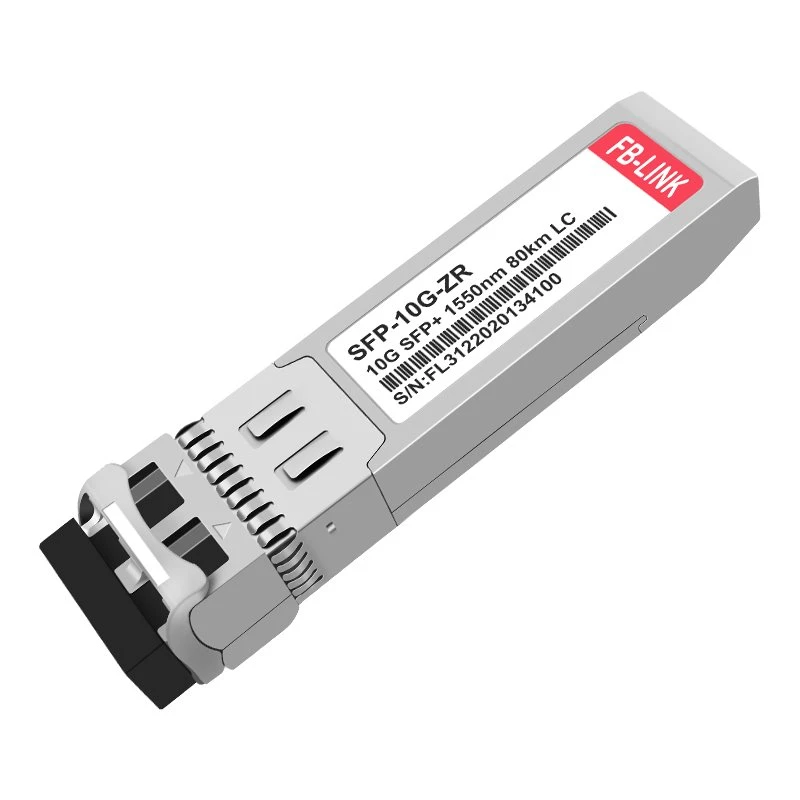


10GBASE SFP+ ZR
10GBASE SFP+ ZR is a very compact 10Gb/s optical transceiver module for serial optical communication applications at 10Gb/s.

- Product Introduction
Item Spotlights
● Max. Power Consumption 1W
● Compliant with IEEE Std 802.3-2005
● 10G Ethernet 10GBase-ZR/ZW Electrical interface specifications per SFF-8431
● Management interface specifications perSFF-8431 and SFF-8472
● SFP+ MSA package with duplex LC connector
● Cooled 1550nm EML Laser
● 8.5 to 11.3Gb/s bi-directional data links
● Single +3.3V power supply
● Class 1 laser safety certifiedOperating temperature Options: - (Commercial) 0oC to +70oC
● Up to 80km on 9/125µm SMF
● RoHS Compliant
Description
|
Compatible |
10GBASE SFP+ ZR |
Vendor Name |
FB-LINK |
|
Form Factor |
SFP+ |
Max Data Rate |
10.3125Gbps |
|
Wavelength |
1550nm |
Max Cable Distance |
80km |
|
Connector |
Duplex LC |
Media |
SMF |
|
Transmitter Type |
EML |
Receiver Type |
APD |
|
TX Power |
0~+4dBm |
Receiver Sensitivity |
<-24dBm |
|
Power Consumption |
≤1W |
Extinction Ratio |
>9.0dB |
|
DDM/DOM |
Supported |
Commercial Temperature Range |
0 to 70°C (32 to 158°F) |
|
Protocols |
SFP+ MSA Compliant, CPRI, eCPRI |
Warranty |
3 Years |
Network infrastructure demands continue to evolve as businesses expand their digital operations across greater distances. When connecting data centers separated by dozens of kilometers or establishing metropolitan area networks, the choice of connectivity hardware becomes critical. Optical transceivers have emerged as the backbone technology enabling high-speed data transmission over extended fiber optic links.
Why Long-Distance Optical Transceivers Matter
Modern enterprises face a persistent challenge: maintaining reliable, high-bandwidth connections across significant distances. Traditional copper-based solutions fall short when distances exceed a few hundred meters. This is where specialized optical transceivers designed for long-reach applications become indispensable.
These sophisticated modules bridge the gap between electronic data processing equipment and optical fiber networks. By converting electrical signals into light and back again, they enable seamless communication across tens of kilometers without signal degradation or the need for intermediate amplification.
The Technology Behind Extended-Range Solutions
Long-distance optical transceivers employ advanced components to achieve their impressive range capabilities. The use of specific wavelengths in the electromagnetic spectrum plays a crucial role. Operating at wavelengths around the 1550nm band offers distinct advantages for extended-reach applications, as this wavelength experiences minimal attenuation in standard single-mode fiber.
The transmitter side typically utilizes temperature-controlled laser technology. This approach ensures stable output characteristics across varying environmental conditions, maintaining signal integrity throughout the transmission path. Meanwhile, high-sensitivity receiver designs with advanced photodetection capabilities capture weak optical signals after their journey through fiber spans.
Key Applications for Extended-Range Optical Transceivers
Optical transceivers with extended reach capabilities serve multiple critical use cases:
Metropolitan Area Networks (MANs): Service providers connecting different neighborhoods or districts within a city rely on these modules to establish backbone connections. The ability to span distances up to several dozen kilometers without regeneration simplifies network architecture and reduces infrastructure costs.
Campus Connectivity: Large university campuses, hospital systems, or corporate facilities spread across multiple buildings benefit from direct fiber links. Rather than deploying multiple shorter-range connections with intermediate equipment, a single long-range transceiver pair can establish the connection.
Data Center Interconnect: Organizations operating multiple data center facilities need reliable, high-bandwidth links between sites. Optical transceivers capable of spanning metropolitan distances enable synchronous replication, load balancing, and disaster recovery architectures.
Carrier Networks: Telecommunications providers use these modules extensively in their infrastructure, connecting central offices, aggregation points, and customer premises equipment across urban and suburban areas.
Performance Characteristics That Matter
When evaluating optical transceivers for long-distance deployment, several technical parameters deserve attention:
Link Budget: The difference between transmitter output power and receiver sensitivity determines the maximum supportable distance. Higher link budgets provide margin for fiber quality variations, connector losses, and future network expansion.
Power Efficiency: Extended-range modules typically consume more power than shorter-reach alternatives due to their sophisticated components. Solutions that minimize power consumption while maintaining performance help reduce operational expenses and cooling requirements.
Temperature Stability: Network equipment often operates in challenging environmental conditions. Optical transceivers with wide operating temperature ranges ensure reliable performance whether deployed in climate-controlled data centers or less controlled environments.
Digital Diagnostics: Modern modules incorporate monitoring capabilities that provide real-time visibility into operating parameters. This functionality enables proactive maintenance and rapid troubleshooting when issues arise.
Integration and Compatibility Considerations
The pluggable nature of contemporary optical transceivers simplifies network deployment and maintenance. Hot-swappable designs allow technicians to install or replace modules without powering down host equipment, minimizing service interruptions.
Standards compliance ensures interoperability across equipment from different manufacturers. When optical transceivers adhere to industry specifications, network operators gain flexibility in vendor selection and avoid lock-in scenarios.
The physical interface design also impacts deployment efficiency. Duplex connector configurations that combine transmit and receive paths into a single connection point reduce cable management complexity in dense equipment installations.
Cost-Benefit Analysis
While extended-range optical transceivers represent a higher initial investment compared to shorter-reach alternatives, they often deliver superior total cost of ownership. By eliminating the need for intermediate regeneration equipment, organizations reduce both capital expenditure on additional hardware and ongoing operational costs for power, cooling, and maintenance.
The ability to upgrade network capacity by replacing only the optical transceivers rather than entire fiber infrastructure provides future-proofing value. As bandwidth demands grow, new transceiver generations can often utilize existing fiber plants.
Deployment Best Practices
Successful implementation of long-distance optical transceivers requires attention to several factors:
Fiber Quality Assessment: Before deployment, verify that fiber infrastructure meets cleanliness standards. Even microscopic contamination on connector end-faces can degrade performance or cause failures.
Power Budget Verification: Calculate expected losses from fiber attenuation, splices, connectors, and any passive components. Ensure adequate margin exists between available link budget and expected losses.
Environmental Considerations: Verify that installation locations meet temperature and humidity specifications. While many optical transceivers operate across wide temperature ranges, extreme conditions may require additional environmental controls.
Testing and Validation: After installation, measure actual optical power levels at transmit and receive points. Compare measurements against specifications to confirm proper operation and identify any issues before placing links into production.
Frequently Asked Questions
What determines the maximum distance for optical transceivers?
The maximum transmission distance depends on several factors working together: the transmitter's output power, the receiver's sensitivity level, and the total optical losses in the fiber path. These losses include fiber attenuation (typically measured in dB per kilometer), connector losses, splice losses, and any passive components in the path. The difference between transmitter power and receiver sensitivity creates a "link budget" that must exceed total path losses with some margin for safety.
Can I mix different brands of optical transceivers at each end of a fiber link?
Yes, as long as both optical transceivers comply with the same industry standards and operate at compatible wavelengths. Standard-compliant modules from different manufacturers should interoperate correctly. However, it's important to verify that both ends support the same data rate, wavelength, and fiber type. Digital diagnostic features may vary between vendors, but basic connectivity should work when standards are matched.
How do I know if my fiber infrastructure can support long-reach optical transceivers?
Single-mode fiber is required for extended-reach applications. Multimode fiber cannot support distances beyond a few hundred meters at 10Gb/s speeds. You should also verify fiber cleanliness, check for damage or excessive bending, and ideally perform optical time-domain reflectometry (OTDR) testing to measure total link loss. If your total expected loss is less than the transceiver's link budget with at least 3dB margin, the infrastructure should be suitable.
What maintenance do optical transceivers require?
Optical transceivers themselves require minimal maintenance, but periodic inspection is valuable. Monitor diagnostic parameters regularly to detect gradual performance degradation. Keep unused transceiver ports protected with dust caps. Most importantly, maintain connector cleanliness-inspect and clean fiber connectors before each connection or reconnection. Replace transceivers showing abnormal temperature readings or significant power degradation.
Are extended-range optical transceivers more likely to fail than short-reach versions?
Not necessarily. While long-reach optical transceivers contain more sophisticated components like temperature-controlled lasers and sensitive receivers, quality modules from reputable manufacturers typically offer similar reliability to shorter-reach versions. The key is choosing products with appropriate environmental ratings for your deployment conditions and following proper handling procedures. Most failures result from contamination, physical damage, or operating outside specified parameters rather than component design.
Can these transceivers work at shorter distances than their maximum rating?
Absolutely. Optical transceivers rated for extended distances work perfectly fine at shorter ranges. However, you may need to add optical attenuation if the link is very short, as extremely high received power can damage or saturate the receiver. Most modern transceivers have wide dynamic ranges, but consult specifications to ensure received power stays within acceptable limits.
What's the difference between cooled and uncooled laser technology?
Cooled lasers incorporate thermoelectric cooling to maintain stable operating temperature regardless of ambient conditions. This provides more consistent wavelength and power output, which is essential for extended-reach applications where even small variations could cause signal degradation over long fiber spans. Uncooled lasers are simpler and consume less power but may exhibit more variation with temperature changes, making them more suitable for shorter-reach applications.
How does wavelength selection affect transmission distance?
Different wavelengths experience different attenuation rates in optical fiber. The 1550nm wavelength band offers the lowest attenuation in standard single-mode fiber (typically around 0.2dB per kilometer), making it ideal for extended-reach optical transceivers. Shorter wavelengths like 1310nm have higher attenuation (around 0.35dB/km), limiting practical distances. This is why long-reach applications consistently use wavelengths in the 1550nm region.
Hot Tags: Optical Transceivers
You Might Also Like