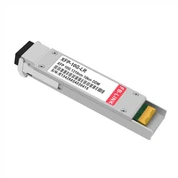
10GBASE SFP+ ER
The module consists of 1550 EML Laser, InGaAs PIN and Preamplifier in a high-integrated optical sub-assembly.

- Product Introduction
Item Spotlights
● Compliant with IEEE Std 802.3-2005
● 10G Ethernet 10GBase-ER/EW Electrical interface specifications per SFF-8431
● Management interface specifications per SFF-8431 and SFF-8472
● SFP+ MSA package with duplex LC connector
● Cooled EML Laser
● Dual CDR from 9.95 to 11.3Gb/s bi-directional data links
● Single +3.3V power supply
● Class 1 laser safety certified
● Operating temperature: - (Commercial) 0oC to +70oC Up to 40km on 9/125µm SMF
● RoHS Compliant
Description
|
Compatible |
10GBASE SFP+ ER |
Vendor Name |
FB-LINK |
|
Form Factor |
SFP+ |
Max Data Rate |
11.3Gbps |
|
Wavelength |
1550nm |
Max Cable Distance |
40km |
|
Connector |
Duplex LC |
Media |
SMF |
|
Transmitter Type |
EML |
Receiver Type |
PIN |
|
TX Power |
-1~+4dBm |
Receiver Sensitivity |
<-16dBm |
|
Power Consumption |
≤1W |
Extinction Ratio |
>3.5dB |
|
DDM/DOM |
Supported |
Commercial Temperature Range |
0 to 70°C (32 to 158°F) |
|
Protocols |
SFP+ MSA Compliant, CPRI, eCPRI |
Warranty |
3 Years |
When building high-performance data center infrastructure or extending network connectivity across metropolitan areas, selecting the right connectivity solution becomes critical. Long-range optical transceivers have revolutionized how enterprises and service providers approach extended-distance networking, offering reliable 10-gigabit connectivity that spans dozens of kilometers without signal degradation.
Understanding Extended-Range Network Connectivity
Optical transceivers serve as the fundamental building blocks of modern fiber optic networks, converting electrical signals into optical light for transmission across fiber cables. For applications requiring connectivity beyond standard campus distances, specialized long-range modules provide the necessary transmission power and receiver sensitivity to maintain signal integrity across extended spans.
The evolution of high-speed networking has created demand for solutions that combine exceptional reach with robust performance characteristics. Advanced optical transceivers designed for extended-range applications utilize sophisticated laser technology and enhanced receiver architectures to achieve distances that would be impossible with standard connectivity modules.
Key Advantages of Long-Distance Optical Transceivers
Superior Range Capabilities
Extended-range modules eliminate the need for costly signal regeneration equipment in many deployment scenarios. By supporting distances up to 40 kilometers over single-mode fiber, these optical transceivers enable direct connections between geographically separated facilities, reducing infrastructure complexity and operational overhead.
Enterprise-Grade Reliability
Temperature-hardened designs ensure consistent performance across varying environmental conditions. Commercial-grade optical transceivers maintain stable operation in standard data center environments, providing the dependability that mission-critical applications demand.
Future-Proof Bandwidth
Supporting data rates exceeding 10 gigabits per second, these connectivity solutions provide ample headroom for growing bandwidth requirements. Organizations can deploy infrastructure confident that their optical transceivers will accommodate increasing traffic loads without requiring premature upgrades.
Comprehensive Monitoring
Digital diagnostic capabilities enable proactive network management. Administrators can monitor real-time parameters including transmit power, receive power, temperature, and voltage, allowing them to identify potential issues before they impact service delivery.
Real-World Applications
Metropolitan Area Networks
Service providers leverage long-range optical transceivers to interconnect central offices and point-of-presence locations across urban areas. This eliminates expensive fiber leasing costs and provides complete control over network infrastructure.
Campus Connectivity
Universities and corporate campuses spanning large geographic areas utilize extended-range modules to connect building clusters without intermediate equipment. This simplifies network architecture and reduces points of potential failure.
Disaster Recovery Solutions
Organizations maintaining hot backup sites rely on long-distance optical transceivers to provide real-time data synchronization between primary and secondary data centers. The extended reach ensures that disaster recovery facilities can be located at safe distances while maintaining high-speed connectivity.
Telecommunications Infrastructure
Carrier networks deploy these optical transceivers extensively in access and aggregation layers, connecting cell sites, customer premises equipment, and network aggregation points with reliable high-bandwidth links.
Technical Considerations for Deployment
Fiber Infrastructure Requirements
Long-range optical transceivers require clean, well-maintained single-mode fiber infrastructure. Regular fiber inspection and cleaning practices ensure optimal performance and prevent premature module degradation caused by contamination.
Power Budget Analysis
Understanding the relationship between transmitter output power, receiver sensitivity, and fiber loss characteristics is essential for successful deployments. Proper power budget calculations account for connector losses, splice losses, and fiber attenuation to ensure adequate link margin.
Wavelength Compatibility
Extended-range modules typically operate at specific wavelengths optimized for long-distance transmission. Verifying wavelength compatibility across all network segments prevents costly deployment errors and ensures seamless integration with existing infrastructure.
Environmental Factors
While commercial-temperature optical transceivers handle standard data center conditions effectively, installations in harsh environments may require enhanced thermal management to maintain optimal operating temperatures.
Making the Right Selection
Choosing appropriate optical transceivers involves evaluating multiple factors beyond simple distance requirements. Consider compatibility with existing network equipment, ensuring that form factors, electrical interfaces, and management protocols align with your infrastructure. Verify that power consumption fits within available budgets, particularly in dense installations where cumulative power draw becomes significant.
Quality assurance matters tremendously in mission-critical environments. Look for optical transceivers that meet relevant industry standards and carry appropriate safety certifications. Comprehensive warranty coverage provides additional peace of mind and protects your infrastructure investment.
Frequently Asked Questions
What distance can these optical transceivers realistically achieve?
Extended-range modules support links up to 40 kilometers over standard single-mode fiber, assuming clean fiber infrastructure and proper installation practices. Actual achievable distance depends on factors including fiber quality, number of connectors and splices, and environmental conditions. For maximum distance applications, conduct thorough power budget analysis and consider incorporating safety margin into your calculations.
Are long-range optical transceivers compatible with standard networking equipment?
Modern long-range optical transceivers utilize industry-standard form factors and interfaces, ensuring broad compatibility across equipment from multiple vendors. However, always verify compatibility with your specific switches and routers before procurement, as some vendors implement proprietary coding or enhanced features that may require vendor-specific modules.
How do I monitor the health of deployed optical transceivers?
Digital diagnostic monitoring provides real-time access to critical operational parameters. Network management systems can poll modules via standard interfaces to retrieve information about transmit power, receive power, temperature, voltage, and laser bias current. Establishing baseline measurements during installation and monitoring trends over time enables proactive identification of degrading components before they cause service interruptions.
Can I mix different optical transceivers in the same network?
While mixing modules from different manufacturers is technically feasible, it can complicate troubleshooting and support processes. For critical infrastructure, standardizing on consistent optical transceivers across your network simplifies inventory management, reduces training requirements, and streamlines support procedures. Ensure that any mixed deployments use compatible wavelengths and maintain proper documentation.
What maintenance do optical transceivers require?
Optical transceivers themselves require minimal maintenance, but the fiber infrastructure connecting them demands regular attention. Implement routine fiber inspection and cleaning schedules, particularly for connections exposed to environmental contaminants. Monitor diagnostic parameters regularly to identify degradation trends. When modules must be removed or installed, handle them carefully to prevent physical damage and always use proper anti-static precautions.
How does temperature affect optical transceiver performance?
Operating temperature significantly impacts laser performance and overall module reliability. Commercial-grade optical transceivers function reliably within specified temperature ranges, but performance may degrade at temperature extremes. Ensure adequate cooling in equipment rooms and avoid installations in direct sunlight or near heat sources. Advanced designs incorporate thermal management features that maintain stable operation across their rated temperature range.
What's the typical lifespan of long-range optical transceivers?
Quality optical transceivers typically provide many years of reliable service when operated within specification. Laser degradation occurs gradually over time, but modern designs incorporate sufficient margin to maintain performance throughout their intended operational life. Regular monitoring of transmit power helps identify aging modules before they fall below minimum specifications. Proper environmental conditions and handling practices significantly extend module lifespan.
Conclusion
Long-range optical transceivers represent essential infrastructure components for organizations requiring reliable high-speed connectivity across extended distances. By understanding application requirements, properly analyzing link budgets, and selecting quality modules that meet relevant industry standards, network architects can deploy solutions that provide years of dependable service. Whether connecting metropolitan facilities, campus buildings, or disaster recovery sites, advanced optical transceivers deliver the performance and reliability that modern networks demand.
Hot Tags: Optical Transceivers
You Might Also Like