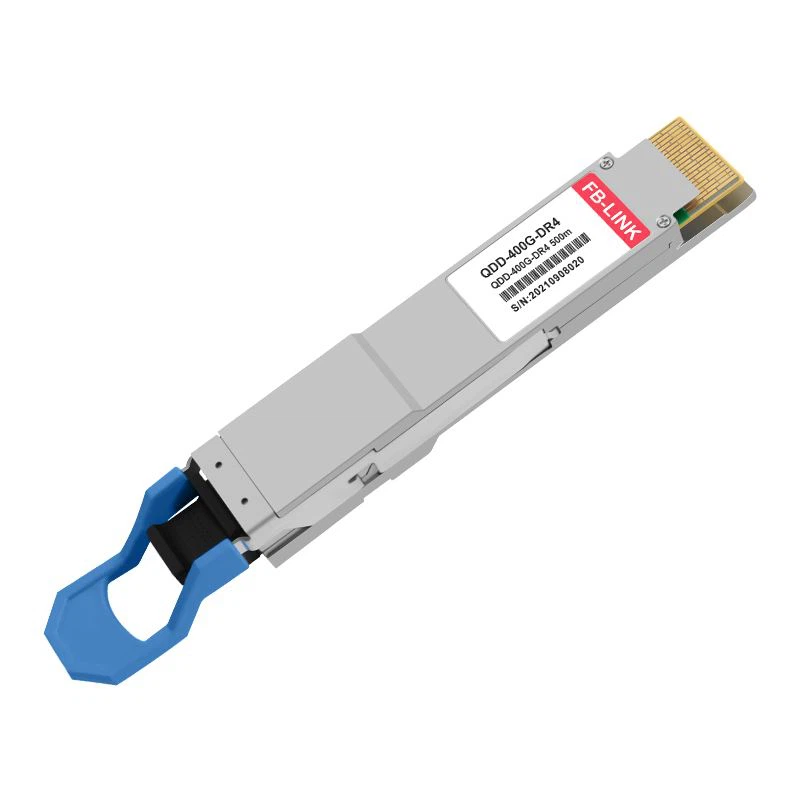


400GBASE QSFP-DD
The 400G QSFP-DD series is a hot-pluggableoptical transceiver,It meets the standard of QSFP-DD MSA,offers customers a wide variety of super high-density transceiver modules and the flexibility of 400 Gigabit Ethernet connectivity options for data center, high- performance computing networks, enterprise core and distribution layers, and service provider applications.
Item Spotlights
● Built-in Inphi DSP Chip, Max. Power Consumption 10W
● Tested in Targeted Switches for Superior Performance, Quality, and Reliability
● Hot Pluggable QSFP-DD Form Factor
● High-speed Electrical Compliant to IEEE 802.3cd
● Compliant with QSFP-DD MSA CMIS Rev5.0, OIF 56G PAM4
● 8x50G PAM4 Retimed 400GAUI-8 Electrical Interface
● Digital Optical Monitoring Capability for Strong Diagnostic Capabilitiesx
● Class 1 Laser Safety and RoHS Compliant

- Product Introduction

400G Interconnect


Multi-channel Data Communications


Description
|
Compatible |
400GBASE QSFP-DD |
Vendor Name |
FB-LINK |
|
Form Factor |
QSFP-DD |
Max Data Rate |
400Gbps |
|
Wavelength |
850nm |
Max Cable Distance |
70m@OM3/100m@OM4 |
|
Connector |
MTP/MPO-16 |
Media |
MMF |
|
Transmitter Type |
VCSEL 850nm |
Receiver Type |
PIN |
|
TX Power |
-6~4dBm |
Receiver Sensitivity |
<-7.9dBm |
|
Powerbudget |
1.9dB |
Receiver Overload |
4dBm |
|
Power Consumption |
≤10W |
Extinction Ratio |
3dB |
|
DSP |
Tx and Rx |
Host FEC |
Supported |
|
DDM/DOM |
Supported |
Commercial Temperature Range |
0 to 70°C (32 to 158°F) |
|
Protocols |
QSFP-DD MSA Compliant |
Warranty |
3 Years |
The exponential growth of cloud computing, artificial intelligence, and big data analytics has created unprecedented demand for high-speed network infrastructure. At the heart of this digital transformation are optical transceivers, sophisticated devices that convert electrical signals to optical signals and vice versa, enabling lightning-fast data transmission across fiber optic cables.
What Makes Modern Optical Transceivers Essential?
Optical transceivers have evolved from simple communication devices to complex, hot-pluggable modules that power today's hyperscale data centers and enterprise networks. The latest generation of these devices, particularly the 400 Gigabit models, represents a quantum leap in performance, delivering four times the bandwidth of previous solutions while maintaining similar form factors.
These advanced modules serve as the critical bridge between network switches and fiber optic cables, facilitating seamless data flow across vast distances. Their hot-pluggable nature allows network administrators to upgrade or replace components without shutting down entire systems, minimizing downtime and maximizing operational efficiency.
The Architecture Behind High-Performance Optical Transceivers
Modern optical transceivers utilize sophisticated engineering principles to achieve remarkable data rates. The 400G QSFP-DD (Quad Small Form-Factor Pluggable Double Density) architecture exemplifies this innovation, leveraging an eight-channel electrical interface to quadruple network capacity compared to traditional four-channel designs.
Key Technical Features
The implementation of VCSEL (Vertical-Cavity Surface-Emitting Laser) technology operating at 850nm wavelength enables efficient short-reach transmission over multimode fiber. This approach proves particularly effective for intra-data center communications, where distances typically range from a few meters to several hundred meters.
Power efficiency remains a critical consideration in modern optical transceivers. Advanced thermal management designs allow these modules to operate at power consumption levels around 10 watts while maintaining optimal performance, even in dense rack configurations where dozens of modules operate simultaneously in close proximity.
Deployment Scenarios for Next-Generation Optical Transceivers
Data Center Spine-Leaf Architecture
Optical transceivers form the backbone of contemporary data center architectures. In spine-leaf topologies, 400G modules connect top-of-rack switches to spine switches, creating high-bandwidth pathways that eliminate network bottlenecks. The ability to transmit data at 400 gigabits per second ensures that even the most demanding workloads-such as real-time machine learning inference or large-scale database operations-experience minimal latency.
High-Performance Computing Networks
Research institutions and financial organizations deploy advanced optical transceivers to interconnect computing clusters where microseconds matter. The SR8 variant, capable of supporting distances up to 100 meters over OM4 multimode fiber, provides the perfect balance of range and performance for these mission-critical applications.
Enterprise Core Networks
As businesses undergo digital transformation, their core network infrastructure must evolve accordingly. Implementing 400G optical transceivers at the network core enables enterprises to future-proof their infrastructure, accommodating growth in video conferencing, cloud application usage, and IoT device proliferation without requiring frequent hardware refreshes.
Connectivity Flexibility and Migration Strategies
One of the most significant advantages of modern optical transceivers is their versatility in connecting heterogeneous network environments. The backward compatibility feature allows organizations to integrate new 400G infrastructure with existing 100G equipment, enabling phased migration strategies that spread capital expenditures over time.
Through the use of specialized breakout cables and adapters, a single 400G module can connect to multiple lower-speed devices. This capability proves invaluable during network upgrades, allowing incremental transitions without requiring wholesale equipment replacement.
The Evolution of Standards and Interoperability
The development of optical transceivers follows a collaborative industry approach through Multi-Source Agreement (MSA) groups. These organizations bring together manufacturers, system vendors, and end users to establish common specifications that ensure interoperability across different vendors' equipment.
This standardization effort has matured significantly over recent years, with comprehensive hardware specifications, thermal design guidelines, and management interface standards now firmly established. The result is a robust ecosystem where optical transceivers from various manufacturers can work seamlessly within the same network infrastructure.
Technical Considerations for Optimal Performance
Digital Signal Processing
Modern optical transceivers incorporate sophisticated DSP (Digital Signal Processing) capabilities in both transmit and receive paths. This processing enables advanced modulation schemes like PAM4 (Pulse Amplitude Modulation with 4 levels), which effectively doubles the data rate per channel compared to traditional NRZ (Non-Return-to-Zero) encoding.
Forward Error Correction
Built-in support for FEC (Forward Error Correction) enhances the reliability of optical transceivers by detecting and correcting transmission errors before they impact application performance. This feature becomes particularly crucial in longer-reach applications or environments with higher optical noise levels.
Digital Diagnostics Monitoring
DDM (Digital Diagnostics Monitoring) functionality within optical transceivers provides real-time visibility into operational parameters such as temperature, voltage, laser bias current, and optical power levels. Network administrators leverage this telemetry data for proactive maintenance and troubleshooting, often preventing failures before they occur.
Selection Criteria for Optical Transceivers
Choosing the appropriate optical transceivers for specific applications requires careful consideration of multiple factors. Distance requirements dictate whether single-mode or multimode fiber variants are necessary. Multimode solutions excel in shorter-distance applications up to several hundred meters, while single-mode options support multi-kilometer transmission.
Environmental conditions also influence selection decisions. Optical transceivers designed for commercial temperature ranges (0 to 70°C) suit most data center applications, but telecommunications and outdoor deployments may require extended or industrial temperature ratings.
Power budget calculations ensure that the transmitted optical power exceeds the receiver sensitivity by a sufficient margin to account for fiber attenuation, connector losses, and aging effects. Professional-grade optical transceivers provide detailed specifications enabling precise link budget analysis.
Future Developments in Optical Transceiver Technology
The trajectory of optical transceivers points toward even higher data rates and improved power efficiency. Industry roadmaps indicate that 800G and 1.6T modules will become commercially available in the coming years, leveraging advanced modulation techniques and novel packaging approaches.
Integration of artificial intelligence capabilities into optical transceivers may enable self-optimizing networks that automatically adjust parameters based on real-time conditions. Such intelligent modules could dynamically tune equalization settings, optimize FEC algorithms, or even predict impending failures through pattern recognition in diagnostic data.
Silicon photonics technology promises to revolutionize optical transceivers by integrating optical and electronic components on the same chip, potentially reducing costs and power consumption while improving reliability. This convergence of photonics and electronics represents a paradigm shift in module design and manufacturing.
Frequently Asked Questions
What is the difference between optical transceivers and optical transponders?
While both devices work with optical signals, optical transceivers combine transmitter and receiver functions in a single, compact module for bidirectional communication. Transponders typically operate as standalone devices that convert between different protocols or wavelengths, often used in long-haul telecommunications networks. Optical transceivers are more common in data center and enterprise environments due to their small form factor and hot-pluggable nature.
How do I determine if my network switch supports 400G optical transceivers?
Check your switch's specification sheet for QSFP-DD port support and verify the firmware version supports 400G operation. Most modern data center switches clearly indicate 400G capability, but older equipment designed for 40G or 100G may lack the electrical interface bandwidth and power delivery required for 400G optical transceivers. Contact your switch vendor's technical support for compatibility confirmation.
Can optical transceivers from different manufacturers work together in the same network?
Yes, optical transceivers that comply with industry MSA standards should interoperate regardless of manufacturer. However, some network equipment vendors implement coded modules that only work with their branded transceivers. Third-party optical transceivers often provide compatibility coding options, but it's essential to verify compatibility before deployment and ensure the modules carry appropriate certifications.
What maintenance do optical transceivers require?
Optical transceivers are largely maintenance-free, but fiber optic connectors require regular cleaning to prevent contamination that degrades signal quality. Use proper fiber cleaning tools and inspect connectors before each insertion. Monitor DDM values regularly for anomalies that might indicate developing problems. Keep spare optical transceivers on hand for rapid replacement in case of failure.
How does temperature affect optical transceiver performance?
Temperature directly impacts optical transceiver performance through its effect on laser wavelength, output power, and receiver sensitivity. Commercial-grade optical transceivers specify operation from 0 to 70°C, with performance guaranteed within this range. Excessive temperatures can shorten component lifespan or cause immediate failure. Ensure adequate airflow in equipment racks and consider thermal management when designing high-density deployments.
What is the typical lifespan of optical transceivers?
Quality optical transceivers typically offer lifespans exceeding 10 years under normal operating conditions. Most manufacturers provide warranty periods of 3-5 years, though actual lifetime depends on operating temperature, duty cycle, and environmental factors. Laser components may gradually degrade over time, but this degradation is usually slow and predictable through DDM monitoring.
Are optical transceivers with higher data rates backward compatible with older infrastructure?
It depends on the specific form factor and port design. QSFP-DD ports can accept older QSFP+ and QSFP28 modules through backward compatibility design, though the link operates at the lower module's speed. However, you cannot insert a 400G QSFP-DD optical transceiver into a standard QSFP28 port due to physical differences. Always verify mechanical and electrical compatibility before attempting mixed-generation deployments.
What fiber types work best with different optical transceivers?
Short-reach optical transceivers operating at 850nm typically use multimode fiber (OM3 or OM4), which offers sufficient bandwidth for distances up to 100-150 meters in data center applications. Long-reach modules operating at 1310nm or longer wavelengths require single-mode fiber capable of supporting transmission over kilometers. The fiber grade (OM3, OM4, OM5 for multimode; OS1, OS2 for single-mode) determines supported distances and bandwidth.
How do optical transceivers compare to direct attach copper cables?
Direct attach copper (DAC) cables integrate transceivers and cable into a single assembly, offering lower cost and power consumption for very short connections (typically under 7 meters). Optical transceivers with fiber provide much greater distance capability, electromagnetic immunity, and lighter weight cabling. Choose DAC for adjacent rack connections and optical transceivers for anything beyond very short distances or where cable routing presents challenges for rigid copper assemblies.
What certifications should I look for when purchasing optical transceivers?
Reputable optical transceivers should carry relevant safety certifications such as CE, FCC, and RoHS compliance for environmental regulations. Look for MSA compliance declarations ensuring adherence to industry standards. Third-party testing certifications from the switch manufacturer can provide additional confidence in compatibility. For critical applications, consider vendors offering extended warranties and comprehensive technical support.
Hot Tags: