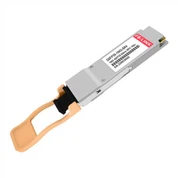
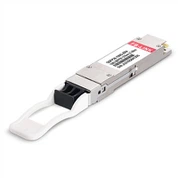
100GBASE ER4
The central wavelengths of the 4 LAN WDM channels are 1295.56, 1300.05, 1304.58 and 1309.14 nm as members of the LAN WDM wavelength grid defined in IEEE 802.3ba.
● Hot-pluggable QSFP28 MSA form factor
● Supports103.125 Gb/s aggregate bit rate
● Power dissipation <5.5W
● Commercial case temperature range of 0°C to 70°C
● Single 3.3V power supply
● Maximum link length of 40km on Single Mode Fiber (SMF)
● Aligned with IEEE 802.3ba
● 4x25G EML LAN-WDM transmitter
● 4x25G NRZ retimed CAUI-4 electrical interface
● Duplex LC receptacles
● I2C management interface
● RoHS compliant

- Product Introduction
Products Description
|
Compatible |
100GBASE QSFP28 ER4 |
Vendor Name |
FB-LINK |
|
Form Factor |
QSFP28 |
Max Data Rate |
103.125Gbps |
|
Wavelength |
1310nm |
Max Cable Distance |
40km |
|
Connector |
Duplex LC |
Media |
SMF |
|
Transmitter Type |
4xEML |
Receiver Type |
APD |
|
TX Power |
-2.9~4.5dBm |
Receiver Sensitivity |
<-20.9dBm |
|
Powerbudget |
18dB |
Receiver Overload |
-4.9dBm |
|
Power Consumption |
≤4.5W |
Extinction Ratio |
>4dB |
|
DDM/DOM |
Supported |
Commercial Temperature Range |
0 to 70°C (32 to 158°F) |
|
Packaging Technology |
BOX Packaging |
CDR(Clock Data Recovery) |
TX & RX Built-in CDR |
|
Protocols |
QSFP28 MSA Compliant |
Warranty |
3 Years |


Related products

100G Single BIDI 20KM

100G LR4 10KM

100G ZR4 80KM

100G CWDM4 2KM
When enterprises and data centers require reliable connectivity across extended distances, optical transceivers become the critical backbone of network infrastructure. These compact modules bridge the gap between electrical signals within switches and optical signals traveling through fiber optic cables, enabling seamless data flow across metropolitan and regional networks.
What Makes Modern Optical Transceivers Essential
Optical transceivers serve as the eyes and ears of high-performance networks, converting electrical impulses into light pulses for transmission and reversing the process at the receiving end. The evolution from 10G to 100G technology has revolutionized how organizations approach bandwidth-intensive applications, making it possible to transmit massive amounts of data across considerable distances without degradation.
The latest generation of 100-gigabit optical transceivers leverages wavelength division multiplexing technology, splitting data streams across multiple optical channels simultaneously. This approach maximizes fiber utilization while maintaining signal integrity over distances that would have seemed impossible just a decade ago.
Key Advantages of Extended-Reach Solutions
Superior Distance Capabilities: Modern extended-reach optical transceivers push transmission boundaries to 40 kilometers and beyond, eliminating the need for expensive signal regeneration equipment between sites. This makes them ideal for connecting branch offices, disaster recovery facilities, or geographically distributed data center campuses.
Enhanced Signal Quality: Advanced receiver technologies, including semiconductor optical amplification and avalanche photodetector designs, ensure that even weak signals arriving after long journeys through fiber maintain sufficient quality for error-free data recovery.
Power Efficiency: Despite their sophisticated capabilities, contemporary optical transceivers maintain reasonable power budgets, typically consuming under 5 watts while delivering 100 gigabits per second of throughput.
Deployment Scenarios for High-Performance Optical Transceivers
Enterprise Campus Connectivity: Organizations with multiple buildings spread across industrial parks or university campuses benefit from direct point-to-point connections using extended-reach optical transceivers. A single fiber pair can link core switches 30-40 kilometers apart without intermediate equipment.
Metropolitan Area Networks: Service providers building out metropolitan fiber rings rely on these optical transceivers to create high-capacity backbone links between central offices and aggregation points throughout cities.
Data Center Interconnection: Perhaps the most demanding application involves connecting primary and secondary data centers for disaster recovery, load balancing, and geographic redundancy. Optical transceivers designed for extended reach enable real-time data replication and seamless failover between facilities dozens of kilometers apart.
Technical Considerations for Deployment
Successful implementation of optical transceivers requires attention to several factors. Fiber quality matters significantly-single-mode fiber with low attenuation characteristics ensures signals arrive with adequate power levels. The standard duplex LC connector configuration provides reliable physical connections while maintaining compact port density.
Temperature tolerance is another crucial specification, particularly for equipment installed in less controlled environments. Industrial-grade optical transceivers operate reliably across temperature ranges from freezing to 70°C, accommodating everything from outdoor equipment cabinets to densely packed data center racks.
Digital diagnostic monitoring has become standard, allowing network administrators to track real-time parameters like optical power levels, temperature, and voltage. This visibility enables proactive maintenance and rapid troubleshooting when issues arise.
Integration with Network Infrastructure
Optical transceivers must seamlessly integrate with existing switching infrastructure. Compliance with Multi-Source Agreement specifications ensures interoperability across equipment from different vendors. Hot-swappable designs allow installation and replacement without disrupting adjacent ports or requiring system shutdowns.
The modular nature of modern optical transceivers provides deployment flexibility-organizations can start with shorter-reach modules for nearby connections and upgrade to extended-reach variants as geographic expansion demands, all using the same switch hardware.
Frequently Asked Questions
What is the difference between standard and extended-reach optical transceivers?
Extended-reach optical transceivers utilize more sophisticated transmitter and receiver technologies to achieve distances of 40 kilometers or more, compared to 10 kilometers or less for standard long-reach variants. They employ techniques like optical amplification and more sensitive photodetectors to maintain signal quality over greater distances.
Do optical transceivers require special configuration?
Most optical transceivers function as plug-and-play devices, automatically negotiating speed and parameters with host equipment. However, for optimal performance over extended distances, enabling forward error correction (FEC) on both ends of the link is typically recommended, as it significantly improves bit error rates.
Can I mix optical transceivers from different manufacturers?
When optical transceivers comply with industry standards like IEEE 802.3 and MSA specifications, they generally interoperate across vendors. However, for mission-critical deployments, many organizations prefer matching pairs to ensure compatibility and simplify support.
What fiber type is required for extended-reach optical transceivers?
Extended-reach optical transceivers require single-mode fiber (SMF) due to its low dispersion characteristics and minimal signal loss over distance. Multimode fiber is unsuitable for these applications as it cannot support the distances and data rates involved.
How do I monitor the health of optical transceivers?
Modern optical transceivers include digital diagnostic monitoring capabilities that report parameters like transmit power, receive power, temperature, and voltage through the management interface. Most network operating systems can display these metrics and alert administrators when values fall outside acceptable ranges.
What is the typical lifespan of optical transceivers?
Quality optical transceivers typically carry 3-5 year warranties and can operate reliably for 10+ years under appropriate conditions. The laser components have expected lifetimes exceeding 100,000 hours, though actual longevity depends on operating temperature and environmental factors.
Are there any distance limitations when deploying these modules?
While extended-reach optical transceivers support distances up to 40 kilometers, actual achievable distance depends on fiber quality, number of connectors and splices in the path, and whether FEC is enabled. A link budget calculation considering all these factors ensures reliable operation before deployment.
Future-Proofing Network Infrastructure
Investing in high-quality optical transceivers provides a foundation for network growth. As bandwidth demands increase, the same fiber infrastructure can often support upgrades to higher-speed optical transceivers, protecting the significant investment in fiber plant installation. Organizations planning today's networks should consider not just current requirements but also anticipated growth over the next 5-10 years.
The standardization around form factors and interfaces means that optical transceivers represent a relatively future-proof investment compared to proprietary networking solutions. As technology advances, newer modules with improved performance or lower power consumption can drop into existing switch ports without forklift upgrades.
Hot Tags:
You Might Also Like