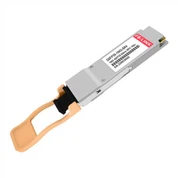
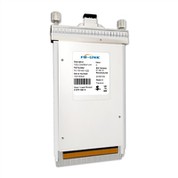
100G QSFP28 ZR4
The 100G QSFP28 ZR4 Optical Transceiver Module is designed for use in 100GBASE Ethernet throughput up to 80km over single mode fiber (SMF) using a wavelength of 1310nm via duplex LC connectors.

- Product Introduction
100G QSFP28 ZR4 Optical Transceiver
The 100G QSFP28 ZR4 Optical Transceiver Module is designed for use in 100GBASE Ethernet throughput up to 80km over single mode fiber (SMF) using a wavelength of 1310nm via duplex LC connectors. Taking BOX+FPC+PCBA separate design, it has great reliability, airtightness and heat dissipation performance. This transceiver is compliant with IEEE 802.3ba 100GBASE-LR4 and IEEE 802.3bm CAUI-4 standard. Digital diagnostics functions are also available via the I2C interface, as specified by the QSFP28 MSA, to allow access to real-time operating parameters. With these features, this easy to install, hot swappable transceiver is suitable to be used in various applications, such as 100G Ethernet, telecom and data center.
Item Spotlights
● Hot-pluggable QSFP28 MSA form factor
● Supports 103.125 Gb/s aggregate bit rate
● Power dissipation <6.0W
● Commercial case temperature range of 0°C to 70°C
● Single 3.3V power supply
● Maximum link length of 80km on Single Mode Fiber (SMF)
● Adopt BOX Packaging, with Great Reliability, Airtightness, and Heat Dissipation Performance
● Aligned with 100G ZR4
● 4x25G EML LAN-WDM transmitter
● 4x25G NRZ retimed CAUI-4 electrical interface
● Duplex LC receptacles
● I2C management interface
● RoHS compliant
Description
|
Compatible |
100G QSFP28 ZR4 |
Vendor Name |
FB-LINK |
|
Form Factor |
QSFP28 |
Max Data Rate |
103.125Gbps |
|
Wavelength |
1310nm |
Max Cable Distance |
80km |
|
Connector |
Duplex LC |
Media |
SMF |
|
Transmitter Type |
EML |
Receiver Type |
APD |
|
TX Power |
2~6.5dBm |
Receiver Sensitivity |
<-28dBm |
|
Powerbudget |
31dB |
Receiver Overload |
2dBm |
|
Power Consumption |
≤6W |
Extinction Ratio |
>6dB |
|
DDM/DOM |
Supported |
Commercial Temperature Range |
0 to 70°C (32 to 158°F) |
|
CDR (Clock and Data Recovery) |
TX & RX Built-in CDR |
Modulation Format |
NRZ |
|
Protocols |
QSFP28 MSA Compliant |
Warranty |
3 Years |
Company strength

Office

Testing workshop

Testing workshop

Testing workshop
FB-LINK is a high-tech enterprise dedicated to the research and development, production, sales, and service of optical communication products. The company was founded in 2012 and currently employs over 200 people, gathering a large number of senior talents in the industry. With high attention to the industry and years of rich experience, the company provides customers with a full range of products, solutions, and services. The company mainly operates 100G QSFP28 LR4, 100G QSFP28 SR4, 100G QSFP28 ER4, 100G QSFP28 ZR4, and so on. The product is widely used in fields such as data centers, metropolitan area networks, local area networks, storage networks, fiber optic channels, fiber to home, and wireless networks. The company insists on survival through quality. We have world-class production and testing equipment from Japan, the United States, and other countries. We have a clean workshop of over 1600 square meters in Shenzhen, with a certain scale of mass production capacity; Strictly control all production processes to ensure that the performance and quality of the shipped products reach international first-class standards.
Company Qualifications


High-speed connectivity has become the backbone of modern enterprise networks, and optical transceivers play a critical role in enabling seamless data transfer across vast distances. Among the various solutions available, the 100G QSFP28 ZR4 module stands out as a powerful option for organizations requiring extended reach capabilities without compromising performance.
What Makes ZR4 Technology Essential for Modern Networks?
Long-distance data transmission presents unique challenges that standard optical transceivers cannot always address. The ZR4 variant specifically targets scenarios where network architects need to bridge gaps of up to 80 kilometers while maintaining 100 Gigabit throughput. This capability makes it invaluable for connecting geographically dispersed data centers, extending metropolitan area networks, and supporting telecommunications infrastructure.
The technology leverages four independent lanes operating at 25 Gigabits per second each, using wavelength division multiplexing around the 1310nm spectrum. This approach allows multiple data streams to travel simultaneously over single-mode fiber, maximizing efficiency while minimizing infrastructure costs.
Key Applications Driving Adoption
Data Center Interconnection: As cloud services expand globally, organizations require reliable connections between facilities that may be dozens of kilometers apart. Optical transceivers with extended reach eliminate the need for intermediate amplification or regeneration equipment, simplifying network architecture and reducing operational expenses.
Metropolitan Area Networks: Service providers building city-wide networks benefit from modules that can span entire metropolitan regions. The ability to connect central offices, aggregation points, and customer premises without additional equipment reduces complexity and improves reliability.
Telecommunications Backbone: Carriers upgrading their networks to meet bandwidth demands rely on high-performance optical transceivers that deliver consistent performance across long fiber spans. The robust design and advanced diagnostics capabilities ensure network uptime and facilitate proactive maintenance.
Technical Advantages That Matter
Modern optical transceivers incorporate several innovations that enhance their utility in demanding environments. Hot-swappable form factors enable maintenance without network downtime, while integrated digital diagnostics provide real-time visibility into operating parameters. Clock and data recovery circuits ensure signal integrity across extended distances, and low power consumption keeps operational costs manageable.
The BOX packaging approach used in advanced designs provides superior protection against environmental factors while optimizing thermal management. This construction method enhances long-term reliability-a crucial consideration for installations expected to operate continuously for years.
Compatibility and Integration Considerations
When deploying optical transceivers, ensuring compatibility with existing infrastructure is paramount. Standards compliance guarantees interoperability across multi-vendor environments, allowing network engineers to mix and match equipment from different manufacturers without compatibility concerns.
The electrical interface design supports integration with modern switches and routers, while the physical connector type determines compatibility with existing fiber infrastructure. Organizations planning upgrades should verify that their fiber plant specifications align with module requirements to achieve optimal performance.
Performance Monitoring and Diagnostics
Advanced optical transceivers provide comprehensive diagnostic capabilities through standardized management interfaces. Network administrators can monitor transmit power, receive sensitivity, temperature, and voltage in real-time, enabling proactive identification of potential issues before they impact service.
These diagnostic features prove especially valuable in large-scale deployments where manually inspecting each connection point would be impractical. Automated monitoring systems can poll diagnostic data and trigger alerts when parameters drift outside acceptable ranges, facilitating rapid response to degrading conditions.
Future-Proofing Network Infrastructure
Investing in quality optical transceivers represents a strategic decision that impacts network capability for years to come. While initial costs may vary, the total cost of ownership depends on factors including reliability, power efficiency, diagnostic capabilities, and vendor support.
Organizations should evaluate modules based on their specific requirements, considering factors such as required reach, environmental conditions, existing infrastructure, and growth projections. Selecting appropriate specifications ensures networks can accommodate future bandwidth demands without requiring premature replacement of transmission equipment.
Frequently Asked Questions
What distance can 100G ZR4 optical transceivers cover?
ZR4-specification modules are designed to transmit data across distances up to 80 kilometers over single-mode fiber. This extended reach makes them suitable for connecting sites across metropolitan areas or between nearby cities without requiring intermediate amplification equipment.
How do optical transceivers differ from standard copper connections?
Optical transceivers use light signals traveling through fiber-optic cable rather than electrical signals through copper wire. This fundamental difference enables much greater transmission distances, higher bandwidth capabilities, immunity to electromagnetic interference, and lower signal degradation over distance.
What does "hot-pluggable" mean for network operations?
Hot-pluggable optical transceivers can be installed or removed while network equipment remains powered on and operational. This feature dramatically simplifies maintenance and upgrades by eliminating the need to schedule downtime for module replacement or installation.
Are all 100G modules interchangeable?
While all 100G modules share the same data rate, they vary significantly in specifications like maximum distance, wavelength, fiber type, and connector style. A ZR4 module designed for 80km transmission cannot substitute for an SR4 module intended for short-reach applications, and vice versa. Always verify compatibility before deployment.
What role does wavelength play in optical transmission?
Different wavelengths optimize for different transmission characteristics. The 1310nm wavelength used in many optical transceivers provides a good balance of distance capability and dispersion tolerance over single-mode fiber. Other wavelengths may be used for different applications or distance requirements.
How important are power consumption specifications?
Power consumption directly impacts operational costs and thermal management requirements. Lower power consumption reduces electricity expenses, minimizes cooling needs, and allows higher port density in switches and routers. For large-scale deployments, even small per-module differences aggregate to significant operational savings.
What maintenance do optical transceivers require?
Quality optical transceivers are largely maintenance-free once installed. However, regular monitoring of diagnostic parameters helps identify potential issues early. Fiber connections should be kept clean, and modules should operate within specified temperature ranges to ensure optimal longevity and performance.
Can I use these modules with any network equipment?
Optical transceivers must match both the physical interface (form factor) and electrical/protocol specifications of the host equipment. QSFP28 modules work with QSFP28 ports on compatible switches and routers. Always verify compatibility with your specific equipment model before purchasing.
Hot Tags:
You Might Also Like