
8PON GPON OLT
This product has a high performance, and compact size is convenient and flexible to use and is easy to deploy, which meets the compact server room’s requirements in device performance and size.

- Product Introduction
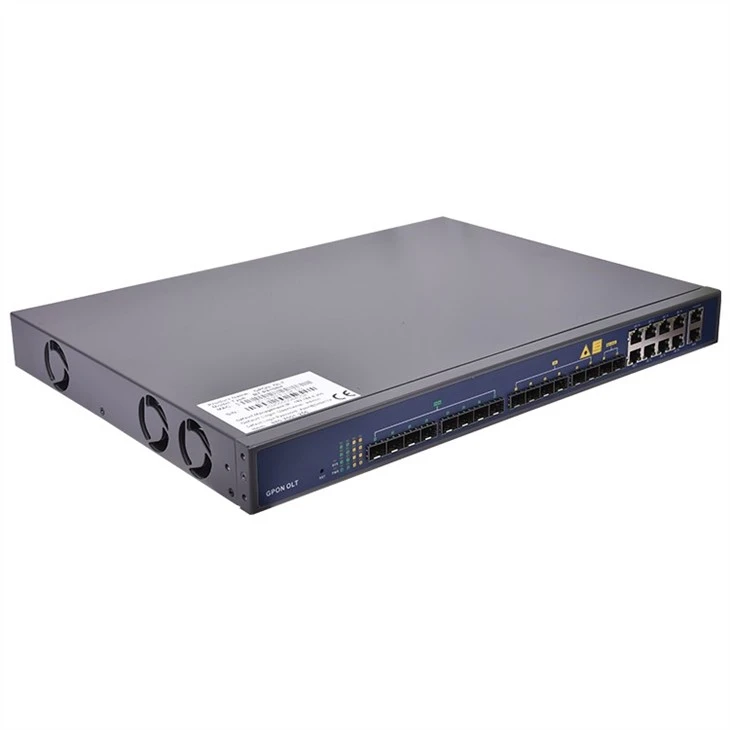
8 PON Ports GPON OLT
This 1U rack-mounted 8-port GPON OLT delivers enterprise-grade fiber connectivity in a compact form factor, fully compliant with ITU-T G.984.x and FSAN standards.
Technical Specifications:
8 GPON ports with 1:128 splitting ratio per port
Downstream bandwidth: 2.5 Gbps per port
Upstream bandwidth: 1.25 Gbps per port
Supports up to 1,024 GPON terminals simultaneously
4x GE copper uplink ports
4x GE SFP uplink ports
2x 10GbE uplink ports
1x USB management interface
Key Features:
Space-efficient 1U design ideal for confined server rooms
High-density port configuration maximizes deployment flexibility
Enterprise-class performance with enhanced network reliability
Energy-efficient operation reduces total cost of ownership
Hot-swappable components for minimal downtime
Applications:
FTTH/FTTP residential and business fiber deployments
Triple-play services (voice, video, data)
IP video surveillance networks
Enterprise campus and building networks
IoT infrastructure backbone
Smart city connectivity solutions
This FB-LINK GPON OLT combines robust performance with exceptional value, making it an ideal choice for operators seeking scalable, reliable fiber access infrastructure.
Item Spotlights
● 1U 19 inch standard box GPON OLT with 8 PON ports
● Compliant with ITU-T G984/G.988 standards and China Telecom GPON Technical Requirements
● L3 function, support static route, ARP proxy, hardware Host Routes, hardware Subnet Routes
● QoS based on port, VID, TOS and MAC address(16K Mac address)
● Support VLAN tag/Un-tag, VLAN transparent transmission, QinQ
● Support IGMP snooping, IGMP Proxy
● Specialized design for system breakdown prevention to maintain stable system
● Support port-based rate limitation and bandwidth control
● Support data encryption, multi-cast, port VLAN, separation, RSTP, etc
● Support Dynamic Bandwidth Allocation (DBA)
● Support ONU auto-discovery/link detection/remote upgrade of software
● Support ONT automatically discovery, auto configuration
● Support ONT firmware can be auto upgraded, download ONT firmware to OLT from web/tftp/ftp
● Support SNMP, telnet, CLI, OMCI/OAM and Web management
● Support power-off alarm function, easy for link problem detection
● Support broadcasting storm resistance function
● Support remote software upgrade
● Two power supply redundancy design
Description
|
Item |
8PON PORTS GPON OLT |
||
|
Management |
Type |
1U 19-inch standard box |
|
|
Uplink Port |
COMBO port |
4 10/100/1000M auto-negotiation Ethernet ports |
|
|
4 SFP interfaces |
|||
|
10-Gigabit |
2 SFP+ interfaces |
||
|
PON Port |
Quantity |
8 |
|
|
Physical interface |
SFP slot |
||
|
Interface type |
ITU-TG.984.2 Class B+/Class C+ |
||
|
Max splitting ratio |
1:128 |
||
|
Management Port |
1 100/1000BASE-Tx out-band Ethernet port |
||
|
USB Port |
1 USB interface (It's used to backup configuration, upgrade program, and record log information) |
||
|
PON Port attribute |
Transmission distance |
20KM |
|
|
Port rate |
Downstream: 2.5Gbps Upstream: 1.25Gbps |
||
|
Wavelength |
Forwarding: 1490nm Receiving: 1310nm |
||
|
Interface type |
SC/UPC |
||
|
Fiber type |
9/125μm SMF (Single Mode Fiber) |
||
|
Light transmission power |
Class B+ +1.5~+5dBm |
Class C+ +3~+7dBm |
|
|
Receiving sensitivity |
Class B+ -28dBm |
Class C+ -30dBm |
|
|
Saturation power |
Class B+ -8dBm |
Class C+ -12dBm |
|
|
Network management method |
Support CLI,SNMP,TELNET,SSH,WEB |
||
|
Business capabilities |
Support device log, device upgrade, device management, condition monitoring, configuration management, and user management. |
||
|
Backplane Bandwidth |
78G |
||
|
Size |
440mm(L)*272.6mm(W)*44mm(H) |
||
|
Weight |
4.50kg |
||
|
Power supply |
220VAC |
AC: 100V~240V,47/63Hz |
|
|
-48DC |
DC:-36V~-72V |
||
|
BBU |
AC: 11V~14V |
||
|
Maximum power |
58W |
||
|
Working environment |
Working temperature |
-15~50℃ |
|
|
Storage temperature |
-40~85℃ |
||
|
Relative humidity |
5~90% (Non-condensing) |
||
The demand for high-speed fiber connectivity has never been greater. As businesses and service providers expand their FTTP infrastructure, choosing the right optical line terminal becomes critical to network success. FB-LINK's 8-port GPON OLT delivers enterprise-grade performance in a compact, cost-effective package designed specifically for modern fiber-to-the-premise deployments.
Powering Next-Generation FTTP Networks
This rack-mounted optical line terminal represents a significant advancement in FTTP technology, combining ITU-T G.984.x compliance with practical deployment flexibility. The system architecture supports up to 1,024 GPON terminals simultaneously, making it an ideal solution for service providers rolling out fiber-to-the-premise services across residential complexes, business parks, and multi-tenant environments.
Each PON interface delivers 2.5 Gbps downstream and 1.25 Gbps upstream capacity with splitting ratios reaching 1:128. This configuration allows providers to maximize their FTTP investment by serving more customers per fiber strand while maintaining exceptional service quality.
Designed for Real-World FTTP Deployments
What sets this GPON OLT apart is its practical approach to deployment challenges. The 1U form factor fits seamlessly into space-constrained server rooms-a common scenario in FTTP rollouts where equipment must be positioned close to service areas. Despite its compact dimensions, the system delivers full carrier-grade functionality.
The connectivity options reflect real deployment needs: four gigabit Ethernet ports, four SFP slots, and two 10-gigabit SFP+ interfaces provide flexible uplink configurations. Whether connecting to existing network infrastructure or building new FTTP architectures, integration becomes straightforward.
Advanced Layer 3 Capabilities
Modern FTTP networks require more than basic connectivity. This OLT includes comprehensive Layer 3 routing functionality with static route support, ARP proxy, and hardware-accelerated routing tables. Network administrators can implement sophisticated traffic management policies based on port, VLAN ID, Type of Service markings, or MAC addresses-with capacity for 16,000 MAC entries.
Quality of Service management ensures that voice, video, and data services maintain appropriate priority levels across the FTTP network. IGMP snooping and proxy features optimize multicast traffic delivery, essential for IPTV services commonly deployed in fiber-to-the-premise environments.
Simplified Management for FTTP Operations
Managing distributed FTTP infrastructure requires efficient tools. The system supports multiple management interfaces including web GUI, CLI, SNMP, Telnet, and SSH access. Automatic ONU discovery eliminates manual provisioning steps during subscriber activation-technicians simply connect the customer premises equipment, and the system handles registration automatically.
Firmware management scales across the entire FTTP deployment. Administrators can push updates to customer ONTs remotely through the OLT, downloading firmware via web interface, TFTP, or FTP. The USB port enables configuration backup and log archiving, supporting compliance requirements and disaster recovery planning.
Reliability for Mission-Critical FTTP Services
Service providers deploying FTTP infrastructure need systems that maintain uptime under all conditions. The dual power supply design provides automatic failover protection. When primary power fails, the system switches seamlessly to backup power, then reverts automatically when primary power returns while simultaneously charging the battery backup unit.
The platform operates reliably across temperature ranges from -15°C to 50°C, accommodating various installation environments from climate-controlled data centers to street-level equipment cabinets. Specialized system breakdown prevention design maintains stability even under stress conditions.
Versatile Applications Beyond Traditional FTTP
While optimized for fiber-to-the-premise deployments, this GPON OLT serves multiple network scenarios:
Triple-Play Service Delivery: Simultaneous voice, video, and high-speed internet over FTTP infrastructure with QoS guarantees for each service type.
Enterprise Campus Networks: Connecting multiple buildings with high-bandwidth fiber links, perfect for corporate campuses expanding their internal FTTP connectivity.
Video Surveillance Networks: Supporting IP cameras across distributed facilities with sufficient bandwidth for high-definition feeds and centralized recording.
Smart City Infrastructure: Powering IoT sensor networks, traffic management systems, and public WiFi through consolidated FTTP backbones.
Technical Excellence Meets Cost Efficiency
The device achieves 78 Gbps backplane bandwidth with just 58 watts maximum power consumption-delivering exceptional performance per watt. This efficiency reduces operating costs across large FTTP deployments where multiple units operate continuously.
Distance capabilities extend to 20 kilometers with Class B+ and Class C+ optical specifications, providing flexibility in network topology design. The system transmits at 1490nm and receives at 1310nm using standard SC/UPC connectors with single-mode fiber, ensuring compatibility with existing FTTP infrastructure.
Frequently Asked Questions
What makes this GPON OLT suitable for FTTP deployments?
The combination of high port density (8 PON ports supporting 1,024 terminals), compact 1U design, and comprehensive Layer 3 functionality makes it ideal for fiber-to-the-premise projects. The system handles the full complexity of FTTP service delivery-from automatic subscriber provisioning to advanced traffic management-while fitting into space-constrained installation environments typical of distributed access nodes.
How does Dynamic Bandwidth Allocation improve FTTP network efficiency?
DBA continuously monitors actual bandwidth usage across all connected subscribers and reallocates unused capacity where it's needed. In FTTP environments where user demand fluctuates throughout the day, this ensures efficient fiber utilization. Heavy users receive additional bandwidth during peak activity while maintaining guaranteed minimums for all subscribers, maximizing the return on FTTP infrastructure investment.
Can this system integrate with existing network management platforms?
Yes, standard SNMP support enables integration with most network management systems. The OMCI and OAM protocols provide standardized communication with subscriber equipment. For FTTP service providers with established OSS/BSS systems, the OLT can be incorporated into existing workflows through these industry-standard interfaces.
What redundancy features protect FTTP service continuity?
The dual power supply configuration automatically switches between AC power sources or from AC to DC backup without service interruption. The system includes power-off alarm functionality that notifies operators immediately when issues occur, enabling rapid response before subscribers experience downtime. RSTP support provides rapid network convergence if upstream connections fail.
How quickly can new subscribers be activated on the FTTP network?
Auto-discovery functionality enables same-visit installation. When technicians install subscriber equipment, the ONU automatically registers with the OLT. If pre-configured service templates are deployed, subscribers can receive service within minutes of physical installation. This accelerates FTTP subscriber acquisition and reduces truck roll costs.
What security features protect the FTTP infrastructure?
Data encryption safeguards customer traffic across the optical distribution network. Port VLAN isolation prevents unauthorized traffic between subscribers. ACL functionality restricts management access to authorized personnel only. Broadcasting storm resistance protects network stability from misconfigured or compromised subscriber equipment. These layers combine to secure both the FTTP infrastructure and customer data.
Is the system scalable for growing FTTP networks?
The 10-gigabit uplink interfaces provide headroom for network growth. As subscriber counts and per-user bandwidth demands increase, the high-capacity backplane and uplinks prevent bottlenecks. Multiple units can be deployed across service areas and managed centrally through unified management interfaces, supporting phased FTTP expansion as customer demand grows.
Building Successful FTTP Infrastructure
Selecting appropriate equipment determines FTTP project success from day one. This 8-port GPON OLT balances carrier-grade capabilities with practical deployment realities-delivering the features service providers need while maintaining the compact footprint and efficiency distributed fiber-to-the-premise architectures require.
Whether launching new FTTP services, expanding existing networks, or upgrading legacy infrastructure, the combination of high performance, comprehensive management capabilities, and competitive pricing positions this platform as a strategic choice for forward-thinking network operators committed to delivering exceptional fiber connectivity to their customers.
Hot Tags: fttp
You Might Also Like