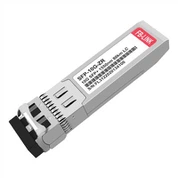
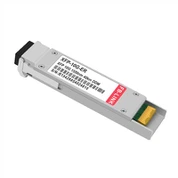
40GBASE LR4
This product is a transceiver module designed for 2m-10km optical communication applications. The design is compliant to 40GBASE-LR4 of the IEEE P802.3ba standard.

- Product Introduction
Item Spotlights
● Compliant with 40G Ethernet IEEE802.3ba and 40GBASE LR4 Standard
● QSFP+ MSA compliant
● Compliant with QDR/DDR Infiniband data rates
● Up to 11.2Gb/s data rate per wavelength
● 4 CWDM lanes MUX/DEMUX design
● Up to 10km transmission on single mode fiber (SMF)
● Operating case temperature: 0 to 70℃
● Maximum power consumption 2.5W
● LC duplex connector
● RoHS compliant
Products Description
|
Compatible |
40GBASE LR4 |
Vendor Name |
FB-LINK |
|
Form Factor |
QSFP+ |
Max Data Rate |
44.6Gbps |
|
Wavelength |
1310nm |
Max Cable Distance |
10km |
|
Connector |
Duplex LC |
Media |
SMF |
|
Transmitter Type |
DFB CWDM |
Receiver Type |
PIN |
|
TX Power |
-7~2.3dBm |
Receiver Sensitivity |
<-11.5dBm |
|
Powerbudget |
4.5dB |
Receiver Overload |
2.3dBm |
|
Power Consumption |
≤3.5W |
Extinction Ratio |
>4.5dB |
|
DDM/DOM |
Supported |
Commercial Temperature Range |
0 to 70°C (32 to 158°F) |
|
Host FEC |
Supported |
Bit Error Ratio(BER) |
1E-12 |
|
Protocols |
OTN OTU3, 40G Ethernet, FiberChannel, SATA/SAS3, MSA Compliant |
Warranty |
3 Years |
Block Diagram of Transceiver

Product compatibility

Related products

40G SR4

10G SR

25G SR

100G SR4
When businesses need reliable long-distance data transmission, optical transceivers become the backbone of their network infrastructure. Among the various solutions available, the 40GBASE LR4 module stands out as a powerful option for organizations requiring robust connectivity across extended distances.
Understanding 40GBASE LR4 Technology
The 40GBASE LR4 represents a significant advancement in optical transceiver technology, specifically engineered to bridge the gap between short-range and ultra-long-range connectivity solutions. This technology leverages CWDM (Coarse Wavelength Division Multiplexing) to achieve impressive performance metrics while maintaining compatibility with existing network architectures.
At its core, this solution utilizes four distinct wavelength channels operating simultaneously. Each channel carries data at speeds reaching beyond 10Gb/s, combining to deliver aggregate throughput that meets the demanding requirements of modern data centers and enterprise networks. The wavelength allocation follows strict ITU-T standards, ensuring interoperability across diverse network equipment.
Key Technical Advantages
Multi-Channel Architecture
The four-lane design represents a sophisticated approach to bandwidth management. By distributing the total data load across multiple wavelengths, optical transceivers of this caliber achieve superior signal integrity compared to single-channel alternatives. Each wavelength operates independently, providing built-in redundancy considerations and improved overall system reliability.
Extended Reach Capabilities
Distance has always been a critical factor in network design. This particular class of optical transceivers addresses that challenge by supporting transmission distances that span several kilometers. Such reach makes them ideal for campus networks, metropolitan area deployments, and interconnecting geographically dispersed facilities without requiring signal regeneration equipment.
Power Efficiency Considerations
Modern data centers face increasing pressure to minimize power consumption. Advanced optical transceivers incorporate efficient conversion mechanisms that balance performance with energy usage. The thermal management design ensures stable operation even under continuous high-load conditions, contributing to lower cooling requirements and reduced operational expenses.
Application Scenarios
Data Center Interconnection
Organizations operating multiple data center facilities benefit significantly from deploying these optical transceivers. The ability to maintain high-speed connections over extended distances enables seamless workload distribution, disaster recovery implementations, and geographic redundancy strategies. Financial institutions, cloud service providers, and large enterprises commonly deploy this technology for mission-critical connectivity.
Enterprise Campus Networks
Universities, corporate campuses, and research facilities with buildings spread across large areas find optical transceivers essential for maintaining unified network infrastructure. The combination of high bandwidth and extended range eliminates the need for intermediate equipment, simplifying network topology and reducing maintenance overhead.
Telecommunications Infrastructure
Service providers building out metropolitan area networks rely on optical transceivers to deliver high-capacity services to business customers. The standards-compliant nature of these modules ensures compatibility with existing infrastructure while providing the performance headroom necessary for future service expansion.
Technical Specifications That Matter
Wavelength Management
The CWDM approach employed by these optical transceivers divides the available optical spectrum into distinct channels. This segmentation occurs at precise wavelength intervals, following international standards that ensure global compatibility. The spacing between channels provides sufficient guard bands to prevent crosstalk while maximizing spectral efficiency.
Connector Interface Design
Physical connectivity plays a crucial role in deployment flexibility. The duplex LC connector format has become an industry standard, offering high port density, reliable mating characteristics, and ease of installation. This connector type supports both transmit and receive functions through a single compact interface, simplifying cable management in high-density environments.
Diagnostic Capabilities
Modern optical transceivers incorporate sophisticated monitoring functions that provide real-time visibility into operational parameters. Temperature, voltage, optical power levels, and other critical metrics become accessible through standardized digital interfaces. This diagnostic capability enables proactive maintenance strategies and rapid troubleshooting when issues arise.
Integration Considerations
Platform Compatibility
Before deploying optical transceivers, organizations must verify compatibility with their existing network equipment. The QSFP+ form factor has achieved widespread adoption across major networking vendors, but subtle variations in firmware requirements or feature support may exist. Consulting vendor compatibility matrices ensures smooth integration without unexpected complications.
Fiber Infrastructure Requirements
Single-mode fiber forms the foundation for long-reach optical transceivers. Unlike multimode fiber, single-mode infrastructure supports the extended distances and higher performance these modules deliver. Organizations planning upgrades should assess their existing fiber plant or budget for new installations that meet the demanding requirements of high-speed optical transmission.
Environmental Factors
Operating environment significantly impacts optical transceiver longevity and reliability. Temperature extremes, humidity levels, and electromagnetic interference all affect performance. Ensuring that installation locations meet specified environmental parameters protects investment and maintains consistent network operation.
Performance Optimization
Link Budget Analysis
Successful deployment of optical transceivers requires careful attention to link budget calculations. Optical power levels at transmission, fiber attenuation characteristics, connector losses, and receiver sensitivity all contribute to the overall link budget. Building in appropriate safety margins ensures reliable operation across the full range of environmental conditions and component tolerances.
Signal Quality Monitoring
Continuous monitoring of signal quality parameters helps maintain optimal network performance. Bit error rates, optical signal-to-noise ratios, and other metrics provide early warning of degrading conditions. Implementing monitoring systems that track these parameters across deployed optical transceivers enables predictive maintenance and prevents service disruptions.
Forward Error Correction
Many modern optical transceivers support Forward Error Correction (FEC) mechanisms that enhance link reliability. FEC adds redundant information to the data stream, allowing the receiver to detect and correct errors without requiring retransmission. This capability proves particularly valuable in challenging optical environments or when operating near the limits of specified transmission distances.
Industry Standards Compliance
IEEE 802.3ba Alignment
Adherence to IEEE standards ensures that optical transceivers function correctly within Ethernet networking environments. The 802.3ba specification defines critical parameters for 40-gigabit Ethernet operation, including physical layer characteristics, encoding schemes, and interoperability requirements. Standards compliance provides confidence that different vendors' equipment will work together seamlessly.
MSA Conformance
Multi-Source Agreement specifications establish common mechanical, electrical, and functional standards for optical transceivers. MSA compliance ensures that modules from different manufacturers can be used interchangeably in compatible host equipment. This standardization reduces vendor lock-in and provides procurement flexibility.
Future-Proofing Strategies
Scalability Considerations
While 40-gigabit connectivity meets many current requirements, network architects must consider future bandwidth demands. Optical transceivers that support migration paths to higher speeds provide better long-term value. Understanding the upgrade options and infrastructure requirements for next-generation technologies informs smarter purchasing decisions.
Software-Defined Networking Integration
As networks evolve toward software-defined architectures, optical transceivers with programmable features and rich telemetry capabilities become increasingly valuable. The ability to dynamically adjust parameters, collect detailed operational data, and integrate with network automation platforms positions organizations for future operational models.
Frequently Asked Questions
What is the maximum transmission distance for 40GBASE LR4 optical transceivers?
These modules typically support transmission distances reaching up to ten kilometers over single-mode fiber. Actual achievable distance depends on factors including fiber quality, number of connections in the optical path, and overall link budget. Organizations requiring longer distances should consider amplification or regeneration solutions.
Can I use multimode fiber with these optical transceivers?
No, 40GBASE LR4 optical transceivers require single-mode fiber for proper operation. The long-wavelength design and extended reach capabilities are specifically optimized for single-mode fiber characteristics. Using multimode fiber will result in severely degraded performance or complete link failure.
How do optical transceivers differ from SFP modules?
The primary differences lie in form factor, bandwidth capacity, and physical interface design. QSFP+ optical transceivers provide four times the bandwidth of comparable SFP+ modules through their multi-lane architecture. The larger physical size accommodates the additional components required for higher performance levels.
What does CWDM mean in the context of these modules?
CWDM stands for Coarse Wavelength Division Multiplexing, a technology that transmits multiple data streams simultaneously using different wavelengths of light. In optical transceivers utilizing CWDM, four distinct wavelengths carry independent data channels, which are combined for transmission and separated at the receiving end.
Do these optical transceivers require special cooling?
Standard optical transceivers rely on the cooling provided by the host equipment's airflow design. No special cooling arrangements are typically necessary, though ensuring adequate ventilation and maintaining ambient temperatures within specified ranges remains important for reliable operation and longevity.
Are optical transceivers hot-swappable?
Yes, QSFP+ optical transceivers support hot-swap operation, meaning they can be installed or removed while the host equipment remains powered and operational. This capability minimizes downtime during maintenance, upgrades, or troubleshooting activities. Always follow proper ESD precautions when handling modules.
How do I know if my network switch supports these optical transceivers?
Consult your switch manufacturer's documentation or compatibility matrix to verify support for QSFP+ modules and the 40GBASE LR4 standard specifically. While the form factor is standardized, some switches may have limitations on supported speeds, power budgets, or specific optical transceiver features.
What maintenance do optical transceivers require?
Minimal maintenance is required for optical transceivers themselves. However, keeping fiber connectors clean is essential for maintaining optimal performance. Use appropriate cleaning tools and techniques to remove dust and contamination. Regular monitoring of diagnostic parameters helps identify potential issues before they cause service problems.
Can I mix optical transceivers from different manufacturers?
While standards compliance should enable interoperability, real-world compatibility may vary. Some network equipment vendors prefer or require specific optical transceiver brands or part numbers. Testing compatibility in non-production environments before large-scale deployment reduces risk of unexpected issues.
What is the typical lifespan of these modules?
Quality optical transceivers typically provide many years of reliable service when operated within specified parameters. Factors affecting lifespan include operating temperature, power cycling frequency, and environmental conditions. Most manufacturers offer warranties ranging from three to five years, reflecting expected operational lifetime.
Hot Tags:
You Might Also Like