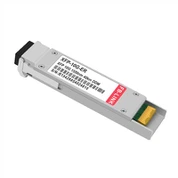
40GBASE SR4
The 40GBASE QSFP+ SR4 is a Four-Channel, Pluggable, Parallel, Fiber-Optic QSFP+ Transceiver for InfiniBand QDR/DDR/SDR,12G/10G/8G/4G/2G fiber channel, PCIe and SAS Applications.

- Product Introduction
Item Spotlights
● Four-channel full-duplex transceiver modules
● Transmission data rate up to 11.3Gbit/s per channel
● Up to 300m on OM3 Multimode Fiber (MMF)
● Low power consumption <1.5W
● Operating case temperature: 0 to 70℃
● 3.3V power supply voltage
● Hot Pluggable QSFP form factor
● MPO connector receptacle
● Built-in digital diagnostic function
Absolute Maximum Ratings
The operation in excess of any absolute maximum ratings might cause permanent damage to this module.
|
Parameter |
Symbol |
Min |
Max |
Unit |
Notes |
|
Storage Temperature |
TS |
-40 |
85 |
℃ |
|
|
Operating Case Temperature |
TOP |
0 |
70 |
℃ |
|
|
Power Supply Voltage |
VCC |
-0.3 |
3.6 |
V |
|
|
Relative Humidity (non-condensation) |
RH |
0 |
85 |
% |
|
|
Input Voltage |
Vin |
-0.3 |
Vcc+0.3 |
V |
|
Recommended Operating Conditions and Power Supply Requirements
|
Parameter |
Symbol |
Min |
Typical |
Max |
Unit |
Notes |
|
Operating Case Temperature |
TOP |
0 |
|
70 |
℃ |
|
|
Power Supply Voltage |
VCC |
3.135 |
3.3 |
3.465 |
V |
|
|
Power Consumption |
|
|
|
1.5 |
W |
|
|
Data Rate |
DR |
|
10.3125 |
11.3 |
Gbps |
|
|
Data Speed Tolerance |
∆DR |
-100 |
|
+100 |
ppm |
|
|
Link Distance with OM3 fiber |
D |
0 |
|
300 |
m |
|
Electrical Characteristics
The following electrical characteristics are defined over the Recommended Operating Environment unless otherwise specified.
| Parameter |
Test Point |
Min |
Typical |
Max |
Unit |
Notes |
|
Differential input impedance |
Zin |
90 |
100 |
110 |
ohm |
|
|
Differential Output impedance |
Zout |
90 |
100 |
110 |
ohm |
|
|
Differential input voltage amplitude |
ΔVin |
300 |
|
1100 |
mVp-p |
|
|
Differential output voltage amplitude |
ΔVout |
500 |
|
800 |
mVp-p |
|
|
Bit Error Rate |
BR |
|
|
E-12 |
|
|
|
Input Logic Level High |
VIH |
2.0 |
|
VCC |
V |
|
|
Input Logic Level Low |
VIL |
0 |
|
0.8 |
V |
|
|
Output Logic Level High |
VOH |
VCC-0.5 |
|
VCC |
V |
|
|
Output Logic Level Low |
VOL |
0 |
|
0.4 |
V |
|
Optical Characteristics
All parameters are specified under the recommended operating conditions with PRBS31 data pattern unless otherwise specified.
| Parameter |
Symbol |
Min |
Typical |
Max |
Unit |
Notes |
|
Transmitter |
||||||
|
Center Wavelength |
λC |
840 |
|
860 |
nm |
1 |
|
RMS Spectral Width |
λrms |
|
|
0.4 |
nm |
1 |
|
Average Launch Power, each lane |
PAVG |
-7 |
|
2.3 |
dBm |
|
|
Optical Modulation Amplitude (OMA) |
POMA |
-5 |
|
0 |
dBm |
1 |
|
Difference in Launch Power between any two lanes |
Ptx,diff |
|
|
4.0 |
dB |
|
|
Launch Power in OMA minus Transmitter and Dispersion Penalty (TDP), each Lane |
OMA-TDP |
-6.5 |
|
|
dB |
1 |
|
Rise/Fall Time |
Tr/Tf |
|
|
50 |
ps |
|
|
Extinction Ratio |
ER |
3.5 |
|
|
dB |
|
|
Transmitter Eye Mask Margin |
EMM |
10 |
|
|
% |
2 |
|
Average Launch Power OFF Transmitter, each Lane |
Poff |
|
|
-30 |
dBm |
|
|
Transmitter Eye Mask Definition {X1, X2, X3, Y1, Y2, Y3} |
|
{0.23, 0.34, 0.43, 0.27, 0.35, 0.4} |
|
|
||
|
Receiver |
||||||
|
Center Wavelength |
λC |
840 |
850 |
860 |
nm |
|
|
Damage Threshold |
THd |
3.4 |
|
|
dBm |
|
|
Overload, each lane |
OVL |
2.4 |
|
|
dBm |
|
|
Receiver Sensitivity in OMA, each Lane |
SEN |
|
|
-9.5 |
dBm |
|
|
Signal Loss Assert Threshold |
LOSA |
-30 |
|
|
dBm |
|
|
Signal Loss Deassert Threshold |
LOSD |
|
|
-12 |
dBm |
|
|
LOS Hysteresis |
LOSH |
0.5 |
|
8 |
dB |
|
|
Optical Return Loss |
ORL |
|
|
-12 |
dBm |
|
Product compatibility

When building or upgrading modern data centers, network architects face a critical decision: selecting the right optical transceivers to support growing bandwidth demands. The 40GBASE SR4 QSFP+ module has emerged as a cornerstone solution for short-reach, high-density applications that require reliable performance without breaking the budget.
Understanding the 40GBASE SR4 Technology
The 40GBASE SR4 represents a significant evolution in optical transceiver design. Unlike traditional single-channel modules, this QSFP+ solution leverages parallel optics technology with four independent channels operating simultaneously. Each channel handles data transmission at approximately 10Gbps, combining to deliver an aggregate throughput of 40Gbps over multimode fiber infrastructure.
This parallel architecture offers several advantages over alternative approaches. The use of 850nm VCSEL (Vertical Cavity Surface Emitting Laser) arrays provides excellent cost-efficiency while maintaining robust performance characteristics. For organizations with existing OM3 fiber installations, these modules deliver reliable connectivity across distances up to 300 meters-ideal for within-building and campus network deployments.
Why Choose QSFP+ Form Factor Optical Transceivers
The QSFP+ (Quad Small Form-factor Pluggable Plus) design has become the industry standard for 40G applications, and for good reason. These compact modules maximize port density on network switches and routers, allowing equipment manufacturers to pack more connectivity into smaller chassis footprints. This density advantage translates directly into reduced rack space requirements and lower overall infrastructure costs.
Hot-swappable functionality ensures that network maintenance and upgrades can occur without disruptive system shutdowns. The standardized MPO/MTP connector interface simplifies cabling infrastructure, with ribbon cables connecting multiple fibers through a single plug. This approach dramatically reduces cable management complexity compared to bundling multiple duplex fiber connections.
Applications Across Multiple Protocols
Modern optical transceivers must support diverse protocol requirements, and the 40GBASE SR4 excels in this regard. Beyond standard Ethernet applications, these modules provide compatibility with InfiniBand QDR/DDR/SDR networks commonly deployed in high-performance computing environments. Storage area networks benefit from Fibre Channel support across multiple speed grades, while PCIe and SAS applications extend the technology's reach into server interconnect and storage connectivity scenarios.
This protocol flexibility makes 40GBASE SR4 modules particularly valuable in converged infrastructure deployments where a single physical layer must accommodate different traffic types. Organizations can standardize on fewer transceiver SKUs while maintaining support for heterogeneous network requirements.
Power Efficiency and Thermal Management
Energy consumption has become a primary concern for data center operators facing rising electricity costs and sustainability mandates. Optical transceivers designed for efficiency help address these challenges at the component level. With typical power consumption well under 1.5 watts per module, 40GBASE SR4 QSFP+ transceivers minimize heat generation while delivering full-bandwidth performance.
The specified operating temperature range allows deployment in standard data center environments without requiring specialized cooling solutions. Built-in thermal management features ensure stable operation across varying ambient conditions, reducing the risk of performance degradation or premature failure due to temperature stress.
Digital Diagnostics and Network Management
Modern network operations demand visibility into component-level performance. Integrated digital diagnostic capabilities provide real-time monitoring of critical parameters including optical power levels, temperature, voltage, and bias current. This telemetry data enables proactive maintenance strategies, allowing network teams to identify degrading transceivers before they cause service interruptions.
Standards-based diagnostic interfaces ensure compatibility with network management platforms from multiple vendors. When troubleshooting connectivity issues, the ability to remotely query transceiver status significantly reduces mean time to resolution compared to older optical transceivers lacking these monitoring capabilities.
Multimode Fiber Infrastructure Considerations
The 40GBASE SR4 specification targets multimode fiber deployments, specifically OM3 and OM4 grades. OM3 fiber, with its laser-optimized 50-micron core, supports 300-meter link distances at 40G speeds. Organizations with OM4 fiber installations can achieve even greater reach, making these optical transceivers suitable for larger campus and warehouse facilities.
Existing multimode infrastructure represents a significant installed base that organizations prefer to leverage rather than replace. The SR4 specification's compatibility with established fiber plants protects previous cabling investments while enabling bandwidth upgrades to 40G speeds. This migration path provides a compelling economic argument compared to single-mode fiber solutions requiring complete infrastructure replacement.
Comparing SR4 to Alternative 40G Solutions
Network designers evaluating 40G connectivity have several optical transceivers options to consider. The 40GBASE LR4 specification uses single-mode fiber and WDM technology to achieve 10-kilometer reach, but at significantly higher cost per port. For the majority of data center applications where links remain under 300 meters, the cost differential makes SR4 the practical choice.
Breakout cables represent another approach, splitting 40G QSFP+ ports into four separate 10G connections. While this offers migration flexibility, it increases cabling complexity and port count requirements. Direct 40G connections using SR4 transceivers provide cleaner topology and simplified management for networks designed around 40G uplinks and server connections.
Quality Considerations and Compatibility Testing
Not all optical transceivers deliver equivalent reliability despite meeting published specifications. Laser manufacturing consistency, component quality, and firmware maturity all impact long-term performance. Organizations should prioritize modules that have undergone extensive compatibility testing with their specific switch and router platforms.
Third-party compatible transceivers can offer significant cost advantages over OEM-branded modules while maintaining equivalent functionality. However, due diligence remains essential-verifying that modules include proper coding to enable full feature support and that vendors provide adequate warranty coverage and technical support.
Installation Best Practices
Proper handling during installation directly impacts optical transceiver longevity and performance. Fiber optic connections require cleanliness to maintain low insertion loss and back reflection. MPO/MTP connectors should be inspected and cleaned before mating, as contamination on the multi-fiber interface affects all channels simultaneously.
Polarity management becomes critical with parallel optics implementations. The transmit channels on one end must align with receive channels on the opposite end, requiring either Type A or Type B MPO cables depending on equipment port configuration. Mismatched polarity results in complete link failure, making proper documentation and labeling essential during installation.
Future-Proofing Your Network Infrastructure
While 100G and 400G technologies continue advancing, 40G connectivity remains highly relevant for many applications. The installed base of 40G-capable switches represents substantial infrastructure investment that organizations will continue operating for years. Optical transceivers supporting 40GBASE SR4 will maintain their utility in server access layer deployments, storage networks, and inter-switch links where 100G represents over-provisioning.
The parallel optics principles established with SR4 have evolved into higher-speed implementations, creating a clear technology progression. Organizations building expertise with 40G parallel optics position themselves well for eventual migration to 100G SR4 and beyond, as the operational concepts remain consistent even as speeds increase.
Frequently Asked Questions
What is the difference between OM3 and OM4 fiber for 40GBASE SR4 transceivers?
Both OM3 and OM4 are laser-optimized multimode fiber types suitable for 40GBASE SR4 applications. OM3 supports distances up to 300 meters at 40G speeds, while OM4 extends this reach to 400 meters due to its lower modal dispersion characteristics. For most data center applications, OM3 provides sufficient distance at a lower fiber cost, making it the more economical choice for building interconnects.
Can 40GBASE SR4 optical transceivers work with OM2 or OM1 fiber?
While 40GBASE SR4 modules will physically connect to older OM1 and OM2 fiber installations, the supported distances decrease dramatically-typically to 100 meters or less. The bandwidth limitations of legacy multimode fiber types cannot support the modal bandwidth requirements for reliable 40G transmission over meaningful distances. Organizations with OM1 or OM2 infrastructure should consider fiber upgrades when deploying 40G connectivity.
How do I verify proper polarity for MPO/MTP cable connections?
MPO/MTP cables come in different polarity types (A, B, and C), and using the wrong type results in transmit channels connecting to transmit channels rather than to receive channels. Type A cables with key-up to key-down orientation work with standard transceiver-to-transceiver connections. Type B cables (key-up to key-up) require cassettes or adapters for proper polarity conversion. Always consult equipment documentation and use a fiber microscope to verify alignment before declaring a connection faulty.
Are third-party compatible optical transceivers as reliable as OEM modules?
High-quality third-party optical transceivers can match or exceed OEM reliability when sourced from reputable manufacturers. The key differentiators include component quality, manufacturing processes, and testing rigor. Look for vendors offering lifetime warranties, comprehensive compatibility testing reports, and responsive technical support. Many organizations successfully deploy third-party modules to achieve 50-70% cost savings without compromising network reliability.
What diagnostic parameters should I monitor for 40GBASE SR4 health?
Key parameters include optical transmit power on each channel (should remain within specified range), optical receive power (indicating fiber path loss), temperature (should stay well below maximum ratings), and supply voltage (should remain stable near 3.3V). Significant deviation in any parameter suggests potential issues. Additionally, monitor bit error rates and FEC corrected errors through your network equipment-increasing error rates often precede complete optical transceiver failure.
Can I use 40GBASE SR4 modules in a 100G QSFP28 port?
This depends entirely on the network equipment. Some switches support mixed speed operation, allowing 40G QSFP+ modules in 100G QSFP28 ports, while others do not. Consult your switch documentation and potentially test in a lab environment before deploying in production. Form factor compatibility exists, but speed negotiation capabilities vary by vendor and platform.
Conclusion
Selecting appropriate optical transceivers remains fundamental to building efficient, scalable network infrastructure. The 40GBASE SR4 QSFP+ platform delivers an optimal balance of performance, density, and cost-effectiveness for short-reach applications over multimode fiber. Its proven reliability, broad protocol support, and compatibility with existing fiber plants make it an enduring choice for data centers and enterprise networks worldwide.
Hot Tags:
You Might Also Like