2.5GBASE SFP BD
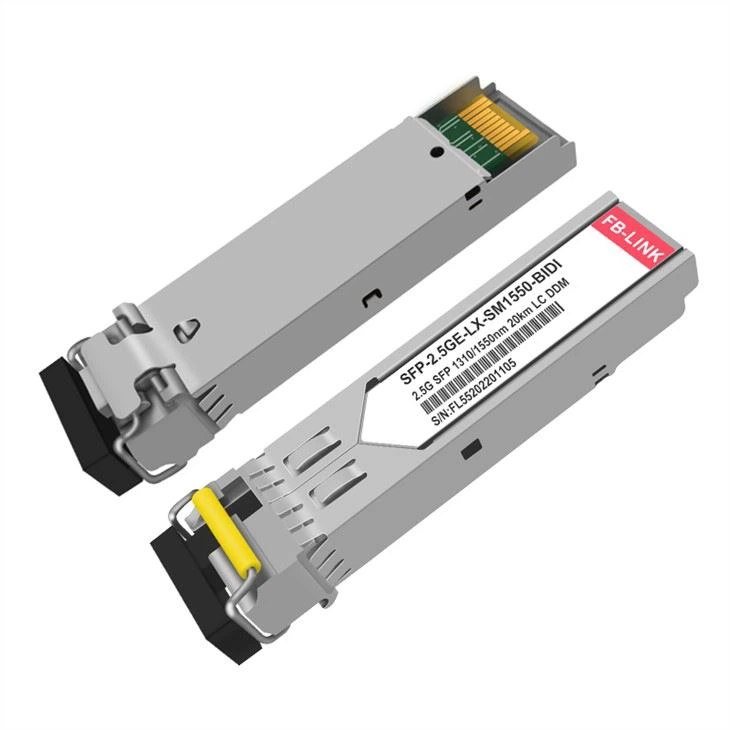
2.5GBASE SFP Bi-Directional transceiver is a high performance, cost effective module ,which is compliant with LC Optics interface with built in WDM for Bi-Directional serial optical data communication applications.

- Product Introduction
Item Spotlights
● Single Mode bi-directional Transmission
● SFP Multi-source Package with LC Receptacle
● Up to 2.5Gb/s Data Links
● Hot-Pluggable Capability
● Up to 80 km on 9/125μm SMF
● Single +3.3V Power Supply
● Built-in WDM
● Isolation > 30dB, Cross Talk < -45dB
● Monitoring Interface Compliant with SFF-8472
● Metal Enclosure, Excellent EMI & ESD Protection
● Compliant with Specifications for IEEE802.3Z
● Compliant with Bellcore TA-NWT-000983
● Eye Safety Designed to Meet Laser Class1, Compliant with IEC60825-1
● RoHS Compliant
Description
|
Compatible |
2.5GBASE SFP BD |
|||
|
Vendor Name |
FB-LINK |
|||
|
Max Data Rate |
2.5Gbps |
|||
|
Wavelength |
1310/1550nm |
1310/1550nm |
1490/1550nm |
1490/1550nm |
|
Connector |
Duplex LC |
|||
|
Receiver Type |
PIN |
PIN |
PIN |
APD |
|
TX Power |
-10~-3dBm |
-5~0dBm |
-2~+3dBm |
-2~+3dBm |
|
Receiver Sensitivity |
<-18dBm |
<-18dBm |
<-19dBm |
<-28dBm |
|
Max Cable Distance |
2KM |
20KM |
40KM |
80KM |
|
Extinction Ratio |
>8.2dB |
|||
|
Commercial Temperature Range |
0 to 70°C (32 to 158°F) |
|||
|
Warranty |
3 Years |
|||
When network infrastructure demands maximum efficiency with minimal cable investment, bi-directional optical transceivers emerge as the intelligent solution. These compact modules revolutionize how data travels across fiber networks by transmitting and receiving signals simultaneously on a single fiber strand.
What Makes Bi-Directional Optical Transceivers Different?
Traditional fiber optic systems require two separate fiber strands-one for transmitting and one for receiving data. Bi-directional optical transceivers break this convention by using wavelength division multiplexing (WDM) technology. By operating on different wavelengths, these modules send data in both directions through a single fiber core, effectively cutting fiber requirements in half.
This technology proves particularly valuable for organizations managing long-distance connections where fiber availability is limited or expensive. The built-in WDM functionality ensures signals remain isolated, preventing interference while maintaining data integrity across extended distances.
Key Applications for High-Performance Optical Transceivers
Modern optical transceivers serve diverse networking environments. Metropolitan area networks benefit from their extended reach capabilities, connecting campus buildings or business districts without intermediate equipment. Telecommunications providers deploy these modules to maximize their existing fiber infrastructure investments.
Enterprise networks utilize optical transceivers to connect remote offices, data centers, or facilities across considerable distances. The hot-pluggable design allows network administrators to perform maintenance or upgrades without shutting down entire systems-a critical feature for operations requiring continuous uptime.
Security and surveillance systems increasingly rely on optical transceivers for transmitting high-bandwidth video feeds across secure fiber connections. The inherent security of fiber optics, combined with extended range capabilities, makes these modules ideal for protecting sensitive data transmission.
Technical Advantages of Modern Optical Transceivers
The single-mode fiber compatibility of advanced optical transceivers enables remarkable transmission distances while maintaining signal quality. The integration of automatic power control and temperature compensation ensures consistent performance across varying environmental conditions.
Monitoring capabilities compliant with industry standards allow network administrators to track real-time performance metrics including optical power levels, temperature, and voltage. This proactive monitoring prevents potential failures before they impact network operations.
Superior electromagnetic interference (EMI) protection and electrostatic discharge (ESD) safeguards ensure reliable operation even in electrically noisy environments. The metal enclosure design provides robust protection for sensitive optical components.
Selecting the Right Optical Transceivers for Your Network
Distance requirements form the primary consideration when choosing optical transceivers. Applications spanning 2 to 20 kilometers demand different specifications compared to ultra-long-haul connections reaching 80 kilometers or beyond. Understanding your maximum required distance helps narrow suitable options.
Power budget calculations determine whether standard photodiode receivers suffice or if avalanche photodiode (APD) technology becomes necessary. APD-based optical transceivers offer enhanced sensitivity, enabling longer distances or additional margin for system losses.
Bandwidth requirements influence transceiver selection. While 2.5Gbps modules support legacy systems and current applications, planning for future growth ensures infrastructure longevity. The hot-pluggable nature of optical transceivers facilitates straightforward upgrades as bandwidth demands increase.
Installation Best Practices for Optical Transceivers
Proper handling protects these sensitive optical components. Always use dust caps when modules aren't connected, as even microscopic contamination degrades signal quality. Clean fiber connectors using appropriate tools and lint-free materials before establishing connections.
Verify wavelength pairing when installing bi-directional optical transceivers. One end must transmit at 1490nm while receiving at 1550nm, with the opposite configuration at the other end. Mismatched wavelengths prevent communication entirely.
Monitor insertion loss during installation. Excessive losses from dirty connectors, damaged fibers, or sharp bends reduce effective transmission distance and reliability. Professional-grade optical power meters quickly identify connection issues before they become operational problems.
The Future of Optical Transceivers in Network Infrastructure
Network demands continue escalating as cloud computing, streaming services, and IoT devices proliferate. Optical transceivers adapt to these challenges through continuous technological advancement. Higher data rates, extended distances, and improved power efficiency represent ongoing development trends.
The shift toward software-defined networking and network function virtualization increases demand for flexible, reliable physical layer infrastructure. Optical transceivers provide the robust connectivity foundation these advanced architectures require.
Environmental sustainability concerns drive innovation in transceiver design. Lower power consumption reduces operational costs and environmental impact-considerations increasingly important for organizations committed to reducing their carbon footprint.
Frequently Asked Questions About Optical Transceivers
What's the difference between single-mode and multi-mode optical transceivers?
Single-mode optical transceivers use laser light sources and narrow-core fiber to achieve distances ranging from kilometers to hundreds of kilometers. Multi-mode transceivers employ LED sources and wider-core fiber, limiting distances typically to 550 meters or less. Single-mode solutions cost more but provide significantly greater range for applications requiring extended connectivity.
Can I mix different brands of optical transceivers in the same network?
Yes, provided they meet the same industry standards and specifications. Optical transceivers following IEEE, MSA, or other recognized standards ensure interoperability. However, verify wavelength compatibility for bi-directional modules and confirm both ends support identical data rates and protocols.
How do I troubleshoot optical transceiver connectivity issues?
Start by verifying the module seats properly and the link LED indicators show activity. Check fiber cleanliness and connections at both ends. Use diagnostic monitoring features to examine transmit power and receive sensitivity levels. Compare readings against manufacturer specifications to identify whether issues stem from the transceiver, fiber infrastructure, or connected equipment.
What does DDM (Digital Diagnostic Monitoring) provide?
DDM functionality, also called DOM (Digital Optical Monitoring), enables real-time monitoring of critical parameters including temperature, supply voltage, transmit power, receive power, and laser bias current. This diagnostic capability allows proactive maintenance by identifying degrading components before complete failure occurs.
How long do optical transceivers typically last?
Quality optical transceivers typically function reliably for 5-10 years under normal operating conditions. Laser diode degradation represents the primary wear mechanism, though this occurs gradually. Proper environmental control, avoiding temperature extremes and maintaining clean optical connections significantly extends operational lifespan.
Are optical transceivers affected by electromagnetic interference?
No, the fiber optic cable itself is immune to electromagnetic interference-a major advantage over copper cabling. However, the transceiver electronics require proper EMI shielding, which quality modules provide through metal enclosures. This immunity makes optical transceivers ideal for industrial environments with motors, generators, or high-power electrical equipment.
What safety considerations apply to optical transceivers?
Laser-based optical transceivers emit invisible infrared light that can damage eyes if viewed directly. Class 1 laser products are safe under normal operating conditions, but never look directly into illuminated fiber connectors. Always use proper fiber inspection tools with built-in safety features when examining live connections.
Hot Tags: Optical Transceivers
You Might Also Like