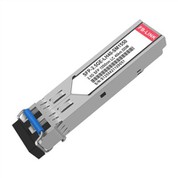
SFP 2.5GBASE ZX
SFP 2.5GBASE ZX Small Form Factor Pluggable (SFP) transceivers are compatible with the Small Form Factor Pluggable Multi-Sourcing Agreement (MSA).

- Product Introduction
Item Spotlights
● Up to 2.5Gb/s data links
● DFB laser transmitter and APD receiver
● Up to 80km on 9/125µm SMF
● Hot-pluggable SFP footprint
● Duplex LC/UPC type pluggable optical interface
● Low power dissipation
● Metal enclosure, for lower EMI
● RoHS compliant and lead-free
● Support Digital Diagnostic Monitoring interface
● Single +3.3V power supply
● Support Digital Diagnostic Monitoring interface
● Compliant with SFF-8472
● Case operating temperature:
Commercial: 0°C to +70°C
Extended: -10°C to +80°C
Industrial: -40°C to +85°C
Description
|
Compatible |
SFP 2.5GBASE ZX |
Vendor Name |
FB-LINK |
|
Form Factor |
SFP |
Max Data Rate |
2.5Gbps |
|
Wavelength |
1550nm |
Max Cable Distance |
80km |
|
Connector |
Duplex LC |
Media |
SMF |
|
Transmitter Type |
DFB |
Receiver Type |
PIN |
|
TX Power |
-2~3dBm |
Receiver Sensitivity |
<-28dBm |
|
Power Consumption |
≤1W |
Extinction Ratio |
>8.2dB |
|
DDM/DOM |
Supported |
Commercial Temperature Range |
0 to 70°C (32 to 158°F) |
|
Supply Voltage |
3.3V |
Warranty |
3 Years |
DDM

Advantage

Fully compatible

Packaging display

The exponential growth of data transmission demands has pushed network infrastructure to evolve rapidly. Among the critical components enabling this evolution, optical transceivers stand as the unsung heroes converting electrical signals into optical signals and back again, facilitating seamless data flow across vast distances. When enterprises need to bridge connections spanning dozens of kilometers, specialized optical transceivers like the 2.5Gb/s 1550nm single-mode variant become indispensable.
Why Long-Distance Optical Transceivers Matter
Modern enterprise networks often require connectivity between geographically dispersed locations-think corporate headquarters connecting to remote data centers, campus networks spanning multiple buildings, or metropolitan area networks linking city-wide facilities. Standard copper-based solutions quickly become impractical beyond a few hundred meters. This is where advanced optical transceivers excel, particularly those engineered for extended reach applications.
The 1550nm wavelength represents a sweet spot in fiber optic communications. This specific wavelength experiences minimal attenuation in single-mode fiber, making it ideal for long-haul transmissions. Combined with sophisticated transmitter and receiver technologies, these optical transceivers can maintain signal integrity across impressive distances while delivering reliable multi-gigabit performance.
Technical Architecture That Delivers
What makes high-performance optical transceivers capable of such remarkable feats? The architecture typically incorporates several sophisticated components working in harmony:
Transmitter Section: At the heart lies a Distributed Feedback (DFB) laser operating at the 1550nm wavelength. Unlike simpler LED-based transmitters, DFB lasers provide the spectral purity and power output necessary for long-distance communication. An integrated driver circuit manages the laser, incorporating Automatic Power Control (APC) to maintain consistent output despite temperature variations and component aging. This closed-loop control system monitors the laser's backlight emission and adjusts bias current dynamically, ensuring stable optical power output throughout the transceiver's operational life.
Receiver Section: On the receiving end, an Avalanche Photodiode (APD) detector provides the sensitivity required to detect attenuated signals after they've traveled extensive distances through fiber. The APD's internal gain mechanism amplifies weak optical signals before conversion to electrical form. A Trans-Impedance Amplifier (TIA) then converts the photocurrent into voltage, which passes through a limiting amplifier that reshapes the signal and outputs clean logic levels for downstream processing.
Diagnostic Capabilities: Modern optical transceivers incorporate Digital Diagnostic Monitoring (DDM), also known as Digital Optical Monitoring (DOM). This feature provides real-time visibility into critical operating parameters-transmitted and received optical power, temperature, supply voltage, and laser bias current. Network administrators can proactively identify degrading links before complete failure occurs, dramatically reducing troubleshooting time and minimizing network downtime.
Applications Across Enterprise Infrastructure
The versatility of 2.5Gb/s optical transceivers makes them suitable for diverse networking scenarios:
Metropolitan Area Networks (MANs): Connecting multiple office locations across a city without relying on telecommunications providers' expensive leased lines. The extended reach capability eliminates the need for intermediate signal regeneration equipment.
Campus Backbone Connections: Large educational institutions or corporate campuses often span several kilometers. These optical transceivers provide reliable inter-building connectivity while maintaining gigabit-class bandwidth.
Data Center Interconnect: As organizations adopt distributed data center architectures for redundancy and disaster recovery, connecting facilities that may be tens of kilometers apart becomes critical. The combination of speed and distance makes these transceivers perfect for such deployments.
Storage Area Networks (SANs): High-availability storage systems often require synchronous replication to remote sites. The low latency and high reliability of quality optical transceivers ensure data consistency across geographically separated storage arrays.
Key Advantages for Network Designers
When evaluating optical transceivers for extended-reach applications, several factors differentiate premium solutions from basic alternatives:
Power Efficiency: With power consumption under one watt, these modules minimize heat generation and reduce cooling requirements-particularly important in densely populated switch chassis where dozens of transceivers may operate simultaneously.
Hot-Swappability: The SFP form factor's hot-pluggable nature allows insertion and removal without powering down equipment, enabling maintenance and upgrades without network disruption.
Broad Compatibility: Well-designed optical transceivers adhere to Multi-Source Agreement (MSA) specifications, ensuring interoperability across equipment from various manufacturers. This open standard approach prevents vendor lock-in and provides deployment flexibility.
Environmental Resilience: Commercial, extended, and industrial temperature ratings mean these transceivers can operate reliably in climate-controlled data centers, semi-conditioned telecommunications closets, or even harsh industrial environments where temperature extremes occur.
Standards Compliance: Adherence to specifications like SFF-8472 ensures proper functionality of advanced features like DDM across different management platforms and network operating systems.
Deployment Considerations
Successfully implementing long-distance optical links requires attention to several factors beyond simply selecting appropriate optical transceivers:
Fiber Infrastructure: Single-mode fiber with 9/125μm core/cladding dimensions is essential. The fiber should be clean, properly terminated with LC/UPC connectors, and tested for acceptable loss budgets. Even small amounts of contamination on fiber end-faces can significantly degrade performance.
Link Budget Calculation: Understanding the power budget ensures reliable operation. With typical transmit power around 0 dBm and receiver sensitivity better than -28 dBm, these transceivers provide substantial link margin. However, account for fiber attenuation (approximately 0.25 dB/km at 1550nm), connector losses (0.3-0.5 dB each), and splice losses if present.
Dispersion Management: At 2.5Gb/s over single-mode fiber, chromatic dispersion rarely becomes limiting within the specified distance range. However, understanding dispersion characteristics becomes important when pushing distance boundaries or considering future upgrades to higher data rates over the same fiber plant.
Monitoring and Maintenance: Leverage the DDM capabilities of these optical transceivers by integrating them into network management systems. Set appropriate thresholds and alerts for parameters like received optical power-declining receive levels often indicate fiber degradation or connector contamination requiring attention.
Quality Indicators
Not all optical transceivers are created equal. Several characteristics separate reliable, enterprise-grade modules from questionable alternatives:
Laser Source Quality: DFB lasers provide superior spectral characteristics compared to Fabry-Perot lasers, enabling longer transmission distances and better performance over the fiber's optical passband.
Receiver Technology: APD receivers offer significantly better sensitivity than PIN photodiodes, enabling detection of weaker signals after long-distance propagation.
Thermal Management: Quality modules incorporate effective thermal design, with metal enclosures providing EMI shielding while dissipating heat efficiently. This extends component lifespan and maintains performance stability.
Testing and Certification: Reputable manufacturers test each transceiver individually across parameters like eye diagram quality, optical power output, receiver sensitivity, and DDM accuracy before shipment.
Frequently Asked Questions
What's the actual usable distance for these optical transceivers?
While rated for distances up to 80 kilometers over standard single-mode fiber, actual achievable distance depends on several factors including fiber quality, number of connectors and splices, and required bit error rate. Most implementations see reliable operation at the full rated distance with proper fiber infrastructure. Always calculate link budget for your specific installation to verify adequate power margin.
Can I use these transceivers with equipment from different manufacturers?
Yes, these optical transceivers follow the SFP MSA standard, which defines mechanical, electrical, and functional specifications ensuring interoperability. They work with switches, routers, media converters, and other networking equipment supporting the SFP form factor, regardless of equipment manufacturer. However, some vendors implement proprietary coding that may require transceivers to identify with specific vendor codes.
How do I know when a transceiver is starting to fail?
The Digital Diagnostic Monitoring feature provides early warning signs. Key indicators include declining received optical power (suggests fiber degradation or transmitter weakening), increasing laser bias current (indicates aging laser requiring more current to maintain output), or temperature excursions beyond normal ranges. Most network management systems can poll these parameters via I2C interface and alert administrators before complete failure occurs.
What's the difference between commercial, extended, and industrial temperature ratings?
Temperature ratings define the ambient operating environment ranges. Commercial (0°C to 70°C) suits climate-controlled spaces like data centers. Extended (-10°C to 80°C) works for semi-conditioned environments like telecommunications closets. Industrial (-40°C to 85°C) handles harsh environments without climate control. Higher temperature ratings typically involve more robust component selection and testing but maintain the same optical performance specifications.
Do these transceivers require special fiber cleaning procedures?
Yes, fiber cleanliness is critical for optimal performance. Even microscopic contamination on connector end-faces can cause significant signal loss or damage. Use appropriate cleaning tools-typically lint-free cleaning sticks with isopropyl alcohol for connector ferrules, and cassette-style cleaners for mating adapters. Always inspect end-faces with a fiber microscope before connection. Never mate dirty connectors, as contamination transfers and can permanently damage the transceiver's optical interface.
Can I mix different transceiver brands at opposite ends of a fiber link?
Absolutely. Because these optical transceivers follow standardized specifications, a transceiver from one manufacturer will communicate perfectly with a different brand at the opposite end, provided both operate at compatible wavelengths and data rates. The optical signal itself is standardized-1550nm light modulated at 2.5Gb/s doesn't care which company manufactured the transmitter or receiver.
What maintenance do optical transceivers require?
Physical maintenance is minimal-keep connector caps on when transceivers aren't connected, and clean fiber connections before mating as mentioned above. From a monitoring perspective, regularly check DDM parameters for trends indicating degradation. Most transceivers will operate reliably for many years (often outlasting the equipment they're installed in) with proper handling and clean optical connections.
How does the automatic power control feature work?
The APC circuit continuously monitors the laser's optical output using a photodiode that captures light from the laser's back facet. If output power begins to drift due to temperature changes or component aging, the APC adjusts the laser's bias and modulation currents to maintain consistent output power. This closed-loop control happens in real-time, ensuring stable transmission quality throughout the transceiver's operational life without manual adjustment.
Hot Tags: sfp 2.5gbase zx, China sfp 2.5gbase zx suppliers, manufacturers, factory
You Might Also Like