
25GBASE SFP28 SR
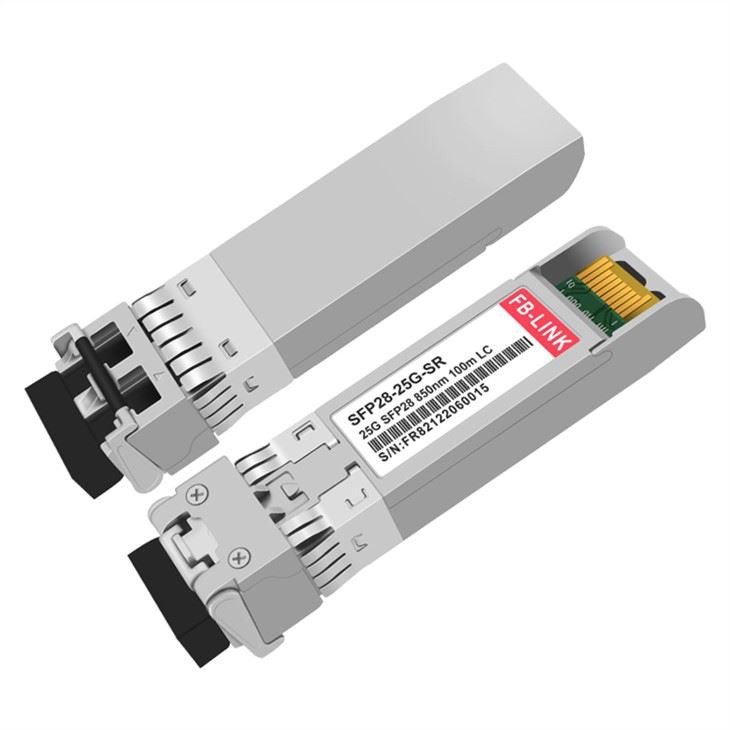
25G SFP28 SR transceiver modules are designed for use in 25 Gigabit Ethernet links on up to 100m of Multi mode fiber.

- Product Introduction
Advantages of 25G
Excellent transmission performance : 25GBASE can cost-effectively expand bandwidth capacity and has become the most in-demand target for large data centers and next-generation center services. 25GBASE uses a single-channel manufacturing process to achieve 25Gbps transmission, which improves network bandwidth performance by 2.5 times compared to the transmission performance of 10GBASE-T. 25GBASE can provide 4 times the switch port density per switch chip, which means it has higher port density and better scalability than 40GBASE.
High compatibility: 25GBASE is both backward compatible with 10GBASE and can also provide forward compatibility (such as 100G Ethernet) through automatic negotiation, which greatly improves connection efficiency and effectively saves costs.
Flexible structure: 25GBASE can support more topological architecture cabling, such as connections between cabinets or EoR switches to servers, and MOR cabling. 25GBASE also provides an effective solution for managing large batches of switches in large cloud data centers.

Description
|
Compatible |
25G SFP28 SR |
Vendor Name |
FB-LINK |
|
Form Factor |
SFP28 |
Max Data Rate |
25.78Gbps |
|
Wavelength |
850nm |
Max Cable Distance |
100m |
|
Connector |
Duplex LC |
Media |
MMF |
|
Transmitter Type |
VCSEL |
Receiver Type |
PIN |
|
TX Power |
-8.4~2.4dBm |
Receiver Sensitivity |
<-10.3dBm |
|
Powerbudget |
1.9dB |
Receiver Overload |
2.4dBm |
|
Power Consumption |
≤1W |
Extinction Ratio |
>2dB |
|
DDM/DOM |
Supported |
Commercial Temperature Range |
0 to 70°C (32 to 158°F) |
|
CDR (Clock and Data Recovery) |
TX & RX Built-in CDR |
FEC Function |
Support RS-FEC, FC FEC |
|
Protocols |
SFF-8472, SFF-8024, SFF-8431, SFF-8432 |
Warranty |
3 Years |
Standards compliant
FEATURE 01
Compatible with SFF-8472/SFF-843/SFF-8432
FEATURE 02
Contains DDM digital detection module
FEATURE 03
Comply with ROHS environmental certification
FEATURE 04
Class 1 Laser Product Compliant with FDA Regulations
FEATURE 05
Meets Class 1 eye safety requirements of EN 60825
FEATURE 06
Meets the electrical safety requirements of EN 60950
Fully compatible

The demand for faster, more efficient data transmission has never been greater. As data centers and enterprise networks continue to evolve, optical transceivers have become the backbone of modern connectivity infrastructure. Among the various solutions available, the 25G SFP28 transceiver operating at 850nm stands out as a powerful option for organizations seeking to upgrade their network capabilities without completely overhauling existing infrastructure.
Understanding the Evolution of Optical Transceivers
Network infrastructure has undergone remarkable transformation over the past decade. While 10G solutions dominated the landscape for years, the exponential growth in data traffic has pushed the industry toward more advanced optical transceivers. The 25G SFP28 represents a significant leap forward, offering substantially higher bandwidth while maintaining compatibility with existing multimode fiber installations.
This technology bridges the gap between legacy 10G systems and next-generation 100G networks. By leveraging single-channel architecture operating at 850nm, these optical transceivers deliver exceptional performance for short-reach applications, particularly within data center environments where distance requirements typically fall within 100 meters.
Technical Architecture and Performance
The 850nm wavelength selection for these optical transceivers is particularly strategic. This frequency band works optimally with VCSEL (Vertical Cavity Surface Emitting Laser) technology, which offers several advantages including lower power consumption, superior thermal management, and cost-effective manufacturing at scale.
These optical transceivers utilize duplex LC connectors and are engineered to operate over OM3 and OM4 multimode fiber. The performance metrics are impressive: transmission reaches up to 70 meters on OM3 fiber and extends to 100 meters on OM4 fiber. The inclusion of both transmit and receive Clock and Data Recovery (CDR) ensures signal integrity even at maximum distances.
Power efficiency is a critical consideration for modern data centers. These optical transceivers consume approximately 1 watt or less, significantly reducing the overall power footprint compared to alternative solutions. This efficiency translates directly into lower operational costs and reduced cooling requirements.
Key Advantages for Enterprise Deployment
Enhanced Port Density: One of the most compelling benefits of these optical transceivers is their ability to deliver four times the switch port density compared to previous generation solutions. This increased density means organizations can deploy more connections within the same physical footprint, maximizing rack space utilization.
Backward and Forward Compatibility: These optical transceivers excel at integration with existing infrastructure. They maintain backward compatibility with 10G networks while simultaneously supporting forward migration paths to 100G through link aggregation. This flexibility protects infrastructure investments and enables gradual, budget-friendly upgrades.
Digital Diagnostics Monitoring: Built-in DDM functionality allows network administrators to monitor critical parameters including temperature, voltage, optical transmit power, optical receive power, and laser bias current. This real-time visibility enables proactive maintenance and rapid troubleshooting, minimizing potential downtime.
Standards Compliance: Full adherence to industry standards including SFF-8472, SFF-8431, and SFF-8432 ensures these optical transceivers work seamlessly across multi-vendor environments. Additionally, RoHS compliance and Class 1 laser safety certification meet global regulatory requirements.
Application Scenarios
These optical transceivers find extensive use across multiple deployment scenarios:
Data Center Interconnects: Server-to-switch connections within hyperscale and enterprise data centers benefit from the high bandwidth and low latency these optical transceivers provide. The ability to aggregate four 25G channels into a single 100G link offers flexible architecture options.
Telecommunications Infrastructure: Service providers leverage these optical transceivers for 5G fronthaul and backhaul applications, where CPRI and eCPRI protocol support is essential. The low latency characteristics make them ideal for time-sensitive telecommunications workloads.
Storage Area Networks: High-performance storage systems demand consistent, reliable connectivity. These optical transceivers deliver the bandwidth and stability required for demanding storage traffic patterns, supporting both traditional and NVMe over Fabrics architectures.
Enterprise Campus Networks: Organizations upgrading backbone connections between buildings or floors can deploy these optical transceivers to future-proof their infrastructure while leveraging existing multimode fiber installations.
Implementation Considerations
When planning deployment of these optical transceivers, several factors warrant careful consideration:
Fiber Infrastructure Assessment: Verify existing fiber types and conditions. While these optical transceivers work with both OM3 and OM4 fiber, achieving maximum distance requires OM4. Fiber cleanliness and proper termination are critical for optimal performance.
Switch Compatibility: Although these optical transceivers adhere to industry standards, confirming compatibility with specific switch models ensures smooth deployment. Most enterprise-grade switches support auto-negotiation, which simplifies configuration.
Power Budget Planning: While individual optical transceivers consume minimal power, aggregate consumption across hundreds of ports requires careful planning. Ensure adequate power delivery infrastructure and cooling capacity.
Cable Management: Proper cable management becomes increasingly important at higher densities. Plan for adequate bend radius and organize cabling to facilitate future maintenance and troubleshooting.
Cost-Benefit Analysis
Transitioning to 25G optical transceivers represents a significant value proposition. The per-gigabit cost is substantially lower than previous generation technologies, while the performance increase of 2.5x over 10G solutions means organizations achieve better ROI on network investments.
Additionally, the power efficiency of these optical transceivers contributes to ongoing operational savings. In large-scale deployments with thousands of ports, the cumulative power savings can be substantial, reducing both electricity costs and cooling requirements.
The extended three-year warranty typically offered with quality optical transceivers provides additional peace of mind and helps predict total cost of ownership with greater accuracy.
Future-Proofing Your Network
Investing in 25G optical transceivers positions organizations advantageously for future network evolution. As bandwidth demands continue growing, the ability to aggregate multiple 25G links into 100G connections provides a clear upgrade path without requiring complete infrastructure replacement.
The support for Forward Error Correction (FEC) including RS-FEC and FC-FEC enhances signal reliability and extends effective transmission distances. This capability becomes increasingly valuable as networks scale and signal integrity challenges emerge.
Frequently Asked Questions
What makes 850nm optimal for these optical transceivers?
The 850nm wavelength is specifically chosen for its compatibility with VCSEL laser technology and multimode fiber. This combination delivers excellent performance for short-reach applications while maintaining cost-effectiveness. The wavelength also minimizes chromatic dispersion over the typical distances these optical transceivers are deployed.
How do these optical transceivers handle temperature variations?
These optical transceivers are designed to operate reliably across a commercial temperature range from 0 to 70 degrees Celsius. The built-in DDM functionality continuously monitors temperature, allowing administrators to track thermal performance and ensure operation within safe parameters.
Can different manufacturers' optical transceivers work together?
Yes, as long as both optical transceivers comply with industry standards such as SFF-8472 and SFF-8432, they should interoperate successfully. The standardized protocols ensure compatibility across multi-vendor environments, though testing is always recommended before large-scale deployment.
What is the difference between OM3 and OM4 fiber for these optical transceivers?
OM4 fiber offers superior bandwidth and lower attenuation compared to OM3, enabling these optical transceivers to achieve their maximum reach of 100 meters. OM3 fiber limits distance to 70 meters. Both fiber types use the same 50-micron core diameter, but OM4's tighter manufacturing tolerances deliver better performance.
How does FEC improve performance in optical transceivers?
Forward Error Correction algorithms detect and correct transmission errors without requiring retransmission. These optical transceivers support both RS-FEC and FC-FEC, which improve bit error rates and extend effective transmission distances by compensating for signal degradation and noise.
What maintenance is required for optical transceivers?
These optical transceivers require minimal maintenance. Regular monitoring of DDM parameters helps identify potential issues before they impact performance. Keeping connector end-faces clean is essential-use appropriate cleaning tools and inspect connectors before each mating. Ensure adequate airflow around transceivers to prevent overheating.
Are these optical transceivers suitable for outdoor deployments?
These optical transceivers are designed for commercial temperature ranges typical of indoor, climate-controlled environments. For outdoor applications or harsh environments, industrial-temperature-rated optical transceivers would be more appropriate, as they can handle extended temperature ranges from -40 to 85 degrees Celsius.
How do I verify optical transceiver performance?
The integrated DDM functionality provides real-time monitoring of transmit power, receive power, and other critical parameters. Compare these readings against the specified ranges. Additionally, bit error rate testing and throughput verification help confirm these optical transceivers are performing optimally within your specific network environment.
What security considerations apply to optical transceivers?
Physical security is paramount since these optical transceivers can be removed and potentially used to intercept data. Implement proper access controls to network equipment. Some advanced switches offer port security features that can detect unauthorized optical transceiver changes. Consider encryption at higher network layers for sensitive data.
How quickly can I deploy these optical transceivers?
Deployment is typically straightforward. These optical transceivers are hot-swappable, meaning they can be installed without powering down equipment. Most switches auto-negotiate speed and parameters. In well-planned deployments, installation of these optical transceivers can proceed rapidly, with dozens of ports configured per hour once cabling is in place.
Hot Tags: