





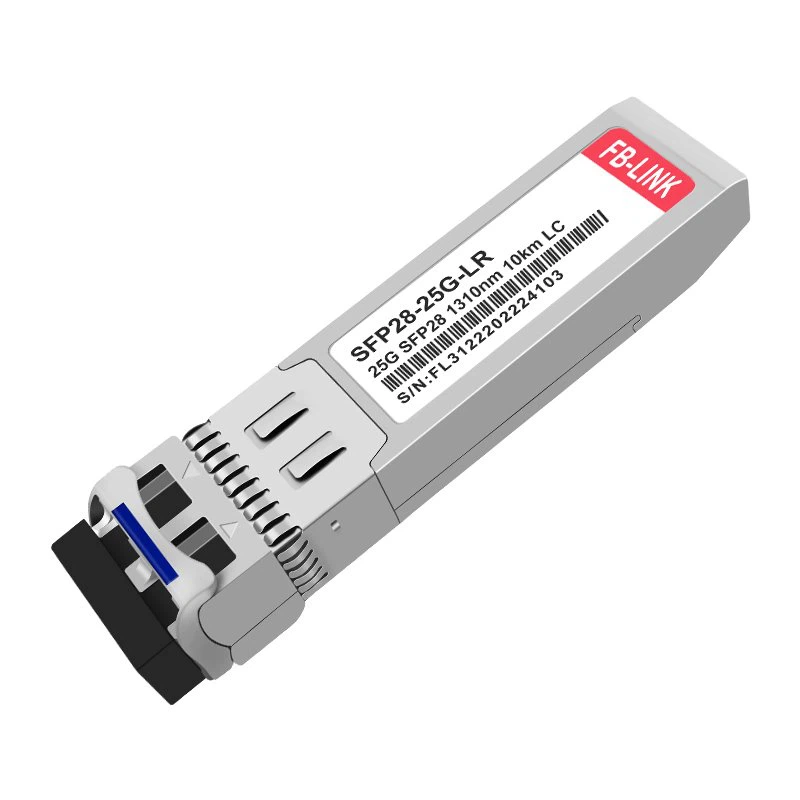

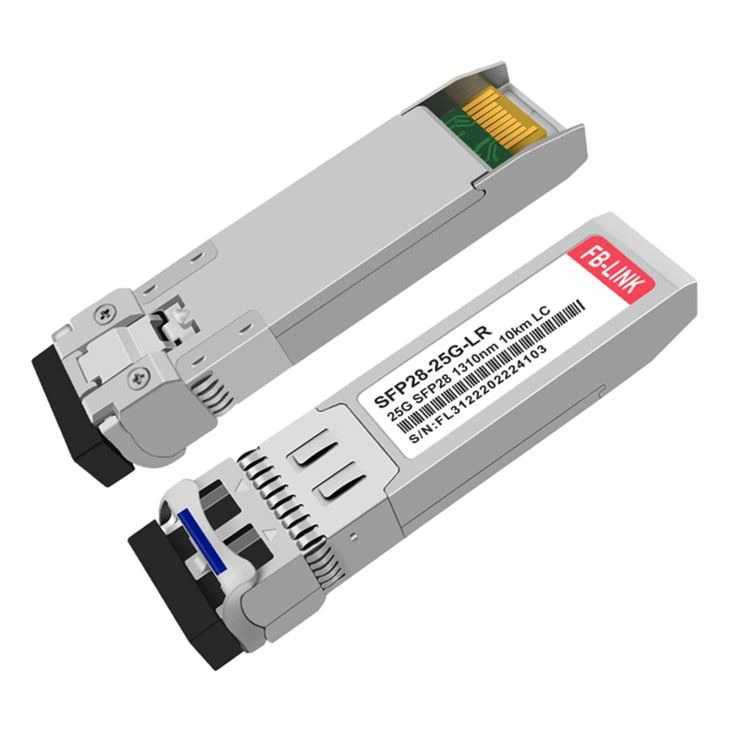
25GBASE SFP28 LR
The 25GBASE SFP28 LR transceiver provides 25GBase-LR throughput up to 10km over single mode fiber (SMF) using a wavelength of 1310nm via an LC duplex connector.
Item Spotlights
● Hot-pluggable SFP28 form factor
● Supports 9.83/10.13/10.31/24.33/25.78Gb/s bit rate
● Power dissipation <1.2W
● Industrial case temperature range of -40°C to 85°C
● Single 3.3V power supply
● Maximum link length of 10km on Single Mode Fiber (SMF)
● Aligned with IEEE 802.3cc
● 25G DFB transmitter and 25G PIN receiver
● Duplex LC receptacles
● I2C management interface
● RoHS compliant

- Product Introduction

Advantages of 25GBASE

Products Description
|
Compatible |
10GBASE SFP28 LR |
Vendor Name |
FB-LINK |
|
Form Factor |
SFP28 |
Max Data Rate |
25.78Gbps |
|
Wavelength |
1310nm |
Max Cable Distance |
10km |
|
Connector |
Duplex LC |
Media |
SMF |
|
Transmitter Type |
DFB 1310nm |
Receiver Type |
PIN |
|
TX Power |
-4.5~2dBm |
Receiver Sensitivity |
<-11.4dBm |
|
Powerbudget |
6.9dB |
Receiver Overload |
2dBm |
|
Power Consumption |
≤1W |
Extinction Ratio |
2dB |
|
DDM/DOM |
Supported |
Commercial Temperature Range |
0 to 70°C (32 to 158°F) |
|
CDR |
TX and RX |
FEC Function |
Supported |
|
Protocols |
MSA Compliant, CPRI, eCPRI |
Warranty |
3 Years |
DDM

Fully compatible

Network infrastructure demands continue to escalate as businesses require faster, more efficient data transmission. Optical transceivers have become the backbone of modern connectivity, with 25G solutions emerging as the sweet spot between performance and cost-effectiveness. Understanding how these components work and their role in your network architecture is essential for making informed purchasing decisions.
Understanding 25G SFP28 Technology
The evolution from 10G to 25G represents more than just a speed upgrade. These optical transceivers utilize advanced single-channel physical layer technology to deliver 25Gbps throughput, effectively providing 2.5 times the capacity of their 10G predecessors. This architectural advantage translates into tangible benefits: lower power consumption per gigabit, higher port density in your switching infrastructure, and reduced total cost of ownership.
What makes this technology particularly compelling is its efficiency. By achieving 50G transmission through dual fiber channels, organizations can bypass the complexity and expense associated with 40G deployments while avoiding the overhead that comes with jumping directly to 100G solutions.
Technical Specifications That Matter
When evaluating optical transceivers for your network, several key parameters determine real-world performance. The LR (Long Reach) variant operates at 1310nm wavelength, enabling transmission distances up to 10 kilometers over single-mode fiber. This makes it ideal for campus networks, metropolitan area connections, and inter-building links within data center complexes.
The duplex LC connector provides reliable physical connectivity, while the hot-swappable design ensures minimal disruption during maintenance or upgrades. Operating at 3.3V with power consumption under 1 watt, these modules minimize both electrical requirements and cooling costs-factors that become significant when deploying hundreds or thousands of ports.
Digital Diagnostic Monitoring (DDM) support deserves special attention. This functionality provides real-time visibility into optical power levels, temperature, voltage, and other critical parameters, enabling proactive maintenance and faster troubleshooting when issues arise.
Deployment Advantages in Modern Networks
Backward compatibility represents one of the most valuable features of these optical transceivers. The auto-negotiation capability means they can communicate with 10G infrastructure, protecting existing investments while providing a migration path forward. This flexibility proves invaluable during phased network upgrades where complete forklift replacements aren't feasible.
Forward compatibility extends this value proposition. As your bandwidth requirements grow, these same modules can participate in 100G configurations through appropriate aggregation strategies, extending their useful lifespan and maximizing return on investment.
The 10-kilometer reach supports diverse topological designs. Whether you're implementing End-of-Row (EoR), Middle-of-Row (MOR), or Top-of-Rack (ToR) architectures, these optical transceivers provide sufficient distance and flexibility. This makes them equally suitable for traditional three-tier designs, modern spine-leaf fabrics, or fat-tree architectures commonly deployed in hyperscale environments.
Standards Compliance and Quality Assurance
Adherence to industry standards ensures interoperability and long-term supportability. Compliance with SFP28 MSA specifications, IEEE 802.3cc 25GBASE-LR Ethernet standards, and CPRI/eCPRI protocols for fronthaul applications guarantees these optical transceivers will integrate seamlessly with equipment from major vendors.
Environmental responsibility factors into quality considerations as well. RoHS compliance means lead-free construction that meets international environmental regulations-increasingly important as corporate sustainability initiatives expand their scope to include IT infrastructure.
The commercial temperature range (0-70°C) covers typical data center and telecom central office environments. For deployments in climate-controlled spaces, this specification provides adequate margin while avoiding the cost premium associated with extended or industrial temperature ratings.
Performance Characteristics
Optical budget calculations determine maximum achievable distance in real-world installations. With transmit power ranging from -4.5 to 2 dBm and receiver sensitivity better than -11.4 dBm, these optical transceivers provide 6.9 dB of power budget. This margin accommodates connector losses, fiber attenuation, and splice losses across the 10-kilometer span while maintaining adequate signal integrity.
The inclusion of Clock and Data Recovery (CDR) circuitry on both transmit and receive paths ensures signal quality even in challenging electrical environments. Forward Error Correction (FEC) support further enhances reliability, detecting and correcting bit errors that would otherwise require retransmission at higher protocol layers.
Integration Considerations
Successful deployment of optical transceivers requires attention to several practical factors. Fiber cleanliness dramatically impacts performance-contaminated connectors account for a significant percentage of "defective" module returns. Implementing proper cleaning protocols and using inspection microscopes during installation prevents many common issues.
Cable management might seem mundane, but proper bend radius control prevents fiber stress that degrades optical performance over time. Minimum bend radius specifications exist for good reason, and violating them-even temporarily during installation-can cause permanent damage.
Switch configuration deserves consideration as well. While most modern equipment auto-detects module types and configures ports appropriately, verifying settings after installation ensures optimal operation. Some platforms require explicit commands to enable certain features like FEC or specific speed modes.
Cost-Benefit Analysis
Evaluating optical transceivers purely on unit price misses the bigger picture. Total cost considerations include power consumption, cooling requirements, port density implications, and operational factors like sparing strategies and mean time to repair.
The 25G sweet spot becomes apparent when modeling these factors. Compared to 10G deployments, you gain 2.5x bandwidth per port without proportional increases in power, space, or cooling. Compared to 40G or 100G options, you reduce both capital and operational expenses while still meeting capacity requirements for many applications.
Quality and Reliability Standards
Three-year warranty coverage reflects manufacturer confidence in product reliability. However, warranty terms alone don't tell the complete story. Manufacturing quality control processes, component sourcing practices, and pre-shipment testing protocols all influence field reliability.
Look for optical transceivers that undergo comprehensive testing including thermal cycling, vibration exposure, and long-term burn-in. These quality assurance measures identify infant mortality failures before modules ship, improving the reliability of your initial deployment and reducing early-life failures that disrupt operations.
Frequently Asked Questions
What distinguishes LR optical transceivers from SR variants?
LR (Long Reach) modules use 1310nm wavelength lasers optimized for single-mode fiber, achieving 10km distances. SR (Short Reach) versions operate at 850nm over multimode fiber with typical ranges of 100 meters. Choose based on your distance requirements and existing fiber infrastructure.
How does port density compare when using 25G versus 10G optical transceivers?
While the physical SFP28 form factor matches SFP+, the bandwidth increase means you need fewer ports to achieve target aggregate capacity. This translates to fewer switch units, reduced rack space, lower power consumption, and simplified cabling-especially valuable in space-constrained environments.
Can these modules operate in existing 10G networks?
Yes, through auto-negotiation. When connected to 10G equipment, optical transceivers capable of 25G operation will detect the lower speed and adjust accordingly. This provides seamless backward compatibility during migration scenarios where mixed-speed environments temporarily exist.
What role does FEC play in optical transceiver performance?
Forward Error Correction adds computational overhead but dramatically improves bit error rates by detecting and correcting transmission errors without requiring retransmission. For longer distances or higher speeds, FEC becomes increasingly important for maintaining acceptable error performance.
How do I verify optical transceivers are functioning correctly after installation?
Use DDM functionality to check transmit and receive optical power levels fall within specification. Compare these values against datasheet parameters and verify they remain stable over time. Significant deviation or rapid changes indicate potential issues requiring investigation.
What maintenance do optical transceivers require?
Minimal active maintenance is required, but periodic monitoring of DDM parameters helps identify degradation before failures occur. Keep spare modules on hand for critical links. Ensure adequate cooling and maintain clean operating environments to maximize lifespan.
Are third-party optical transceivers compatible with major switch vendors?
Standard-compliant modules from reputable manufacturers generally work across vendors. However, some equipment requires specific coding or memory map configurations for full functionality. Verify compatibility for your specific switch models, particularly regarding advanced features.
How does 25G technology fit into 100G migration strategies?
Four 25G channels aggregate to 100G, providing a natural migration path. You can start with 25G server connections and spine uplinks, then transition to native 100G as requirements grow. This staged approach distributes capital expenditure and aligns spending with actual capacity needs.
What's the difference between QSFP28 and SFP28 optical transceivers?
QSFP28 modules provide 100G through four 25G lanes in a larger form factor. SFP28 delivers single-lane 25G in the compact SFP form factor. Breakout cables allow connecting one QSFP28 port to four SFP28 ports, providing deployment flexibility.
How do environmental factors affect optical transceiver performance?
Temperature extremes, humidity, dust, and vibration all impact reliability. Operating within specified temperature ranges ensures consistent performance. In harsh environments, consider modules rated for extended temperature ranges or implement environmental controls to protect sensitive optical components.
Making the Right Choice
Selecting appropriate optical transceivers involves balancing multiple factors: bandwidth requirements, distance constraints, existing infrastructure, budget parameters, and future growth projections. The 25G LR solution occupies a strategic position in this landscape, offering compelling economics for many deployment scenarios.
Consider not just immediate needs but how your network will evolve. The flexibility these optical transceivers provide-working with legacy 10G equipment while enabling future 100G scaling-makes them a prudent choice for organizations that value both performance and investment protection.
As network demands continue accelerating, having infrastructure components that deliver reliable high-speed connectivity becomes increasingly critical. Whether supporting cloud applications, storage networks, or telecommunications infrastructure, choosing quality optical transceivers ensures your network foundation can support business requirements both today and tomorrow.
Hot Tags:
You Might Also Like


