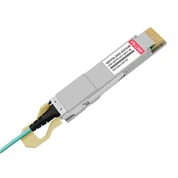
25GBASE BIDI SFP28
25GBASE BIDI SFP28 transceiver modules are designed for use in wireless front-haul links on up to 10km of single mode fiber.

- Product Introduction
Item Spotlights
● Hot-pluggable SFP28 form factor
● Supports 9.83/10.13/10.31/24.33/25.78Gb/s bit rate
● Power dissipation <1.2W
● Industrial case temperature range of -40°C to 85°C
● Single 3.3V power supply
● Maximum link length of 10km on Single Mode Fiber (SMF)
● Aligned with IEEE 802.3cc
● 25G DFB transmitter and 25G PIN receiver
● Single LC receptacles
● I2C management interface
● RoHS compliant
Description
|
Compatible |
25GBASE BIDI SFP28 |
Vendor Name |
FB-LINK |
|
Form Factor |
SFP28 |
Max Data Rate |
25.78Gbps |
|
Wavelength |
1270/1330nm |
Max Cable Distance |
10km |
|
Connector |
Duplex LC |
Media |
SMF |
|
Transmitter Type |
DFB BIDI |
Receiver Type |
PIN |
|
TX Power |
-2~4dBm |
Receiver Sensitivity |
<-13dBm |
|
Powerbudget |
11dB |
Receiver Overload |
2dBm |
|
Power Consumption |
≤1W |
Extinction Ratio |
3.5dB |
|
DDM/DOM |
Supported |
Commercial Temperature Range |
0 to 70°C (32 to 158°F) |
|
CDR |
TX and RX |
FEC Function |
Not Supported |
|
Protocols |
MSA Compliant, CPRI, eCPRI |
Warranty |
3 Years |

The evolution of network infrastructure demands cutting-edge technology that can handle increasing bandwidth requirements while maintaining cost-efficiency. Optical transceivers have become the backbone of modern data transmission, enabling seamless connectivity across various applications. Among these advanced solutions, the 25Gb/s bidirectional SFP28 transceiver stands out as a revolutionary component that's transforming how we approach network design.
Understanding Bidirectional Technology in Modern Networks
Optical transceivers utilizing bidirectional technology represent a significant leap forward in network efficiency. Unlike traditional transceivers that require two fiber strands for transmission and reception, BIDI modules accomplish both functions over a single fiber strand. This innovative approach uses different wavelengths-specifically 1270nm and 1330nm-to transmit and receive data simultaneously, effectively doubling your fiber infrastructure's capacity without additional cabling costs.
This wavelength division multiplexing (WDM) technology makes BIDI transceivers particularly attractive for organizations looking to maximize their existing fiber infrastructure. Whether you're upgrading legacy systems or building new networks, the ability to achieve high-speed connectivity while using half the fiber resources translates to substantial cost savings in both materials and installation labor.
Key Applications Across Industries
The versatility of advanced optical transceivers makes them indispensable across multiple sectors. Wireless front-haul networks benefit tremendously from these modules, as they provide the high-bandwidth, low-latency connections essential for 5G infrastructure. Telecommunications providers rely on this technology to deliver consistent performance across metropolitan and access networks.
Data centers represent another critical application area. As cloud computing and virtualization continue to expand, the demand for reliable, high-speed interconnects between servers, switches, and storage systems grows exponentially. The hot-pluggable design allows for seamless maintenance and upgrades without network downtime, a crucial feature for mission-critical operations.
Enterprise networks are increasingly adopting 25G technology to future-proof their infrastructure. The support for multiple bit rates provides flexibility for various network architectures, ensuring compatibility with existing equipment while enabling smooth migration paths to higher speeds.
Technical Advantages That Set This Technology Apart
Modern optical transceivers incorporate sophisticated features that ensure optimal performance under demanding conditions. The industrial temperature range capability makes these modules suitable for deployment in challenging environments, from outdoor wireless installations to temperature-controlled data center environments. This reliability is backed by comprehensive digital diagnostics and monitoring capabilities, allowing network administrators to proactively manage and troubleshoot their infrastructure.
Power efficiency is another compelling advantage. With consumption under 1.2 watts, these modules help reduce overall energy costs and cooling requirements-considerations that become increasingly important at scale. The single 3.3V power supply simplifies power distribution and reduces the complexity of supporting infrastructure.
The integration of clock and data recovery (CDR) circuits on both transmit and receive paths ensures signal integrity across the entire link distance. This feature is particularly valuable in maintaining reliable connections in environments with electromagnetic interference or when dealing with longer fiber runs approaching the maximum distance specification.
Compliance and Standards: Ensuring Interoperability
One of the most critical aspects of optical transceivers is their adherence to industry standards. Compliance with SFP28 Multi-Source Agreement (MSA) specifications guarantees physical and electrical interoperability with equipment from various manufacturers. This standardization protects your investment by preventing vendor lock-in and ensuring you have multiple sourcing options.
Support for CPRI and eCPRI protocols makes these modules particularly relevant for radio access network (RAN) applications. As mobile networks evolve toward more distributed and flexible architectures, having optical transceivers that support these fronthaul protocols becomes essential for building future-ready wireless infrastructure.
The alignment with IEEE 802.3cc standards ensures compatibility with 25 Gigabit Ethernet equipment, providing seamless integration into existing network ecosystems. RoHS compliance demonstrates environmental responsibility, an increasingly important consideration for organizations with sustainability mandates.
Performance Parameters That Matter
When selecting optical transceivers, understanding the performance specifications helps ensure the right fit for your application. The power budget of 11dB provides sufficient margin for typical installations, accounting for fiber loss, splice losses, and connector losses while maintaining reliable operation. The receiver sensitivity and transmitter power specifications ensure consistent performance across varying environmental conditions.
The extinction ratio specification indicates the quality of the optical signal, which directly impacts bit error rates and overall link reliability. Higher extinction ratios typically result in better performance, particularly over longer distances or in systems with multiple optical components.
Digital diagnostics and monitoring (DDM) support allows real-time tracking of critical parameters including temperature, supply voltage, transmit power, and receive power. This visibility enables proactive maintenance strategies and helps identify potential issues before they impact network performance.
Installation and Deployment Considerations
Deploying optical transceivers successfully requires attention to several factors. Proper fiber cleanliness is paramount-even microscopic contamination can significantly impact performance or cause permanent damage. Using appropriate cleaning procedures and inspection tools before installation helps ensure optimal link performance from day one.
Understanding the complementary wavelength pairing is crucial for BIDI applications. Each transceiver must be paired with a counterpart using the opposite wavelength configuration. This means a 1270nm TX/1330nm RX module must connect to a 1330nm TX/1270nm RX module at the other end of the fiber link.
Cable management practices should account for minimum bend radius requirements to prevent fiber damage and signal degradation. While single-mode fiber is robust, excessive bending can introduce losses that compromise link budget margins.
Cost-Benefit Analysis for Network Upgrades
Investing in advanced optical transceivers delivers compelling return on investment through multiple channels. The reduction in fiber infrastructure requirements-using one fiber instead of two-cuts material costs significantly, particularly over longer distances where fiber represents a substantial portion of total project expenses.
Installation time decreases proportionally, as fewer fibers need to be spliced, tested, and documented. This labor savings becomes especially significant in large-scale deployments or retrofit scenarios where conduit space is limited.
The hot-pluggable nature eliminates the need for network downtime during maintenance or upgrades, preserving business continuity and avoiding the costs associated with service interruptions. This feature alone can justify the investment for organizations where network availability directly impacts revenue.
Energy efficiency translates to operational savings that accumulate over the module's lifespan. When multiplied across hundreds or thousands of ports in a large network, the reduced power consumption and associated cooling requirements contribute meaningfully to total cost of ownership.
Future-Proofing Your Network Infrastructure
As network demands continue escalating, selecting optical transceivers that support multiple bit rates provides valuable flexibility. The ability to operate at various speeds allows networks to evolve gradually, matching capacity increases to actual demand rather than requiring wholesale infrastructure replacement.
The proven reliability of this technology, backed by comprehensive warranty coverage, ensures that your investment will deliver consistent performance for years to come. As 25G becomes the new baseline for high-performance networking, having infrastructure that supports these speeds positions organizations to take advantage of emerging applications and services.
Frequently Asked Questions
What is the main advantage of BIDI optical transceivers compared to standard modules?
BIDI technology allows transmission and reception over a single fiber strand using different wavelengths, effectively doubling your fiber infrastructure's capacity. This reduces fiber costs, simplifies cable management, and is particularly valuable when conduit space is limited or when retrofitting existing installations.
Can these modules work with existing 10G infrastructure?
While these transceivers are designed for 25G operation, they support multiple bit rates. However, both ends of the connection must use compatible speeds and wavelengths. Upgrading from 10G typically requires replacing transceivers at both ends of each link, though the existing fiber infrastructure can usually be reused if it meets quality standards.
What distance limitations should I consider for my deployment?
These modules support links up to 10 kilometers on single-mode fiber. The actual achievable distance depends on fiber quality, number of connectors and splices, and overall link loss budget. For distances approaching the maximum specification, professional fiber testing is recommended to ensure adequate margin.
How do I know if two BIDI transceivers are compatible with each other?
BIDI transceivers must use complementary wavelength pairs. A module transmitting at 1270nm and receiving at 1330nm must connect to a module transmitting at 1330nm and receiving at 1270nm. Always verify wavelength specifications before installation to ensure proper pairing.
What maintenance is required for optical transceivers?
Regular monitoring through digital diagnostics interfaces helps identify degrading performance before failures occur. Physical inspection of connectors should be performed periodically, with cleaning as needed. The modules themselves require no internal maintenance, but ensuring adequate cooling and clean operating environments extends their operational life.
Are these transceivers suitable for outdoor installations?
The industrial temperature range capability makes them suitable for outdoor environments within appropriate enclosures. However, protective housing must shield the modules from direct environmental exposure while providing adequate ventilation. Always consult deployment guidelines for specific installation scenarios.
What should I do if link performance is below expectations?
Start by checking digital diagnostic data for transmit power, receive power, and temperature readings. Inspect and clean all fiber connectors, verify correct wavelength pairing, and test fiber link loss with an optical power meter and light source. If issues persist, professional fiber certification may reveal problems with splices or fiber quality.
How does this technology support wireless fronthaul applications?
The support for CPRI and eCPRI protocols makes these optical transceivers ideal for connecting remote radio units to baseband processing equipment. The low latency and high bandwidth meet the stringent requirements of modern wireless networks, particularly for 5G deployments where fronthaul capacity is critical.
Hot Tags:
You Might Also Like