





Can a transceiver can both send and receive information?
 Oct 29, 2025|
Yes, a transceiver can both send and receive information. The term "transceiver" combines "transmitter" and "receiver," describing a device that integrates both functions into a single unit. This bidirectional capability allows transceivers to handle two-way communication across various mediums, including radio waves, optical fiber cables, and ethernet networks.
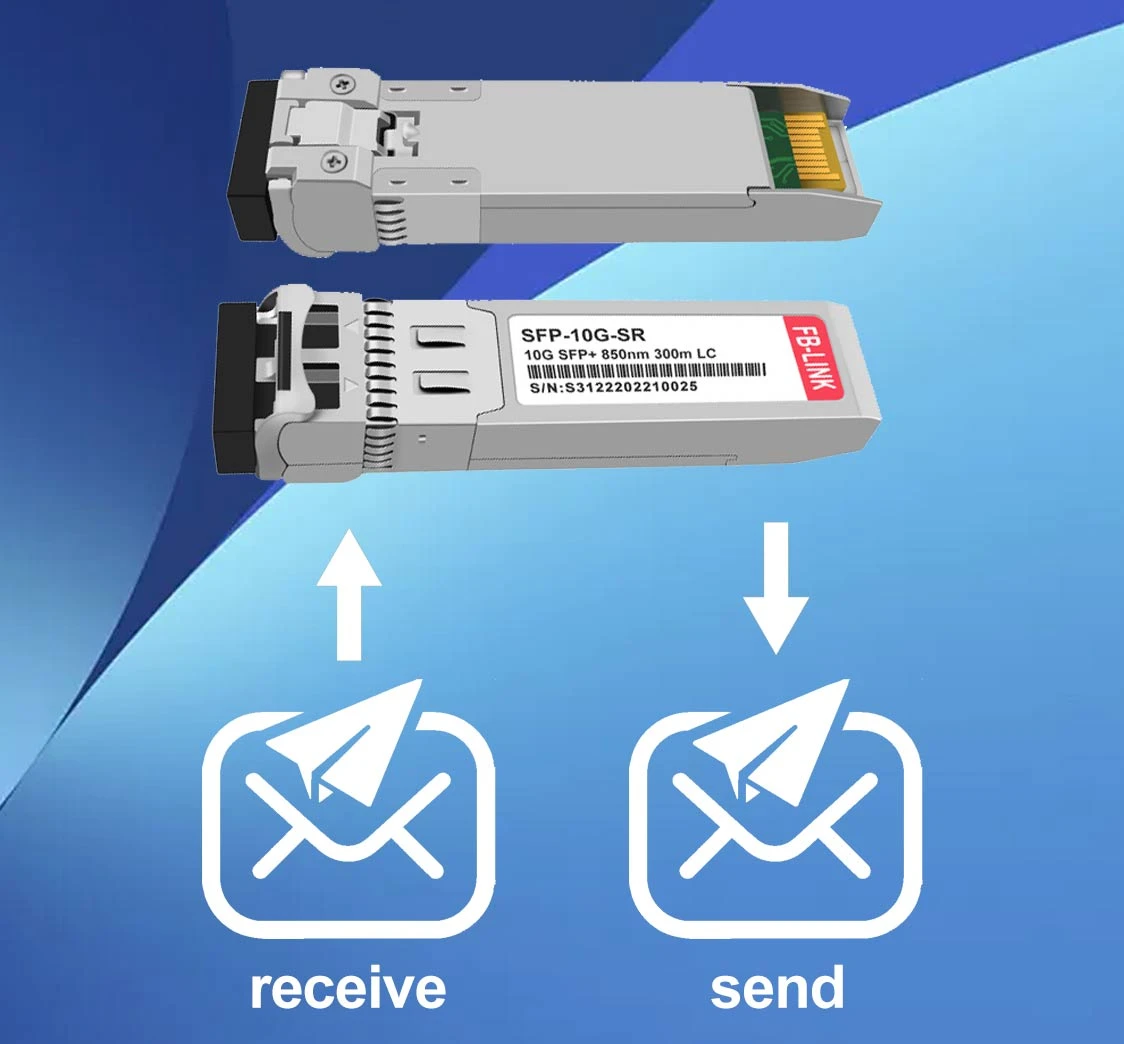
How Transceivers Enable Bidirectional Communication
The fundamental principle that a transceiver can both send and receive information comes from its integrated circuitry that switches between transmission and reception modes. The device contains both transmitting components (such as laser diodes, LEDs, or RF generators) and receiving components (like photodiodes or RF detectors) within the same housing.
When transmitting, a transceiver converts electrical signals into the appropriate output format-whether radio frequencies, light pulses, or modulated electrical signals. The transmitter section generates, modulates, and amplifies the signal before sending it through the communication channel. During reception, the process reverses: incoming signals are detected, demodulated, and converted back into electrical signals that connected devices can process.
The operational efficiency depends on whether it operates in half-duplex or full-duplex mode. Half-duplex transceivers can either send or receive at any given moment, but not both simultaneously. They use an electronic switch to alternate between modes, connecting both functions to a single antenna or communication channel. Walkie-talkies and certain radio systems exemplify this approach.
Full-duplex transceivers, by contrast, demonstrate how a transceiver can both send and receive information at the same time. They accomplish this by operating the transmitter and receiver on different frequencies or using separate physical channels. Cell phones operate in full-duplex mode, allowing both parties in a conversation to speak simultaneously. Network transceivers in data centers typically employ full-duplex operation over separate twisted-pair cables or optical fibers for each direction.
Technical Architecture Across Transceiver Types
Different applications require specialized transceiver architectures. The optical transceiver market, valued at $13.57 billion in 2025, is projected to reach $25.74 billion by 2030, reflecting a compound annual growth rate of 13.66% as data centers upgrade to support AI infrastructure and higher bandwidth demands.
Radio frequency transceivers convert intermediate frequencies to radio frequencies, enabling wireless voice and data transmission. These devices integrate power amplifiers for transmission and low-noise amplifiers for reception. RF transceivers power everything from satellite communications to consumer devices like cordless phones.
Optical transceivers perform a more complex conversion process. During transmission, they convert electrical signals into light pulses using laser diodes or LEDs. The light travels through fiber optic cable at speeds approaching 299,792 kilometers per second. At the receiving end, photodiodes detect incoming light and generate electrical current proportional to the signal intensity. Modern optical transceivers support data rates exceeding 800 Gbps, with demand for 400G and 800G modules driving 27% revenue growth in the transceiver market during 2024.
Ethernet transceivers, also called Media Access Units, connect electronic devices within local area networks. They handle collision detection, digital signal processing, and network access control. These transceivers follow IEEE 802.3 standards and provide the physical layer interface for network communications.
Wireless transceivers blend RF and ethernet capabilities to enable Wi-Fi and Bluetooth communications. They manage frequency hopping, channel selection, and protocol handling while maintaining compatibility with various wireless standards. The proliferation of connected devices-with 5G networks alone expected to connect billions of devices-has intensified demand for efficient wireless transceivers.
Duplex Modes: Understanding Simultaneous vs Sequential Operation
The distinction between half-duplex and full-duplex operation fundamentally shapes how effectively a transceiver can both send and receive information in different scenarios.
Half-duplex operation imposes a sequential communication pattern. Because the transmitter and receiver share the same antenna or channel through an electronic switch, only one function can be active at a time. When a device transmits, its receiver is disabled to prevent the transmitted signal from overwhelming incoming signals. Ham radios, walkie-talkies, and many single-frequency radio systems employ half-duplex operation because it reduces hardware complexity and cost.
The constraint becomes apparent in real-time applications. Users must coordinate their communication, often using phrases like "over" to signal when they've finished transmitting. However, half-duplex systems excel in scenarios where immediate two-way conversation isn't required or where spectrum efficiency matters more than conversation flow.
Full-duplex transceivers eliminate this constraint by separating transmit and receive functions. Frequency Division Duplexing (FDD) assigns different carrier frequencies to each direction. A cellular phone might transmit on 825-845 MHz while receiving on 870-890 MHz, maintaining sufficient frequency separation to prevent interference. This separation allows both functions to operate continuously without mutual interference.
Time Division Duplexing (TDD) takes a different approach, rapidly alternating between transmission and reception on the same frequency. The switching occurs fast enough that users experience apparently simultaneous communication. TDD systems dynamically allocate time slots based on traffic demand-if more data needs to flow in one direction, the system assigns more time slots to that direction.
Full-duplex Ethernet achieves bidirectional communication through physical separation. Modern Ethernet connections use two twisted pairs or two optical fibers, with one dedicated to sending and the other to receiving. This arrangement doubles the effective bandwidth and eliminates collisions, significantly improving network performance compared to half-duplex configurations.
Performance Implications in Modern Networks
Understanding that a transceiver can both send and receive information simultaneously carries measurable performance implications. Full-duplex operation effectively doubles network capacity by allowing concurrent data flow in both directions. A 1 Gbps full-duplex connection provides 1 Gbps in each direction simultaneously, for a total theoretical throughput of 2 Gbps.
Data centers have overwhelmingly adopted full-duplex transceivers because latency-sensitive applications cannot tolerate half-duplex delays. AI training clusters connecting tens of thousands of GPUs require lossless, full-duplex fabrics to maintain training efficiency. A study of data center operations found that full-duplex communication reduces frame retransmissions by eliminating collisions, cutting latency by 40-60% compared to half-duplex configurations in high-traffic scenarios.
The shift toward higher data rates is accelerating. Hyperscale cloud providers like Google, Amazon, and Microsoft drove a surge in 800G transceiver demand starting in March 2023. These transceivers enable data centers to handle increasing AI workloads and cloud traffic. The optical transceiver market saw shipments of modules operating at 400 Gbps and above increase 60% in 2024 alone, with 800G deployments expanding rapidly.
Power consumption becomes a critical factor at these speeds. While transceivers enable high-speed bidirectional communication, they're typically the most power-consuming component in wireless systems-often using ten times more power than microcontrollers or sensors. Receiving signals consumes nearly as much power as transmitting them, which has driven development of duty cycling mechanisms that switch radios off during idle periods while maintaining network connectivity.

Application Domains and Real-World Use Cases
The fact that a transceiver can both send and receive information enables entire categories of modern technology.
Telecommunications infrastructure depends on transceivers at every level. Cell towers contain base station transceivers that simultaneously handle thousands of connections. The 2024 rollout of 5G networks required deployment of new transceiver technology capable of operating across wider frequency ranges and supporting enhanced data rates. Each cell phone contains multiple transceivers-cellular, Wi-Fi, Bluetooth, and sometimes NFC-all capable of bidirectional communication.
Data centers commanded 61% of optical transceiver revenue in 2024, growing at 14.87% annually through 2030. Within these facilities, transceivers connect switches to servers, enable storage area networks, and link multiple data center locations. A typical hyperscale data center might contain hundreds of thousands of transceivers managing petabytes of data movement daily.
Industrial automation increasingly relies on transceiver technology. Smart factory systems use ruggedized transceivers to connect sensors, actuators, and control systems across manufacturing environments. Transportation systems employ transceivers in vehicle-to-vehicle communication, traffic management, and railway signaling. These applications require transceivers that can reliably send status updates while simultaneously receiving control commands.
Satellite communications presents unique transceiver challenges. Ground stations must transmit signals to satellites while receiving downlinks, often with vastly different power levels. Satellite transceivers must handle Doppler shift from orbital motion, compensate for propagation delays, and maintain lock despite atmospheric interference. The ability to simultaneously transmit telemetry while receiving commands keeps satellites operational and responsive.
Consumer electronics incorporates transceivers throughout. Your laptop's Wi-Fi adapter is a transceiver managing bidirectional internet traffic. Wireless earbuds contain Bluetooth transceivers maintaining audio streams in both directions for calls. Smart home devices use various transceiver types-Z-Wave, Zigbee, or Wi-Fi-to send sensor data while receiving commands from automation systems.
The Evolution Toward Higher Integration
Transceiver technology continues evolving toward greater integration and capability. Silicon photonics is emerging as a transformative approach for optical transceivers. By integrating photonic components with CMOS electronics on the same chip, silicon photonics offers lower costs, higher performance, and better scalability than traditional approaches. This technology enables 800 Gbps and 1.6 Tbps transceivers that data centers need for AI and machine learning workloads.
Co-packaged optics (CPO) represents the next integration step. Rather than using pluggable transceivers, CPO embeds optical components directly into switch packaging. This tighter integration reduces power consumption by 30-40% and latency by eliminating electrical-to-optical conversions at pluggable interfaces. Multiple vendors demonstrated CPO systems in 2024, with volume production beginning in 2025.
Linear Drive Pluggable optics (LPO) takes a different approach, removing digital signal processing and clock-data recovery from transceivers and pushing these functions into switch chips. This simplification reduces transceiver power consumption and cost while maintaining performance for data center applications. LPO particularly suits switch-to-switch, switch-to-server, and GPU-to-GPU connections in machine learning clusters.
The transceiver industry is standardizing around higher lane rates. Early systems used 10G lanes; current systems employ 25G and 50G lanes; emerging systems are implementing 100G and 200G per-lane technologies. These faster lanes allow transceivers to achieve higher aggregate speeds without increasing physical connector density. An 800G transceiver using eight 100G lanes occupies the same footprint as older 400G transceivers using eight 50G lanes.
Selecting the Right Transceiver Configuration
Choosing whether a transceiver can both send and receive information simultaneously or sequentially depends on application requirements and constraints.
Budget-conscious applications with asymmetric traffic patterns often benefit from half-duplex configurations. If data flows primarily in one direction with occasional acknowledgments, half-duplex operation provides adequate performance at lower cost. Simple control systems, remote monitoring, and point-to-multipoint broadcasts exemplify scenarios where half-duplex suffices.
Applications requiring real-time interaction demand full-duplex capability. Voice over IP systems, video conferencing, and interactive gaming cannot tolerate the turn-taking delay that half-duplex imposes. Network backbone connections and data center fabrics similarly require full-duplex to maximize throughput and minimize latency.
Distance considerations affect transceiver selection. Optical transceivers come in reach categories-short reach (up to 100 meters), medium reach (10-40 kilometers), and long reach (beyond 40 kilometers). Short-reach multimode transceivers cost less but work only within buildings. Long-reach single-mode transceivers enable metro area connections and data center interconnects but cost significantly more.
Form factor compatibility matters in existing infrastructure. The industry has standardized on SFP, SFP+, QSFP28, QSFP-DD, and OSFP form factors, each supporting different data rates and connector densities. A 400G upgrade might use QSFP-DD transceivers in existing QSFP ports for backward compatibility, or OSFP transceivers if maximum density matters more than legacy support.
Environmental conditions influence transceiver specifications. Industrial transceivers withstand wider temperature ranges, vibration, and electromagnetic interference. Consumer-grade transceivers optimize for lower cost in controlled environments. Military and aerospace applications require specialized transceivers meeting stringent reliability and security requirements.
Frequently Asked Questions
Can transceivers send and receive on different frequencies simultaneously?
Yes, full-duplex transceivers commonly use different frequencies for transmission and reception, a technique called Frequency Division Duplexing. This separation-typically 20-45 MHz in cellular systems-prevents the transmitted signal from interfering with incoming signals. The transceiver includes filters that isolate each frequency band, allowing simultaneous operation without cross-interference.
What's the actual speed difference between half-duplex and full-duplex transceivers?
Full-duplex operation doubles effective bandwidth by enabling simultaneous bidirectional data flow. A 1 Gbps full-duplex link provides 1 Gbps in each direction for 2 Gbps total capacity, while the same link in half-duplex mode must share that 1 Gbps between both directions. Beyond raw bandwidth, full-duplex eliminates collisions and retransmissions, reducing latency by 40-60% in congested networks.
Do all modern cell phones use full-duplex transceivers?
Yes, cellular phones employ full-duplex transceivers that allow both parties to speak simultaneously. The phone uses FDD to separate uplink and downlink frequencies, maintaining independent transmit and receive channels. This full-duplex capability extends across cellular, Wi-Fi, and Bluetooth connections, though Wi-Fi actually uses rapid half-duplex switching that appears full-duplex to users.
How do optical transceivers convert between electrical and light signals?
During transmission, a transceiver applies electrical current to a laser diode or LED, causing it to emit light. Modulation circuits vary the light intensity to encode digital information. At the receiving end, a photodiode absorbs incoming light photons, liberating electrons that create electrical current proportional to the light intensity. Signal processing circuits then recover the digital data from this current.
Key Takeaways
A transceiver can both send and receive information by integrating transmitter and receiver functions into a single device
Half-duplex transceivers alternate between sending and receiving, while full-duplex transceivers operate simultaneously in both directions
Full-duplex operation doubles effective bandwidth and reduces latency by eliminating collisions
The optical transceiver market is growing at 13.66% annually, reaching $25.74 billion by 2030, driven by data center expansion and AI infrastructure
Modern transceivers support data rates exceeding 800 Gbps, with 100G and 200G per-lane technologies enabling next-generation networks
Data Sources
Mordor Intelligence - Optical Transceiver Market Analysis 2025-2030
Yole Group - Optical Transceivers for Datacom and Telecom 2024
Wikipedia - Transceiver and Duplex Telecommunications
TechTarget - Transceiver Definition and Full-Duplex Transmission
Fortune Business Insights - Optical Transceiver Market Research 2024
McKinsey & Company - Opportunities in Networking Optics 2025