





Transceiver usage improves network performance
 Nov 05, 2025|
Transceiver usage improves network performance by reducing latency, increasing bandwidth efficiency, and enabling faster data transmission speeds. Modern optical transceivers can cut data transmission delays to as low as 3 nanoseconds while supporting speeds up to 800 Gbps and beyond.
The performance gains stem from how transceiver usage handles signal conversion. By transforming electrical signals into optical pulses, fiber optic transceivers bypass the physical limitations of copper-based systems. Light travels through fiber at approximately 200,000 kilometers per second, creating minimal latency of about 5 microseconds per kilometer compared to the inherent delays in electrical transmission.
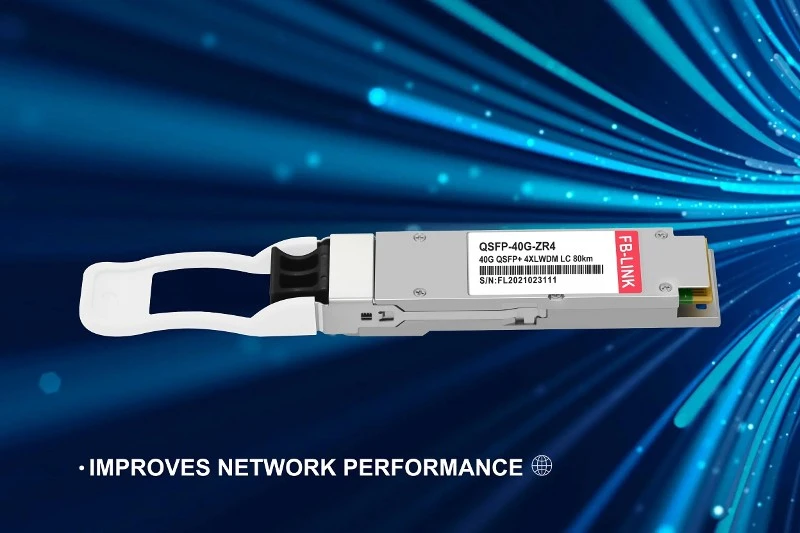
How Transceivers Reduce Network Latency
Network latency directly impacts user experience and application performance. Every millisecond matters when handling real-time applications like high-frequency trading, video conferencing, or cloud computing workloads.
Traditional copper-based networks face inherent delays from electrical signal propagation and processing overhead. Strategic transceiver usage eliminates many of these bottlenecks through optical transmission. For standard 10G transceivers, typical latency measures just 3 nanoseconds from transmitter input to receiver output. This represents a fraction of the delay introduced by conventional network equipment.
Low-latency transceivers achieve even better results by removing forward error correction (FEC) processing. While FEC improves signal reliability, it adds up to 100 nanoseconds of latency to each transmission. For latency-sensitive applications, transceivers with CDR (clock and data recovery) bypass functions can reduce this overhead significantly.
The fiber medium itself contributes to lower latency. Single-mode optical fiber with a refractive index of 1.4682 creates approximately 5 microseconds of latency per kilometer. While this seems minor, it becomes substantial across metropolitan or campus networks. More importantly, fiber avoids the signal degradation issues that plague copper cables, maintaining consistent low-latency performance over longer distances.
Data centers deploying 400G and 800G transceivers for AI workloads prioritize latency reduction. These systems require consistent data flow between thousands of GPUs processing parallel computations. Even microsecond-level delays can cascade into significant performance degradation. AI cluster servers, such as the NVIDIA DGX H100 system equipped with four 400G ports, depend on ultra-low latency transceivers to maintain job completion times within acceptable parameters.
Bandwidth Optimization Through Transceiver Technology
Network bandwidth represents the theoretical maximum data transfer capacity, while throughput measures actual data successfully transmitted. Effective transceiver usage bridges the gap between these metrics through efficient signal modulation and transmission techniques.
Modern transceivers employ advanced modulation schemes to maximize bandwidth utilization. PAM4 (four-level pulse amplitude modulation) signaling doubles the data rate per electrical lane compared to traditional NRZ (non-return-to-zero) encoding. This allows 400G transceivers to operate over existing infrastructure designed for lower speeds, effectively doubling bandwidth efficiency without complete network replacement.
Coherent optical transceivers take bandwidth optimization further by utilizing both the amplitude and phase of light waves. Quadrature Amplitude Modulation (QAM) schemes encode multiple bits per symbol, dramatically increasing the volume of information transmitted through a single channel. This spectral efficiency enables long-distance transmission at 400G and 800G speeds over existing fiber infrastructure.
The global optical transceiver market reflects this demand for higher bandwidth, projected to exceed $10 billion annually by 2026. Organizations are upgrading from 100G to 400G and 800G variants to accommodate exploding data volumes. The transition addresses a critical challenge: data center traffic continues growing at roughly 25% annually while physical space and power budgets remain constrained.
Multiplexing technologies within transceivers also optimize bandwidth usage. Dense Wavelength Division Multiplexing (DWDM) allows multiple optical channels to coexist on a single fiber strand, each carrying independent data streams at different wavelengths. A single fiber pair using DWDM can transport terabits of aggregate bandwidth, making it possible to serve growing bandwidth demands without constantly deploying new fiber infrastructure.
Optimal transceiver usage impacts overall network bandwidth utilization. Hot-swappable modules like QSFP28, QSFP-DD, and OSFP form factors provide flexibility as bandwidth requirements evolve. Organizations can upgrade individual transceivers without replacing entire network devices, allowing gradual migration from 100G to 400G infrastructure as budget and requirements dictate.
Throughput Improvements in Data Center Networks
Throughput measures actual data successfully transmitted across the network, accounting for real-world conditions like congestion, packet loss, and retransmissions. Proper transceiver usage directly influences throughput through capacity, reliability, and compatibility with modern network architectures.
High-speed transceivers enable data centers to handle massive parallel workloads. A single 400G transceiver can support the bandwidth equivalent of four 100G links, but with lower overall latency and power consumption. For data centers running AI training workloads, this translates to faster model training times and improved resource utilization.
Real throughput gains depend on proper transceiver selection for specific use cases. Short-reach (SR) transceivers optimized for multimode fiber deliver peak performance up to 100 meters, ideal for intra-data center connections. Long-reach (LR) variants extend this capability to 10 kilometers or more for campus networks and data center interconnects, maintaining high throughput across longer distances.
The Data Center Optical Transceiver market has experienced significant growth, valued at approximately $1.87 billion in 2024. This growth reflects the critical role transceivers play in enabling high-throughput networks necessary for cloud services, enterprise applications, and large-scale data processing.
Network architecture affects how transceiver usage impacts throughput. Leaf-spine architectures commonly deployed in modern data centers benefit from high-density transceiver deployments. Each leaf switch connects to every spine switch through high-speed optical links, creating multiple parallel paths for data flow. This design minimizes hop counts and eliminates bottlenecks, allowing transceivers to operate at maximum throughput capacity.
Linear Pluggable Optics (LPO) transceivers represent an emerging approach to maximize throughput while reducing power consumption. By eliminating power-hungry digital signal processors and relying on host switch ASICs for signal conditioning, LPO modules achieve comparable throughput to traditional transceivers while consuming 30-40% less power. This efficiency becomes critical as data centers scale to support AI workloads requiring thousands of high-speed interconnects.
Power Efficiency and Performance Trade-offs
Network performance extends beyond speed metrics to include power consumption. As data centers push toward higher bandwidth requirements, power efficiency becomes a limiting factor. Optimizing transceiver usage directly impacts overall data center operating costs and capacity planning.
Modern 800G transceivers consume approximately 20 watts of power, demanding robust cooling systems to maintain operational temperatures. This represents a significant increase from 100G modules that typically draw 3.5 watts. However, the power-per-gigabit metric actually improves with higher-speed transceivers, making them more efficient at scale.
Digital Signal Processor (DSP) technology within transceivers dramatically affects power efficiency. Recent innovations have reduced DSP power consumption by approximately 50x over the past decade while improving performance. These efficiency gains enable feasible deployment of 400G and 800G links without proportional increases in data center power infrastructure.
Thermal management directly influences transceiver performance. Laser diodes within transmitter optical subassemblies (TOSA) are temperature-sensitive components. Variations in operating temperature affect laser wavelength, output power, and signal quality. Thermoelectric coolers (TECs) provide precise temperature control, maintaining optimal laser performance across varying ambient conditions.
For longer-reach transceivers, temperature control becomes even more critical. These modules require laser stability and consistent performance characteristics across a wide operating range, typically -10°C to 85°C. Proper thermal management prevents performance degradation that would otherwise result in higher bit error rates, reduced link distances, or complete link failures. Smart transceiver usage includes monitoring thermal conditions to ensure sustained performance.
Active Copper Cables (ACCs) offer an alternative approach balancing performance and power efficiency for shorter connections. At 1.6T speeds, ACCs can replace passive Direct Attach Copper (DAC) cables for distances up to 3 meters, providing enhanced reach without the full power overhead of optical transceivers. This hybrid approach optimizes the power-performance equation for specific use cases within data center racks.

Implementation Considerations for Network Upgrades
Deploying new transceivers requires careful planning to ensure compatibility, maintain service continuity, and achieve expected performance improvements. Several technical and operational factors influence successful transceiver usage implementation.
Form factor compatibility represents the first consideration. Modern transceiver standards include multiple variants-QSFP28 dominates 100G deployments, while 400G implementations use QSFP-DD or OSFP form factors. The 800G transition introduces additional complexity with OSFP variants (open-top, close-top, and riding heat sink) that may have different compatibility requirements with network interface cards and switches.
Distance requirements determine appropriate transceiver selection. Organizations must accurately assess link lengths and account for future network expansion. Deploying short-reach transceivers on links that later need to extend past 100 meters requires costly replacements. Conversely, using long-reach modules for short connections wastes budget on unnecessary capability.
Interoperability testing prevents deployment issues. While industry standards govern transceiver specifications, real-world compatibility varies between vendors. Many organizations conduct limited pilot deployments before committing to large-scale rollouts, validating that transceivers from different manufacturers work reliably with existing network equipment.
Network downtime during transceiver deployment must be minimized. Hot-swappable transceivers enable upgrades without powering down network devices, but organizations still need maintenance windows to verify proper operation and troubleshoot issues. Planning gradual migration paths-such as upgrading spine switches before leaf switches-maintains network availability throughout the transition.
Fiber infrastructure assessment is essential before transceiver upgrades. Higher-speed transceivers often have more stringent requirements for fiber cleanliness, quality, and type. Multimode fiber that adequately supported 10G links may not meet specifications for 100G operation. Single-mode fiber generally provides more upgrade flexibility but requires appropriate transceiver variants designed for longer distances.
Standards and Future Development
Industry standards ensure transceiver interoperability and guide development roadmaps. Understanding these standards helps organizations make informed decisions about network investments and timing for technology adoption.
The IEEE 802.3 standard governs Ethernet optics specifications, defining requirements for speeds from 10G through 800G. Recent work focuses on 1.6T Ethernet specifications, with initial deployments expected in hyperscale data centers by 2025-2026. These standards specify physical layer parameters, including optical power budgets, wavelength ranges, and dispersion tolerances.
The Optical Internetworking Forum (OIF) develops specifications for emerging technologies. Their 800ZR and 800LR standards define coherent optical transmission for 800G Ethernet, enabling data center interconnects over distances up to 80 kilometers. These standards facilitate multi-vendor deployments and reduce implementation risks.
Multi-Source Agreements (MSAs) complement formal standards by defining specific mechanical, electrical, and optical specifications for transceiver form factors. The LPO MSA (Linear Pluggable Optics Multi-Source Agreement), for example, establishes requirements ensuring LPO modules from different manufacturers work interchangeably across network equipment.
Co-Packaged Optics (CPO) represents a fundamental shift in transceiver architecture. Rather than pluggable modules inserted into switch ports, CPO integrates optical components directly onto switch silicon. Early demonstrations show 51.2T switching capacity, with CPO adoption expected to grow significantly by 2030. This integration reduces latency, improves power efficiency, and supports higher port densities.
Silicon photonics technology continues advancing, enabling more integrated and cost-effective optical components. By fabricating lasers, modulators, and detectors on silicon wafers using semiconductor manufacturing processes, vendors can reduce costs and improve yields. This technology underpins many next-generation transceiver designs and CPO implementations.
The evolution toward 1.6T and beyond requires advances across multiple areas. Higher speeds demand 200G SerDes (serializer/deserializer) technology in network processors, moving beyond current 100G implementations. Optical components must support faster modulation rates while maintaining signal quality. Thermal management systems need further innovation to handle increased power densities.
Frequently Asked Questions
How much latency reduction can transceivers provide?
Low-latency optical transceivers reduce transmission delays to approximately 3 nanoseconds for 10G modules. Removing FEC processing can eliminate an additional 100 nanoseconds. The fiber medium itself adds only about 5 microseconds per kilometer, substantially less than copper-based alternatives.
What bandwidth improvements do modern transceivers enable?
Current-generation transceivers support speeds from 100G to 800G, with 1.6T modules beginning deployment. Coherent optical technology and advanced modulation schemes like PAM4 effectively double bandwidth utilization over older encoding methods without requiring complete infrastructure replacement. Proper transceiver usage can deliver 2-4x bandwidth improvements depending on network conditions.
Do higher-speed transceivers consume more power?
While 800G transceivers consume roughly 20 watts compared to 3.5 watts for 100G modules, the power-per-gigabit metric actually improves at higher speeds. Recent DSP innovations have reduced power consumption by approximately 50x over the past decade while increasing performance.
Can transceivers be upgraded without network downtime?
Most modern transceivers use hot-swappable form factors, allowing installation and removal without powering down network equipment. However, organizations should still plan maintenance windows to verify proper operation and address any compatibility issues that emerge.
Note: Performance improvements vary based on specific transceiver models, network architecture, and implementation quality. Organizations should conduct thorough compatibility testing and assessment before large-scale deployments to ensure expected performance gains materialize in their specific environment.