





What are transceiver functions?
 Oct 18, 2025|
A transceiver serves as a bidirectional communication bridge, converting electrical signals into optical or radio signals for transmission while simultaneously receiving and converting incoming signals back into electrical format. These compact devices enable modern networks to handle massive data volumes efficiently, with the optical transceiver market projected to reach $37.61 billion by 2032, growing at 14.9% annually from 2026. This growth reflects the critical role transceivers play in supporting cloud computing, 5G networks, and AI infrastructure that demand unprecedented bandwidth and speed.
The explosion in data traffic-driven by cloud services consuming billions in AI infrastructure investments from companies like Microsoft, which announced $500 million for cloud and AI infrastructure expansion in Quebec in November 2023-has made high-performance transceivers indispensable. As networks evolve from 100G to 800G speeds and beyond, understanding how these devices function becomes crucial for anyone involved in network infrastructure, data center operations, or telecommunications.
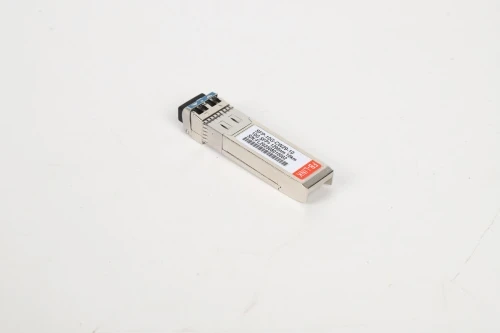
Converting Signals: The Core Transceiver Operations
At its heart, a transceiver performs two fundamental functions that work in opposite directions simultaneously.
Transmission Process
When transmitting data, transceivers use electronic components to condition and encode data into light pulses through laser sources such as VCSEL, FP, DFB, and EML lasers. The process begins when a network device sends an electrical signal to the transceiver. Inside the transmitter section, laser drivers control these light sources to generate precise optical signals. Each pulse of light represents binary data, with the modulation format determining how information is encoded-whether through simple on-off patterns or more complex schemes like PAM-4 that pack more data into each signal.
For radio transceivers, the transmission side converts digital data into radio frequency signals through modulation, amplifies these signals to appropriate power levels, and broadcasts them via antenna. RF transceivers can operate in half-duplex mode (transmitting or receiving but not simultaneously) or full-duplex mode (transmitting and receiving in parallel on different frequencies).
Reception and Conversion
On the receiving end, the transceiver captures incoming optical signals through photodiode semiconductors like PIN or APD detectors. These convert light back into electrical current, which is then amplified and processed by electronic circuits. The receiver section must distinguish genuine signals from noise, correct errors, and deliver clean digital data to the host device.
This dual functionality-handling both directions of communication within one module-dramatically simplifies network architecture compared to using separate transmitter and receiver components. The term "transceiver" itself combines "transmitter" and "receiver," and modern transceivers can both transmit and receive through a communications channel using an antenna or fiber connection.
Form Factors: Matching Physical Design to Network Needs
Transceiver form factors have evolved significantly to accommodate increasing data rates while maintaining or reducing physical size. These standardized shapes determine port compatibility, power consumption, and thermal characteristics.
SFP and Enhanced Variants
Small Form-factor Pluggable (SFP) transceivers replaced the larger GBIC format and support data rates up to 5 Gbps, while the enhanced SFP+ version extends speeds to 16 Gbps. SFP modules dominate 1G and 10G applications, particularly in enterprise networks and access layers where individual high-speed connections are needed. The compact size allows for dense port configurations-a single switch can house 48 SFP ports in just one rack unit.
SFP28 modules push single-channel speeds to 25-28 Gbps, primarily serving data center 25G Ethernet deployments. These modules maintain backward compatibility with SFP+ ports at reduced speeds, offering deployment flexibility. SFP+ ports typically accept SFP optics but operate at reduced 1 Gbps speed, though you cannot use SFP+ transceivers in standard SFP ports since SFP+ doesn't support speeds below 1 Gbps.
QSFP Family for High-Density Applications
Quad Small Form-factor Pluggable (QSFP) transceivers integrate four independent channels, with QSFP+ supporting 4x10 Gbps for aggregate 40G speeds and QSFP28 delivering 4x25 Gbps for 100G total bandwidth. The "quad" architecture proves especially valuable in data centers where space is at a premium. Network administrators can use a single QSFP28 port as either one 100G link or break it out to four separate 25G connections using appropriate cabling.
QSFP56 modules use advanced PAM-4 modulation to achieve 50 Gbps per lane for 200G aggregate speeds within the same physical footprint. For next-generation applications, QSFP-DD supports 400 Gbps by doubling the channel count to eight lanes, while OSFP handles the thermal requirements of 800G optics with a larger thermal envelope, with OSFP expanding at 16.47% CAGR as hyperscalers like Meta adopt it for top-of-rack switches.
Specialized Form Factors
CFP (C Form-factor Pluggable) modules serve long-haul telecommunications applications requiring coherent optics and higher power budgets. Though larger than QSFP variants, CFP transceivers deliver extended reach for metro and carrier networks. XFP modules briefly served 10G applications but were largely superseded by the more compact and lower-power SFP+ standard.
Speed Capabilities: From Gigabits to Terabits
Modern transceivers span an enormous range of data rates, with each generation pushing boundaries to satisfy growing bandwidth appetites.
Current Generation Speeds
The optical transceiver market encompasses devices from 1 Gbps to 800 Gbps and beyond, with the 10-40 Gbps segment valued at over $15 billion expected by 2032. In practical deployments, 10G and 25G transceivers handle server connectivity and network access layers. The 40G tier serves aggregation functions in medium-sized data centers, while 100G has become the backbone standard for most enterprise and cloud provider networks.
The 100-400 Gbps band held 38% market share in 2024, yet the >400 Gbps category is advancing at 16.31% CAGR through 2030. This shift reflects AI workloads requiring lossless fabrics connecting tens of thousands of GPUs. Starting in March 2023, demand for 800G modules surged dramatically, driven by hyperscale clients like Google, Amazon, and Nvidia, followed by Microsoft and Meta increasing their 400G module orders later in 2023.
Next-Generation Developments
Broadcom has predicted network speeds reaching 800 gigabits per second in 2025 and forecasted 1.6 terabits per second by 2026. These advances rely on multiple innovations working together: more sophisticated modulation schemes that encode more bits per symbol, increased parallelization with more optical lanes per module, and silicon photonics integration that reduces size and power consumption.
The industry continues exploring alternative approaches. Linear drive pluggable optics (LPO) eliminate power-hungry DSP chips to reduce latency and energy consumption-critical for GPU-to-GPU connectivity in machine learning clusters. Co-packaged optics (CPO) places transceivers directly adjacent to switch chips, further reducing power and enabling even higher aggregate bandwidth.
Fiber Compatibility: Single-Mode and Multi-Mode Options
Transceiver performance depends heavily on matching the module type to the fiber infrastructure.
Multi-Mode Fiber Applications
Multi-mode fiber (MMF) transceivers use VCSEL lasers operating at 850nm wavelength. MMF is typically used for applications up to 10km, with OM3 fiber supporting 10G speeds up to 300 meters and OM4 extending this to 400 meters for 10G or 100 meters for 100G. The larger core diameter of multi-mode fiber (50 or 62.5 microns) allows multiple light paths, which limits distance due to modal dispersion but reduces cost for short-reach applications.
Data centers rely heavily on MMF for intra-rack and row connections where distances rarely exceed 300 meters. The lower cost of VCSEL lasers and MMF cable makes this the economical choice for high-volume, short-distance deployments. OM5 fiber adds wideband MMF capability for short-wave wavelength division multiplexing, further increasing capacity over existing cable plants.
Single-Mode Fiber for Extended Reach
Single-mode fiber dominated with 57% market share in 2024, using narrow core diameter (9 microns) to support transmission distances from 2 kilometers to over 80 kilometers depending on transceiver type. SMF transceivers employ DFB or EML lasers operating at 1310nm or 1550nm wavelengths, providing the spectral purity needed for long-distance transmission.
Medium-reach 10-40 km links are growing at 15.32% CAGR as metro-edge data center clusters adopt 400ZR pluggables that deliver 400 Gbps over 80 km without external amplification. This eliminates the need for separate amplification equipment in many campus and metro applications. For telecommunications carriers, long-reach transceivers extend beyond 40 km using coherent detection technology that recovers signal phase and amplitude information.
Wavelength Division Multiplexing: Maximizing Fiber Capacity
WDM technology allows a single fiber strand to carry multiple independent data streams simultaneously by using different wavelengths (colors) of light.
CWDM and DWDM Approaches
Coarse WDM (CWDM) spaces wavelengths 20nm apart, typically offering 8 to 18 channels. CWDM transceivers cost less and consume less power but provide limited capacity expansion. They excel in enterprise and metro applications where moderate channel counts suffice. Dense WDM (DWDM) packs channels just 0.8nm apart (or closer), enabling 40, 80, or even 96 channels on a single fiber pair.
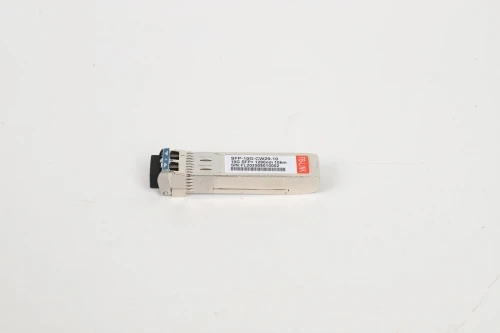
The 100GBASE-CWDM4 QSFP28 transceiver provides 100 Gbps aggregate rate over 2 km of single-mode fiber by multiplexing four wavelengths, with demultiplexing separating incoming wavelengths into four channels. This approach quadruples fiber capacity without installing new cables-a major advantage when duct space is limited or pulling new fiber is cost-prohibitive.
DWDM systems require precise wavelength control and temperature stabilization, increasing transceiver cost and power consumption. However, the massive capacity gain justifies the expense for carrier networks and large data center interconnects. Modern DWDM systems combined with coherent modulation can deliver multiple terabits per second capacity over single fiber pairs.
BiDi and Single-Lambda Solutions
Bidirectional (BiDi) transceivers transmit and receive on different wavelengths over a single fiber strand, cutting fiber requirements in half. A 100G BiDi module might transmit at 1310nm while receiving at 1550nm, with the far-end transceiver using the opposite pairing. This proves especially valuable when fiber count is severely constrained.
Single-lambda modules use advanced modulation like PAM-4 to transmit high data rates on a single wavelength. Single lambda 100G transceivers use PAM-4 signaling to transmit 100G data streams over a single wavelength, eliminating the need for WDM or parallel fiber while supporting distances from 500 meters to 10 kilometers depending on the variant. The simplification reduces cost and power consumption compared to parallel optics.
Application Domains: Where Transceivers Enable Connectivity
Different industries and use cases drive distinct transceiver requirements, from speed and reach to reliability and environmental specifications.
Data Center Infrastructure
Data centers commanded 61% of optical transceiver revenue in 2024 and continue growing at 14.87% CAGR, driven by AI training clusters requiring lossless fabrics connecting tens of thousands of GPUs. Within modern data centers, transceivers connect servers to top-of-rack switches, aggregate traffic between racks and rows, and link facilities for redundancy and load balancing.
The U.S. data center sector continues expanding rapidly, with Northern Virginia, Dallas/Fort Worth, Silicon Valley, Chicago, Phoenix, New York Tri-State Area, and Atlanta representing the seven leading markets according to 2024 CBRE analysis. Each new facility deployment requires thousands of transceivers across multiple speed tiers. Hyperscale operators increasingly run optical budget models before electrical power models, demonstrating how transceivers now dictate facility design.
Telecommunications Networks
The telecommunications segment dominated the market in 2022 with substantial share, driven by increased data traffic, optical network upgrades, and rapid 5G network deployment. Carriers use transceivers across multiple network layers: in radio access networks connecting cell towers, in metro transport rings aggregating traffic, and in long-haul backbone networks spanning continents.
According to GSMA data, 5G connections hit 1.6 billion by end of 2023 and are expected to grow to 5.5 billion by 2030, with China reporting 851 million 5G mobile subscribers as of February 2024. This massive buildout requires coherent DWDM transceivers for fronthaul and backhaul connections. The transition from 4G to 5G has accelerated optical transceiver adoption, with North America showing 64% year-over-year increase in 5G connections in 2023, adding 77 million connections to reach 197 million total.
Enterprise and Campus Networks
Enterprise deployments prioritize reliability, manageability, and gradual migration paths. Organizations typically deploy 1G and 10G transceivers for desktop and server connections, with 25G or 40G aggregation links. The ability to mix speeds within a single infrastructure allows incremental upgrades as budgets permit.
Campus networks spanning multiple buildings benefit from longer-reach transceivers. A university might use 10G-LR modules to connect buildings up to 10 kilometers apart over single-mode fiber, avoiding the need for intermediate active equipment. Financial institutions and healthcare facilities often require transceivers meeting specific environmental and security certifications.
Industrial and Specialized Applications
Industrial automation increasingly relies on deterministic Ethernet requiring transceivers with extended temperature ratings and ruggedized housings. Industrial domains are adopting ruggedized optics for smart-factory backbones and transportation telemetry, and while small today, they broaden the application slate and diversify revenue streams. Manufacturing plants, power utilities, and transportation systems need transceivers that operate reliably in harsh conditions with extreme temperatures, vibration, and electromagnetic interference.
Military and aerospace applications demand transceivers meeting MIL-SPEC standards for shock, vibration, and temperature cycling. These specialized modules cost significantly more but provide the reliability required for critical communications systems. Scientific research facilities use transceivers for high-speed data acquisition from instruments and sensors.
Technical Specifications: Understanding Key Parameters
Selecting appropriate transceivers requires evaluating multiple technical characteristics that determine compatibility and performance.
Optical Power Budget
Transmit power and receive sensitivity define the optical budget-the maximum loss a link can tolerate while maintaining acceptable error rates. A transceiver with -6 dBm transmit power and -14 dBm receive sensitivity provides 8 dB budget. This must cover fiber attenuation, connector losses, splice losses, and safety margin for component aging.
Engineers calculate link budgets carefully to ensure connections work reliably throughout the component lifetime. Insufficient margin causes intermittent errors that are difficult to diagnose. Excessive margin wastes money on more expensive transceivers when lower-cost options would suffice. Temperature variations affect laser output power and receiver sensitivity, requiring additional margin in unconditioned environments.
Digital Diagnostics Monitoring
DDM (also called Digital Optical Monitoring or DOM) provides real-time reporting of transceiver operating parameters through the management interface. Modern transceivers report transmit power, receive power, laser bias current, supply voltage, and temperature. This telemetry enables proactive monitoring to identify degrading components before failures occur.
Network management systems can track transceiver health across thousands of ports, alerting when parameters drift outside normal ranges. Receive power measurements help diagnose dirty connectors or damaged fibers. Tracking laser bias current reveals aging lasers that may fail soon. DDM has become essential for maintaining large-scale networks with acceptable operational costs.
Modulation and Coding Schemes
Early transceivers used simple on-off keying (OOK), also called non-return-zero (NRZ), with each bit represented by presence or absence of light. As speeds increased, the industry adopted four-level pulse-amplitude modulation (PAM-4) starting with QSFP56 modules, using the same physical specifications as QSFP28 but encoding two bits per symbol to double data rates.
PAM-4 encodes two bits per symbol using four distinct signal levels, effectively doubling the data rate for a given baud rate. However, PAM-4 requires more sophisticated signal processing and has lower noise immunity than NRZ. Coherent modulation schemes used in long-haul transceivers encode data in both amplitude and phase of the optical carrier, achieving even higher spectral efficiency at the cost of increased complexity and power consumption.
Environmental and Compliance Requirements
Commercial-grade transceivers typically operate from 0°C to 70°C, suitable for climate-controlled data centers and network equipment rooms. Industrial and extended-temperature modules function from -40°C to 85°C for outdoor cabinets and harsh environments. Some applications require conformal coating or hermetic sealing to protect against moisture and contaminants.
Transceivers must meet regulatory standards for safety and electromagnetic compatibility. FCC regulations in the United States and CE marking in Europe ensure devices don't cause harmful interference. The FCC oversees transceiver use in the United States, with manufacturers required to meet specific standards depending on intended use, and the FCC monitoring both production and use since devices can be modified to violate regulations.
Regional Market Dynamics: Deployment Patterns and Growth
Geographic differences in infrastructure maturity, regulatory environments, and economic conditions shape transceiver adoption patterns globally.
North American Leadership
North America dominated the global optical transceiver market with 36.05% share in 2024, owing to well-established telecommunications infrastructure, rapid 5G deployment, and presence of key players. The concentration of hyperscale data center operators-Amazon, Microsoft, Google, and Meta-in the United States drives enormous transceiver consumption. These companies operate at scales where even small efficiency improvements in cost per bit or power per bit translate to hundreds of millions in savings.
The United States optical transceiver market reached $3.3 billion in 2024 and is expected to grow to $10.0 billion by 2033 at 13.08% CAGR, with the U.S. hosting more than 2,600 data centers requiring transceivers to connect and transmit data within and between facilities. American cloud providers' aggressive infrastructure expansion sets technology roadmaps that vendors worldwide follow.
Asia-Pacific Growth
Asia Pacific held 38% of 2024 revenue and leads CAGR tables at 16.47% thanks to China's domestic supply chain and aggressive data center roadmaps, with government cloud programs and immediate 5G monetization underpinning continuous investment. Countries like China, Japan, South Korea, and India are building massive telecommunications and data center infrastructure to support their digital economies.
China has developed significant domestic transceiver manufacturing capability, with companies like Innolight, Accelink, and Hisense Broadband competing globally. Government policies promoting technology independence accelerate local production of critical components. The region's manufacturing-heavy economy and rapidly growing internet user base create sustained demand for networking equipment.
European Market Characteristics
Europe combines mature telecommunications infrastructure with stringent environmental and data protection regulations. GDPR requirements influence data center locations and architectures, affecting transceiver deployment patterns. European carriers have been early adopters of coherent DWDM technologies for metro and regional networks.
The continent's emphasis on energy efficiency drives adoption of lower-power transceiver technologies. Regulations like the EU Energy Efficiency Directive push network operators to minimize power consumption per bit transmitted. Silicon photonics and other advanced technologies gain traction faster in Europe due to these efficiency mandates.
Future Trajectory: Innovation and Market Evolution
Several technological and market forces will shape transceiver development over the coming years, with implications for network architects and infrastructure investors.
Silicon Photonics Integration
Silicon photonics leverages mature CMOS manufacturing processes to build optical components on silicon substrates. SiPh offers high performance, low cost, high yield, and volume manufacturing advantages by leveraging CMOS technology, though it has limitations in laser sources compared to III-V materials like InP and GaAs. By integrating lasers, modulators, and detectors on a single chip, manufacturers reduce size, power consumption, and cost while increasing production volumes.
Co-packaged optics represents the next evolution, mounting transceiver chips directly onto switch ASICs to minimize electrical path lengths. This approach promises to solve the power consumption crisis as data rates climb toward 1.6 Tbps per port. However, CPO requires fundamental changes to manufacturing, testing, and field serviceability that will take years to fully develop.
AI-Driven Infrastructure Demands
In 2024, the datacom sector experienced an astonishing 45% year-over-year surge in AI-powered optical transceiver market growth, with the optical transceiver market reaching $22.4 billion by 2029 driven by high demand for modules above 400G from cloud service operators. Training large language models and running inference at scale requires massive GPU clusters with extremely high bandwidth, low latency interconnects.
AI workloads differ from traditional data center traffic in their traffic patterns-more east-west GPU-to-GPU communication rather than north-south client-server flows. This drives adoption of specialized network architectures like fat-tree and CLOS topologies that consume enormous numbers of transceivers. AI training also demands lossless networks, requiring buffer management and flow control that stress transceiver performance.
Sustainability and Power Efficiency
As data centers handle growing amounts of digital information with rising cloud services demand, the need for high-speed, dependable data transmission increases, with Microsoft's $500 million cloud and AI infrastructure investment in Quebec exemplifying this expansion trend. However, power consumption has emerged as a limiting factor for further data center growth in many regions.
Transceivers must become more energy efficient as port speeds increase. The industry targets maintaining or reducing power per bit even as aggregate data rates climb. Linear drive optics eliminate DSP chips to save 30-40% power compared to traditional designs. New modulation formats and manufacturing techniques continue pushing efficiency boundaries. Regulatory pressure and corporate sustainability commitments accelerate this evolution.
Coherent Pluggable Adoption
Hyperscale operators' direct module procurement is replacing intermediary distribution, which has doubled coherent pluggable sales to approximately $600 million in 2024. Previously confined to expensive line cards in carrier transport systems, coherent optics now appear in small, hot-pluggable form factors like CFP2-DCO and QSFP-DD packages.
This democratizes coherent technology for data center interconnect and metro applications. Cloud providers deploy 400ZR modules for connecting facilities within metro areas, eliminating expensive DWDM transport equipment. As coherent DSP chips become more powerful and energy-efficient, we can expect these technologies to penetrate deeper into network architectures.

Frequently Asked Questions
What's the practical difference between SFP+ and QSFP28 for data center use?
SFP+ provides a single 10G channel in a compact form factor, requiring one port per 10G connection. QSFP28 delivers four 25G channels (100G aggregate) or can break out to four separate 25G connections using appropriate cabling. For spine-leaf architectures, QSFP28 provides 4x the bandwidth density in the same space, reducing switch costs and simplifying cabling. However, individual 10G server connections still commonly use SFP+ since the port count matches the need.
How do I know if my fiber plant supports higher-speed transceivers?
Upgrading transceiver speeds requires verifying fiber type, quality, and distance. Multi-mode fiber must meet minimum modal bandwidth specifications-OM3 for 40G/100G under 100m, OM4 for extended distances. Single-mode fiber generally supports multiple generations without replacement, but connector quality becomes critical at higher speeds. Dirty or damaged connectors causing acceptable loss at 10G may create excessive errors at 100G. Professional fiber testing and cleaning often enables speed upgrades without infrastructure changes.
Why are some 100G transceivers much more expensive than others?
Price varies based on reach requirements and technology. A 100GBASE-SR4 multi-mode module for 100-meter connections costs significantly less than a 100GBASE-LR4 single-mode module rated for 10 kilometers. Coherent 100G modules for 80+ kilometer links cost even more due to sophisticated DSP requirements. BiDi and single-lambda variants fall in the mid-range. Brand name vs. compatible transceivers represent another cost dimension, with compatible modules often delivering identical specifications at 30-50% lower prices.
Can I mix different transceiver brands on the same network link?
Multi-source agreements ensure different manufacturers' transceivers interoperate when following the same standard. A Cisco-branded 10GBASE-SR can communicate with a generic 10GBASE-SR from another vendor. However, some switch vendors lock ports to accept only their branded optics, requiring compatible transceivers coded to emulate the original vendor. Digital diagnostics formats may differ slightly between brands, affecting monitoring capabilities even when basic communication works fine.
What's driving the rapid shift from 100G to 400G in data centers?
The combination of AI workloads, cloud computing growth, and video streaming creates traffic that doubles roughly every 18-24 months in major data centers. Operators must constantly upgrade backbone and aggregation speeds to avoid bottlenecks. Data centers represented 61% of optical transceiver revenue in 2024, with AI training clusters demanding 800G and above speeds to create lossless fabrics connecting tens of thousands of GPUs. Cost per bit and power per bit both improve at higher speeds, making 400G more economical than deploying four separate 100G links for equivalent capacity.
How does temperature affect transceiver performance and reliability?
Laser output power decreases as temperature rises, while receiver noise increases. This reduces optical margin and can cause link errors or failures if the transceiver operates beyond its rated temperature range. Many switches report transceiver temperature through DDM, allowing administrators to detect thermal issues. Extended-temperature transceivers use more robust components and thermal compensation circuits but cost more. Adequate data center cooling prevents most thermal problems, though airflow design around densely populated switch faceplates deserves careful attention.
What role will transceivers play as networks move toward 800G and 1.6T speeds?
Higher speeds concentrate more bandwidth in fewer ports, improving data center economics but challenging power delivery and thermal management. Broadcom predicted 800 Gbps speeds in 2025 with 1.6 Tbps forecasted by 2026. The industry explores multiple approaches: QSFP-DD and OSFP form factors with eight electrical lanes, co-packaged optics integrating transceivers with switch silicon, and linear drive designs eliminating power-hungry DSP chips. These innovations will determine whether Moore's Law-like scaling continues for network bandwidth or whether physical limitations force architectural changes.
Strategic Considerations for Network Planning
Understanding transceiver functions and capabilities enables better infrastructure decisions. Organizations should evaluate not just current requirements but also anticipate growth trajectories and technology evolution. The transceiver market's transition toward 400G and 800G speeds reflects broader shifts in how we process and transmit information.
Investing in infrastructure that accommodates transceiver upgrades-quality fiber plants, appropriate connector types, adequate cooling-provides flexibility for future needs without complete replacement. As AI, cloud computing, and data-intensive applications proliferate, the humble transceiver remains the critical enabler that converts electrical signals into the optical streams powering our connected world.