





Color optical modules: WDM, WDM and SDM
 Dec 01, 2025|
Let's discuss several scenarios for 5G optical modules and fronthaul optical modules.
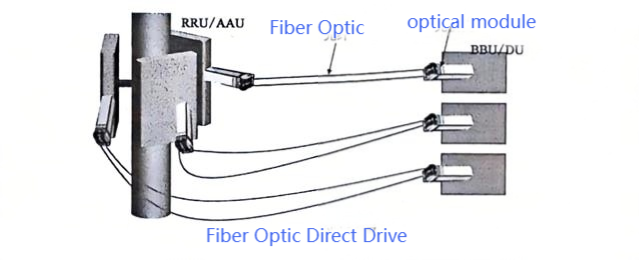
The diagram below shows a direct fiber optic drive solution. In the most common configuration, the base station has three sectors, requiring three optical modules. The BBU/DU at the other end of the fiber requires an additional three optical modules.
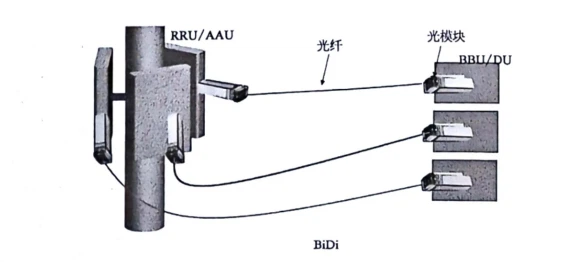
The image below shows the BiDi fronthaul solution.
The image below shows a passive optical fiber fronthaul. Let's explain it using a 6-wavelength method (the principle of a 12-wavelength method is similar). "Colored light" means that the long optical fiber in the middle carries many signals transmitted in a wavelength multiplexing mode.
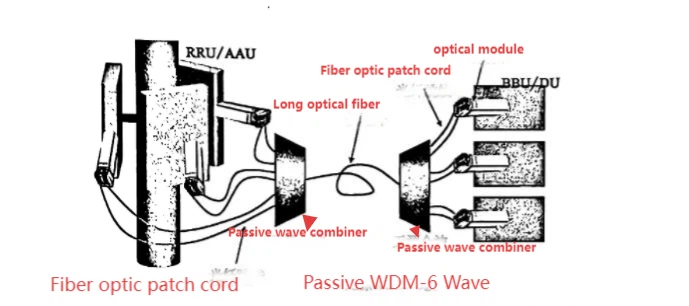
Six separate optical fibers of different wavelengths are combined into a single fiber, or the wavelength of one optical fiber is split into six separate fibers. This is the function of a wavelength combiner/demultiplexer.
Passive wavelength combiners are devices that do not require an external power supply; a commonly used example is an arrayed waveguide grating (AWG).
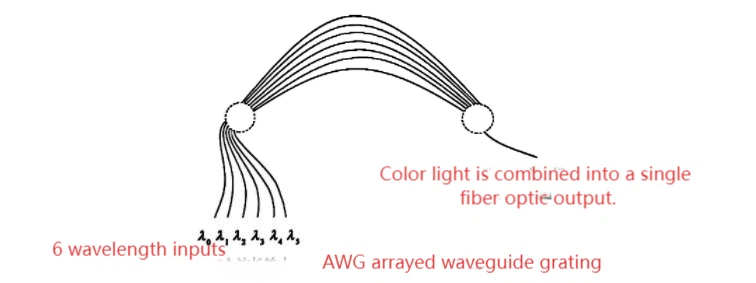
The key function of AWG (Active Wavelength Division Multiplexing) is to combine n wavelength ports together. However, another important characteristic is that once the design is complete, the relationship between which port inputs/outputs which wavelength is fixed.
This leads to the concept of semi-active wavelength division multiplexing (SWDM), where one end uses passive WDM and the other end uses an active controller. This is used for switching between primary and backup lines, and for design redundancy (see diagram on the next page).
Semi-active solutions can be used in more critical applications to prevent line failures.
In summary:
Wavelength division multiplexing (WDM) combines multiple wavelengths onto a single optical fiber for transmission.
Active WDM allows for configurable wavelength ports, requiring power supplies and circuitry.
Passive wavelength division multiplexing (WDM) is a fixed-wavelength port solution that requires no additional configuration circuitry, making it simple and cost-effective.
Semi-active WDM uses passive multiplexing on the side closer to the antenna and active control on the side closer to the central control room.