





Link Aggregation Setup: LACP Configuration Guide
 Feb 16, 2026|
 Link Aggregation Setup: LACP Configuration Guide
Technical Review by 100G Modules Engineering Team
Why Your Procurement Committee Should Care About LACP
The question isn't whether link aggregation adds value. The question is whether the investment justifies the protection it provides for your specific environment. This guide exists to give you the technical foundation and cost framework needed to make that case internally, or to determine that a simpler approach serves your requirements better.
Link Aggregation Control Protocol combines multiple physical network connections into a single logical channel. IEEE 802.1AX governs the current specification, defining how switches negotiate which ports participate in an aggregate and how traffic distributes across members. The protocol delivers two distinct benefits that procurement decisions should evaluate separately: bandwidth scaling through parallel links, and path redundancy that maintains connectivity when individual links fail.
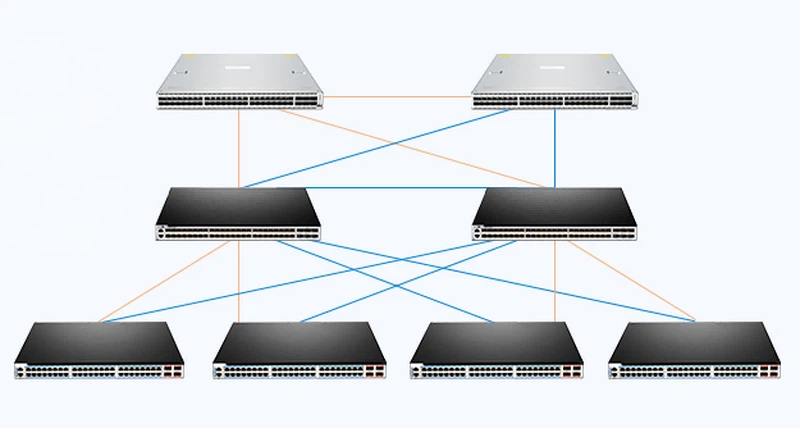
Understanding which benefit drives your project determines the appropriate investment level. Bandwidth scaling requires traffic patterns with multiple concurrent flows. Redundancy provides value regardless of traffic profile. Most procurement justifications emphasize redundancy because the ROI calculation is more straightforward: compare the cost of aggregated infrastructure against the cost of downtime events that single-link failures would cause.
Technical Requirements That Affect Your Bill of Materials
IEEE 802.3ad Clause 43 mandates that all aggregate members operate at identical speeds in full-duplex mode. This requirement directly impacts transceiver procurement because mixed-speed configurations will not form a functioning aggregate. Planning a four-port LAG means purchasing four transceivers of the same data rate specification.
The protocol exchanges LACPDUs at multicast address 01:80:C2:00:00:02 to negotiate aggregate formation. Two operational modes exist: active mode initiates negotiation, passive mode responds only when the partner initiates. At least one endpoint must run active mode for the aggregate to form. Both endpoints running passive mode results in no negotiation occurring, a common misconfiguration that wastes deployment time.
LACPDU timing affects failure detection speed. Fast mode transmits every second with a three-second timeout. Slow mode transmits every thirty seconds with a ninety-second timeout. Critical path deployments typically require fast mode, but both endpoints must match. Mismatched timeout configurations cause instability that appears as intermittent flapping in monitoring systems.
Maximum aggregate membership varies by vendor implementation. Most platforms support eight active ports with eight additional standby ports. System priority values determine which switch controls active port selection when standby members exist. Lower numeric priority indicates higher precedence. Default values differ across vendors: Cisco defaults to 32768, Juniper to 127.
Hardware Investment Analysis: What Actually Costs What
The transceiver market has shifted dramatically from OEM-dominated pricing. Third-party compatible modules now represent the majority of data center optics deployments, with savings that directly affect LACP project ROI calculations.
| Specification | Third-Party Range | OEM Reference | Typical Savings |
|---|---|---|---|
| 10G SFP+ SR (MMF 300m) | $25-34 | $250-500 | 85-93% |
| 25G SFP28 SR (MMF 100m) | $49-74 | $400-800 | 88-91% |
| 100G QSFP28 SR4 (MMF 100m) | $150-280 | $1,200-2,000 | 81-88% |
These figures change the math on aggregate versus single high-speed link decisions. Consider a 40Gbps bandwidth requirement with redundancy. Two implementation paths exist:
Path A: 4×10G SFP+ Aggregate
Transceiver cost: 4 × $30 = $120. Uses existing LC duplex fiber and familiar SFP form factor. Provides N+3 redundancy where any single link failure maintains 75% bandwidth.
Path B: Single 40G QSFP+ Link
Transceiver cost: approximately $150. Requires MPO/MTP connectivity, potentially triggering fiber infrastructure changes. Zero redundancy at optical layer.
The transceiver delta is negligible. The infrastructure delta determines project cost. If your facility already runs MPO/MTP backbone cabling, Path B costs less. If you're working with LC duplex plant, Path A avoids cabling retrofit expenses that typically run $50-200 per drop depending on pathway complexity.
Path C: 4×25G SFP28 Aggregate
This approach delivers 100Gbps aggregate bandwidth while maintaining LC duplex compatibility. Transceiver investment around $250 total. The 25G SFP28 form factor shares mechanical specifications with 10G SFP+, meaning existing cable plant and patch panel infrastructure remains usable. Hyperscale operators including Google and Microsoft adopted this migration path specifically to avoid the MPO/MTP transition costs that 40G deployments require.

Vendor Configuration Reference
Cisco IOS platforms create aggregates through port-channel interfaces. Member ports attach using the channel-group command with mode selection. The active keyword enables LACP negotiation where the local switch initiates. Configuration applies under each physical interface:
interface GigabitEthernet0/1
channel-group 1 mode active
Verification uses show etherchannel summary to confirm member status and show lacp neighbor to validate partner parameters.
Juniper Junos defines aggregate interfaces as ae0 through aeN before assigning physical members. The architectural separation means LACP parameters apply to the logical interface while physical binding happens under member port configuration:
set interfaces ge-0/0/0 gigether-options 802.3ad ae0
set interfaces ae0 aggregated-ether-options lacp active
The show lacp interfaces command displays negotiation state across all aggregates.
Aruba AOS-CX implements LAG configuration through dedicated interface context. Hash algorithm selection directly affects traffic distribution and warrants attention during initial deployment. Layer 3+4 hashing typically provides optimal distribution for mixed workloads by incorporating TCP/UDP port numbers into the calculation.
Dell OS9/OS10 follows patterns similar to Cisco implementation. Cross-platform deployments require attention to default value differences, particularly system priority settings that determine aggregate control when connecting switches from different vendors.
Calculating Whether LACP Investment Makes Sense for Your Environment
Industry downtime statistics provide context but cannot substitute for organization-specific analysis. The Uptime Institute 2024 survey reported that 54% of significant outages exceeded $100,000 in impact. EMA Research documented average costs of $14,056 per minute across their survey population (enterprisemanagement.com). These figures establish that downtime carries real cost, but your procurement justification needs numbers specific to your operation.
Framework for Internal ROI Calculation:
Annual Revenue × IT Dependency Percentage ÷ 8760 hours = Hourly Downtime Cost
A $50M annual revenue organization with 40% IT dependency calculates to approximately $2,283 per hour of downtime. If single-link failures historically cause two hours of unplanned downtime annually, that represents $4,566 in quantifiable risk.
Against this, calculate the LACP investment: additional switch ports (if required), transceivers for redundant paths, cabling, and implementation labor. For many environments, the redundant transceiver investment falls under $500 total. The math typically favors aggregation when hourly downtime cost exceeds $2,000.
However, this framework only captures direct revenue impact. Regulated industries face compliance penalties that multiply exposure. Healthcare and financial services organizations report downtime costs exceeding $9M per hour in ITIC surveys, reflecting both operational and regulatory dimensions.
When Single-Link Simplicity Wins:
Low IT dependency percentages, particularly in organizations where revenue generation continues during network outages, shift the calculation. Manufacturing facilities with local process control systems, retail operations with offline POS capability, and organizations with mature manual failover procedures may find that single high-speed links with rapid replacement SLAs provide equivalent protection at lower complexity.
The decision framework should also consider traffic profile. Single TCP flows cannot exceed single-link bandwidth regardless of aggregate configuration. Database servers running sequential queries, backup operations streaming from single sources, and video editing workstations pulling footage from centralized storage will not see bandwidth improvement from aggregation. These use cases gain redundancy value only.
For environments with complex traffic analysis requirements, our applications engineering team provides flow distribution modeling. Contact details at document end.
Troubleshooting Aggregate Formation Failures
Mode mismatch causes the majority of deployment delays. Two passive endpoints never form an aggregate because neither initiates LACPDU transmission. Two active endpoints form correctly. Active paired with passive forms correctly. The failure mode that consumes troubleshooting time involves one endpoint configured for static aggregation (Cisco mode on) while the partner expects LACP negotiation. Static mode does not transmit LACPDUs, so the LACP-enabled partner never sees a valid partner.
VLAN configuration mismatch causes port suspension. All aggregate members must carry identical VLAN membership. Trunk ports require matching allowed VLAN lists. Access ports require matching access VLAN assignment. The suspension state appears in show command output and clears when configuration aligns.
Speed mismatch prevents member activation. The IEEE specification requires identical data rates across all aggregate members. A port configured for auto-negotiation that settles at 1Gbps cannot join an aggregate whose other members negotiated 10Gbps. Forcing speed configuration on all member ports eliminates this variable.
Physical layer instability manifests as LACP flapping under load. Root causes include thermal throttling when switch port density creates cooling challenges, marginal fiber connections with elevated insertion loss, and transceiver quality issues that only surface at sustained high utilization. Documented cases in TrueNAS community forums traced aggregate instability to SFP thermal events that occurred after extended backup operations raised port temperatures (truenas.com). DOM telemetry showing receive power fluctuation or temperature approaching threshold values indicates physical layer investigation rather than protocol-level troubleshooting.
Firmware-specific behaviors occasionally affect aggregate stability. Certain platform releases have documented issues with LACP negotiation timing during boot sequences or stack member transitions. Vendor release notes warrant review when aggregate behavior deviates from expected patterns. Our compatibility matrix includes firmware validation notes for common platform combinations.
Hash Algorithm Selection and Distribution Optimization
Traffic distribution across aggregate members uses hash calculations that map flows to physical links. The algorithm selection determines which packet fields contribute to the hash. Layer 2 hashing uses MAC addresses. Layer 3 adds IP addresses. Layer 3+4 incorporates TCP/UDP port numbers for maximum entropy in the hash input.
The practical impact: environments with limited unique endpoint pairs see poor distribution with Layer 2 hashing. Server farms with many clients distributing requests across multiple backend nodes see good distribution with Layer 3 hashing. Environments where many flows exist between the same IP pairs but on different ports require Layer 3+4 hashing to achieve reasonable distribution.
Hash calculation happens independently at each end of the aggregate. The sending switch determines which member link carries each frame. This creates asymmetric flow distribution where request and response traffic may traverse different physical paths. The asymmetry is normal and expected.
Distribution quality correlates with flow count. Aggregate deployments with fewer than twelve concurrent flows typically show uneven member utilization. Mathematical properties of modulo operations favor power-of-two member counts. Four-member aggregates distribute more evenly than three-member configurations for the same flow set.
Advanced hash optimization including seed diversity for multi-tier topologies and vendor-specific algorithm tuning available through technical consultation.
Transceiver Selection Criteria for Aggregate Deployments
Digital Optical Monitoring capability becomes essential rather than optional in LAG configurations. When one member of an eight-port aggregate begins experiencing elevated bit error rates, DOM telemetry provides early warning before the degraded port causes hash redistribution. The transceiver should report receive power, transmit power, temperature, and supply voltage to whatever monitoring platform manages the environment.
Thermal characteristics affect deployment density. Adjacent switch ports running high-density optics accumulate heat that can trigger throttling.
SFP28 at 25Gbps generates measurably more heat than SFP+ at 10Gbps. Aggregate configurations that populate consecutive ports compound thermal load. Platform specifications indicate maximum supported port group configurations.
Quality consistency across aggregate members matters more than individual module specifications. Bit error rate variations between transceivers in the same aggregate create uneven performance that the hash algorithm cannot compensate for. Sourcing all members of an aggregate from the same qualified production lot reduces this variable.
Connector type determines infrastructure compatibility. SFP+ and SFP28 use LC duplex connections compatible with the fiber plant installed in most facilities. QSFP+ and QSFP28 typically require MPO/MTP connectivity. Breakout cables exist to convert QSFP ports to four independent SFP connections, enabling QSFP28 switch infrastructure to serve as LAG members using LC duplex cabling to endpoints.
Procurement Considerations for Third-Party Transceivers
OEM pricing premiums on optical transceivers reflect branding margin rather than component quality differential. Manufacturing sources for third-party and OEM transceivers overlap substantially. The performance specifications derive from the same underlying component suppliers.
Warranty implications require factual understanding rather than vendor fear narratives. The Magnuson-Moss Warranty Act prohibits conditioning warranty coverage on use of branded components. Network equipment vendors cannot void switch warranties solely because third-party transceivers are installed. The legal burden falls on the manufacturer to demonstrate that a third-party component caused the specific failure under warranty claim.
Practical TAC interaction strategy: maintain a small inventory of OEM transceivers for situations requiring vendor support escalation. If initial troubleshooting cannot isolate fault location, swapping to OEM optics eliminates transceiver questioning from the support conversation. The cost of keeping two or three OEM units for this purpose represents a fraction of fleet-wide OEM procurement.
Vendor support desk experiences vary. Some organizations report zero friction using third-party optics through multiple TAC cases. Others encounter initial pushback that resolves when fault isolation demonstrates the transceiver is not involved. Having DOM data available showing healthy optical parameters accelerates this conversation.
Third-party transceiver vendors typically offer extended warranty terms. Lifetime warranties against defect are common in the compatible optics market, compared to the one-year terms typical of OEM transceiver coverage.
Decision Framework Summary
| Factor | Favors LACP | Favors Single High-Speed |
|---|---|---|
| Existing fiber type | LC duplex plant | MPO/MTP already deployed |
| Traffic profile | Many concurrent flows | Single large transfers |
| Downtime cost | >$2,000/hour | <$500/hour |
| IT dependency | Revenue-critical systems | Manual failover viable |
| Growth trajectory | Incremental scaling | Known fixed requirement |
LACP provides genuine value for environments where concurrent flow counts support distribution benefits and where downtime costs justify redundancy investment. The protocol adds complexity that single-link deployments avoid. The decision should reflect your actual traffic profile and risk tolerance rather than assumed best practice.
Next Steps for Your Evaluation
For projects requiring formal vendor qualification, our technical team provides compatibility verification against your specific switch platform and firmware combination. Request includes bill of materials review, DOM integration confirmation, and applicable regulatory compliance documentation.
Aggregate deployment planning requires transceiver specifications matched to your port count and reach requirements. Contact our applications engineering team with your switch platform list and we'll provide a configuration-specific quotation within 24 hours.
100G Modules | 100gmodules.com | Request for Quotation: sales@100gmodules.com