





Muxponder vs Transponder: Understanding the Difference
 Apr 25, 2026|
 Most articles frame the muxponder vs transponder question as a vocabulary exercise. What does each one do, how are they different. The real issue is operational, and it shows up months after the hardware ships. We manufacture both types of OTN line cards at our Shenzhen facility, and the support conversations that take the longest are never about product specs. They are about customers who bought the right device for the wrong network scenario. One case last year: a cloud-edge operator deployed a 400G muxponder on a two-site DCI link carrying nothing but 100GE. Their traffic projection assumed a regional merger that never closed, and two of the four client ports sat dark for eight months. When they finally asked whether a pair of single-channel transponders would have been simpler and cheaper, we ran the numbers together. The transponder path would have cut their per-port equipment cost by roughly 40%, with lower power draw on top of that. The muxponder was not the wrong product. It was the wrong product for that traffic profile.
How Transponder and Muxponder Signal Mapping Differs
Transponder
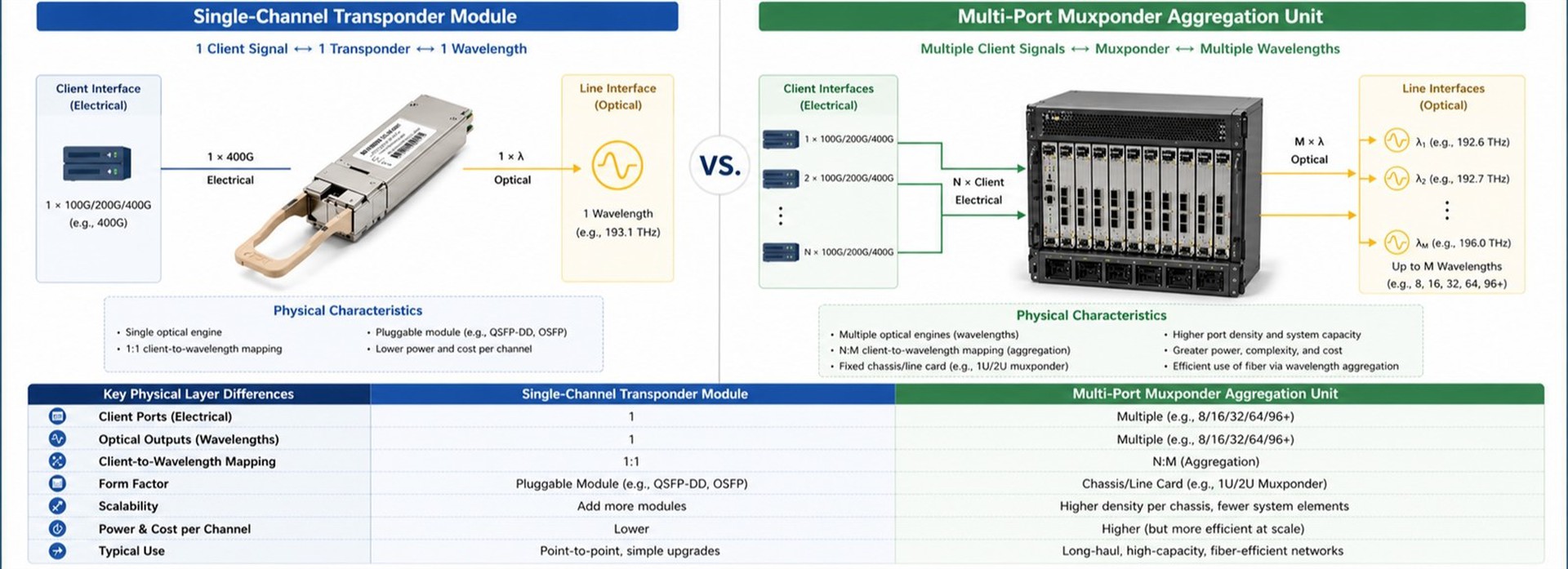
A transponder performs a 1:1 optical-electrical-optical conversion. One client signal goes in, one ITU-grid DWDM wavelength comes out. The signal gets retimed, reshaped, and re-amplified through 3R processing, but the mapping ratio stays one-to-one.
Muxponder
A muxponder wraps that same OEO engine inside an aggregation layer. Multiple lower-rate client signals get mapped into OTN containers per ITU-T G.709, then multiplexed onto a single higher-rate wavelength. Four 100G streams become one 400G lambda.
The output is N:1 instead of 1:1, which means fewer wavelengths consumed for the same aggregate throughput. That efficiency is conditional. It holds when you actually fill the client ports, and when the aggregated services share compatible SLA requirements. In mixed-traffic environments with independent protection needs, those conditions break faster than most product briefs suggest. We walk through the specific break point further down.
Why Latency Splits the Muxponder-Transponder Decision Before Price Does
Every OEO hop adds processing delay. Industry references place the range for a minimal-processing transponder, with no OTN wrapping and no FEC where the link margin allows it, somewhere around 10 to 15 microseconds per pass. Actual figures depend on the specific DSP and modulation format (TelcoCloudBridge). Once you add OTN encapsulation, FEC encode/decode, and ODU multiplexing, latency climbs. How much depends on the vendor's DSP architecture, which is why requesting back-to-back latency test data in your RFP matters more than reading a headline spec.
In our DCI project consultations, we screen with a sub-100-microsecond one-way delay budget. Any application that fits inside that envelope, financial trading feeds, synchronous storage replication, real-time telemetry, almost always belongs on a dedicated transponder path rather than an aggregated muxponder uplink. For a metro backbone consolidating IPTV and enterprise Ethernet, that additional processing time is invisible. When clients ask us for "the fastest option," the first question back is always: what is your delay budget, and is it per-hop or end-to-end? The answer usually sorts out the device class within five minutes.
Muxponder Aggregation Efficiency and the Utilization Trap
The density argument for muxponders is real. Aggregating ten 10G services onto a single 100G wavelength uses less rack space, less power, and fewer DWDM channels than ten separate transponder cards. Research on multilayer optical network power models confirms that OTN-layer equipment is the dominant contributor to network power consumption, and that reducing OEO processing hops can yield significant savings (IEEE Photonic Networks, 2012).
Aggregation economics, however, depend on fill rate. We pulled utilization and power billing data from seven metro ring deployments over the past three years where we had full visibility into both our 100G DWDM muxponder cards and standalone transponder alternatives running side by side.
In five of the seven, the cost-per-active-gigabit crossover landed around three-quarters port utilization. The two outliers involved heavy Fibre Channel traffic, where ODU framing overhead for FC pushes the crossover point lower. G.709 framing alone consumes roughly 7% of line-side bandwidth for FEC and OAM (ITU-T G.709 framework, OTN overview). A 400G DWDM muxponder running at half capacity ends up more expensive per live gigabit than two standalone 100G transponders doing the same job. We have seen this exact scenario three times in the past two years, always with the same root cause: the customer purchased for projected traffic growth that did not materialize on schedule.
Selecting a Transponder or Muxponder by Deployment Scenario
Point-to-point DCI carrying uniform high-speed traffic
100GE or 400GE between two data center sites, is transponder territory. Traffic is homogeneous, latency requirements are usually tight, and coherent pluggable modules like 400ZR can sometimes sit directly in switch QSFP-DD ports, eliminating the external transponder entirely. Where the link budget needs amplification or wavelength conversion beyond what a pluggable handles, a single-channel transponder card with minimal OTN overhead is the cleaner architecture. This recommendation changes once the same DCI link also carries storage replication or Fibre Channel on a different protocol. In our experience, once non-Ethernet traffic exceeds roughly 20% of total port capacity, or requires independent protection groups, the transponder-only approach stops making economic sense.
Metro aggregation of mixed-rate, mixed-protocol services
Is where OTN muxponder multiplexing pays for itself. An ISP consolidating 10GE, 25GE, and Fibre Channel from multiple enterprise clients onto a shared DWDM backbone gets real value from N:1 mapping. Fewer wavelengths, simpler ROADM configuration, and OTN-layer per-service performance monitoring through tandem connection monitoring that a bare transponder cannot provide.
Alien wavelength expansion over a third-party ROADM network
Favors transponders. Marcatel, a Mexican carrier, deployed Fujitsu 1FINITY T300 transponders as alien wavelengths over their installed ROADM infrastructure to add 100G QPSK capacity. They chose transponders specifically because the book-ended pair architecture kept fault isolation simple across vendor boundaries: no OTN client-side mapping meant no OTN-layer failure modes invisible to the host line system. Research on alien wavelength deployments through open WDM interfaces has documented cost reductions of up to 60% and power savings of up to 70% for high-rate services (Optica Publishing Group). If Marcatel had used muxponders, every aggregation-layer fault would have been a black box to the third-party OLS. On a capacity-expansion project where uptime risk tolerance is low, that trade-off does not pencil out (Fujitsu Network Blog).
Legacy SONET/SDH migration to OTN
Is the one scenario where muxponders are not just preferable but practically necessary. Mapping STM-64 and OC-48 client signals into ODU containers for transport over a modern DWDM backbone is what muxponder aggregation was built for. Deploying one transponder per legacy circuit at 2.5G wastes wavelengths at a rate that makes the entire migration uneconomical. If you are planning this type of transition, our DCI OTN platform lineup supports mixed-generation client interfaces on the same chassis.
The FEC Mismatch Trap in Multi-Vendor Transponder and Muxponder Deployments
Of all the support issues we handle on OTN interworking, FEC mode mismatch between trunk endpoints burns the most troubleshooting hours. When one end runs standard G.709 FEC and the other runs enhanced or proprietary FEC, the link may establish but carry persistent uncorrectable errors. On certain Cisco ONS 15454 card types, the FEC-MISM alarm does not trigger under this condition. The system logs rising uncorrected FEC word counts without ever flagging a root cause (Cisco DWDM Troubleshooting, Release 9.2). Multi-vendor environments are especially vulnerable, particularly muxponder-to-transponder interworking where each side may default to a different FEC profile out of the box. Verifying FEC mode alignment on both trunk ports before turning up a new wavelength takes five minutes. Diagnosing phantom bit-error problems after the link is in service has cost our customers days. If you are evaluating hardware from multiple suppliers, put FEC mode interoperability at the top of your acceptance test checklist.
Will Coherent Pluggables Replace the Standalone Transponder?
400ZR and OpenZR+ pluggable coherent modules are compressing the role of external transponder hardware in point-to-point DCI. When a switch hosts a coherent DWDM optic directly in its QSFP-DD port, a separate transponder becomes redundant for that link.
Muxponder functionality is a different matter. OTN-layer aggregation, multi-protocol client mapping, per-service monitoring with six levels of TCM: none of this is replicated by any pluggable coherent module shipping today. As long as the client mix includes Fibre Channel, legacy SONET/SDH, or any protocol requiring independent OTN-layer fault isolation, pluggable optics cannot do what a muxponder does. Our position is specific: the device under genuine competitive pressure from pluggable coherent technology is the single-channel transponder in short-reach, single-protocol Ethernet applications. Muxponders serving mixed-service metro and long-haul aggregation will remain the correct architecture for at least the next two to three product generations, based on the current coherent pluggable roadmap and OTN standardization timeline.
For a broader look at how DWDM wavelength management fits into these architecture decisions, we covered the fundamentals in our guide to DWDM network design.
Getting the muxponder vs transponder match wrong in either direction, over-aggregating with a muxponder you cannot fill, or under-consolidating with transponders that waste wavelengths, compounds over a 5-7 year equipment lifecycle. Our engineering team provides FEC interoperability verification and link-budget analysis on both device classes before shipment. If you are comparing options now, send us your link parameters and traffic profile. We will return a preliminary architecture recommendation within two business days: request a consultation.