





DWDM Wavelength Planning: C-Band & L-Band Guide
 Apr 23, 2026|
 Most channel tables tell you where each ITU wavelength sits. They do not tell you which channels to actually activate, how many to leave empty for your next upgrade cycle, or what happens to your C-band OSNR budget the day you light up L-band on the same fiber. This guide covers those decisions - the ones that keep a wavelength map viable through three upgrade cycles instead of forcing a redesign at the second.
We build and ship DWDM transceivers, mux/demux modules, and amplifier cards out of our Shenzhen facility. We run compatibility testing across Huawei, ZTE, and Cisco switch platforms before anything leaves the factory, and we support customers through deployment. That background shapes every recommendation here: we are not neutral academics, and we are not going to pretend otherwise. What we are is a team that sees wavelength planning mistakes come back as RMA tickets and emergency engineering calls - which gives us a specific kind of knowledge that textbook coverage does not.
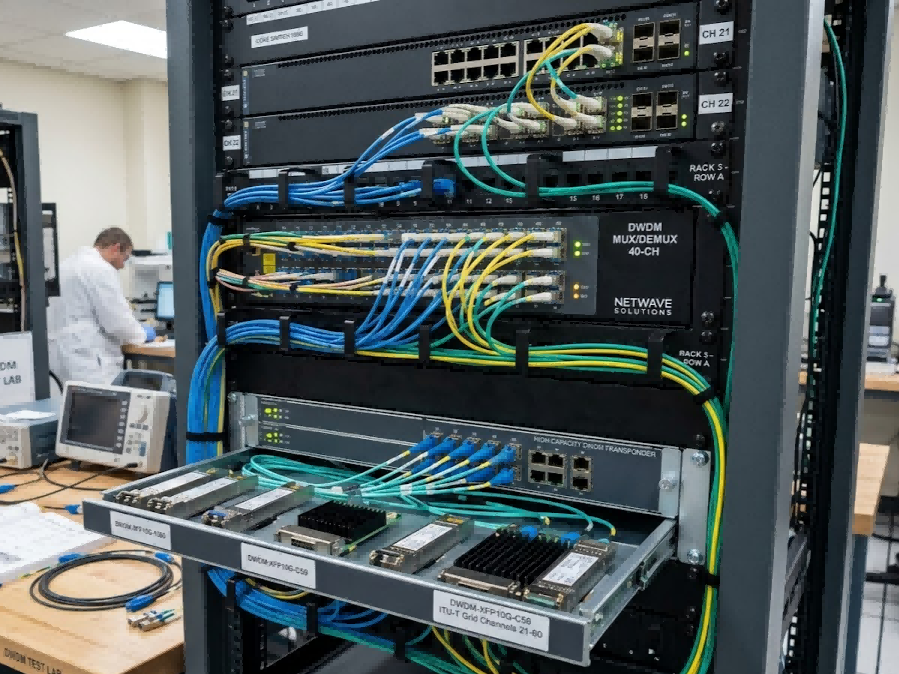
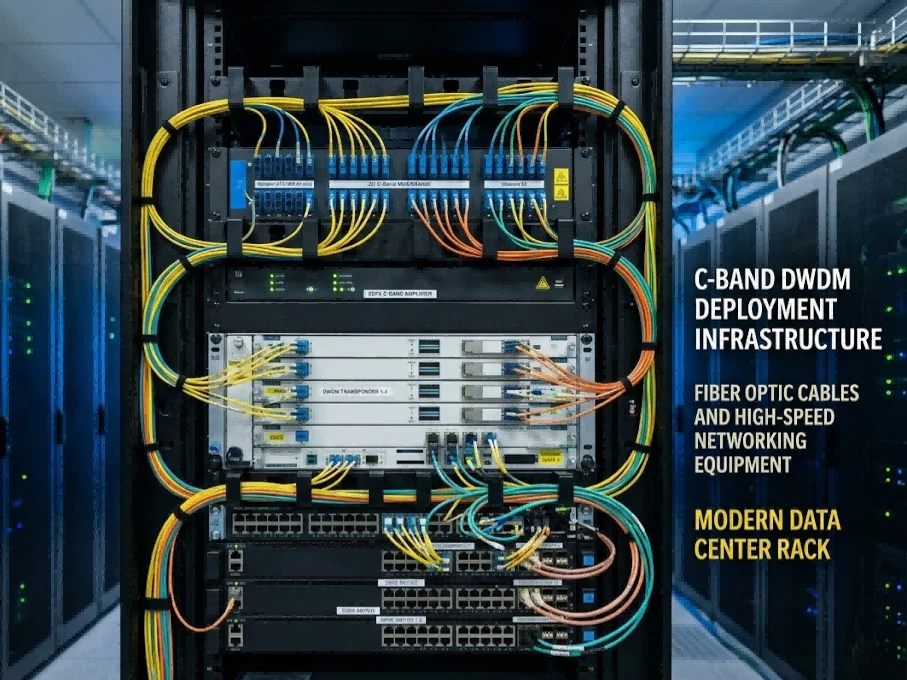
C-Band Channel Spacing in DWDM Networks: 100 GHz or 50 GHz
C-band - 1530 to 1565 nm - carries the vast majority of deployed DWDM traffic worldwide. Erbium-doped fiber amplifiers hit peak gain in this window, single-mode fiber attenuation bottoms out near 0.20 dB/km at 1550 nm, and the ITU-T G.694.1 grid from channel 17 through 61 is supported by every commercial transponder we have tested against (ITU-T). You are not going to win on C-band design - everyone has the same amplifier window and the same ITU grid. The goal is to avoid choices that lock you in.
Most people approach the spacing question - 100 GHz versus 50 GHz - as a capacity planning exercise, but it is really an equipment lifecycle decision. Our standard 100G QSFP28 DWDM modules covering the full C17–C61 ITU grid cover C17 through C61 on the 100 GHz grid, and for a deployment under 40 wavelengths running 10G or 100G coherent, that is the right fit. Filter tolerances are relaxed enough that passive mux/demux costs stay low, and you are not paying for spectral precision you do not need.
That reasoning breaks down when 400G enters your roadmap. A 400G DP-16QAM signal at 64 GBaud occupies a spectral width exceeding 50 GHz - it physically cannot transit a fixed 50 GHz filter without clipping, and on a 100 GHz grid you strand nearly half of every channel slot. Lightwave Online documented this as the primary driver behind the industry's migration away from fixed channel plans (Lightwave Online). Our tunable DWDM transponder cards configurable for 50 GHz and 100 GHz channel spacing support 50 GHz and 100 GHz configurations across the full C-band - but the passive infrastructure you bolt them into is the constraint that matters. Mux/demux modules and ROADM WSS blades are not field-swappable the way a transceiver is. Choose your grid at the passive layer based on where the network needs to be in five years. Transceivers swap out in minutes; mux/demux and WSS infrastructure does not.
When Your DWDM Wavelength Plan Needs L-Band Expansion
L-band - 1565 to 1625 nm - extends your channel count by roughly the same number you have in C-band. Operators generally reach for it when C-band channel utilization passes the 60–70% mark and traffic forecasting shows no plateau within the planning horizon. But the decision to go C+L is not symmetrical with the original C-band buildout, and treating it as "just more channels" is where projects get into trouble.
The technical gap between C-band and L-band amplification goes well beyond what spec sheets convey. It directly changes how you budget link power. IEICE research established that L-band EDFAs exhibit measurably greater dynamic gain tilt and temperature sensitivity than C-band units, with a stronger inhomogeneous broadening effect that makes per-channel gain control less predictable when wavelengths are added or removed in service (IEICE Transactions). In practice, we have seen this show up during customer link commissioning as channel-to-channel power variation around ±2 dB on L-band links where the same fiber and span design held within ±0.5 dB on C-band. You cannot just pad your existing link budget by a couple of dB and call it done - L-band requires a fundamentally different engineering exercise covering EDFA, SOA, and Raman amplifier selection, and the amplifier card you spec for L-band should not be a cost-optimized afterthought.
The second issue is inter-band interference. When C-band and L-band co-propagate, stimulated Raman scattering transfers energy from shorter wavelengths toward longer ones. If you light up L-band channels on a live C-band system without pre-loading L-band spectrum with ASE noise, your C-band short-wavelength channels lose power - sometimes enough to trigger FEC threshold alarms on production traffic. We have seen this happen on live networks. Integrated C+L architectures address this specifically by deploying channelized ASE loading from day one, keeping fiber power distribution stable regardless of how many L-band channels are actually carrying traffic. If your equipment vendor's C+L upgrade path requires you to visit every amplifier site and swap cards when L-band goes live, you are looking at a significantly higher migration cost and risk window than an integrated approach.
Inhomogeneous Broadening
L-band effects make per-channel gain control less predictable compared to C-band baseline environments.
Raman Scattering
Energy transfer from short C-band to long L-band wavelengths can trigger production traffic alarms.
Flex-Grid vs. Fixed Grid: A DWDM Channel Plan Decision You Cannot Retrofit
This section can be short because the conclusion is not complicated: if you are deploying new ROADM nodes today, specifying anything less than CDC (colorless, directionless, contentionless) with flex-grid WSS is building in a constraint you will pay to remove within three to five years.
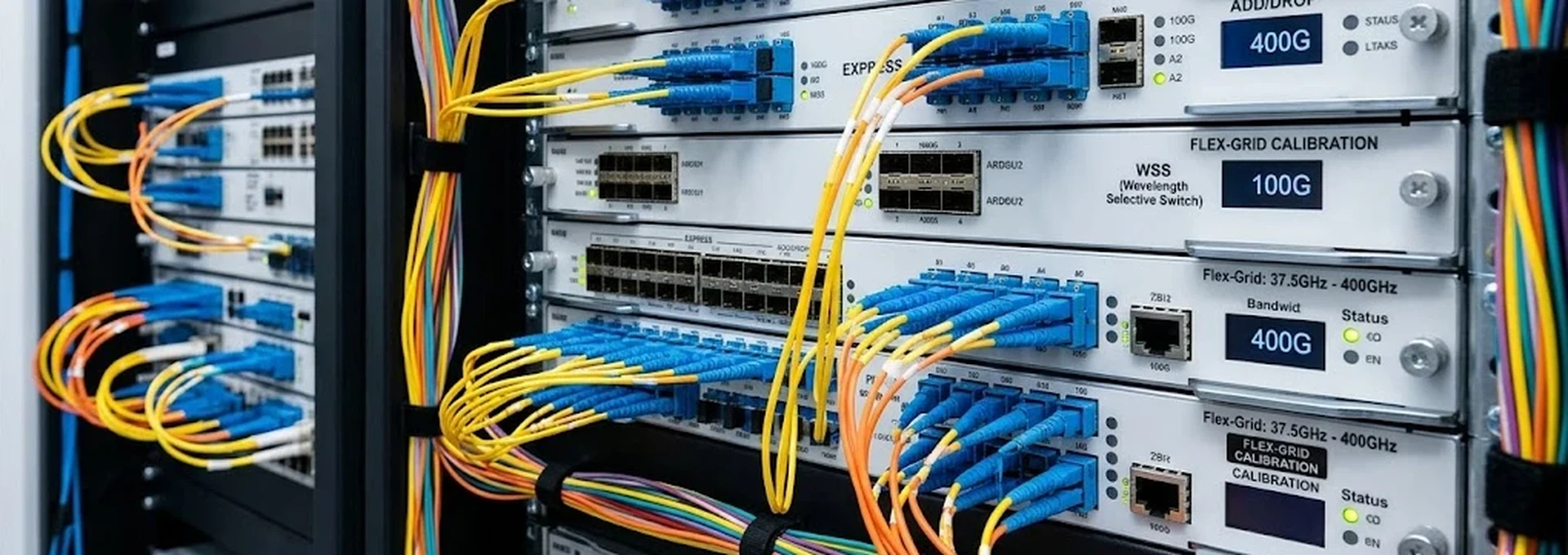
Fixed 50 GHz WSS modules assign every wavelength the same spectral slot regardless of its actual occupied bandwidth. A 100G DP-QPSK signal needs about 37.5 GHz; a 400G DP-16QAM signal needs 75 GHz. Flex-grid WSS allocates spectrum in 12.5 GHz increments per ITU-T G.694.1, giving each signal exactly what it needs. The capacity difference in a mixed-rate metro ring running both 100G and 400G is the difference between exhausting C-band at 50 wavelengths versus stretching it past 70 - which directly affects when you face the L-band expansion question above.
Wavelength contention adds another layer. On fixed-grid ROADM nodes, the same channel number cannot be dropped at two different ports on the same node - a blocking condition that gets worse as channel counts rise. CDC architecture eliminates this, but only if the hardware supports it from initial deployment. We stock DWDM mux/demux modules for fixed and flex-grid 40-channel C-band deployments for both fixed and flex-grid configurations, but our consistent recommendation to customers doing greenfield builds is flex-grid at the passive layer. The hardware cost premium is in the single-digit percentages; the avoided rework cost is not.
DWDM Channel Assignment Mistakes We See in Actual Deployments
Channel tables are standardized. The mistakes happen in how people use them.
The most common issue we encounter during pre-deployment support is ITU channel ID misalignment in multi-vendor environments. ITU-T G.694.1 numbers channels starting from 1, but the industry convention for 100 GHz C-band uses C17 through C61. L-band numbering is worse - Cisco's ONS 15454 uses a completely separate L-band channel scheme that does not map one-to-one to other vendors' numbering (Cisco DWDM Reference). When a customer orders our fixed-wavelength DWDM SFP+ transceivers pre-configured to a specific ITU channel frequency for "channel 35," the first thing our engineers confirm is whether they mean ITU channel 35 (193.5 THz / 1549.32 nm) or a vendor-specific channel map number that might correspond to a completely different wavelength. Getting this wrong means two ends of a link transmit on different frequencies - a fault that does not always show up as a clean failure; sometimes it presents as marginal BER that passes acceptance testing but degrades under load.
Alien wavelength management is the second underestimated risk. When a third-party transponder injects a DWDM signal into a line system that has no a priori knowledge of that signal's spectral characteristics, the alien channel can degrade adjacent wavelengths. Research in Optica Applicata confirmed experimentally that alien signal bandwidth must be strictly controlled to prevent this (Optica Applicata). For customers running our modules as alien wavelengths on third-party line systems, we provide measured spectral width data and recommended per-channel launch power - this is not information that typically appears on a product datasheet, and it matters more than the transceiver's list price.
A third issue - less common but more damaging - is deploying DWDM over legacy G.653 dispersion-shifted fiber without accounting for four-wave mixing. DSF has near-zero chromatic dispersion in C-band, which makes FWM extremely efficient. An IEEE-documented case on Taiwan's submarine cable infrastructure showed this forced a complete redesign of wavelength positions and power levels before the link could carry traffic (IEEE Xplore). If your fiber plant includes DSF segments - common in networks built before 2005 - your wavelength plan needs unequal channel spacing or L-band-only operation on those spans.
We manufacture DWDM transceivers from 1G SFP to 100G QSFP28 across the full C-band ITU grid, plus mux/demux modules, EDFA cards, and chassis systems. Full channel tables and compatibility matrices are on our DWDM equipment page. If you are mapping a wavelength plan to a purchase order, our engineers can cross-reference your channel assignments against our 100G DWDM QSFP28 inventory and confirm ITU compliance before shipment.
FAQ
Q: What ITU channels do your DWDM modules support?
A: Our 100G QSFP28 DWDM modules cover C17 through C61 on the 100 GHz grid. Tunable variants can be software-configured to any channel within that range. For 50 GHz-spaced systems, we carry both fixed and tunable options - contact our engineering team with your channel plan for exact model matching.
Q: How do I align channel numbering between your modules and my existing line system?
A: Provide us your line system vendor and model during ordering. Our pre-shipment verification includes confirming that the wavelength and frequency your system expects on a given channel ID matches what our module will transmit. This step is especially critical in mixed-vendor environments where L-band channel numbering varies by platform.
Q: Can your modules operate as alien wavelengths on third-party DWDM systems?
A: Yes, and we provide measured spectral width and recommended launch power data for alien wavelength integration. We have validated alien operation on several major OLS platforms - ask our team for compatibility notes specific to your line system.