





SFP optical transceivers features provide performance options
 Nov 07, 2025|
SFP optical transceivers features deliver flexible connectivity through hot-swappable modules that support multiple data rates, transmission distances, and fiber types. These compact devices enable network administrators to configure each port independently, adapting infrastructure to specific requirements without replacing entire networking equipment.
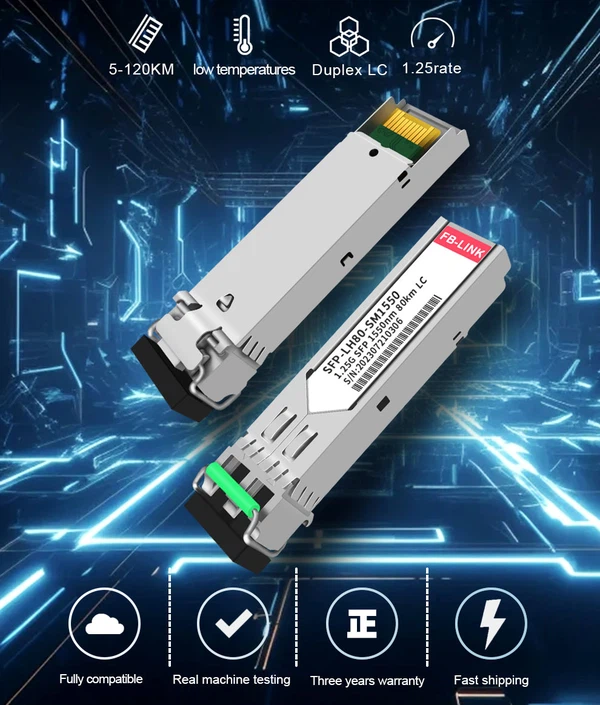
Modularity and Hot-Swappable Architecture
The fundamental advantage of SFP optical transceivers features lies in their modular design, standardized through the Multi-Source Agreement (MSA) under the Small Form Factor Committee. This hot-swappable capability allows technicians to insert or remove modules from active networking equipment without powering down systems or interrupting data transmission.
Network operations benefit significantly from this architecture. Equipment failures that would traditionally require scheduled maintenance windows can now be addressed immediately. A failing transceiver in a production environment gets replaced in seconds rather than requiring system downtime. This characteristic extends to network upgrades as well-transitioning from Fast Ethernet to Gigabit Ethernet merely requires swapping the transceiver module, not the entire switch or router.
The hot-swap functionality relies on several protective mechanisms. TX fault indicators monitor laser performance and signal system status when operational parameters fall outside acceptable ranges. Surge current protection prevents damage during insertion, while the I²C serial interface enables automatic module recognition. These safeguards ensure that the convenience of hot-swapping doesn't compromise system reliability or laser component integrity.
Variable Speed Support Across Form Factors
SFP optical transceivers features encompass multiple speed tiers, each optimized for different bandwidth requirements. Standard SFP modules support data rates from 100 Mbps to 4.25 Gbps, serving legacy Fast Ethernet and Gigabit Ethernet applications. The 1000BASE-T copper variant handles gigabit speeds over Category 5 cabling within 100-meter ranges.
The SFP+ enhanced specification, introduced in 2006, elevated performance to 10 Gbps for 10 Gigabit Ethernet and 8 Gbps for Fibre Channel networks. These modules maintain the same physical dimensions as standard SFP, enabling backward compatibility in many implementations-though operating at reduced speeds when placed in standard SFP ports.
Further iterations expanded capacity significantly. SFP28 modules, standardized in 2014, support 25 Gbps transmission for next-generation data center architectures. The SFP56 variant, emerging in 2024, doubles that to 50 Gbps using PAM4 signaling technology. Each form factor addresses specific network evolution paths, allowing organizations to scale bandwidth incrementally rather than through wholesale infrastructure replacement.
Wavelength Options and Transmission Distance Flexibility
SFP optical transceivers features provide extensive wavelength selection, directly impacting transmission distance capabilities. This diversity allows precise matching between application requirements and transceiver specifications.
Multimode fiber implementations predominantly use 850nm wavelength transceivers with LED or VCSEL light sources. These modules deliver cost-effective solutions for short-range applications-typically 550 meters for Gigabit Ethernet over OM3 fiber, reducing to 300 meters at 10 Gbps speeds. Data center rack-to-rack connections and campus building interconnects frequently deploy 850nm modules due to their economic advantages and adequate reach for these environments.
Single-mode fiber transceivers operating at 1310nm wavelengths extend reach to 10-40 kilometers depending on laser specifications. The 1310nm band experiences approximately 0.35 dB/km attenuation in standard single-mode fiber, enabling metropolitan area network deployments and point-to-point links between facilities. These transceivers use laser diodes providing focused, narrow-beam transmission through the fiber's 9-micron core.
For long-haul applications, 1550nm wavelength transceivers exploit the lowest attenuation window in optical fiber-approximately 0.25 dB/km. Standard 1550nm modules achieve 80-kilometer transmission, with extended-range variants reaching 120-160 kilometers. Telecommunications providers rely on this wavelength for backbone connections spanning cities and interconnecting data centers across metropolitan regions.
Bidirectional (BiDi) transceivers introduce additional flexibility by using wavelength-division multiplexing over single fibers. Common configurations pair 1310nm/1490nm or 1490nm/1550nm wavelengths, transmitting and receiving simultaneously on one fiber strand. This approach doubles fiber capacity in existing infrastructure, particularly valuable where fiber counts are limited or additional cable installation is cost-prohibitive.
Digital Diagnostic Monitoring Capabilities
A critical advancement in SFP optical transceivers features is Digital Diagnostic Monitoring (DDM), standardized through the SFF-8472 specification. This functionality transforms passive transceivers into active monitoring devices that report operational parameters in real-time through an I²C serial interface.
DDM enables tracking of five essential parameters: transceiver temperature, supply voltage, laser bias current, transmitted optical power, and received optical power. These measurements provide comprehensive health monitoring of each optical link. Temperature readings detect thermal stress that could indicate inadequate cooling or environmental issues. Voltage monitoring identifies power supply instabilities before they cause failures.
Laser bias current tracking offers particularly valuable predictive maintenance capabilities. As lasers age, quantum efficiency decreases, requiring higher bias current to maintain consistent output power. Monitoring this parameter reveals laser degradation trends, allowing proactive module replacement before catastrophic failure. Network operators can schedule maintenance during planned windows rather than responding to unexpected outages.
The optical power measurements address troubleshooting efficiency. When link performance degrades, DDM data immediately indicates whether the issue stems from transmitter output weakness, excessive fiber attenuation, or receiver sensitivity problems. This diagnostic capability eliminates guesswork, reducing mean time to repair significantly. A technician can remotely assess link health across an entire network infrastructure without physical inspection of every connection point.
Modern network management systems poll DDM data continuously, establishing baseline performance metrics and triggering alerts when parameters exceed threshold values. This proactive monitoring approach has become standard practice in enterprise networks, data centers, and telecommunications infrastructure where uptime requirements are stringent.
Fiber Type Compatibility and Link Budget Considerations
SFP optical transceivers features must align precisely with fiber infrastructure characteristics to ensure reliable operation. Single-mode and multimode fiber types are not interchangeable-they require distinct transceiver specifications matched to their physical properties.
Multimode fiber, with core diameters of 50 or 62.5 microns, supports multiple light propagation modes. This design accommodates LED-based light sources and relaxed coupling tolerances, reducing component costs. However, modal dispersion limits achievable distances. OM3 multimode fiber enables 300-meter 10 Gbps transmission, while OM4 extends this to 400 meters and OM5 to 550 meters at the same speed. The bandwidth-distance product constrains applications to campus environments and intra-building connections.
Single-mode fiber's 9-micron core permits only one propagation mode, eliminating modal dispersion. This characteristic enables the extraordinary distances achievable at 1310nm and 1550nm wavelengths. The tradeoff involves higher precision requirements for optical coupling and more expensive laser sources, but the capability to span tens of kilometers without regeneration justifies these costs in appropriate applications.
Link budget calculations determine practical transmission distances by accounting for all signal losses. Transmitter output power minus receiver sensitivity establishes the available power budget. Each fiber segment contributes attenuation based on wavelength and fiber quality-typically 0.35 dB/km at 1310nm or 0.25 dB/km at 1550nm for single-mode fiber. Connectors add 0.3-0.5 dB insertion loss per mating pair. Splices contribute 0.1-0.3 dB. A system margin of 3-5 dB accounts for aging, temperature variations, and unexpected losses.
For a 10-kilometer link using 1310nm single-mode transceivers: if transmit power is -3 dBm and receiver sensitivity is -20 dBm, the available budget is 17 dB. Fiber loss at 3.5 dB (10 km × 0.35 dB/km), connector loss at 1.0 dB (two connections), and 3 dB system margin totals 7.5 dB, providing adequate margin for reliable operation. This calculation methodology ensures link viability before deployment.
Temperature Ranges and Environmental Hardening
SFP optical transceivers features include temperature specifications that determine suitable deployment environments. Commercial-grade modules operate within 0°C to 70°C ranges, adequate for climate-controlled facilities such as data centers, telecommunications central offices, and indoor networking closets. These modules optimize cost-performance ratios for standard enterprise applications.
Industrial-grade transceivers withstand -40°C to 85°C temperature extremes, enabling deployment in harsh conditions. Outdoor telecommunications equipment, traffic management systems, industrial control networks, and military communications require this extended temperature tolerance. The wider operating range involves enhanced component selection, conformal coating for circuit boards, and ruggedized mechanical construction. These modifications increase costs but prove essential where environmental conditions exceed commercial specifications.
The temperature range directly impacts reliability in field conditions. A cell tower in northern climates experiences winter temperatures well below commercial module limits, while summer sun exposure drives temperatures above upper thresholds. Using commercial modules in such environments guarantees premature failures. Industrial transceivers designed for these conditions maintain specifications across the entire temperature range, ensuring consistent performance year-round.
Beyond temperature, industrial modules often incorporate additional protective features: enhanced electromagnetic interference shielding, improved electrostatic discharge protection, and hermetic sealing against moisture ingress. These characteristics address the complete spectrum of environmental challenges encountered in outdoor and industrial installations.

Connector Types and Physical Interfaces
SFP optical transceivers features employ various connector standards that determine physical compatibility with fiber infrastructure. The LC (Lucent Connector) duplex configuration dominates modern implementations, offering a compact form factor with 1.25mm ferrule diameter. This small size enables high port density on networking equipment while maintaining reliable connection performance. Most fiber-optic SFP modules specify LC duplex connectors-one fiber for transmit, one for receive.
SC (Subscriber Connector) interfaces appear in legacy installations and certain telecommunications applications. The larger 2.5mm ferrule provides robust mechanical characteristics but consumes more panel space. Some long-haul modules specify SC connectors where the larger form factor accommodates additional optical components or thermal management requirements.
BiDi transceivers use LC simplex connectors since they require only single-fiber operation. The simplex configuration eliminates one fiber strand, halving fiber count requirements in fiber-constrained installations. This design proves particularly valuable in retrofits where adding fiber capacity is impractical or cost-prohibitive.
RJ-45 connectors serve copper SFP variants, maintaining familiar Ethernet interface standards. These modules enable equipment originally designed for fiber-optic connections to interface with copper twisted-pair cabling within the 100-meter distance limitation. This flexibility allows mixing fiber uplinks with copper edge connections on a single platform.
MPO/MTP multi-fiber connectors appear in high-density applications requiring parallel optics. While less common in standard SFP form factors, they become relevant in QSFP and higher-speed implementations where multiple fiber pairs carry parallel data streams to achieve aggregate bandwidth targets.
Protocol Support and Application Versatility
SFP optical transceivers features extend beyond simple physical connectivity to support diverse networking protocols and standards. Ethernet applications dominate, with modules available for 100BASE-FX Fast Ethernet, 1000BASE-SX/LX Gigabit Ethernet, and 10GBASE-SR/LR 10 Gigabit Ethernet. Each variant optimizes for specific distance and fiber type combinations, providing precisely matched solutions for network topology requirements.
Fibre Channel storage networks utilize dedicated SFP modules supporting 1GFC, 2GFC, 4GFC, 8GFC, and 16GFC speeds. These protocols require specific encoding schemes-8b/10b for speeds through 8GFC, transitioning to 64b/66b encoding at 16GFC for improved efficiency. Storage area networks depend on these specialized modules to interconnect servers, storage arrays, and SAN switches with guaranteed performance characteristics.
SONET/SDH telecommunications protocols have corresponding SFP implementations for OC-3, OC-12, OC-48, and STM standards. These modules enable integration of optical transport equipment into Ethernet-based platforms, supporting legacy telecommunications infrastructure while transitioning toward packet-based architectures.
Passive Optical Network (PON) applications use specialized SFP modules for GPON, EPON, and 10G-PON standards. These fiber-to-the-home and fiber-to-the-premises deployments require transceivers with asymmetric wavelength specifications-often 1490nm downstream and 1310nm upstream-and must handle the split ratios inherent in passive optical splitter networks.
The protocol versatility of SFP optical transceivers features allows network architects to deploy unified equipment platforms across diverse applications. A single switch model can serve Ethernet access, Fibre Channel storage, and telecommunications transport simply by populating ports with appropriate transceiver modules.
Vendor Compatibility and Multi-Source Agreements
While the MSA establishes mechanical and electrical standards for SFP optical transceivers features, practical compatibility presents complexities. Major networking equipment vendors implement proprietary memory coding that identifies approved transceiver modules. This validation mechanism serves quality assurance purposes but creates market dynamics favoring vendor-specific modules.
Third-party transceiver manufacturers produce MSA-compliant modules coded to emulate vendor-specific requirements. These compatible modules offer substantial cost savings-often 50-80% below OEM pricing-while maintaining technical specifications. The compatibility depends on accurate coding implementation and adherence to electrical characteristics that equipment expects during initialization and operation.
Network administrators weighing cost optimization against vendor support considerations must evaluate several factors. Warranty terms often specify OEM-supplied components, though many vendors acknowledge third-party modules for out-of-warranty equipment. Technical support may require module swapping as a troubleshooting step, creating operational friction. Firmware updates occasionally modify transceiver validation routines, potentially affecting previously working third-party modules.
Testing and validation protocols mitigate these risks. Establishing qualified vendor lists through laboratory testing and pilot deployments builds confidence in specific third-party sources. Maintaining OEM spares for critical links while deploying compatible modules elsewhere balances cost and risk effectively.
The MSA's original intent-enabling multiple manufacturers to produce interoperable modules-succeeds at the physical and electrical level. The business practices layered atop these technical standards introduce complexity that organizations must navigate based on their specific risk tolerance and budget constraints.
Performance Metrics and Quality Indicators
SFP optical transceivers features include several specifications that indicate quality levels and performance capabilities. Bit error rate (BER) specifications define acceptable error thresholds, typically 10^-12 or better for telecommunications-grade modules. This metric reflects the transceiver's ability to maintain signal integrity across environmental variations and aging.
Extinction ratio measurements indicate the contrast between optical "1" and "0" states-typically 9-10 dB for quality modules. Higher extinction ratios provide better receiver discrimination, improving link margins and enabling reliable operation in marginal conditions. Low-quality modules with poor extinction ratios may function adequately in benign environments but fail under stress conditions.
Receiver sensitivity specifications define the minimum optical power required for reliable data recovery. A 1000BASE-LX module might specify -20 dBm sensitivity, meaning it can detect signals as weak as -20 dBm while maintaining the specified BER. More sensitive receivers enable longer-distance transmission or provide additional system margin for given distances.
Eye diagram analysis provides comprehensive signal quality assessment by superimposing multiple bit transitions. A "wide-open" eye indicates clean signal transitions with adequate timing margins and amplitude separation. Eye closure due to jitter, intersymbol interference, or noise reduces margins and increases error probability. Quality transceivers maintain specified eye mask requirements across their operating temperature range and throughout their rated lifetime.
DDM accuracy specifications matter for effective monitoring. Temperature measurements should maintain ±3°C accuracy, voltage within ±3%, and optical power within ±3 dB. These tolerances enable reliable threshold setting and trend analysis. Lower-quality modules may report inaccurate DDM data, undermining the diagnostic value this feature should provide.
Frequently Asked Questions
What makes SFP transceivers hot-swappable and why does this matter?
Hot-swappability stems from protective circuitry and standardized interfaces that allow module insertion and removal during system operation. TX fault monitoring, surge protection, and automatic configuration prevent damage during transitions. This capability eliminates maintenance windows for module replacement, reducing operational overhead and improving availability in production networks where downtime carries significant business impact.
How do wavelength choices affect transmission distance capabilities?
Wavelength determines fiber attenuation rates and dispersion characteristics. The 850nm wavelength suits multimode fiber for distances under 550 meters with cost-effective LED sources. At 1310nm, single-mode fiber enables 10-40 kilometer transmission with moderate attenuation of 0.35 dB/km. The 1550nm wavelength achieves 80-120 kilometer ranges by leveraging fiber's lowest loss window at 0.25 dB/km, though requiring more sophisticated laser components.
Can standard SFP modules work in SFP+ ports?
Most SFP+ ports accept standard SFP modules through backward compatibility, operating at the lower module speed-typically 1 Gbps rather than the port's 10 Gbps capability. The reverse typically fails: SFP+ modules cannot function in standard SFP ports due to electrical interface differences. This asymmetric compatibility allows gradual network upgrades by maintaining legacy modules during transitions to higher-speed infrastructure.
What DDM parameters provide the most operational value?
Laser bias current trends offer the strongest predictive maintenance indicators, revealing impending module failures months before occurrence as aging lasers require increasing current to maintain output power. Received power monitoring immediately identifies fiber degradation or connection issues, while temperature tracking detects environmental problems. Combined, these metrics transform reactive troubleshooting into proactive maintenance, substantially reducing unplanned outages in production networks.
Implementation Considerations for Network Design
Deploying SFP optical transceivers features effectively requires systematic planning that accounts for current requirements and future expansion. Link budget calculations should incorporate 3-5 dB safety margins beyond theoretical limits to accommodate fiber aging, contamination accumulation, and temperature-induced performance variations. This conservative approach prevents marginal links that function initially but degrade into unreliability over time.
Fiber infrastructure characterization precedes transceiver selection. Documenting fiber types, core sizes, and connector conditions across the network enables accurate specification matching. Mixing single-mode and multimode segments without proper documentation leads to mismatched transceivers, failed links, and troubleshooting delays. Maintaining asset databases that track each fiber span's characteristics streamlines deployment and supports efficient maintenance operations.
Standardization strategies balance inventory management against application-specific optimization. Limiting transceiver types to a few common specifications simplifies sparing and reduces stock investment. However, using 10-kilometer modules for 500-meter links wastes cost unnecessarily. Establishing tier systems-short-reach multimode, medium-reach single-mode, and long-haul configurations-provides adequate flexibility while maintaining manageable inventory diversity.
Temperature specifications must align with deployment environments. Outdoor installations, industrial facilities, and uncontrolled spaces require extended-temperature modules despite higher costs. Using commercial modules in these applications guarantees failures that exceed the cost differential many times over through emergency troubleshooting, unplanned replacement, and service disruptions.
Testing protocols should validate transceiver performance before production deployment. Loopback testing confirms basic functionality, while extended burn-in periods under load reveal marginal modules that might fail prematurely. DDM monitoring during testing establishes baseline parameters and verifies measurement accuracy. These validation steps prevent deploying defective modules into critical infrastructure.
Vendor qualification processes for compatible modules should include laboratory evaluation, pilot deployments, and performance monitoring over extended periods. While cost savings justify third-party sourcing, quality variations among manufacturers necessitate due diligence. Establishing approved vendor relationships based on demonstrated reliability protects network integrity while capturing economic benefits.
Documentation standards recording transceiver installations-including serial numbers, installation dates, and DDM baselines-enable lifecycle management and failure pattern analysis. This operational discipline supports data-driven maintenance scheduling and vendor performance evaluation, continuously improving infrastructure reliability through systematic knowledge accumulation.
The versatility that SFP optical transceivers features provide translates into tangible operational advantages when deployed thoughtfully within frameworks that address technical requirements, environmental conditions, and organizational processes. Network infrastructure investments spanning years to decades benefit from this careful planning that balances immediate functionality against long-term maintainability and scalability requirements.