





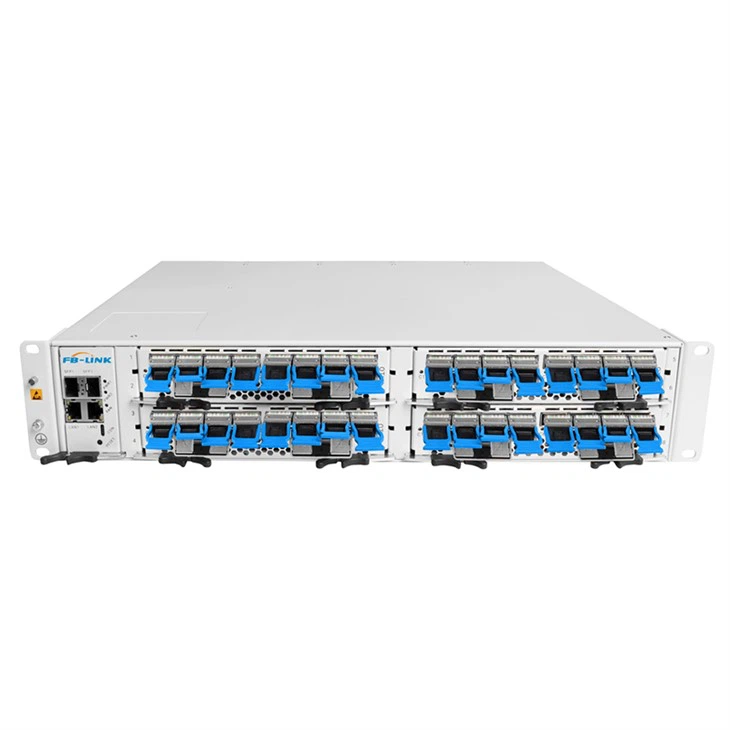


6.4T DCI Transmission Platform
DCI2800-II 6.4T DCI Transmission Platform is a high-speed WDM product independently developed by FB-LINK. The service board supports multi service and large capacity transmission networking applications.It is mainly positioned for the interconnection between operators and Internet enterprise data center rooms, and can also be applied to various transmission applications of local network / metropolitan area network convergence layer and access layer long-distance network.

- Product Introduction
DCI2800-II 6.4T DCI Transmission Platform is a high-speed WDM product independently developed by FB-LINK. Its service boards support multi-service, high-capacity transmission networking applications, primarily designed for interconnection between telecom operators and internet enterprise data centers. The platform is also applicable to various transmission scenarios in local networks, metro network aggregation layers, access layers, and long-haul networks.
The chassis features an advanced hardware architecture with a centerless board design, significantly enhancing the equipment's ventilation and heat dissipation capabilities. With a single-board switching capacity of up to 800Gbps and total electrical layer processing capacity of 3.2Tbps, the system delivers intelligent transmission solutions tailored to diverse capacity requirements, distance specifications, and business applications.
Features
● It adopts photoelectric integration and pluggable modular design; components support hot-swappable, on-demand deployment and on-demand expansion.
● It adopts the heat dissipation design of front air and rear air, provides 1+1 FRU fan unit, and supports automatic speed adjustment.
● 19-inch standard rack type, suitable for data center equipment room, and can be deployed in the same cabinet as IT equipment.
● The transmission capacity of each pair of optical fibers can reach 25.6Tbit/s @ C+ band 400G*64λ, and the maximum transmission capacity of each subrack is 3.2Tbit/s.
● The single-wavelength capacity can reach 400G, and it is oriented to 600G&800G&1.2T continuous evolution.
● The optical layer board is highly integrated with OA, WSS, VOA, OSC, OTDR, OCM, OLP and other functions to simplify the internal fiber connection.
● Support 10GE, 100GE, 100GE FlexE(Unware), STM-64, 10GE WAN, OTU2, OTU4 and other service access.
● Support 9-dimensional ROADM networking, and support flexible grid (Flexible Grid).
● Supports comprehensive performance monitoring of the service layer, OTN layer, and optical layer, with visible quality.
● Provides multiple multi-layer network-level and device-level protection schemes. The protection switching delay is less than 50ms, ensuring superior protection performance
● Support NETCONF/YANG standard open interface and GUI management platform based on B/S architecture.


The exponential growth of cloud computing, digital transformation, and distributed applications has fundamentally changed how enterprises manage their network infrastructure. As organizations expand their data center footprint across multiple locations, the need for robust, high-performance connectivity has never been more critical. Data Center Interconnect (DCI) technology has emerged as the backbone that enables seamless communication between geographically dispersed facilities.
What Makes DCI Essential for Modern Enterprises
DCI solutions bridge the gap between data centers, creating unified network environments that support disaster recovery, workload migration, and distributed cloud architectures. Unlike traditional WAN connections, DCI infrastructure is purpose-built for high-bandwidth, low-latency communication between data centers, supporting everything from real-time data replication to live virtual machine migration.
The evolution of DCI technology has reached a pivotal moment. Organizations now require transmission capacities that can handle massive data volumes while maintaining cost efficiency. Modern optical transport systems have revolutionized DCI capabilities, offering unprecedented bandwidth density and flexibility.
Key Advantages of Next-Generation DCI Infrastructure
Scalability Without Limits
Contemporary DCI platforms embrace modular architectures that grow with your business. Hot-swappable components eliminate downtime during upgrades, while pluggable modules allow organizations to deploy capacity incrementally rather than over-provisioning from day one.
Operational Excellence
Advanced DCI systems integrate sophisticated monitoring across multiple network layers. This visibility enables proactive management, reducing mean time to repair and optimizing network performance. Automated thermal management and intelligent power distribution further reduce operational overhead.
Future-Ready Architecture
The telecommunications landscape continues evolving toward higher single-wavelength capacities. Leading DCI solutions are engineered for seamless evolution, supporting current requirements while providing clear migration paths to next-generation technologies without forklift upgrades.
Enterprise-Grade Reliability
Mission-critical applications demand network infrastructure that never fails. Modern DCI implementations incorporate multi-layered protection mechanisms with sub-50-millisecond failover times, ensuring business continuity even during component failures or network disruptions.
DCI Use Cases Across Industries
Financial Services: High-frequency trading platforms and banking systems rely on DCI connections to synchronize transactions across data centers while meeting stringent compliance requirements for data sovereignty.
Healthcare: Medical institutions use DCI networks to share imaging data, electronic health records, and enable telemedicine applications across hospital campuses and research facilities.
Cloud Service Providers: Hyperscale operators depend on DCI infrastructure to interconnect availability zones, enabling geographic redundancy and providing customers with seamless multi-region deployments.
Media and Entertainment: Content distribution networks leverage DCI solutions to replicate massive video libraries and deliver high-quality streaming experiences across global audiences.
Technology Foundations of Modern DCI
The technical foundation of advanced DCI systems rests on optical transport technology. Dense wavelength-division multiplexing (DWDM) enables multiple data streams to travel simultaneously over single fiber pairs, dramatically increasing capacity while reducing physical infrastructure requirements.
Reconfigurable optical add-drop multiplexer (ROADM) technology brings unprecedented flexibility to DCI networks. This capability allows network operators to dynamically provision wavelengths and reroute traffic without physical intervention, enabling rapid response to changing business needs.
Integration is another hallmark of contemporary DCI platforms. By consolidating optical amplification, switching, monitoring, and protection functions onto unified boards, modern systems minimize complexity while enhancing reliability.
DCI Deployment Considerations
Physical Infrastructure: Standard rack-mount form factors enable DCI equipment to coexist with IT infrastructure, optimizing data center real estate and simplifying installation.
Thermal Design: Front-to-back airflow patterns align with data center cooling best practices, ensuring efficient heat dissipation without specialized environmental requirements.
Management Systems: Open interfaces based on industry standards facilitate integration with existing OSS/BSS platforms, while web-based management consoles provide intuitive day-to-day operations.
Service Flexibility: Support for diverse protocols ensures DCI infrastructure accommodates both legacy systems and cutting-edge applications, protecting technology investments.
Frequently Asked Questions About DCI
What is the difference between DCI and traditional WAN?
DCI is specifically optimized for data center-to-data center connectivity with emphasis on high bandwidth, low latency, and dedicated infrastructure. Traditional WAN serves general-purpose connectivity across diverse locations. DCI solutions typically offer greater bandwidth density, more sophisticated optical technology, and features tailored to data center operations like synchronous replication and storage extension.
How does DCI support disaster recovery strategies?
DCI enables real-time or near-real-time data replication between primary and backup data centers. The high-bandwidth, low-latency characteristics of DCI links allow organizations to maintain synchronous copies of critical data across sites. When disaster strikes, workloads can failover to the secondary location with minimal data loss and rapid recovery times, often measured in seconds rather than hours.
What bandwidth capacities do modern DCI solutions support?
Current DCI technologies support extensive capacity ranges. At the wavelength level, solutions can handle hundreds of gigabits per second on individual channels. When multiple wavelengths are combined across fiber pairs, aggregate capacities can reach tens of terabits per second, providing headroom for years of traffic growth without infrastructure replacement.
Can DCI infrastructure scale as my organization grows?
Yes, modern DCI architectures are designed for incremental scalability. Modular designs allow you to add capacity by installing additional components rather than replacing entire systems. This pay-as-you-grow approach aligns capital expenditure with actual business needs while maintaining investment protection.
Is DCI only for large enterprises?
While DCI technology originated in large-scale environments, solutions now exist across a spectrum of sizes and price points. Mid-market organizations with multi-site operations, hybrid cloud deployments, or disaster recovery requirements can benefit from DCI infrastructure. The key is matching the solution to your specific capacity, distance, and budget requirements.
How does DCI integrate with cloud connectivity?
DCI complements cloud connectivity strategies by providing the transport layer between on-premises data centers and cloud on-ramps. Many organizations use DCI to interconnect their private data centers while also extending connectivity to public cloud regions, creating hybrid architectures. The same optical infrastructure that supports inter-data center communication can often carry cloud connectivity traffic.
What protection mechanisms do DCI systems offer?
Sophisticated DCI platforms implement protection at multiple levels. Optical layer protection can automatically switch traffic to backup paths in case of fiber cuts. Equipment redundancy ensures component failures don't interrupt service. Path diversity across physical routes provides resilience against regional outages. These combined mechanisms deliver the carrier-grade reliability demanded by business-critical applications.
How difficult is it to manage a DCI network?
Modern DCI systems emphasize operational simplicity through comprehensive management platforms. Unified dashboards provide visibility across all network layers, from physical infrastructure to service-level performance. Automated provisioning reduces configuration time, while standards-based APIs enable integration with existing tools. Many organizations find DCI networks easier to manage than the collection of disparate systems they replace.
The Future of DCI Technology
The trajectory of DCI development points toward even greater capacities, improved power efficiency, and enhanced intelligence. Artificial intelligence and machine learning are beginning to optimize DCI network operations, predicting failures before they occur and automatically adjusting configurations for optimal performance.
As edge computing proliferates, DCI concepts are extending beyond traditional data center pairs to encompass more distributed architectures. The principles that make DCI effective for connecting major facilities are being adapted to interconnect edge locations, creating hierarchical networks that support latency-sensitive applications.
Organizations investing in DCI infrastructure today are positioning themselves for the demands of tomorrow's digital economy. The combination of massive bandwidth, operational flexibility, and proven reliability makes DCI technology fundamental to enterprise network strategy.
Whether you're planning disaster recovery infrastructure, building hybrid cloud connectivity, or enabling distributed applications, DCI solutions provide the foundation for success. The right DCI platform doesn't just solve today's challenges-it creates possibilities for innovation that haven't yet been imagined.
Hot Tags: DCI


