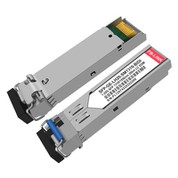
18CH CWDM Dual-fiber Mux/Demux, 1270-1610nm, 3.5dB Typical IL, LC/UPC, ABS Box Module
CWDM is a low-cost WDM transmission technology for the access layer of metropolitan area networks. An optical multiplexer is used to multiplex optical signals of different wavelengths into a single optical fiber for transmission. At the receiving end of the link, an optical demultiplexer is used to decompose the mixed signal in the optical fiber into signals of different wavelengths and connect them to the corresponding receiving end. equipment. CWDM equipment greatly reduces network operating costs due to its low cost, small size, low power consumption, easy maintenance, and convenient power supply. And is used by a wide range of network systems. Products can meet the customized needs of various universities, operators and enterprises.

- Product Introduction
Specifications
|
Parameter |
4 Channel |
8 Channel |
16 Channel |
18 Channel |
||||||
|
Mux Mux |
Demux |
Mux |
Demux |
Mux |
Demux |
Mux |
Demux |
|||
|
Center Wavelength (nm) |
1270~1610/1271~1611 |
|||||||||
|
Center wavelength Accuracy (nm) |
±0.5 |
|||||||||
|
Channel Spacing (nm) |
20 |
|||||||||
|
Channel Passband (@-0.5dB bandwidth)(nm) |
±7.5/±6.5 |
|||||||||
|
Insertion Loss(dB) |
≤1.5 |
≤2.5 |
≤3.5 |
≤3.5 |
||||||
|
Channel Uniformity(dB) |
≤0.6 |
≤1.0 |
≤1.5 |
≤1.5 |
||||||
|
Isolation(dB) |
Adjacent |
>30 |
||||||||
|
Non-adjacent |
>40 |
|||||||||
|
Isolation(dB) |
Express with filter |
>30 |
||||||||
|
Express without filter |
>12 |
|||||||||
|
Channel Ripple(dB) |
<0.3 |
|||||||||
|
Insertion Loss Temperature Sensitivity(dB/℃) |
<0.005 |
|||||||||
|
Wavelength Temperature Shifting(nm/℃) |
<0.002 |
|||||||||
|
Polarization Dependent Loss(dB) |
<0.1 |
|||||||||
|
Polarization Mode Dispersion(ps) |
<0.1 |
|||||||||
|
Directivity(dB) |
>50 |
|||||||||
|
Return Loss(dB) |
>45 |
|||||||||
|
Maximum Power Handling(mW) |
300 |
|||||||||
|
Operating Temperature(℃) |
-40~+85 |
|||||||||
|
Storage Temperature(℃) |
-40~+85 |
|||||||||
|
Package dimension (mm) (Glass tube) |
5.5*25 |
|||||||||
|
Package dimension (mm) (Steel tube) |
5.5*34 |
|||||||||
|
Package dimension(mm) (ABS box) |
L100×W80×H10 |
|||||||||
|
L120×W80×H18 |
||||||||||
|
L141×W115×H18 |
||||||||||
|
A |
B |
C |
D |
E |
F |
|
Number of Channels |
1st Channel |
Configuration |
Fiber Type |
Fiber Length |
Connector |
|
04:4 Channel 08:8 Channel 16:16 Channel 18:18 Channel N:N Channel
|
27:1270nm …… 47:1470nm 49:1490nm …… 61:1610nm |
M:Mux D:Demux O:OADM |
1:Bare fiber 2:900um loose tube 3:2mm Cable 4:3mm Cable |
1:1m 2:2m S:Specify |
0:None 1:FC/APC 2:FC/PC 3:SC/APC 4:SC/PC 5:ST 6:LC S:Specify
|
Wavelength division multiplexing has revolutionized how we transmit data across fiber optic networks. Among the various multiplexing technologies available, CWDM (Coarse Wavelength Division Multiplexing) stands out as a cost-effective solution that delivers impressive performance for metropolitan and enterprise networks.
What Makes CWDM an Ideal Choice for Network Expansion
CWDM technology allows multiple optical signals to travel simultaneously through a single fiber by assigning each signal a different wavelength. This approach dramatically increases bandwidth capacity without requiring additional fiber infrastructure. Unlike its counterpart DWDM (Dense Wavelength Division Multiplexing), CWDM uses wider channel spacing, which reduces component costs while maintaining excellent signal quality.
The key advantage of implementing CWDM solutions lies in their ability to operate across a broad spectrum range, typically from 1270nm to 1610nm. This wide operational window provides flexibility for various network configurations and future scalability. The technology utilizes standard channel spacing, allowing network administrators to add or remove wavelengths as demand fluctuates without disrupting existing traffic.
Performance Characteristics That Matter
When evaluating CWDM multiplexers, several critical performance metrics determine overall network reliability. Insertion loss represents one of the most important factors, as lower values ensure that optical signals maintain their strength throughout transmission. Modern CWDM devices achieve minimal signal degradation, preserving data integrity across extended distances.
Channel isolation is another crucial specification that prevents crosstalk between adjacent wavelengths. Superior isolation ensures that each channel operates independently, eliminating interference that could compromise data transmission. The difference between adjacent and non-adjacent channel isolation becomes particularly important in high-density deployments where multiple wavelengths operate simultaneously.
Temperature stability represents a significant consideration for CWDM installations in diverse environments. Professional-grade multiplexers maintain consistent performance across extreme temperature ranges, from arctic conditions to desert heat. This thermal resilience ensures reliable operation in outdoor cabinets, industrial facilities, and data centers without climate control.
Applications Driving CWDM Adoption
Telecommunications providers leverage CWDM technology extensively for metro networks, where the cost-per-bit advantage over traditional approaches delivers substantial savings. Service providers can multiply their fiber capacity without trenching new cables, reducing both capital expenditure and deployment time.
Enterprise networks benefit equally from CWDM implementation. Organizations with multiple buildings across campus environments use this technology to interconnect facilities with high-bandwidth links. Storage area networks (SANs) also rely on CWDM to extend connectivity between data centers, supporting disaster recovery and business continuity strategies.
Cable television operators have embraced CWDM for video distribution, combining multiple HD channels onto single fibers. This consolidation simplifies network architecture while supporting the ever-increasing demand for high-quality video content.
Design Considerations for Optimal Performance
Successful CWDM deployment requires careful attention to several technical factors. Wavelength accuracy must be tightly controlled to ensure signals remain within their designated channels. Even slight deviations can cause adjacent channel interference or signal loss at filtering stages.
Polarization effects present another design challenge that quality CWDM products address through careful engineering. Polarization-dependent loss and polarization mode dispersion can degrade signal quality if not properly managed. Advanced multiplexer designs minimize these effects, ensuring consistent performance regardless of the polarization state of incoming light.
Return loss specifications indicate how well the device prevents reflections that could destabilize laser sources or create noise in the optical system. High return loss values demonstrate superior optical impedance matching and contribute to overall system stability.
Installation and Integration Best Practices
CWDM multiplexers come in various form factors to accommodate different deployment scenarios. Compact glass tube packaging suits space-constrained applications, while steel tube options provide enhanced mechanical protection for industrial environments. Larger housing options with protective enclosures facilitate outdoor installations or equipment rooms where additional shielding is beneficial.
Proper handling during installation preserves the optical quality of connectors and internal components. Following manufacturer guidelines for bend radius, connector cleaning, and environmental protection ensures long-term reliability. Many installations benefit from using protective enclosures that shield against dust, moisture, and mechanical stress.
The Economic Value Proposition
Organizations evaluating network infrastructure investments find CWDM particularly attractive due to its favorable cost structure. The technology requires fewer precision components than denser multiplexing approaches, translating to lower initial equipment costs. Additionally, the passive nature of CWDM devices means no power consumption or active cooling requirements, reducing operational expenses.
The ability to incrementally add capacity represents another economic advantage. Rather than overbuilding network capacity upfront, administrators can deploy channels as needed, aligning capital expenditure with revenue-generating services. This pay-as-you-grow model improves return on investment and reduces financial risk.
Future-Proofing Network Infrastructure
As bandwidth demands continue their exponential growth, CWDM technology provides a clear upgrade path. Networks initially deployed with partial channel utilization can easily accommodate additional wavelengths as requirements increase. The standardized wavelength grid ensures compatibility with a wide range of optical transceivers and equipment from multiple vendors.
Emerging applications in 5G fronthaul and backhaul networks are driving renewed interest in CWDM solutions. The technology's ability to aggregate multiple cell sites onto common fiber infrastructure aligns perfectly with the densification strategies required for next-generation wireless networks.
Frequently Asked Questions
What is the main difference between CWDM and DWDM?
CWDM uses wider channel spacing (typically 20nm) compared to DWDM's much tighter spacing (often less than 1nm). This makes CWDM components less expensive and suitable for shorter distances, while DWDM supports more channels and longer reach. CWDM is ideal for metro networks and enterprise applications where cost-effectiveness matters more than channel density.
How many channels can a CWDM system support?
Standard CWDM systems typically support up to 18 channels across the wavelength range from 1270nm to 1610nm with 20nm spacing. However, practical deployments often use 4, 8, or 16 channels depending on bandwidth requirements. The modular nature of CWDM allows starting with fewer channels and expanding as needed.
What distances can CWDM technology cover effectively?
CWDM typically performs well for distances up to 80-120 kilometers, depending on fiber quality and channel wavelength. Shorter wavelengths (around 1310nm) experience higher attenuation than longer wavelengths (1550nm region). For metropolitan networks and campus interconnects under 40km, CWDM delivers excellent performance at significantly lower cost than alternatives.
Do CWDM multiplexers require power or active cooling?
No, CWDM multiplexers are passive optical devices that require no electrical power. They use thin-film filter technology to separate and combine wavelengths purely through optical properties. This passive operation means zero power consumption, no heat generation, and higher reliability since there are no electronic components to fail.
Can CWDM work with existing fiber infrastructure?
Yes, CWDM works with standard single-mode fiber (SMF) already installed in most networks. There's no need to replace existing fiber to implement CWDM. Organizations can multiply their fiber capacity simply by adding CWDM multiplexers at each end of the fiber link and using wavelength-specific transceivers.
How does temperature affect CWDM performance?
Quality CWDM multiplexers are designed to maintain stable performance across industrial temperature ranges. While extreme temperatures can cause slight wavelength shifts, professional-grade devices incorporate temperature compensation to minimize these effects. The wavelength stability and insertion loss variations remain within acceptable limits throughout the operating temperature range.
Is special training required to install CWDM equipment?
Basic fiber optic installation skills are sufficient for CWDM deployment. Technicians familiar with fiber connector cleaning, proper handling techniques, and optical power measurement can successfully install CWDM systems. The passive nature and straightforward architecture make CWDM more accessible than complex active optical systems.
What maintenance do CWDM systems require?
CWDM multiplexers require minimal maintenance due to their passive design. Periodic connector inspection and cleaning represent the primary maintenance activities. Unlike active equipment, there are no software updates, cooling system maintenance, or power supply replacements to worry about. This low maintenance profile contributes to the technology's excellent total cost of ownership.
Hot Tags: CWDM