





8CH DWDM-LGX-BOX
DWDM multi-channel multiplexer /demultiplexer (Mux /DeMux)modules are available on ITU channel spacing of 100GHz. They demonstrate low loss, temperature insensitivity and reliable performance in any system application.Fixed Mux/DeMux modules offer low-cost wavelength management solutions that are suitable for long haul, metro, and access application.

- Product Introduction
Specifications
|
Item |
Unit |
Parameters |
||
|
Channel Spacing |
GHz |
100GHZ |
||
|
Wavelength Range |
C- band ITU channels |
|||
|
Channel Centers |
nm |
ITU |
||
|
Channels |
ch |
4 |
8 |
16 |
|
Passbandwidth |
nm |
≥ +/- 0.13 |
||
|
Passband Ripple |
dB |
≤ 0.5 |
||
|
Channel Insertion Loss |
dB |
≤1.5 |
≤2.5 |
≤4.8 |
|
Channel EXP Insertion Loss |
dB |
≤1.8 |
≤2.8 |
≤5.0 |
|
Isolation (adjacent channel) |
dB |
≥30 |
||
|
Isolation (non-adjacent channel) |
dB |
≥ 40 |
||
|
Polarization Dependent Loss |
dB |
≤ 0.2 |
||
|
Polarization Mode Dispersion |
ps |
≤ 0.2 |
||
|
Directivity |
dB |
≥ 50 |
||
|
Return Loss |
dB |
≥ 45 |
||
|
Optical Power Handling |
mW |
≤ 500 |
||
|
Operating Temperature Range |
0C |
-5 to 70 |
||
|
Storage Temperature Range |
0C |
-40 to +85 |
||
|
Fiber Type |
NA |
SMF-28e+ |
||
|
Package dimensions |
mm |
L100 x W80 x H10(2CH-8CH) |
||
|
L142 x W102 x H14.5(9CH-18CH) |
||||
All the specifications are based on the devices without connector.
Applications configuration diagram
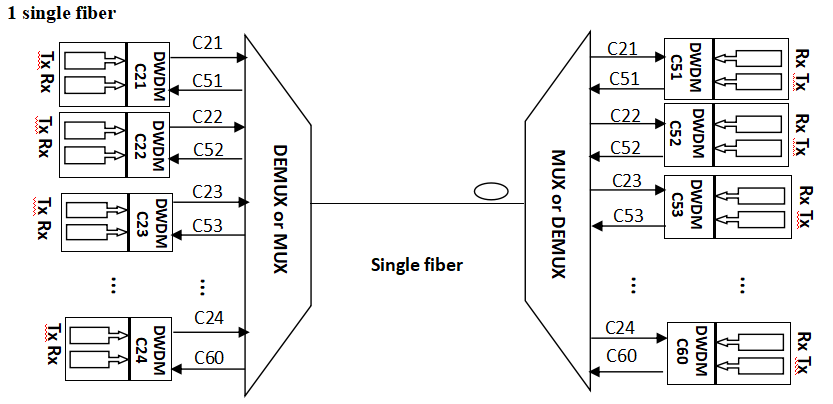
Simplex Bi-Directional Transmission should be used in pairs, MUX/DEMUX port for specific wavelength must be opposite.

Ordering information
|
product |
Channel |
ITU channel |
Fiber Type |
Fiber Length |
Connector |
|
100G DWDM OADM |
4=4 channel 8=8 channel 16=16 channel |
C20= 1561.42 nm |
1=Bare fiber 3=3.0mm |
1=1m 2=2m |
0=None 2=FC/PC |
On ITU grid in C-band
|
Channel |
Frequency (THz) |
Wavelength (nm) |
Channel |
Frequency (THz) |
Wavelength (nm) |
|
H60 |
196.05 |
1529.163 |
C60 |
196 |
1529.553 |
|
H59 |
195.95 |
1529.944 |
C59 |
195.9 |
1530.334 |
|
H58 |
195.85 |
1530.725 |
C58 |
195.8 |
1531.116 |
|
H57 |
195.75 |
1531.507 |
C57 |
195.7 |
1531.898 |
|
H56 |
195.65 |
1532.290 |
C56 |
195.6 |
1532.681 |
|
H55 |
195.55 |
1533.073 |
C55 |
195.5 |
1533.465 |
|
H54 |
195.45 |
1533.858 |
C54 |
195.4 |
1534.250 |
|
H53 |
195.35 |
1534.643 |
C53 |
195.3 |
1535.036 |
|
H52 |
195.25 |
1535.429 |
C52 |
195.2 |
1535.822 |
|
H51 |
195.15 |
1536.216 |
C51 |
195.1 |
1536.609 |
|
H50 |
195.05 |
1537.003 |
C50 |
195 |
1537.397 |
|
H49 |
194.95 |
1537.792 |
C49 |
194.9 |
1538.186 |
|
H48 |
194.85 |
1538.581 |
C48 |
194.8 |
1538.976 |
|
H47 |
194.75 |
1539.371 |
C47 |
194.7 |
1539.766 |
|
H46 |
194.65 |
1540.162 |
C46 |
194.6 |
1540.557 |
|
H45 |
194.55 |
1540.953 |
C45 |
194.5 |
1541.349 |
|
H44 |
194.45 |
1541.746 |
C44 |
194.4 |
1542.142 |
|
H43 |
194.35 |
1542.539 |
C43 |
194.3 |
1542.936 |
|
H42 |
194.25 |
1543.333 |
C42 |
194.2 |
1543.730 |
|
H41 |
194.15 |
1544.128 |
C41 |
194.1 |
1544.526 |
|
H40 |
194.05 |
1544.924 |
C40 |
194 |
1545.322 |
|
H39 |
193.95 |
1545.720 |
C39 |
193.9 |
1546.119 |
|
H38 |
193.85 |
1546.518 |
C38 |
193.8 |
1546.917 |
|
H37 |
193.75 |
1547.316 |
C37 |
193.7 |
1547.715 |
|
H36 |
193.65 |
1548.115 |
C36 |
193.6 |
1548.515 |
|
H35 |
193.55 |
1548.915 |
C35 |
193.5 |
1549.315 |
|
H34 |
193.45 |
1549.715 |
C34 |
193.4 |
1550.116 |
|
H33 |
193.35 |
1550.517 |
C33 |
193.3 |
1550.918 |
|
H32 |
193.25 |
1551.319 |
C32 |
193.2 |
1551.721 |
|
H31 |
193.15 |
1552.122 |
C31 |
193.1 |
1552.524 |
|
H30 |
193.05 |
1552.926 |
C30 |
193 |
1553.329 |
|
H29 |
192.95 |
1553.731 |
C29 |
192.9 |
1554.134 |
|
H28 |
192.85 |
1554.537 |
C28 |
192.8 |
1554.940 |
|
H27 |
192.75 |
1555.343 |
C27 |
192.7 |
1555.747 |
|
H26 |
192.65 |
1556.151 |
C26 |
192.6 |
1556.555 |
|
H25 |
192.55 |
1556.959 |
C25 |
192.5 |
1557.363 |
|
H24 |
192.45 |
1557.768 |
C24 |
192.4 |
1558.173 |
|
H23 |
192.35 |
1558.578 |
C23 |
192.3 |
1558.983 |
|
H22 |
192.25 |
1559.389 |
C22 |
192.2 |
1559.794 |
|
H21 |
192.15 |
1560.200 |
C21 |
192.1 |
1560.606 |
Understanding DWDM Technology: The Backbone of Modern Fiber Optic Networks
Fiber optic networks have revolutionized how we transmit data across the globe, and at the heart of this revolution lies Dense Wavelength Division Multiplexing. This sophisticated technology enables network operators to maximize their existing fiber infrastructure by transmitting multiple wavelengths of light simultaneously through a single optical fiber.
What Makes DWDM Essential for High-Capacity Networks
Dense Wavelength Division Multiplexing represents a quantum leap in optical networking efficiency. By utilizing different wavelengths (or colors) of light to carry separate data streams, DWDM systems can dramatically increase the bandwidth capacity of fiber optic cables without requiring additional physical infrastructure. This approach has become indispensable for telecommunications providers, data centers, and enterprises seeking to meet ever-growing bandwidth demands.
The technology operates within specific wavelength bands, with the C-band being particularly popular due to its optimal performance characteristics. Each wavelength channel functions as an independent data highway, operating at precise frequencies defined by the International Telecommunication Union standards. This standardization ensures interoperability across different manufacturers and network segments.
Core Advantages of Implementing DWDM Solutions
Bandwidth Scalability Without New Fiber
The most compelling benefit of Dense Wavelength Division Multiplexing is its ability to multiply network capacity without laying new fiber cables. Organizations can expand from 4 channels to 8, 16, or even more channels as their bandwidth requirements grow, all using the same physical fiber infrastructure. This scalability translates into significant cost savings and faster deployment times.
Enhanced Network Flexibility
DWDM technology supports diverse protocol types and data rates on different wavelengths simultaneously. This protocol transparency means networks can carry various services - from traditional internet traffic to storage area networks and video distribution - all on the same fiber strand. The flexibility extends to wavelength management, where channels can be added, dropped, or reconfigured without disrupting existing traffic.
Future-Proof Investment
Investing in Dense Wavelength Division Multiplexing infrastructure provides long-term value. As network demands evolve, operators can activate additional channels or upgrade existing ones to higher data rates without replacing the underlying DWDM equipment. This upgradability protects capital investments and ensures networks can adapt to emerging technologies.
Critical Performance Characteristics
When evaluating DWDM systems, several technical parameters determine overall network performance and reliability. Channel insertion loss affects signal strength and determines maximum transmission distances. Lower loss values enable longer reaches without amplification, reducing network complexity and operational costs.
Isolation between channels is crucial for maintaining signal integrity. Adequate isolation prevents crosstalk, where signals from one wavelength interfere with adjacent channels. This parameter becomes increasingly important in dense configurations with narrow channel spacing.
Polarization effects can degrade optical signals over long distances. Quality DWDM components minimize polarization dependent loss and polarization mode dispersion, ensuring stable performance across diverse environmental conditions and fiber types.
Application Scenarios Driving DWDM Adoption
Metropolitan and Long-Haul Networks
Telecommunications carriers rely heavily on Dense Wavelength Division Multiplexing for both metro and long-distance networks. The technology enables efficient interconnection between cities and countries while supporting the massive bandwidth requirements of modern internet services. Its cost-effectiveness makes it the preferred solution for scaling backbone infrastructure.
Data Center Interconnection
Cloud service providers and enterprises with multiple data centers use DWDM to create high-capacity links between facilities. This application is particularly critical for disaster recovery, workload distribution, and data replication. The ability to transmit multiple 100G or 400G wavelengths over a single fiber pair provides the throughput needed for real-time data synchronization.
Enterprise Private Networks
Large organizations with campus environments or multiple office locations deploy Dense Wavelength Division Multiplexing to build private optical networks. These implementations offer superior security compared to leased services while providing dedicated bandwidth for mission-critical applications.
5G Mobile Backhaul and Fronthaul
The rollout of 5G networks demands unprecedented backhaul capacity to support the high data rates promised by next-generation mobile services. DWDM technology provides the scalable, low-latency connections required between cell sites and core network infrastructure.
Design Considerations for Optimal Performance
Selecting the appropriate DWDM configuration requires careful analysis of current and projected bandwidth needs. Channel count should accommodate immediate requirements while providing room for growth. Organizations must balance the cost of higher channel counts against the potential need for future upgrades.
Operating environment plays a significant role in system reliability. Industrial and outdoor deployments require equipment rated for extended temperature ranges, while controlled environments like data centers can utilize standard specifications. Proper attention to environmental factors ensures consistent performance throughout the equipment lifecycle.
Connector types and fiber management affect installation complexity and long-term maintainability. Various connector options support different deployment scenarios, from quick field installations to permanent data center installations. Cable management solutions should facilitate easy troubleshooting and minimize service disruptions during maintenance.
Frequently Asked Questions
What is the difference between DWDM and CWDM?
Dense Wavelength Division Multiplexing uses tighter channel spacing (typically 100 GHz or less) compared to Coarse Wavelength Division Multiplexing, which uses wider spacing (20 nm). This allows DWDM to support many more channels - potentially 40, 80, or even 96 wavelengths on a single fiber. DWDM systems generally offer longer transmission distances and higher aggregate bandwidth, though they require more precise temperature control and are typically more expensive than CWDM solutions.
How does channel spacing affect DWDM system capacity?
Channel spacing determines how many wavelengths can fit within a given optical band. A 100 GHz spacing allows for numerous channels within the C-band while maintaining adequate isolation between adjacent wavelengths. Tighter spacing like 50 GHz or 25 GHz can double or quadruple channel counts, but requires more sophisticated filtering and places stricter demands on laser stability and temperature control.
Can DWDM work with existing fiber infrastructure?
Yes, one of the key advantages of Dense Wavelength Division Multiplexing is its compatibility with existing single-mode fiber installations. Standard SMF-28 fiber, which has been widely deployed for decades, works excellently with DWDM systems. This backward compatibility means organizations can upgrade network capacity without the expense and disruption of installing new fiber cables.
What maintenance is required for DWDM equipment?
DWDM systems are generally low-maintenance once properly installed. Regular monitoring of optical power levels, bit error rates, and channel performance helps identify potential issues before they impact service. Keeping connector end-faces clean is essential for maintaining low insertion loss and preventing signal degradation. Most modern systems include built-in diagnostics that simplify troubleshooting and reduce mean time to repair.
How do I calculate the total capacity of a DWDM system?
Total system capacity equals the number of channels multiplied by the data rate per channel. For example, a 16-channel system with each channel carrying 100 Gbps provides 1.6 Tbps of aggregate bandwidth. However, actual usable capacity may be slightly lower due to forward error correction overhead and protocol encapsulation. Dense Wavelength Division Multiplexing systems can be incrementally upgraded by activating additional channels or increasing per-channel data rates as requirements grow.
What causes signal degradation in DWDM networks?
Several factors can degrade optical signals in Dense Wavelength Division Multiplexing systems. Fiber attenuation reduces signal power over distance, while dispersion causes pulse spreading that limits data rates. Nonlinear effects become significant at high power levels or over long distances. Component quality, particularly regarding insertion loss and isolation specifications, directly impacts overall system performance. Proper network design accounts for these factors through appropriate component selection, spacing of optical amplifiers, and dispersion compensation techniques.
Conclusion: Strategic Value of DWDM Infrastructure
Dense Wavelength Division Multiplexing has evolved from a specialized technology into a fundamental building block of modern optical networks. Its ability to extract maximum value from fiber infrastructure while supporting diverse applications makes it an essential tool for network architects and operators.
Organizations planning network expansion should evaluate DWDM solutions as a strategic investment rather than a simple capacity upgrade. The technology's scalability, protocol flexibility, and long-term upgradability provide a solid foundation for meeting both current demands and future requirements. Whether connecting data centers, building metropolitan networks, or supporting 5G infrastructure, Dense Wavelength Division Multiplexing delivers the performance and economics needed for success in an increasingly bandwidth-intensive world.
By understanding the key performance parameters and application requirements, network planners can design DWDM systems that optimize both technical performance and total cost of ownership. The result is a robust, scalable optical infrastructure capable of supporting organizational growth for years to come.
Hot Tags: DWDM


