





External Transceivers Meet Connectivity Standards
 Oct 31, 2025|
External transceivers achieve standards compliance through a dual-layer architecture: Multi-Source Agreements (MSAs) govern physical form factors and electrical interfaces, while protocol standards like IEEE 802.3, Fibre Channel, and ITU-T specifications define data transmission characteristics. This separation allows a single transceiver to support multiple network protocols while maintaining mechanical interoperability across vendors.
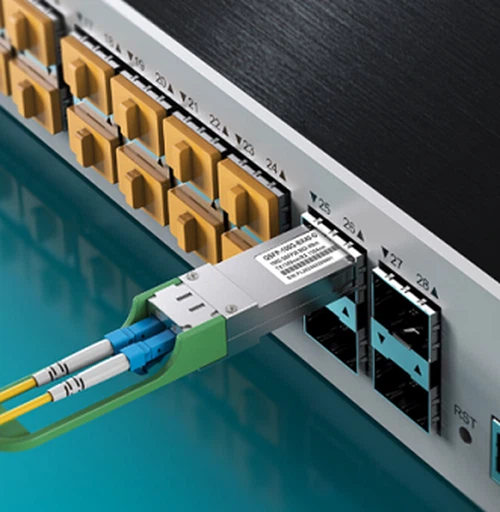
The Standards Framework for External Transceivers
External transceivers operate within an ecosystem governed by three distinct categories of standards. Multi-Source Agreements establish the physical dimensions and electrical pinouts that enable hardware compatibility. Protocol standards define how data is encoded, transmitted, and received across different network types. Testing and certification requirements ensure transceivers perform reliably under real-world conditions. These layers work together to create interoperable networking components.
The distinction matters because a transceiver must satisfy requirements at each level simultaneously. An SFP+ module designed for 10 Gigabit Ethernet needs SFF-8431 mechanical compliance, IEEE 802.3ae electrical specifications, and proven performance through laboratory testing. Failing any single requirement prevents deployment in standards-compliant infrastructure.
Multi-Source Agreements: Physical Layer Foundation
MSAs emerged in the 1990s when equipment manufacturers faced incompatible transceiver interfaces across vendors. The Small Form-factor Pluggable (SFP) MSA, published in 2001, established unified specifications for transceiver dimensions, cage design, electrical connectors, and host board layout. This standardization enabled third-party manufacturers to produce compatible modules at competitive prices.
The SFP MSA specifies precise mechanical tolerances down to hundredths of millimeters. Transceivers must fit within a 13.4mm × 8.5mm × 56.5mm envelope with specific connector locations. The electrical interface uses a 20-pin connector with defined signal assignments for transmit data, receive data, power, and monitoring functions. Host equipment designed to these specifications accepts any MSA-compliant transceiver regardless of manufacturer.
SFP+ enhanced the original SFP design for 10Gbps operation through improved electrical specifications in SFF-8431 and SFF-8432. The same mechanical form factor accommodates higher speeds by reducing signal loss and electromagnetic interference. QSFP (Quad Small Form-factor Pluggable) uses four parallel channels in a similar package size, enabling 40Gbps and 100Gbps data rates through QSFP+ and QSFP28 variants.
Recent MSA developments address speeds beyond 100Gbps. The QSFP-DD MSA doubles port density by stacking two rows of electrical contacts, supporting 200Gbps and 400Gbps. The OSFP MSA provides enhanced thermal management for 400Gbps and 800Gbps transceivers operating in high-power environments. Each MSA evolution maintains backward compatibility where possible-QSFP28 ports accept QSFP+ modules at reduced speeds.
MSA compliance requires manufacturers to submit designs for mechanical verification. The SFF Committee maintains detailed specifications including PCB layout guidelines, thermal requirements, and EMI shielding standards. Transceivers undergo dimensional inspection and electrical testing at authorized laboratories before receiving MSA certification.
IEEE 802.3 Ethernet Standards Compliance
IEEE 802.3 defines Ethernet physical layer specifications from 10Mbps to 400Gbps. External transceivers implement these standards through precise optical or electrical transmission parameters. The standard specifies wavelengths, power levels, dispersion tolerances, and signal timing that transceivers must meet for interoperability.
For 10 Gigabit Ethernet, IEEE 802.3ae defines multiple physical layer variants. The 10GBASE-SR specification requires 850nm VCSEL (Vertical Cavity Surface Emitting Laser) sources transmitting -7.3dBm to -1dBm optical power over multimode fiber. The 10GBASE-LR variant uses 1310nm lasers with different dispersion characteristics for single-mode fiber up to 10 kilometers. Transceivers implement the specific variant's requirements to achieve the designated reach and performance.
IEEE 802.3ba introduced 40 Gigabit and 100 Gigabit Ethernet using parallel optics and wavelength division multiplexing. A 100GBASE-SR4 transceiver transmits four 25Gbps optical lanes at 850nm wavelength, each meeting specific optical modulation amplitude (OMA) and extinction ratio requirements. The standard defines transmitter and dispersion eye closure quaternary (TDECQ) limits that manufacturers verify during production testing.
The IEEE 802.3 frame structure remains consistent across speeds, allowing transceivers to handle standard Ethernet frames from 64 to 1518 bytes. The physical medium dependent (PMD) sublayer within transceivers converts electrical signals from the host device into optical or electrical signals appropriate for the transmission medium. This conversion must preserve signal integrity while meeting jitter, noise, and timing specifications.
Higher-speed standards like IEEE 802.3ck for 100Gbps, 200Gbps, and 400Gbps per wavelength introduce PAM4 (4-level Pulse Amplitude Modulation) encoding. PAM4 doubles spectral efficiency compared to traditional NRZ encoding but requires more sophisticated signal processing within transceivers. These modules incorporate forward error correction (FEC) to maintain acceptable bit error rates under increased noise sensitivity.

Fibre Channel Standards Integration
Fibre Channel transceivers follow specifications developed by INCITS Technical Committee T11. These standards define storage area network interfaces operating at 1, 2, 4, 8, 16, 32, 64, and 128 Gbps. Unlike Ethernet's packet-based approach, Fibre Channel provides lossless data delivery critical for storage applications.
The FC-PI-5 standard specifies 16GFC physical interfaces operating at 14.025Gb/s line rate using 64b/66b encoding. Transceivers must support this specific baud rate while maintaining backward compatibility with 4GFC and 8GFC devices. The standard defines transmitter output power, receiver sensitivity, and optical budget for multimode (up to 125 meters) and single-mode (up to 10 kilometers) fiber implementations.
32GFC transceivers operate at 28.05Gb/s line rate per the FC-PI-6 specification. These modules often share the SFP28 form factor with 25G Ethernet transceivers but implement Fibre Channel-specific protocol requirements. The encoding, frame structure, and flow control mechanisms differ fundamentally from Ethernet despite using similar physical hardware.
Fibre Channel transceivers implement ordered sets-specific bit patterns used for link initialization, error recovery, and protocol control. These ordered sets follow precise timing requirements that transceivers must generate and recognize correctly. The FC-PI standards specify bit error rate performance, typically requiring less than 10^-12 errors per bit for storage network reliability.
Testing for Fibre Channel compliance includes transmitter characteristics (optical power, wavelength accuracy, spectral width), receiver parameters (sensitivity, overload threshold), and interoperability with different cable plant configurations. The standards define specific test patterns and measurement methodologies that manufacturers follow during qualification.
ITU-T Optical Transport Standards
ITU-T Recommendations G.957 and G.959.1 specify optical interfaces for telecommunications networks. These standards address inter-domain interfaces in optical transport networks, focusing on long-haul applications where transceivers must maintain performance over extended distances and through optical amplifiers.
G.957 defines optical interface parameters for synchronous digital hierarchy (SDH) systems at STM-1, STM-4, STM-16, and STM-64 bit rates. Transceivers designed for these applications must meet specific wavelength ranges (1310nm or 1550nm), minimum launched power, dispersion penalties, and receiver sensitivities. The standard categorizes interfaces by application code indicating reach and optical characteristics.
G.959.1 extends these specifications to optical transport network (OTN) physical layer interfaces. Application codes like P1I1-2D2 define complete interface requirements including optical tributary signal class, number of channels, dispersion tolerance, and maximum attenuation. Transceivers claiming G.959.1 compliance must demonstrate conformance to all parameters within the specified application code.
ITU-T standards emphasize optical budget calculations-the difference between minimum transmitter power and receiver sensitivity must exceed the sum of fiber attenuation, connector losses, and margin for aging. Transceivers designed for telecommunications applications typically provide higher optical power and better receiver sensitivity compared to data center modules to accommodate longer reaches.
Wavelength accuracy receives particular attention in ITU-T standards for dense wavelength division multiplexing (DWDM) applications. Transmitters must maintain wavelength stability within ±2.5GHz around the ITU-T grid frequencies defined in G.694.1. This precision enables multiple wavelengths to coexist on the same fiber without interference.
Multi-Standard Transceiver Architecture
Modern transceivers increasingly support multiple protocol standards through programmable digital signal processors (DSPs). A single SFP28 module might operate as 25G Ethernet per IEEE 802.3by or as 32G Fibre Channel per FC-PI-6, with the host system selecting the appropriate mode through management interface commands.
This versatility requires careful design to satisfy overlapping requirements. The transmitter must generate optical signals meeting both Ethernet's TDECQ specifications and Fibre Channel's transmitter eye mask requirements. The receiver must handle different modulation formats and frame structures while maintaining the sensitivity and overload specifications of each standard.
The SFF-8472 digital diagnostic monitoring interface provides real-time data on transceiver performance. This MSA defines a standardized memory map accessible via I2C protocol where transceivers report operating temperature, supply voltage, laser bias current, transmit power, and receive power. Both Ethernet and Fibre Channel standards reference SFF-8472 for monitoring capabilities, enabling common management software across different network types.
Protocol-specific requirements appear in areas like flow control, error handling, and link management. Ethernet transceivers implement auto-negotiation sequences defined in IEEE 802.3, while Fibre Channel modules must support ordered set detection and primitive sequence handling. The physical layer management interface accommodates these protocol differences through separate register spaces and control mechanisms.
Compliance Testing and Certification
Transceiver manufacturers perform extensive testing to verify standards compliance before product release. Physical layer testing measures electrical and optical parameters using calibrated oscilloscopes, optical spectrum analyzers, and bit error rate testers. These measurements compare against limits specified in the relevant standards documents.
For Ethernet transceivers, transmitter testing includes TDECQ measurement-a comprehensive metric combining effects of noise, distortion, and inter-symbol interference. The IEEE 802.3 standard defines specific measurement procedures using reference receiver equalization and clock recovery. Transceivers must achieve TDECQ values below the standard's maximum limit, typically 2.6dB for 100GBASE-SR4.
Receiver stress testing applies degraded optical signals with controlled amounts of jitter, noise, and amplitude variation. The transceiver must maintain operation without errors at specified stress levels, demonstrating margin beyond normal operating conditions. This testing uses pattern generators creating standardized stress patterns defined in the protocol standards.
Interoperability testing validates that transceivers work correctly with equipment from different manufacturers. Independent test houses operate interoperability labs where modules undergo testing against multiple switch and router platforms. These tests verify that auto-negotiation completes successfully, link stability maintains over temperature variations, and performance meets specifications across different cable types.
Compliance testing laboratories maintain accreditation to ISO/IEC 17025, ensuring measurement accuracy and traceability. Test equipment undergoes regular calibration against national standards, and test procedures follow documented methods reviewed by industry standards bodies. Manufacturers receive test reports documenting measured parameters and pass/fail determinations against standard requirements.
Some applications require additional certification beyond basic standards compliance. Telecommunications equipment may need approval from regulatory bodies verifying electromagnetic compatibility and safety. Federal Communications Commission testing in the United States or CE marking in Europe ensures transceivers don't cause radio frequency interference and meet laser safety requirements per IEC 60825-1.
The Evolution of Standards Coordination
Standards organizations coordinate their work to avoid conflicting requirements. The IEEE 802.3 working group maintains liaison relationships with ITU-T Study Group 15 and INCITS Technical Committee T11. When IEEE develops new Ethernet speeds, they consider how these might coexist with Fibre Channel or ITU-T applications sharing similar form factors.
The MSA groups work closely with protocol standards bodies to ensure physical interfaces can support emerging data rates. When IEEE 802.3bs specified 200G and 400G Ethernet, the QSFP-DD MSA simultaneously developed mechanical specifications accommodating the required electrical lanes. This parallel development accelerates product availability by avoiding sequential standardization bottlenecks.
Emerging technologies like 800G and 1.6T Ethernet drive new standards development across multiple organizations. IEEE 802.3df defines the protocol requirements while MSAs address packaging constraints and thermal management. Component manufacturers participate in both efforts, ensuring practical implementations can meet proposed specifications.
The standards development process incorporates industry feedback through public comment periods and interoperability demonstrations. Participants test draft specifications before final approval, identifying issues that might prevent real-world deployment. This iterative refinement produces standards that balance technical performance with manufacturing feasibility.
Practical Implications for Network Deployment
Understanding standards compliance helps network engineers make informed purchasing decisions. A transceiver labeled "IEEE 802.3ae compliant" should interoperate with any 10GBASE-SR or 10GBASE-LR interface, but verifying the specific physical layer variant prevents deployment mismatches. Similarly, "MSA compliant" confirms mechanical fit but doesn't guarantee protocol compatibility.
Third-party transceivers benefit from open standards by providing alternatives to original equipment manufacturer modules. MSA compliance ensures physical compatibility while protocol standard conformance delivers functional interoperability. Cost-conscious organizations can purchase third-party modules with confidence when proper standards certification exists, though warranty implications require consideration.
Mixed-vendor environments particularly benefit from rigorous standards compliance. Network upgrades can proceed incrementally, replacing individual transceivers without requiring simultaneous equipment changes. Standards-based designs enable gradual migration from 10G to 25G or 100G while maintaining connectivity with existing infrastructure.
Future network designs should consider how standards evolve to support higher speeds and new applications. The transition from 100G to 400G introduced PAM4 modulation, requiring different signal quality metrics and testing approaches. Understanding these evolution patterns helps anticipate compatibility requirements for planned infrastructure upgrades.
Testing Beyond Compliance
Production networks demand reliability exceeding minimum standards requirements. Leading transceiver manufacturers perform extended temperature testing across -40°C to +85°C ranges, even when target applications specify narrower commercial temperature ranges. This additional margin reduces field failure rates under unexpected environmental conditions.
Vibration and shock testing verifies mechanical robustness for applications in challenging environments. Transportation networks and industrial automation require transceivers surviving significant mechanical stress beyond what office environments impose. Standards like IEC 60068 define test procedures that manufacturers apply to ruggedized transceiver variants.
Long-term aging tests identify potential reliability issues before products reach customers. Manufacturers operate transceivers continuously at elevated temperatures while monitoring optical power, wavelength drift, and electrical parameters. Accelerated aging reveals failure mechanisms that might appear after thousands of operating hours, allowing design improvements before volume production.
These extended qualification efforts complement standards compliance testing, building confidence in product reliability. Standards define minimum acceptable performance at specific test points, while comprehensive qualification programs characterize behavior across the full operating envelope and product lifetime.
Common Questions About Transceiver Standards Compliance
Do all SFP+ transceivers work with any SFP+ port?
SFP+ transceivers share the same mechanical form factor per the MSA, ensuring physical compatibility, but protocol support varies. An SFP+ module designed for 10G Ethernet may not function in a Fibre Channel port expecting 8GFC or 16GFC protocols. Always verify both the mechanical MSA compliance and the protocol standard (IEEE 802.3, FC-PI-5, etc.) match your application requirements.
What's the difference between MSA compliance and IEEE compliance?
MSA compliance governs physical dimensions, electrical pinouts, and form factor specifications-essentially the mechanical packaging. IEEE compliance addresses the data transmission protocol, including modulation format, signal levels, and encoding schemes. A transceiver needs both: MSA compliance ensures it physically fits and connects properly, while IEEE compliance ensures it communicates correctly with network equipment.
Can a single transceiver be compliant with multiple standards?
Yes, many modern transceivers support multiple protocol standards simultaneously. An SFP28 module might comply with both IEEE 802.3by for 25G Ethernet and FC-PI-6 for 32G Fibre Channel. The host equipment selects the operating mode through management interface commands. However, the transceiver must be specifically designed for multi-protocol operation-not all modules offer this flexibility.
How do I verify a transceiver meets required standards?
Check the manufacturer's datasheet for explicit standards compliance claims and request test reports if deploying in critical applications. Reputable manufacturers provide documentation showing measurements against specific standard requirements. For high-reliability deployments, consider transceivers tested at independent interoperability labs that verify multi-vendor compatibility beyond basic compliance testing.
External transceivers navigate a complex standards landscape spanning physical form factors, protocol specifications, and testing requirements. The coordinated evolution of MSAs, IEEE standards, Fibre Channel specifications, and ITU-T recommendations enables the interoperable, multi-vendor ecosystem that modern networks depend on. Understanding how these standards layers interact helps network professionals select appropriate transceivers and anticipate how emerging technologies will integrate with existing infrastructure.