





Fiber Optic Splitter Guide: PLC Splitter Types for Every Deployment Scenario
 May 12, 2026|
 The passive optical splitter is the single largest source of signal attenuation in any PON network, and yet most deployment failures trace back not to the splitter's optical performance, but to choosing the wrong packaging for the wrong environment.
In FTTH deployments running near their power budget limit, a packaging mismatch that forces field re-splicing can cost 3–5 technician-hours per node before accounting for subscriber complaints during the service window. With the global PON equipment market projected to grow from $17.6 billion in 2025 to over $60 billion by 2034 (Fortune Business Insights), the volume of fiber optic splitter selection decisions happening right now across FTTH rollouts, data center builds, and 5G backhaul projects is enormous.
This fiber optic splitter guide walks through the six major PLC splitter packaging types, the technical parameters that actually drive selection decisions, and the deployment architecture choices that determine which packaging belongs where. It also covers the field-level mistakes that silently erode your optical power budget.
PLC Technology vs. FBT: A Quick Framing, Not a Full Debate
Two manufacturing technologies dominate the fiber optic splitter market: Fused Biconical Taper (FBT) and Planar Lightwave Circuit (PLC). This guide focuses almost entirely on PLC, and here's why that's a deliberate choice rather than an oversight.
FBT splitters fuse and taper two or more fibers together to redistribute optical power. The process is mature and inexpensive for low split counts. A 1×2 or 1×4 FBT unit costs meaningfully less than its PLC equivalent. But the technology hits hard limits quickly. Any FBT configuration above 1×4 requires cascading multiple 1×2 modules inside a single package, and that cascading introduces cumulative uniformity problems. The nominal maximum insertion loss difference between output ports on a 1×4 FBT splitter is approximately 1.5 dB. On a 1×8 or higher, that unevenness becomes a serious constraint on transmission distance consistency. FBT units also operate within narrow wavelength windows (1310 nm, 1490 nm, and 1550 nm) and show significantly higher loss outside those bands.
PLC splitters, manufactured using semiconductor photolithography on silica substrates, solve this problem structurally. The waveguide circuit divides optical power with port-to-port uniformity typically within 0.5 dB, regardless of whether the split ratio is 1×4 or 1×64. They also support a continuous wavelength range of 1260–1650 nm, covering every standard PON wavelength including those required for emerging 50G-PON systems.
Our position on PLC splitter selection for new networks: for any FTTH, GPON, or data center fiber deployment with split ratios above 1×4, PLC is the only technology worth specifying. FBT still has a legitimate role in signal monitoring taps, asymmetric split ratio applications (e.g., 90/10 or 70/30 for network monitoring), and cost-constrained 1×2 installations where wavelength flatness doesn't matter. But treating FBT and PLC as interchangeable options for network-scale deployments is a planning error that costs more in maintenance and performance degradation than it saves in upfront component pricing.
Six Fiber Optic Splitter Packaging Types: What Each One Actually Solves
The PLC chip inside every splitter is fundamentally the same, a silica waveguide on a quartz substrate, coupled to input and output fiber arrays. What differs across the six standard packaging types is the mechanical protection, connector termination, installation method, and environmental rating. Choosing the right PLC splitter packaging type means matching these physical characteristics to your deployment environment, not just your split ratio.
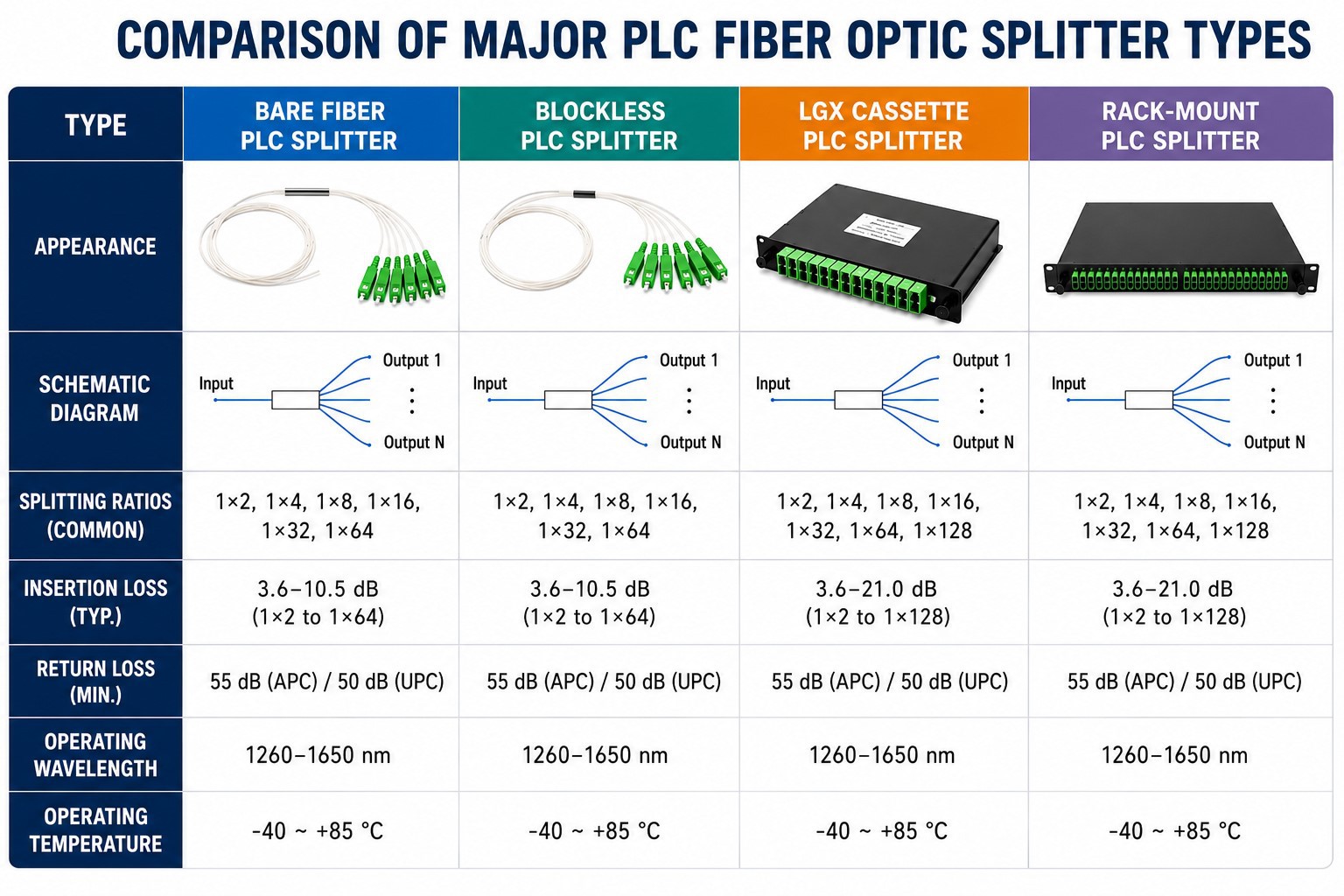
Bare Fiber PLC Splitter
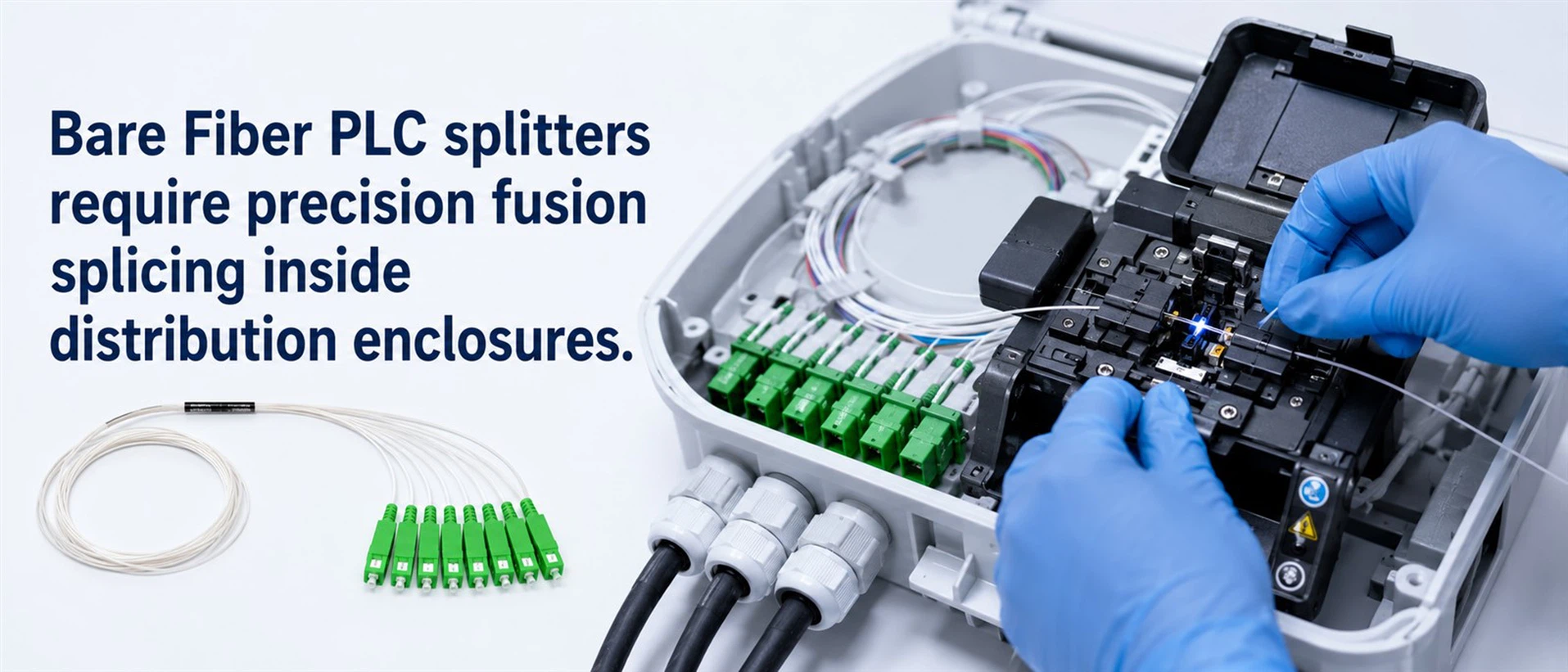
The bare fiber PLC splitter strips packaging to its absolute minimum: the chip sits inside a small protective housing with unterminated fiber pigtails on both input and output sides. No connectors. No enclosure. Installation requires fusion splicing every fiber end.
This is the right choice when you need maximum density inside existing splice closures or terminal boxes and your installation crew has reliable fusion splicing capability on site. FTTH projects in Southeast Asia and parts of Latin America use bare fiber splitters extensively because they integrate into the tightly packed splice trays already standard in those markets.
The trade-off is zero field serviceability without splicing equipment. If a technician needs to reconfigure ports or troubleshoot a specific output branch, there's no connector to unplug. It's a splice-and-test operation every time. For deployments where the splitter location will be accessed frequently, or where installation teams vary in skill level, bare fiber creates long-term operational risk that the upfront savings don't justify.
Blockless (Mini Module) Fiber Optic Splitter
The blockless splitter, sometimes called a mini module or micro-type PLC splitter, adds a stainless steel tube around the PLC chip and terminates all fiber ends with connectors (typically SC/APC or LC/UPC). The result is a slim, connectorized unit that's plug-and-play without fusion splicing.
This packaging bridges the gap between bare fiber density and cassette-style manageability. It fits inside fiber optic terminal boxes and small distribution enclosures where a full ABS or LGX module would be physically too large. Blockless PLC splitters are the workhorse of building-level and floor-level distribution points in multi-dwelling unit (MDU) FTTH projects.
One operational detail that matters in practice: the 0.9 mm buffered fiber pigtails on blockless units are meaningfully more fragile than the 2.0 mm or 3.0 mm cables on ABS and cassette types. Standard 0.9 mm buffer begins to produce measurable microbend-induced attenuation, on the order of 0.1–0.3 dB additional loss, when routed through bends tighter than 15 mm radius. This is consistent with the bending fatigue characteristics described in IEC 60793-2 for small-diameter buffered fibers. In MDU terminal boxes that see frequent technician access for subscriber adds, moves, or troubleshooting, that repeated handling accelerates fiber fatigue. When our engineering team reviewed maintenance records from a 280-unit MDU retrofit in Manila, nodes accessed more than six times in the first year showed measurably higher per-port attenuation than low-access nodes on the same floor. If your distribution point sees that level of access frequency, ABS packaging with its thicker 2.0 mm cable offers better long-term durability despite the slightly larger footprint.
ABS Box PLC Splitter
The ABS (Acrylonitrile Butadiene Styrene) box splitter encases the PLC chip in a rigid plastic housing with impact resistance and reasonable thermal stability. Connectorized fiber exits through strain-relief boots on both ends. Standard configurations range from 1×4 through 1×32, with 2.0 mm or 3.0 mm cable outputs. Many ABS modules now ship with bend-insensitive fiber (G.657A1 compliant) supporting a minimum bend radius of 10 mm, which significantly reduces routing-related loss in tight enclosures.
ABS packaging is the default selection for outdoor fiber distribution boxes in FTTH and FTTx deployments worldwide. The plastic housing provides sufficient environmental protection for pole-mounted or underground cabinet installation when placed inside an IP65-rated enclosure. Its compact footprint makes it the go-to for fiber optic splitter placement inside outdoor distribution terminals where space is constrained but connector access is still needed.
The limitation is scalability within a single installation point. ABS boxes are standalone and don't integrate into rack systems or modular chassis. For central office or headend deployments where you might need 8 or 16 splitters in close proximity, managing individual ABS boxes becomes cumbersome compared to cassette or rack-mount alternatives.
ABS or Blockless: which one for your fiber optic splitter deployment? In MDU hallway terminal boxes where space is the primary constraint and the box will rarely be opened after initial commissioning, blockless is the better fit. Its smaller form factor leaves more room for cable management. But if that same terminal box serves as an active maintenance point with technicians entering it quarterly or more frequently for subscriber adds or fault isolation, the ABS enclosure's thicker cable jacket and more robust strain relief will survive repeated handling far better. The deciding variable isn't the splitter's optical performance (identical PLC chip inside both); it's how often human hands will disturb it. If your operations team doesn't have documented maintenance frequency data for this node type, default to ABS. The cost delta is under $2 per port and the durability uplift is unambiguous.
LGX Cassette PLC Splitter
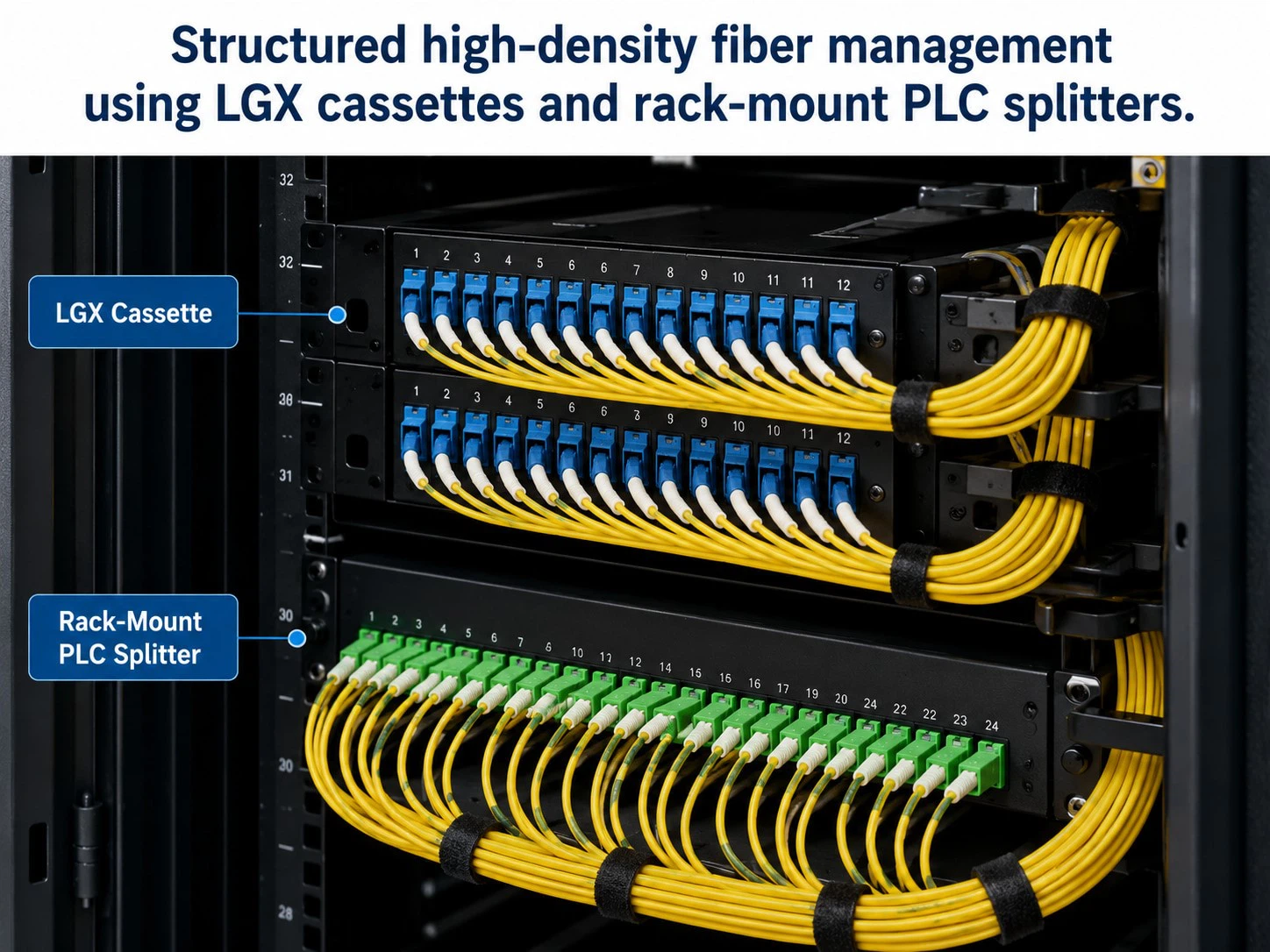
The LGX cassette packages the PLC splitter inside a standardized metal housing designed to slide into LGX-compatible fiber optic patch panels and enclosures. Adapters on the front panel provide connectorized port access, while internal fiber management keeps routing organized.
This is the right format when your network design calls for centralized splitter placement inside a structured cabling environment. Central offices, headend facilities, and enterprise telecom rooms are the natural homes for this packaging. A standard 1U LGX enclosure provides 4 cassette slots, allowing you to mix any combination of split ratios. Two 1×16 cassettes plus one 1×8 plus one 1×4 delivers 44 downstream ports in a single rack unit, with every port individually accessible from the front panel for testing or reconfiguration.
LGX cassettes also represent the best option for deployments where you need configuration flexibility. The modular plug-and-play approach reduces mean time to repair significantly compared to spliced or standalone box solutions. A failed cassette swaps out in under two minutes without affecting adjacent ports.
For greenfield builds with no prior infrastructure commitment, LGX offers broader multi-vendor availability and shorter spare-part lead times in most global markets compared to FHD. Unless your contracting operator has already standardized on FHD across their existing plant, LGX is the default choice for new central office deployments.
FHD Cassette Fiber Optic Splitter
FHD (Fiber High Density) cassettes function similarly to LGX cassettes but are designed for FHD-series enclosures with higher port density per rack unit. The fiber management inside is tighter, and the adapter panel accommodates more connections in the same physical width.
The decision between LGX and FHD cassette PLC splitters is primarily driven by your existing rack infrastructure. If your central office or data center already runs FHD-series patch panels and enclosures, specifying FHD cassette splitters maintains system compatibility and maximizes density. If you're building from scratch, the LGX recommendation above applies. Mixing LGX and FHD within the same rack creates ongoing operational friction: different cassette widths, different adapter plates, different spare-part inventories. Pick one system and standardize.
1U Rack-Mount Fiber Optic Splitter
The rack-mount PLC splitter integrates one or more PLC units into a standard 19-inch, 1U chassis with front-panel adapter access and internal fiber management. Configurations typically support 1×8 through 1×32, with some manufacturers offering 1×64 in a single 1U frame.
Rack-mount units are the natural selection for data center fiber distribution, high-density PON headends, and any deployment where centralized management, cable organization, and rapid port identification take priority over component cost. They're also the easiest format to integrate with automated fiber monitoring systems, because every port is accessible and labeled from the front panel.
The trade-off: rack-mount splitters occupy dedicated rack space. In dense colocation environments where rack real estate is scarce, dedicating 1U per splitter tier competes with active equipment for space. In those scenarios, LGX cassette-based solutions inside shared enclosures may deliver better space efficiency while maintaining the same per-port accessibility.
Packaging Selection Summary
| Packaging Type | Best Environment | Connector Required | Typical Split Range | Key Selection Criterion |
|---|---|---|---|---|
| Bare Fiber | Splice closures, terminal boxes | No (splice only) | 1×2 – 1×64 | Maximum density, permanent installation |
| Blockless | Small distribution boxes, MDU terminals | Yes | 1×2 – 1×32 | Compact size, infrequent access |
| ABS Box | Outdoor distribution cabinets, pole mounts | Yes | 1×4 – 1×32 | Durability, frequent maintenance access |
| LGX Cassette | Central offices, patch panels | Yes | 1×2 – 1×32 | Modular flexibility, 4 slots per 1U |
| FHD Cassette | High-density patch panels | Yes | 1×2 – 1×32 | Maximum port count per rack unit |
| 1U Rack Mount | Data centers, PON headends | Yes | 1×8 – 1×64 | Centralized management, monitoring integration |
Edge cases such as split ratio mismatches, mixed indoor/outdoor cable runs, and upgrade-path constraints aren't captured in this table. Contact our engineering team for scenario-specific PLC splitter guidance based on your project parameters.
Split Ratio and Insertion Loss: The Numbers That Drive Your Power Budget
Every split doubles the theoretical minimum insertion loss by approximately 3 dB. That's the physics of dividing optical power. But the actual insertion loss of manufactured PLC splitters includes additional factors: waveguide imperfections, fiber-to-chip coupling efficiency, and connector interface losses. The standard reference values per Telcordia GR-1209-CORE specifications are:
| Split Ratio | Max Insertion Loss (PLC) | Typical Use Scale |
|---|---|---|
| 1×2 | 3.4 dB | Point-to-point redundancy, monitoring taps |
| 1×4 | 7.1 dB | Small office/building, rural FTTH |
| 1×8 | 10.5 dB | MDU buildings, campus networks |
| 1×16 | 13.5 dB | Medium-density FTTH, suburban PON |
| 1×32 | 16.9 dB | Standard FTTH residential, GPON backbone |
| 1×64 | 20.1 dB | High-density urban FTTH, large-scale PON |
(Fibre Fibre - Insertion Loss Reference Table)
For engineers evaluating 1×32 PLC splitter specifications specifically: insertion loss ≤16.9 dB, return loss ≥55 dB (APC connectors), operating wavelength 1260–1650 nm, operating temperature −40°C to +85°C, polarization dependent loss (PDL) ≤0.3 dB. These values apply to all major packaging types (ABS, LGX, rack-mount) since the internal PLC chip is identical.
The number that matters most isn't the splitter's insertion loss in isolation. It's the total optical path loss from OLT to ONT. A practical power budget calculation for a standard GPON Class B+ deployment looks like this:
OLT transmit power: +3 dBm
Fiber attenuation (10 km single-mode at 0.3 dB/km): −3.0 dB
1×32 PLC splitter insertion loss: −16.9 dB
Two connector pairs (0.3 dB each): −0.6 dB
One fusion splice: −0.1 dB
Total path loss: −20.6 dB
Signal arriving at ONT: +3 − 20.6 = −17.6 dBm
ONT receiver sensitivity (Class B+): −27 dBm
Margin: 9.4 dB
That 9.4 dB margin looks comfortable on paper. But field reality diverges from the datasheet: connector aging, dust accumulation, cable bends added during maintenance, and fiber optic splitter degradation over temperature cycling all consume margin over time. In FTTH deployments we've supported across Asia-Pacific and Middle Eastern markets, networks built with exactly 3 dB of minimum margin reliably start generating subscriber-level service complaints within the first several years of operation as cumulative degradation eats into the budget. Based on our commissioning and maintenance records across 15+ FTTH projects, a minimum operational margin of 5–6 dB at initial deployment is a more defensible engineering target for infrastructure designed to last 15+ years. The exact degradation timeline depends on climate zone and installation quality, but the direction is always the same: margin only shrinks, never grows.
Centralized vs. Distributed Splitting: The Architecture Decision Most Guides Ignore
This is the section that separates a fiber optic splitter selection guide from a product catalog. The choice between centralized and distributed (cascaded) splitting architecture fundamentally changes which PLC splitter packaging you need, where you install it, and how your network scales over time. Most competing guides skip this entirely or mention it in passing. Yet it's the single biggest driver of splitter-related deployment cost and operational complexity.
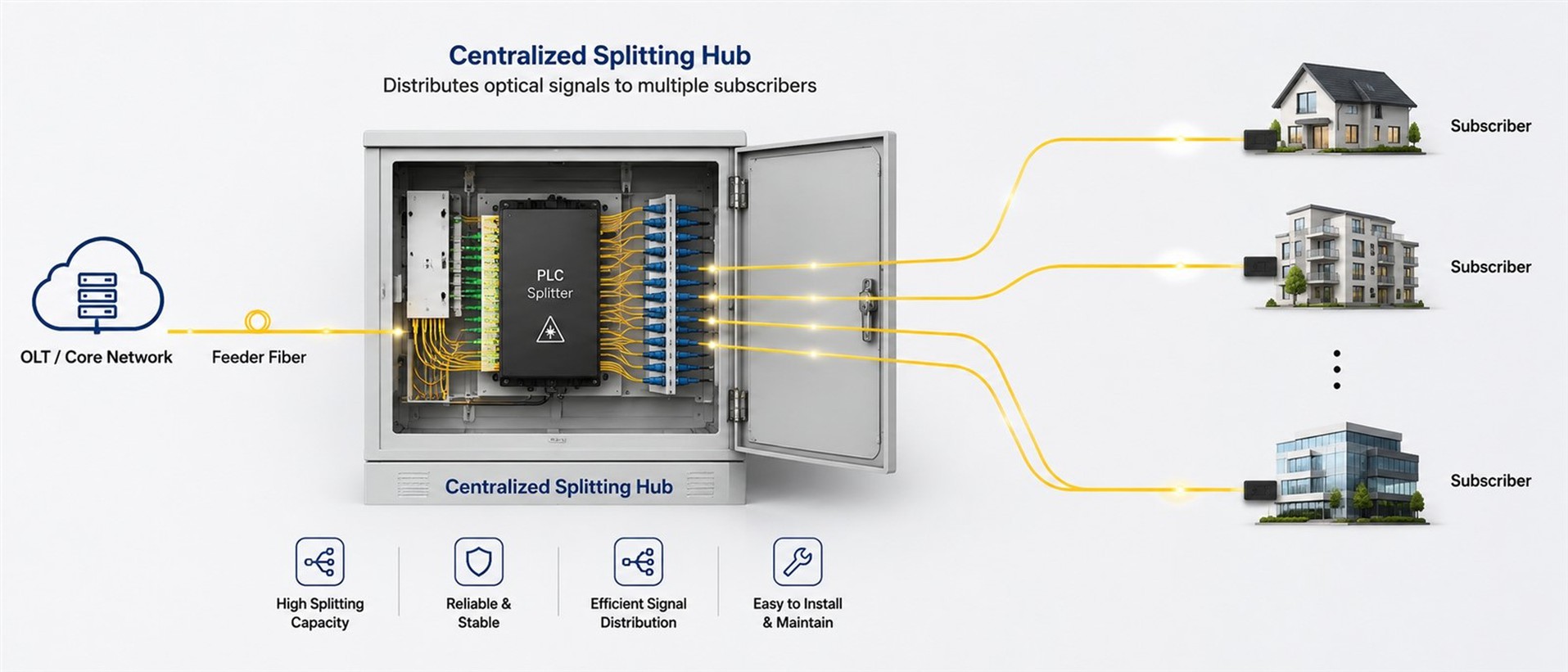
Centralized splitting places a single high-ratio splitter (typically 1×32 or 1×64) at one location, usually an Optical Distribution Terminal (ODT) or Fiber Distribution Hub (FDH), between the central office and subscriber premises. One OLT port connects to one splitter, and 32 or 64 individual fibers run from that splitter to each ONT.
Distributed (cascaded) splitting stages the split across two or more locations. A common configuration uses a 1×4 PLC splitter near the central office feeding four downstream locations, each housing a 1×8 splitter, achieving the same 1:32 overall ratio through two stages.
The conventional wisdom is that centralized splitting is simpler and distributed splitting saves fiber. That's true but incomplete. The real trade-off matrix involves:
OLT port utilization and take-up rate. In new FTTH deployments, first-year subscriber activation rates typically remain well below 50%, with many greenfield buildouts seeing 20–40% in markets tracked by the FTTH Council. With centralized 1×32 splitting, each OLT port serves a maximum of 32 premises, but if only 10 are active in year one, that port is operating at 31% utilization. Distributed architectures mitigate this by allowing the first-stage splitter to serve a wider geographic area, improving early-stage port efficiency. However, the second-stage splitters create fixed infrastructure at each distribution point regardless of local take-up. In dense urban areas with high expected subscriber density and faster take-up trajectories, centralized splitting recovers its port efficiency faster and is generally the better architecture. In suburban and rural buildouts where premises are spread across large distances and first-year activation stays low, distributed splitting's ability to defer second-stage infrastructure investment makes more financial sense.
Research indicates that distributed architectures can reduce FDH cabinet capacity requirements by up to 75% and cut distribution fiber counts by a similar proportion (Outside Plant Cabling). In suburban and rural deployments where premises are spread across large areas, that reduction in physical infrastructure is significant.
Cumulative insertion loss and what it costs in reach. Two-stage cascading adds the insertion losses of both splitters plus the additional connector or splice interfaces between them. A 1×4 first stage (7.1 dB) followed by a 1×8 second stage (10.5 dB) totals 17.6 dB in PLC splitter losses alone, compared to 16.9 dB for a single-stage 1×32. Add two extra connector pairs (0.6 dB) and potentially two extra splices (0.2 dB), and the cascaded architecture consumes nearly 1.5 dB more margin than centralized. At a standard single-mode attenuation of 0.3 dB/km, that 1.5 dB translates to approximately 4–5 km of reduced maximum reach. In networks already operating near the edge of their power budget, particularly rural deployments with long feeder fiber runs, that distance penalty can push distant subscribers below the ONT receiver threshold.
Troubleshooting complexity. Centralized splitting provides a single physical access point for testing the entire splitter distribution. An OTDR trace from the ODT can characterize every downstream branch. With distributed splitting, fault isolation requires access to multiple field locations, each of which may be a pole-mounted closure or underground pedestal that needs a truck roll and possibly a permit.
How this connects to PLC splitter packaging choice: centralized architectures favor LGX cassettes or 1U rack-mount units at the FDH location, because port density and organized management at a single site are critical. Distributed architectures push the second-stage splitters into outdoor environments. ABS box or blockless types inside weatherproof closures become the standard choice. Your splitting architecture literally determines which packaging type you'll purchase in volume. Planning one without the other is how projects end up with the right splitter chip in the wrong housing.
For those designing the OLT side of a centralized PON architecture, the port count and optical budget calculations tie directly to GPON OLT system specifications. The PLC splitter split ratio you select defines how many OLT ports your headend requires and what optical class each port must support.
Five Deployment Mistakes That Silently Destroy Optical Performance
Technical specs on a datasheet and performance in a 15-year field deployment are different things. The following five failure modes come from real-world FTTH and enterprise fiber projects. These are the kind of problems that don't surface during commissioning but generate escalating service calls in years 3 through 7.
- Connector contamination during installation. This is the most common and most preventable cause of excess insertion loss in newly deployed fiber optic splitter circuits. A single dust particle on an SC/APC ferrule endface can increase insertion loss by 1 dB or more. Across a 32-port splitter installation with multiple connectors, uncleaned endfaces can consume 3–5 dB of margin that the design assumed would be available. In our commissioning records across 15+ FTTH projects in Southeast Asia and the Middle East, connector contamination accounted for over 60% of initial power budget failures at the port level, a proportion consistent with field diagnostics reported by SDG Cable (SDG Cable). The fix is procedural, not technical: mandatory inspection and cleaning of every connector before every mating, using fiber-optic grade cleaning tools, with results verified by a handheld fiber microscope. It adds 30 seconds per connector and prevents the vast majority of initial-deployment performance failures. FB-LINK ships all pre-terminated PLC splitter assemblies with 100% factory endface inspection, eliminating the connector contamination variable at the manufacturing stage. Field-side connector mating still requires on-site discipline.
- Inadequate strain relief at mounting points. When a fiber optic splitter module is mounted without proper strain relief, mechanical tension transfers from the cable to internal fiber joints. Over months and years of thermal expansion, wind loading (in aerial installations), or vibration, that tension gradually shifts fiber alignment at the chip-to-array coupling point. The result is a slow, steady increase in insertion loss that accelerates as the displacement compounds. By the time it's detectable on a standard power meter, the internal damage is permanent. Proper mounting requires dedicated strain-relief hardware at every cable entry point and sufficient service loop to prevent any tension path between the external cable and the internal splitter assembly.
- Using non-IP-rated splitters in outdoor environments without proper enclosures. ABS box splitters are frequently marketed as suitable for outdoor use, but the box itself is not the enclosure. The ABS housing alone does not meet IP65 or IP66 ingress protection standards. It must be installed inside a weatherproof cabinet or closure that provides the environmental sealing. Deploying ABS PLC splitters in unsealed or improperly sealed outdoor housings allows moisture ingress that corrodes fiber interfaces and adhesive bonds inside the splitter module. The degradation is gradual and initially symmetrical across all output ports, making it invisible to per-port differential testing. Only an absolute power measurement against the original commissioning baseline reveals the drift. Most operators don't maintain those baselines, which is why this failure mode goes undetected until subscriber impact is widespread.
- Ignoring temperature cycling effects on long-term PLC splitter reliability. PLC splitters operate across a rated temperature range of −40°C to +85°C, and every manufacturer publishes specifications tested at those extremes. What's less discussed is the cumulative effect of daily temperature cycling: the repeated expansion and contraction of the waveguide chip, adhesive layers, and housing materials at different rates. Over thousands of cycles, micro-displacements alter optical coupling efficiency between the chip and fiber arrays, producing branch-to-branch imbalance that didn't exist at commissioning. Outdoor deployments in climates with wide diurnal temperature swings (desert regions, continental climates) are most vulnerable. Periodic power budget re-verification, not just once at installation but annually, is the only reliable way to catch this drift before it causes service impact.
- Misdiagnosing splitter degradation as transceiver failure. When output power drops gradually across all ports of a splitter, the problem often presents at the ONT side as reduced receive power. The instinctive troubleshooting response is to suspect the OLT transceiver or the feeder fiber. Both are upstream and easier to test from the headend. Splitters, as passive devices with no management interface, tend to be assumed healthy until explicitly tested. In practice, a technician needs to measure power at the splitter's input and at each output to confirm per-port insertion loss hasn't drifted beyond spec. Without that step, operators can spend weeks chasing transceiver replacements and fiber testing while the actual fault, a degraded splitter, continues to affect every subscriber on that branch.
A Decision Framework for PLC Splitter Selection
Rather than ending with a generic summary, here's a structured approach to selecting the right PLC splitter configuration for a specific project. Walk through these four decision points in order:
1. Determine your splitting architecture first.
Centralized or distributed? This decides where your splitters will physically live and how many stages of splitting your power budget must accommodate. Dense urban deployments with high expected subscriber density and faster take-up trajectories lean toward centralized 1×32. Port efficiency recovers quickly as activation ramps. Suburban and rural deployments with lower initial take-up and long distribution distances benefit from distributed 1×4 / 1×8 cascading, deferring second-stage infrastructure cost until demand materializes.
2. Match fiber optic splitter packaging to environment.
Indoor structured cabling directs you to LGX or FHD cassette, or 1U rack-mount. Outdoor cabinet or pole-mount means ABS box or blockless inside IP65+ enclosure. Splice closure integration means bare fiber. This is not a preference decision; it's an environmental compatibility requirement.
3. Validate insertion loss against your total link budget.
Calculate total path loss including fiber attenuation, all connector pairs, all splice points, and splitter insertion loss. Confirm that the result leaves at least 5–6 dB of operational margin below your ONT receiver sensitivity. If the margin is tight, reducing the split ratio by one step (e.g., from 1×64 to 1×32) is cheaper than upgrading the transceiver class or shortening the fiber run. The specifics of each project's cable routing, splice count, and environmental exposure make this calculation unique to every deployment. A generic template gets you to 80%, but the remaining 20% of variables determine whether distant subscribers maintain service through year ten. Project-specific link budget calculations accounting for your cable routing, splice count, and local temperature profile are available from our engineering team on request.
4. Plan for maintenance and monitoring access.
Every fiber optic splitter port will eventually need testing. Choose a packaging type that gives technicians connector access without requiring fusion splicing. The exception is bare fiber in permanently sealed splice closures where the splitter will never be individually serviced.
What 50G PON Means for Fiber Optic Splitter Selection Today
The first live-network 50G PON trial was completed in mid-2024 by Nokia and Google Fiber in the United States (Mordor Intelligence), and multiple operators across Asia Pacific are running proof-of-concept deployments. The 50G-PON standard (ITU-T G.9804) operates at wavelengths that sit within the same 1260–1650 nm window that PLC splitters already support, which means existing PLC infrastructure is forward-compatible with next-generation PON without splitter replacement.
This is one of the strongest practical arguments for specifying PLC over FBT in any fiber optic splitter deployment happening now. An FBT splitter optimized for today's GPON wavelengths (1310/1490 nm) may not perform acceptably at the wavelengths 50G-PON systems adopt. A PLC splitter installed today will support tomorrow's overlay upgrade without a truck roll to the splitter location. For infrastructure with a 15–20 year expected lifespan, that wavelength flexibility is not a theoretical benefit. It's a concrete operational cost avoidance.
Emerging trends in smart splitter technology, specifically PLC modules with embedded optical power monitors that report per-port insertion loss to a network management system, are also worth tracking. These aren't yet mainstream for mass FTTH deployment, but for enterprise and data center environments where per-port visibility justifies the premium, they represent the next step in passive network monitoring.
For organizations building or upgrading fiber infrastructure now, FB-LINK's fiber optic solutions portfolio includes PLC splitter options engineered for compatibility across current GPON and next-generation PON architectures.
FAQ
Q: What is the difference between PLC and FBT fiber optic splitters?
A: PLC splitters use semiconductor waveguide technology for uniform signal distribution across all ports, supporting ratios up to 1×64 and wavelengths from 1260 to 1650 nm. FBT splitters fuse fibers together, costing less at low split counts but producing uneven output above 1×4. PLC is the standard for FTTH and PON networks.
Q: How do I calculate the optical power budget for a PLC splitter?
A: Subtract fiber attenuation, splitter insertion loss, and all connector/splice losses from your OLT transmit power. The result must exceed your ONT receiver sensitivity with at least 5–6 dB of margin for long-term reliability.
Q: Which PLC splitter packaging type works best for outdoor FTTH?
A: ABS box PLC splitters inside IP65/IP66-rated outdoor enclosures are the most widely deployed option. For smaller distribution points, blockless (mini module) splitters inside sealed terminal boxes are common.
Q: What causes PLC splitter performance to degrade over time?
A: Temperature cycling, moisture ingress from inadequate sealing, and mechanical stress from improper mounting are the primary causes. Degradation is typically gradual and symmetrical, making it difficult to detect without baseline power measurements.
Q: Should I use centralized or distributed splitting in my FTTH network?
A: Centralized splitting suits dense urban areas with high expected take-up rates. Distributed splitting reduces infrastructure costs in suburban and rural deployments but introduces higher cumulative insertion loss and more field access points for troubleshooting.
Need help choosing the right fiber optic splitter for your project? Contact FB-LINK's engineering team for deployment-specific recommendations based on your network architecture and site conditions.