





Breakout Cable Guide: Parallel Fiber Applications for 40G Through 800G Networks
 May 08, 2026|
 A fiber optic breakout cable-also called a fanout or harness cable-takes one multi-fiber MPO/MTP connector and splits it into individual duplex connectors (typically LC). This allows a single high-speed parallel port to connect to multiple lower-speed duplex devices: a 100G QSFP28 SR4 port fanning out to four 25G SFP28 servers, or an 800G switch port splitting into two independent 400G GPU NIC links.
This breakout cable guide for data center parallel fiber deployments covers the engineering decisions that separate a clean installation from a $50,000 emergency change order: architecture selection, polarity planning, loss budgets, and the deployment mistakes we keep seeing in the field.
How Parallel Fiber Breakout Actually Works
An MPO-to-LC breakout cable has an MPO/MTP multi-fiber connector on one end and multiple duplex connectors on the other. An 8-fiber MPO breaks out to four LC duplex pairs. A 16-fiber MPO-16 fans into eight LC pairs, or two separate MPO-12 connectors for module-to-module splitting.
This is mechanically different from a trunk cable, which has MPO connectors on both ends for switch-to-switch permanent links, and from a conversion cable, which remaps fiber groupings (say, 2×MPO-12 to 3×MPO-8) without changing connector families. Trunk cables handle the backbone. Conversion cables handle architecture transitions. MTP breakout cables handle the last meter between your parallel infrastructure and duplex equipment.
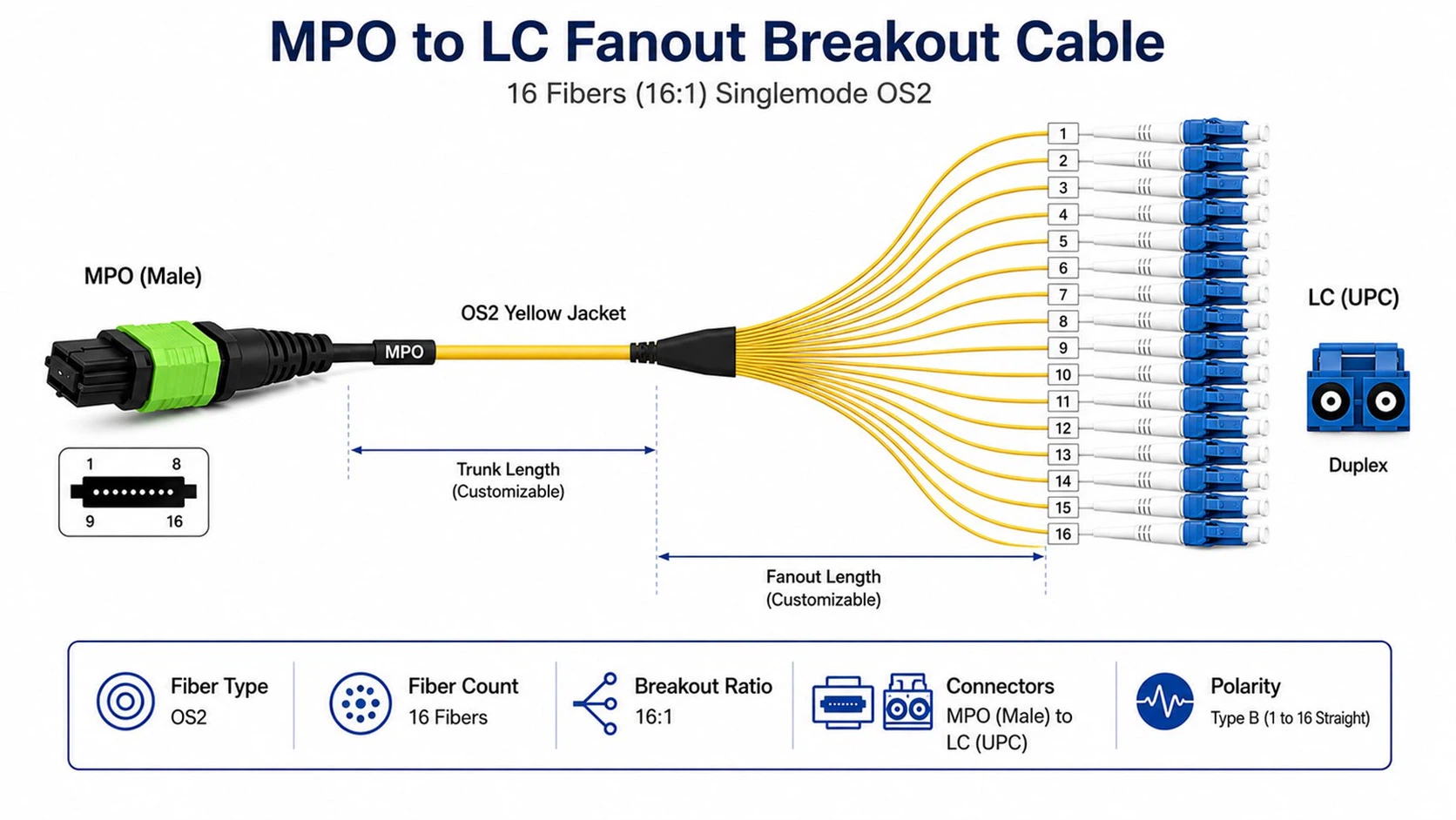
Breakout Cable Types by Connector and Fiber Count
Breakout cables fall into three primary configurations defined by fiber count: 8-fiber (for 40G/100G SR4 and 400G DR4), 16-fiber (for 400G SR8 and 800G SR8), and 24-fiber (for high-density structured cabling backbone applications). The connector type, fiber count, and connector gender must match your transceiver's physical interface exactly, and the options have multiplied as parallel optics moved from 40G to 800G.
The most common configurations: 8-fiber MPO-12 to 4×LC duplex (for 40G SR4, 100G SR4, 400G DR4), 16-fiber MPO-16 to 8×LC duplex or to 2×MPO-12 (for 400G SR8, 800G SR8), and 24-fiber MPO-24 to 3×MPO-8 or 12×LC duplex (for high-density structured cabling). SC connectors still appear in legacy telecom installations but are functionally absent from modern data center breakout designs. LC dominates due to its half-size footprint and latch mechanism. If you are inheriting a legacy system with SC-terminated fiber panels, the fastest path forward is SC-to-LC hybrid adapters at the panel; custom SC-fanout breakout cables typically require 4–6 weeks lead time from most manufacturers.
Connector Gender Rule
Connector gender follows one rule: transceivers are male, so every breakout cable that mates to a transceiver must be female. For panel-to-panel trunk connections, gender depends on the adapter type. If your MPO/MTP cable assemblies arrive with the wrong gender, you cannot fix this in the field without a US Conec MTP PRO connector and a pin exchanger tool, which most technicians do not carry.
Base-8 vs Base-12 vs Base-16: Which Architecture Fits Your Breakout Design?
The Base-8 versus Base-12 decision is where the largest hidden cost sits in any breakout deployment, and our position is unambiguous: for any new parallel optics installation, Base-8 is the correct default.
The Cost of Stranded Fiber
Here's the math. A 100G QSFP28 SR4 port on your spine switch costs roughly the same whether it connects to one 100G device or four 25G servers. The breakout cable is the difference between those two topologies, and between wasting 75% of your port bandwidth or using all of it. Across 500 links, that's 2,000 fibers carrying zero data. At typical OM4 pricing, the stranded fiber investment alone runs $10,000–$16,000 before you account for the panel space those unused fibers occupy. One data center operation we supported documented $40,000 in stranded capacity after a 100G rollout on Base-12 infrastructure.
Clean Port Mapping
The breakout-level impact is equally concrete. A Base-8 MPO-to-LC harness yields four duplex LC pairs that map cleanly to 4-port, 8-port, 16-port, and 32-port line cards. All those numbers divide evenly by four. A Base-12 harness gives you six LC pairs, which doesn't align with 16- or 32-port cards without leaving orphaned ports.
But this base-8 vs base-12 breakout cable decision has a condition that changes everything: if you already have a Base-12 trunk plant with hundreds of installed links, the conversion cassette path (2×MPO-12 rear → 3×MPO-8 front) delivers 100% fiber utilization from legacy glass without pulling new cable. The trade-off is an extra connection point, typically 0.35–0.5 dB of additional insertion loss, which tightens your link budget. For channels running close to the 1.5 dB limit of 100GBASE-SR4 (IEEE 802.3bm), that trade-off needs to be calculated, not assumed.
Ripping out Base-12 trunk for Base-8 is justified in one scenario: you're pulling all new cable in a wing with 200+ new parallel optic links and a 5+ year horizon. For anything smaller, conversion cassettes are the right call.
For 400G and 800G environments using SR8 or DR8 transceivers with 16-fiber interfaces, Base-16 (MPO-16) enters the picture. An MPO-16 to dual MPO-12 breakout cable is the standard method for splitting one 800G switch port into two independent 400G server links, a topology covered in detail below.
Polarity Planning for Breakout Cables: Type A, B, C, U1, and U2
Polarity errors are the single most common cause of breakout link failure, and they're maddening to troubleshoot because the physical connection looks perfect while the link stays dark.
The core requirement: every transmit fiber must arrive at a receive port on the far end. In an 8- or 16-fiber MPO breakout cable, the lane mapping across the entire channel, trunk, patch panel, breakout harness, duplex patch cord, must maintain Tx-to-Rx alignment across every fiber position.
Use Type B for parallel optic breakout cables. Not "consider" or "recommended"-use it. Type B fully reverses fiber positions (position 1 maps to position 12), uses identical component types on both ends of a channel, and aligns with the transceiver pinouts defined by IEEE 802.3 for QSFP and OSFP interfaces. Type A can work but requires a Type B patch cord on one end of every channel, a requirement that gets forgotten at 3 AM during a cutover, and at that point you're swapping transceivers three times before someone checks polarity.
Avoid Type C for parallel optics entirely. Its pair-flip mapping (1↔2, 3↔4, etc.) works fine for duplex-to-duplex scenarios but scrambles lane assignments in parallel transceivers. Many vendor guides list A, B, and C as equivalent options without flagging this limitation, which is how deployments end up with one link working and the adjacent one failing for no obvious reason.
A development worth tracking: ANSI/TIA-568.3-E introduced universal polarity Methods U1 and U2 in 2022. Both use Type-B trunks and standard A-to-B duplex patch cords, eliminating the need for unique MPO-to-LC modules on each end. Method U2 natively supports direct breakout applications, including 400G-to-4×100G fan-outs. Under the old A/B/C system, a 4-rack deployment might require five distinct MPO component part numbers. Method U2 collapses that to two: a Type-B trunk and a standard LC patch cord. Most existing breakout cable guides still only cover A/B/C, which means engineers designing new builds miss the simplification U2 offers.
But here's the variable most suppliers won't surface: U2's Type-B adapter orientation (key-up to key-up) does not support singlemode APC connectors, which require opposing angled end faces for proper return loss. If your 400G/800G deployment uses singlemode DR optics, Method U1 with Type-A adapters is the correct choice despite U2's simplicity advantage. To verify on-site: check your MPO adapter panel's key orientation. If adapters are key-up-to-key-up with APC-polished ferrules, you have a U2-incompatible configuration regardless of what your cabling spec says.
Breakout Cable Applications by Speed Tier: 40G to 800G
| Speed | Transceiver | Fiber Count | MPO Type | Breakout Config | Fiber / Max Distance |
|---|---|---|---|---|---|
| 40G | QSFP+ SR4 | 8 | MPO-12 (8 active) | 1×MPO → 4×LC duplex | OM4 150m |
| 100G | QSFP28 SR4 | 8 | MPO-12 (8 active) | 1×MPO → 4×LC duplex | OM4 100m |
| 400G | QSFP-DD DR4 | 8 | MPO-12 (8 active) | 1×MPO → 4×LC duplex | OS2 500m |
| 400G | QSFP-DD SR8 | 16 | MPO-16 | 1×MPO-16 → 2×MPO-12 | OM4 100m |
| 800G | OSFP 2×DR4 | 16 | Dual MPO-12 | Direct dual MPO-12 | OS2 500m |
| 800G | OSFP SR8 | 16 | MPO-16 | 1×MPO-16 → 2×MPO-12 | OM5 recommended |
The fiber type column assumes new cable pulls. If you're reusing existing OM3 or OM4 trunk infrastructure for 400G+ applications, the distance limits and loss margins shift, in some cases enough to disqualify a link that would pass on paper. The architecture section above covers the conversion cassette math for those scenarios.
800G-to-2×400G Breakout in AI Data Centers
In GPU-based AI clusters, switches run 800G while server NICs (ConnectX-7, BlueField-3) remain at 400G. This creates the most common 800G breakout cable architecture in production today: one OSFP 800G port splitting into two independent 400G links via MPO breakout cabling.
The physical implementation depends on the transceiver's interface. An OSFP SR8 with a single MPO-16 connector requires an MPO-16 to dual MPO-12 breakout cable; each MPO-12 leg connects to a 400G SR4 or DR4 NIC. An OSFP 2×DR4 with dual MPO-12 connectors needs no breakout at all; each MPO-12 port connects directly to a 400G DR4 module. In practice, the two MPO-12 legs from a single OSFP breakout often route to different patch panels in different racks. Label both legs with the parent OSFP port ID and leg designation (A/B) before routing. Polarity troubleshooting across a 72-port GPU tray without this labeling is a 4-hour exercise.
Non-negotiable requirements
- APC (Angled Physical Contact) polish is mandatory on all MPO connectors in 400G/800G parallel optic channels.
- APC and UPC connectors must never be mated together; this causes irreversible physical damage.
- Cable length matters for thermal management: Spec lengths to match actual routing distances.
The OM4 vs OM5 question for 800G SR8: for new builds, spec OM5. Based on our manufacturing cost data, the per-meter premium currently runs 15–25% over OM4 on standard 8-fiber harness orders, and OM5's SWDM support provides a concrete upgrade path to 1.6T optics without recabling. Explaining to your VP why an 800G cluster ran at OM4 margins and now needs a full recable for 1.6T is not a conversation worth having.
For GPU cluster topology reviews and 800G cable specifications, contact our data center solutions engineering team for a channel-level design audit.
Insertion Loss Budget in Breakout Channels
A standard 100G SR4 breakout channel, two mated MPO pairs plus 30 meters of OM4 fiber, consumes roughly 0.8–1.1 dB of a 1.5 dB total channel budget (IEEE 802.3bm). That leaves 0.4–0.7 dB of headroom. Add a Base-12-to-Base-8 conversion cassette (0.35–0.5 dB additional) and remaining margin drops to 0.2–0.4 dB, acceptable only if every connector in the channel is elite-grade and end-faces are immaculate.
Elite-Grade vs Standard
Standard-grade MPO assemblies contribute 0.3–0.7 dB per mated pair. Elite/low-loss assemblies sit below 0.3 dB (Fluke Networks). The engineering difference isn't just polish quality; elite-grade connectors use tighter ferrule alignment tolerances and higher-precision guide pins.
Testing Precision
Testing matters as much as component selection. Ensure your multimode test equipment uses encircled flux (EF) compliant launch conditions. Without EF compliance, multimode insertion loss measurements can vary by 0.3–0.8 dB on the same link.
Based on our production line pricing, elite MPO assemblies typically cost 20–40% more than standard grade on a per-cable basis. Across a 500-link deployment, that premium buys you 0.2–0.4 dB of headroom per channel, headroom that determines whether your links stay up as connectors age over 3–5 years of cleaning and re-mating.
Five Deployment Mistakes That Cost Real Money
Mating APC with UPC MPO connectors.
This destroys both end faces. In mixed-vintage environments where 400G APC coexists with legacy 10G/40G UPC infrastructure, color-coded dust caps and clear labeling are your only defense.
Polarity mismatch between trunk and breakout harness.
A Type A trunk paired with a Type A breakout cable without a Type B patch cord at one end results in Tx-to-Tx connections. The link doesn't come up. A $2 visual fault locator tracing each fiber end-to-end would have found it in minutes.
Wrong connector gender.
Plugging a male MPO breakout into a male transceiver port. The guide pins collide, the ferrule scores, and you've just turned two expensive components into scrap.
Ignoring microbend during installation.
Pulling breakout harness legs through tight cable management with excessive tension creates micro-deformations. Maintain bend radius ≥10× cable outer diameter and use Velcro wraps. Never use zip ties that compress the jacket.
Skipping end-face inspection.
A single dust particle on a 9 µm single-mode core blocks the optical path. Clean and inspect every connector before mating, every time. Thirty seconds prevents hours.
How to Choose a Breakout Cable for Your Data Center: Decision Checklist
The selection follows a fixed sequence. Shortcutting any step guarantees a mismatch somewhere.
Identify the transceiver model. Its datasheet defines fiber count, MPO interface, connector gender, and polish type. Everything downstream depends on this.
Confirm your cabling architecture. Base-8 installed? Proceed to step 3. Base-12 installed with plans to support parallel optics? → Evaluate conversion cassettes and recalculate loss budget before proceeding. Greenfield? → Default to Base-8.
Select polarity method. New parallel build → Type B. Extending existing Method A installation → match existing, but verify Type B patch cord at one end. Singlemode DR deployment needing U-method → U1 (not U2).
Determine fiber type and distance. SR applications under 100m → OM4 minimum, OM5 preferred for 800G. DR/FR applications → OS2. Stop here if your calculated channel length exceeds the transceiver's maximum supported distance.
Calculate insertion loss budget. Sum every connection point: trunk MPO pair + breakout MPO-to-LC + any cassette or adapter. Compare against application maximum. If margin is under 0.3 dB, specify elite-grade assemblies.
Verify connector gender and polish. Female MPO for transceiver connections. APC for all 400G/800G parallel optics. Confirm across every component in the bill of materials.
Order and test. Every pre-terminated assembly should ship with a Tier 1 test report showing per-fiber insertion loss measured under EF-compliant launch conditions.
For conversion cassette configurations and loss calculations, our MPO/MTP spec sheets include pre-calculated insertion loss tables by channel length. If your channel margin is under 0.3 dB even with elite-grade components, contact our engineering team for a channel-level loss audit against your specific topology.
FAQ
Q: What is the difference between a breakout cable and a trunk cable?
A: A trunk cable uses MPO/MTP connectors on both ends for permanent backbone links. A breakout cable fans out from one MPO/MTP connector to multiple duplex connectors (LC, SC), enabling a single parallel port to connect multiple lower-speed duplex devices.
Q: Should I use Base-8 or Base-12 breakout cables for 100G SR4?
A: Base-8. The transceiver uses exactly 8 fibers, so Base-12 wastes 33% of fiber capacity per link.
Q: What polarity type works for parallel optic breakout cables?
A: Type B. It uses identical components on both ends and aligns with QSFP/OSFP transceiver pinouts.
Q: Can an 800G port break out into two 400G connections?
A: Yes, using an MPO-16 to dual MPO-12 cable, or direct dual MPO-12 connections depending on the transceiver's interface design.
Q: What insertion loss should I expect from MPO breakout cables?
A: Standard assemblies: 0.3–0.7 dB per mated pair. Elite/low-loss: below 0.3 dB. Verify against your application's maximum channel loss.
FB-LINK has manufactured and tested MPO/MTP breakout assemblies since 2008, serving data center and telecom operators across 50+ countries. Every breakout cable we ship includes a Tier 1 insertion loss test report verified with EF-compliant test equipment. ISO 9001 certified production. We also build cables for environments where the standard catalog doesn't fit: custom fiber counts, non-standard breakout lengths, hybrid SM/MM assemblies, and specific polish/gender combinations for mixed-vintage environments. Explore our fiber optic patchcord product line or reach out to our engineering team for a specification review on your next parallel fiber deployment.