





Fiber optic transceiver
 Aug 14, 2025|
Advanced Technology for High-Speed Data Transmission

In today's digital landscape, the demand for high-speed, reliable data transmission has never been greater. The fiber optic transceiver stands as the cornerstone of modern optical communication systems, enabling the seamless transmission of vast amounts of data across networks worldwide. From streaming 4K and 8K video content to supporting live broadcast events, these sophisticated devices are essential components that bridge the gap between electrical and optical signals.
A fiber optic transceiver is a compact, pluggable module that serves dual functions: converting electrical signals to optical signals for transmission (transmit function) and converting received optical signals back to electrical signals (receive function). This bidirectional capability makes the fiber optic transceiver indispensable in modern telecommunications infrastructure.

Fiber optic transceivers enable high-speed data transmission in modern data centers and communication networks
Fundamental Principles of Fiber Optic Communication
The Science Behind Optical Transmission
The operation of a fiber optic transceiver is based on the principle of total internal reflection. When light travels through an optical fiber, it bounces off the fiber walls at angles greater than the critical angle, ensuring minimal signal loss over long distances. This phenomenon allows fiber optic transceiver modules to maintain signal integrity across kilometers of fiber cable.
The core components that enable this process include:
Light Sources
Modern fiber optic transceiver units utilize either Light Emitting Diodes (LEDs) or laser diodes as light sources. Laser diodes, particularly Vertical Cavity Surface Emitting Lasers (VCSELs) and Distributed Feedback (DFB) lasers, are preferred for high-speed applications due to their coherent light output and superior performance characteristics.
Photodetectors
On the receiving end, fiber optic transceiver modules employ photodiodes, typically PIN (Positive-Intrinsic-Negative) or APD (Avalanche Photo Diode) structures, to convert incoming optical signals back to electrical current.

Total internal reflection allows light to travel through optical fibers with minimal loss
Wavelength Division Multiplexing (WDM)
Advanced fiber optic transceiver systems leverage WDM technology to dramatically increase transmission capacity. By utilizing different wavelengths of light simultaneously on a single fiber, a fiber optic transceiver can support multiple data channels.
Common Wavelengths
- 850nm for multimode fiber applications
- 1310nm and 1550nm for single-mode fiber systems
- Dense WDM (DWDM) channels in the C-band (1530-1565nm)
Types and Classifications of Fiber Optic Transceivers
SFP Transceivers
Small Form-factor Pluggable transceivers represent one of the most widely adopted form factors. These compact modules support data rates up to 1 Gbps and are hot-swappable.
SFP+ Transceivers
Building upon the SFP platform, SFP+ modules support data rates up to 10 Gbps while maintaining backward compatibility with SFP slots.
QSFP+ and QSFP28
For ultra-high-speed applications, QSFP+ and QSFP28 modules offer 40G and 100G capabilities respectively, utilizing parallel optics.
CFP Series
The CFP series modules are designed for 100G and beyond applications, incorporating sophisticated digital signal processing.

Comparison of common fiber optic transceiver form factors showing size differences and connector types
Transmission Distance Classifications
| Transceiver Type | Distance Range | Typical Wavelength | Fiber Type | Common Applications |
|---|---|---|---|---|
| Short Range (SR) | Up to 300m | 850nm | Multimode | Data center interconnects, campus networks |
| Long Range (LR) | Up to 10km | 1310nm | Single-mode | Metropolitan area networks, inter-building connections |
| Extended Range (ER) | Up to 40km | 1550nm | Single-mode | Long-haul communications, regional networks |
| ZR Transceivers | Up to 80km | 1550nm | Single-mode | Ultra-long-haul links, backbone networks |
Manufacturing Process and Production Workflow
Component Fabrication
The production of a high-quality fiber optic transceiver begins with the fabrication of critical optical and electronic components. The manufacturing process involves several sophisticated steps:
Semiconductor Wafer Processing
The laser diode and photodiode chips used in fiber optic transceiver modules begin as semiconductor wafers. Through photolithography, ion implantation, and epitaxial growth processes, the active regions are precisely defined. Quality control at this stage is crucial, as any defects will directly impact fiber optic transceiver performance.
Optical Component Assembly
The optical bench assembly represents the heart of any fiber optic transceiver. This process involves:
- Die Bonding: Laser diodes and photodiodes are precisely mounted onto submounts using specialized die bonding equipment
- Wire Bonding: Ultra-fine gold or aluminum wires connect the semiconductor devices to the electrical interfaces
- Optical Alignment: Coupling lenses and optical isolators are aligned with sub-micron precision to maximize optical coupling efficiency

Semiconductor wafer processing for laser diodes and photodiodes

Precision optical alignment during transceiver manufacturing
PCB Assembly and Integration
The electronic control circuitry of a fiber optic transceiver is assembled on high-frequency printed circuit boards (PCBs). This process includes:
Component Placement
Surface-mount technology (SMT) equipment places resistors, capacitors, and integrated circuits with extraordinary precision. The tolerances must be extremely tight to ensure proper fiber optic transceiver functionality.
Reflow Soldering
Controlled-atmosphere reflow ovens create reliable solder joints while preventing oxidation that could degrade fiber optic transceiver performance.
Driver IC Integration
Specialized driver and receiver integrated circuits are incorporated to provide the necessary electrical interfaces and signal conditioning required for optimal fiber optic transceiver operation.
Final Assembly and Packaging
The final assembly of a fiber optic transceiver involves several critical steps:
Optical Path Assembly
The transmit and receive optical paths are constructed using precision-machined components. Optical isolators prevent back-reflections that could destabilize laser operation in the fiber optic transceiver.
Hermetic Sealing
Critical optical components within the fiber optic transceiver are often hermetically sealed to prevent contamination and ensure long-term reliability.
Connector Integration
The fiber optic connector interface is precisely aligned and secured, ensuring optimal optical coupling when the fiber optic transceiver is connected to fiber cables.
Quality Control and Testing Procedures
Optical Performance Testing
Every fiber optic transceiver undergoes comprehensive optical testing to verify performance specifications:
Optical Power Measurement
Calibrated optical power meters verify that the fiber optic transceiver transmit power falls within specified limits across the operating temperature range.
Extinction Ratio Testing
This critical parameter ensures that the fiber optic transceiver can clearly distinguish between logical '1' and '0' states in the optical domain.
Eye Diagram Analysis
High-speed oscilloscopes capture eye diagrams to verify signal integrity and timing margins of the fiber optic transceiver under various operating conditions.
Environmental Testing
Temperature Cycling
Each fiber optic transceiver is subjected to multiple temperature cycles ranging from -40°C to +85°C to verify reliability under thermal stress.
Vibration and Shock Testing
Mechanical stress testing ensures that the fiber optic transceiver can withstand the rigors of installation and operation in challenging environments.
Humidity Testing
Extended exposure to high humidity conditions verifies that the fiber optic transceiver sealing is effective and components remain stable.

Advanced testing equipment ensures fiber optic transceivers meet strict performance specifications
Digital Signal Processing and Advanced Technologies
Forward Error Correction (FEC)
Modern high-speed fiber optic transceiver modules incorporate sophisticated FEC algorithms to improve link performance and extend transmission distances. These digital signal processing techniques allow the fiber optic transceiver to correct transmission errors in real-time, significantly improving system reliability.
Digital Signal Processing (DSP)
Advanced fiber optic transceiver modules utilize DSP chips to implement chromatic dispersion compensation, polarization mode dispersion compensation, and adaptive equalization to optimize signal quality under varying channel conditions.
Coherent Detection
State-of-the-art fiber optic transceiver systems employ coherent detection, which offers superior sensitivity compared to direct detection methods. Coherent modules utilize local oscillator lasers and high-speed ADCs for advanced signal processing.
Coherent Detection Technology
Coherent fiber optic transceiver modules represent the cutting edge of optical communication technology, enabling unprecedented data rates and transmission distances. These advanced systems utilize:
Local Oscillator Lasers
Providing a reference signal for coherent mixing, enabling the detection of both amplitude and phase information from the incoming optical signal.
90-Degree Optical Hybrids
Enabling both amplitude and phase information recovery by splitting and combining signals in quadrature phases.
High-Speed ADCs
Converting analog optical signals to digital format for DSP processing, enabling advanced compensation algorithms.
Applications in Media and Entertainment Industry
Broadcast and Production Facilities
In broadcast environments, fiber optic transceiver modules enable the transmission of uncompressed video signals between production equipment. The high bandwidth capability of modern fiber optic transceiver technology is essential for:
4K and 8K Video Transport
Ultra-high-definition video formats require massive bandwidth. A single 8K video stream can consume up to 48 Gbps of bandwidth, making advanced fiber optic transceiver technology crucial for real-time production workflows.
Live Event Coverage
Outside broadcast applications rely on fiber optic transceiver modules to deliver multiple video feeds from remote locations back to production facilities with minimal latency.
Streaming and Content Distribution
Content Delivery Networks (CDNs)
Global CDN infrastructures depend on high-capacity fiber optic transceiver links to distribute video content efficiently. The reliability and performance of fiber optic transceiver modules directly impact user experience quality.
Data Center Interconnects
Streaming platforms utilize fiber optic transceiver technology to connect geographically distributed data centers, ensuring content availability and reducing latency for end users.
Future Trends and Technological Developments
Silicon Photonics Integration
The integration of silicon photonics technology is revolutionizing fiber optic transceiver design, offering cost reduction, higher integration density, and improved power efficiency.
Quantum Technologies
Emerging quantum communication applications are driving the development of specialized fiber optic transceiver modules capable of handling quantum states of light for ultra-secure communications.
Artificial Intelligence Integration
Next-generation fiber optic transceiver modules are incorporating AI algorithms for predictive maintenance, adaptive optimization, and intelligent network management.
Projected Data Rate Evolution
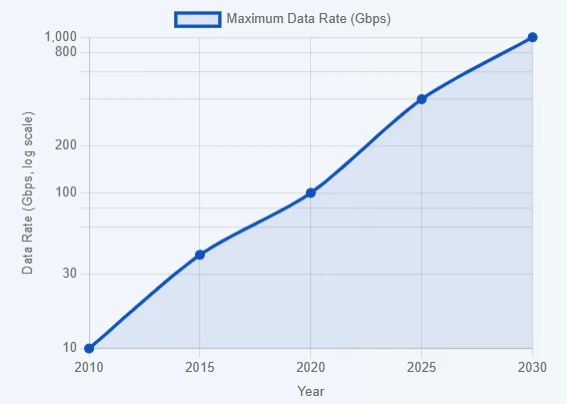
The demand for higher data rates continues to accelerate, driven by emerging applications in media, cloud computing, and IoT. Fiber optic transceiver technology is evolving to meet these demands through innovations in modulation formats, wavelength division multiplexing, and advanced signal processing.
By 2030, we can expect commercial deployment of terabit-class transceivers that will enable the next generation of high-bandwidth applications and services.
Environmental Considerations and Sustainability
Green Manufacturing Practices
Leading fiber optic transceiver manufacturers are implementing sustainable practices throughout the product lifecycle:
Material Selection
Using environmentally friendly materials and reducing the use of hazardous substances in fiber optic transceiver production.
Energy Efficiency
Developing fiber optic transceiver modules with lower power consumption to reduce overall network energy requirements.
Recycling Programs
Establishing take-back programs for end-of-life fiber optic transceiver modules to promote circular economy principles.
Industry Standards and Compliance
International Standards Organizations
IEEE Standards
The Institute of Electrical and Electronics Engineers maintains critical standards for fiber optic transceiver interfaces and performance requirements.
ITU-T Recommendations
The International Telecommunication Union provides global standards for fiber optic transceiver applications in telecommunications networks.
MSA Agreements
Multi-Source Agreements ensure interoperability between fiber optic transceiver modules from different manufacturers.
Compliance Testing and Certification
Every commercial fiber optic transceiver must undergo rigorous compliance testing to ensure adherence to industry standards. This includes:
EMI/EMC Testing: Verifying electromagnetic compatibility to ensure the fiber optic transceiver doesn't interfere with other equipment and remains unaffected by external electromagnetic sources.
Safety Certification: Ensuring user and equipment safety through compliance with international safety standards for laser products and electrical safety.
Environmental Compliance: Meeting RoHS and other environmental regulations restricting the use of hazardous substances in fiber optic transceiver manufacturing.
Technical Specifications and Performance Metrics
Key Performance Indicators
Bit Error Rate (BER)
A critical metric defining the reliability of fiber optic transceiver operation, typically specified as better than 10^-12 for high-quality modules. This means fewer than one bit error in every trillion bits transmitted.
Optical Signal-to-Noise Ratio (OSNR)
This parameter determines the sensitivity and performance margin of fiber optic transceiver systems in the presence of optical noise. Higher OSNR values indicate better signal quality and greater transmission reach.
Chromatic Dispersion Tolerance
Modern fiber optic transceiver modules must operate reliably across a wide range of fiber dispersion characteristics. Advanced transceivers incorporate DSP-based compensation to extend dispersion tolerance.
Power Budget Calculations
The optical power budget of a fiber optic transceiver system determines the maximum transmission distance and number of optical components that can be included in the link. This calculation considers:
Power Budget Formula
Power Budget = Transmitter Output Power - Receiver Sensitivity
The total link loss must be less than the power budget to ensure reliable operation
Link Losses
Including fiber attenuation, connector lossesand splice losses that reduce signal strength.
System Margins
Installation and Maintenance Best Practices
Proper Handling Procedures
ESD Protection
Fiber optic transceiver modules contain sensitive electronic components that require proper electrostatic discharge protection during handling and installation. Always use grounded wrist straps and anti-static work surfaces.
Optical Connector Care
The optical interfaces of fiber optic transceiver modules must be kept clean and protected from contamination to maintain optimal performance. Use proper cleaning tools and always cover unused connectors.
Temperature Management
Proper thermal management ensures that fiber optic transceiver modules operate within specified temperature ranges for maximum reliability and lifespan. Ensure adequate ventilation and cooling in equipment racks.
Troubleshooting and Diagnostics
Digital Diagnostics Monitoring (DDM)
Modern fiber optic transceiver modules incorporate DDM capabilities, providing real-time monitoring of critical parameters including optical power, temperature, and bias current. This enables proactive maintenance and faster troubleshooting.
Link Testing
Proper commissioning of fiber optic transceiver links involves comprehensive testing using optical time-domain reflectometers (OTDRs) and bit error rate testers (BERTs) to verify link quality and performance margins.
Common Troubleshooting Steps
Verify proper seating of the fiber optic transceiver in its socket
Check for clean, undamaged optical connectors
Measure optical power levels at both ends of the link
Check for excessive temperature in the equipment rack
Verify compatibility between transceiver models and equipment
Consult DDM data for abnormal operating parameters
The fiber optic transceiver represents one of the most critical components in modern optical communication systems. From enabling ultra-high-definition video streaming to supporting next-generation data center architectures, fiber optic transceiver technology continues to evolve to meet ever-increasing bandwidth demands.
As we move toward an increasingly connected world, the importance of reliable, high-performance fiber optic transceiver solutions cannot be overstated. The continuous advancement in fiber optic transceiver technology, including silicon photonics integration, coherent detection, and AI-enabled optimization, ensures that these devices will remain at the forefront of optical communication technology.
The media and entertainment industry's reliance on fiber optic transceiver technology for 4K, 8K, and future video formats demonstrates the critical role these devices play in delivering high-quality content to global audiences. As bandwidth requirements continue to grow, fiber optic transceiver manufacturers must continue to innovate, developing solutions that combine exceptional performance, reliability, and cost-effectiveness.
Understanding the complete ecosystem of fiber optic transceiver technology – from fundamental principles to manufacturing processes, applications, and future trends – is essential for anyone involved in designing, deploying, or maintaining modern optical communication systems. The fiber optic transceiver will undoubtedly remain a cornerstone technology as we build the infrastructure for tomorrow's digital world.