





SFP & SFP+ MSA: What the Specs Define, What Vendors Lock Down
 Mar 02, 2026|
 Every time you plug a transceiver into a switch made by a different manufacturer and the link comes up clean, a Multi-Source Agreement made that possible. The SFP MSA and SFP+ MSA are two of the most consequential documents in optical networking - yet most engineers who depend on them daily have never read either one. These agreements are not marketing labels. They are precise technical specifications that define exactly how a pluggable transceiver must be built so it works in any compliant host port, from any vendor, without negotiation or guesswork.
MSA vs. Formal Standards: An Important Distinction
A Multi-Source Agreement is a voluntary specification jointly authored by competing manufacturers. It is not ratified by any official standards body. IEEE 802.3 defines how Ethernet frames are encoded and transmitted across a physical medium. ITU-T G.694.1 defines DWDM channel spacing. The SFP MSA defines none of that. What it defines is the transceiver module itself - its physical dimensions, 20-pin electrical connector layout, power supply requirements, signal assignments, and the management interface used for identification and diagnostics.
This separation of concerns is what makes the system work. IEEE tells the industry what the signal should look like. The MSA tells the industry what the box carrying that signal should look like. As long as both sides comply, a 1000BASE-LX module from a factory in Shenzhen will behave identically to one from a facility in Texas when inserted into the same switch port. That interchangeability is what turned optical transceivers from vendor-locked accessories into a competitive commodity market.
How the SFP Replaced the GBIC - and Why It Matters for Understanding MSAs
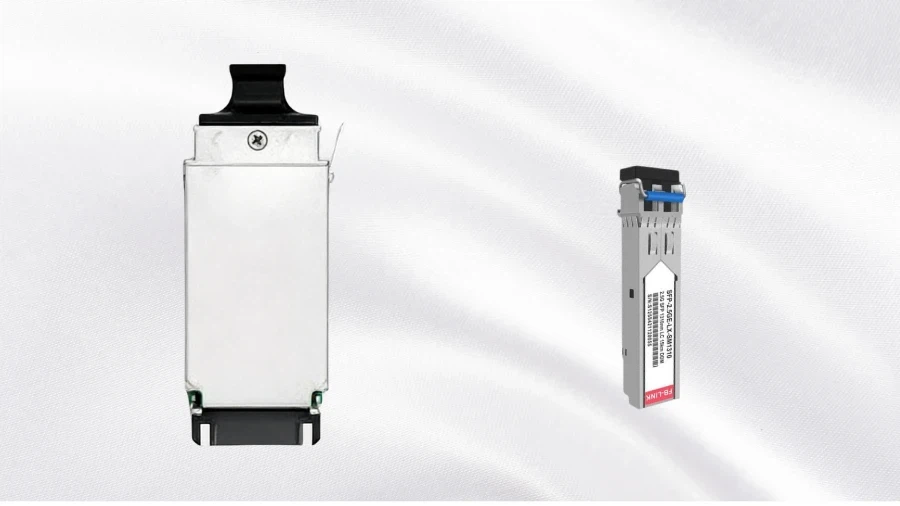
Before the SFP existed, the GBIC (Gigabit Interface Converter) was the standard hot-pluggable transceiver form factor, governed by its own MSA specification SFF-8053, first published in 1995. GBICs worked, but they were physically large - roughly twice the footprint of an SFP - and used SC duplex connectors that consumed considerable faceplate space. A typical Catalyst 6500 line card could accommodate perhaps 16 GBIC ports. The math was simple and brutal: as networks scaled, there was no way to deliver 48 Gigabit fiber ports per line card in a GBIC form factor.
The SFP MSA, documented as INF-8074i and published on May 12, 2001, was the industry's direct answer to that density problem. Fifteen companies signed the original agreement, including Finisar, IBM, Agilent Technologies, Molex, Lucent Technologies, Picolight, and Infineon Technologies. The specification shrank the module to roughly half the GBIC's volume, switched from SC to LC connectors, and used a 20-pad edge connector instead of the GBIC's pin-based interface. Suddenly, 48-port SFP line cards were not just possible - they became standard.
What makes this history relevant today is the pattern it established. Each subsequent transceiver generation - SFP+, SFP28, QSFP+, QSFP28, QSFP-DD - followed the same MSA-driven process: competing manufacturers sit down, agree on shared physical and electrical specifications, publish the document, and let the market compete on quality, price, and support rather than proprietary form factors. The result is a progression of transceiver types spanning 1G through 400G, all governed by this same framework.
Inside INF-8074i: What the SFP MSA Actually Specifies
INF-8074i covers four major areas. First, mechanical dimensions: every MSA-compliant SFP module must fit within the same physical envelope and mate with the same cage and connector system. Second, the electrical interface: the 20-pin edge connector defines transmit and receive differential data pairs, power rails (VccT for transmitter, VccR for receiver), ground connections, a transmit-fault output, a transmit-disable input, three module-definition pins (Mod-Def 0/1/2) for presence detection and the I2C serial interface, and a rate-select pin for dual-rate operation.

Third, the EEPROM memory map: a 256-byte block at I2C address 0xA0 stores the module's identity - manufacturer name, part number, serial number, supported data rates, wavelength, link length ratings, and connector type. This is the data your switch reads within milliseconds of module insertion. Fourth, the specification provides recommended host board layouts, bezel designs, and insertion/extraction force limits to ensure consistent field serviceability. Understanding what the MSA does and does not guarantee is fundamental to understanding how transceiver modules actually function inside your network equipment.
SFP+ and the CDR Decision That Killed XFP
When 10 Gigabit Ethernet arrived, the industry initially standardized on the XFP form factor (documented in INF-8077i). XFP modules were physically larger than SFPs because they contained the clock and data recovery (CDR) circuitry inside the module itself, along with the complete electronic dispersion compensation (EDC) engine. This made XFP modules more complex, more power-hungry, and more expensive.
The SFP+ MSA, formally SFF-8431, took a fundamentally different approach. It moved CDR and signal conditioning from the module to the host system's SerDes (serializer/deserializer). This meant the SFP+ module itself became simpler - essentially a laser, a photodetector, and minimal driver electronics - while preserving the same compact mechanical footprint as the original SFP. The tradeoff was that host switch designs needed more capable SerDes, but ASIC vendors were already moving in that direction.
The result was decisive. SFP+ modules were smaller, cheaper, and consumed less power than XFP. Port density doubled or tripled on the same faceplate. XFP faded from the market within a few years. That same CDR-on-host architecture carried forward into today's 10GBASE SFP+ modules across every reach variant - SR, LR, ER, ZR - and set the template for 25G and 100G designs. The SFF-8431 specification, at revision 4.1 since July 2009, remains the governing document for 10G SFP+ to this day.
Digital Diagnostics and the SFF-8472 Specification
Both SFP and SFP+ modules typically implement Digital Diagnostics Monitoring (DDM) as defined in SFF-8472, now maintained by the SNIA SFF Technical Work Group. DDM exposes five real-time parameters through the I2C management interface: transmit optical power, receive optical power, laser bias current, module temperature, and supply voltage. These values are stored at I2C address 0xA2 and can be read by the host system for SNMP-based monitoring.
Laser bias current trending deserves particular attention. A laser diode that requires steadily increasing bias current to maintain stable output power is approaching end-of-life. Catching this pattern through DDM data lets operations teams schedule proactive replacements instead of troubleshooting unexplained link flaps at 3 AM. This diagnostic capability is equally relevant whether you are running 10G copper SFP+ modules in a mixed-media campus or single-mode fiber across a metro ring. The latest SFF-8472 revision (12.5, published 2025) added expanded page-select support and new transceiver codes, reflecting the specification's ongoing evolution even for mature form factors.
Vendor Lock-In: How EEPROM Coding Actually Works
The SFP MSA leaves certain EEPROM byte ranges designated as "vendor specific" - notably bytes 96 through 127 at address 0xA0. Some equipment manufacturers exploit these undefined bytes by writing proprietary identification codes into their branded modules. When any module is inserted, the switch firmware reads these bytes and compares them against an expected value. If the code does not match, the port throws an "unsupported transceiver" warning or refuses to activate entirely.
This restriction is not an MSA requirement - it is a firmware-level policy imposed by the host vendor on top of the standard. The rejected third-party module still meets every mechanical, electrical, and optical specification in INF-8074i or SFF-8431. Third-party suppliers counteract this by programming the correct vendor-specific codes into their modules' EEPROMs. On Cisco IOS platforms, administrators can also override the check with the service unsupported-transceiver command, though Cisco TAC will not support this configuration. This coding dynamic is one of the most important variables when evaluating which transceiver works in a given switch platform.
What Happened to the Original 15 Signatories
Tracking the fate of the original INF-8074i signatories tells the broader story of optical industry consolidation. Finisar was acquired by II-VI in 2019, which subsequently rebranded as Coherent Corp. Agilent spun off its semiconductor operations into Avago Technologies, which merged with Broadcom. Lucent Technologies merged with Alcatel and was later absorbed into Nokia. Infineon sold its fiber optics unit. Picolight was acquired by JDSU (now Viavi Solutions). Of the fifteen original signatories, most no longer exist as independent entities - yet the specification they authored continues to govern billions of modules shipped every year.
This is arguably the MSA model's greatest strength. The agreement outlives the companies that created it. Because the specification is public and implementation is open, any manufacturer can build compliant modules without licensing fees or proprietary dependencies. That same openness is why the MSA framework scaled seamlessly from 1G SFP all the way to 400G QSFP-DD modules built for hyperscale data centers - and why pluggable transceivers remain the dominant interconnect model across enterprise, telecom, and cloud infrastructure alike.