





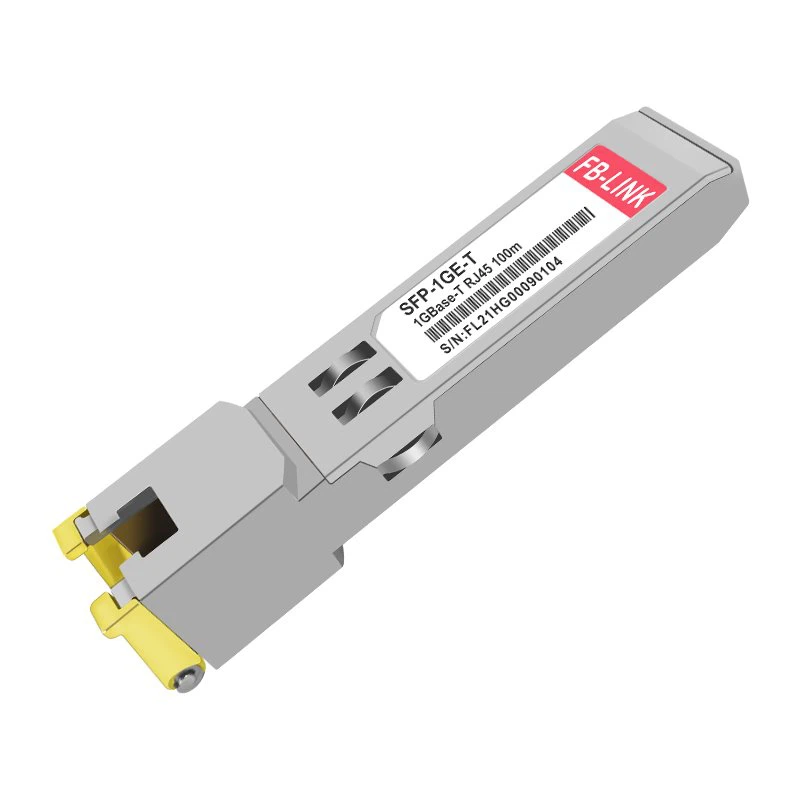

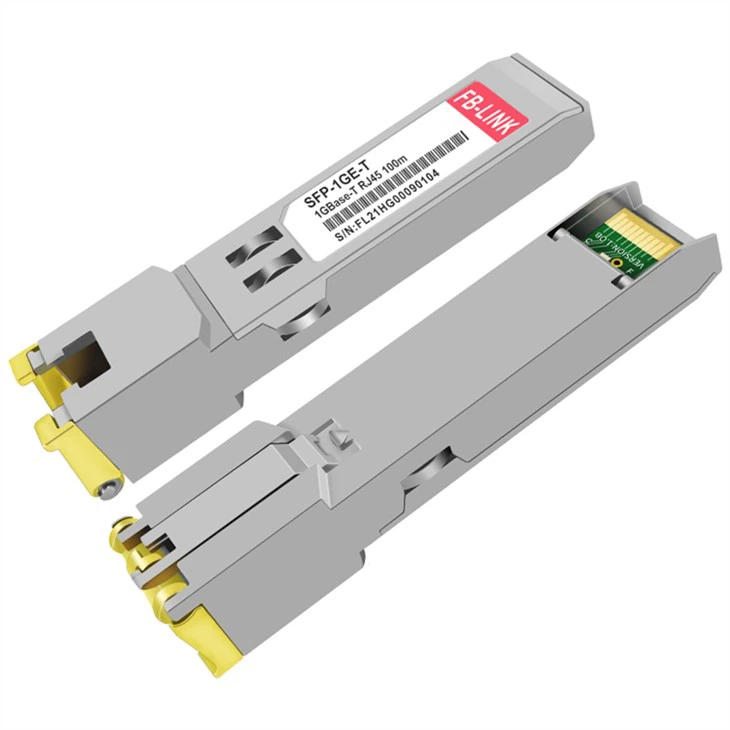
10/100/1000BASE SFP RJ45
10/100/1000BASE SFP RJ45 series optical module, according to the different hardware configuration, can be divided into eight categories, specific reference to the company's internal model shall prevail.
Item Spotlights
● Tested in Targeted Switches for Superior Performance, Quality, and Reliability
● Terminated RJ45 Connectors Allow 1G Bandwidth over Existing Copper Infrastructure
● Hot Pluggable SFP MSA Compliant
● Power dissipation <1W
● Commercial case temperature range of -40°C to 85°C
● Single 3.3V power supply
● Maximum link length of 100m on Network Cable
● Aligned with IEEE 802.3z
● RoHS compliant

- Product Introduction
Features
Dimensions: Interoperable with any SFP+ port rack system.
Performance: Using the PHY standard, data can be transmitted over copper cables without errors using block encoding.
Auto-negotiated backward compatibility: It is compatible with previous generation 10/100/1000BASE-T networks for seamless migration to 10Gb Ethernet.

Application Option 1: Connect the server/or storage device with 10GBASE-T RJ-45 port to the network switch with SFP+ port.

Application option 2: Upgrade the network to 10G on edge switches
Description
|
Compatible |
10/100/1000BASE RJ45 |
Vendor Name |
FB-LINK |
|
Form Factor |
SFP |
Max Data Rate |
1000Mbps |
|
Wavelength |
1550nm |
Max Cable Distance |
100m |
|
Connector |
RJ45 |
Media |
Cat 5e/6/6a |
|
EMC (Electro Magnetic Compatibility) |
Supported |
MTBF |
217,330 Hours |
|
Power Consumption |
≤1W |
Bit Error Ratio (BER) |
1000BASE-T guarantees a link BER of 1E-12 when supporting 100m on Cat 5e/6/6a. |
|
DDM/DOM |
Not Supported |
Commercial Temperature Range |
0 to 70°C (32 to 158°F) |
|
Protocols |
IEEE Std 802.3 and 802.3ab, SFP MSA Compliant |
Warranty |
3 Years |
Fully compatible

Shipping

When building or upgrading network infrastructure, selecting the right connectivity solution can make all the difference between a seamless operation and persistent technical headaches. Among the various optical transceivers available today, RJ45 copper modules stand out as versatile, cost-effective options that bridge the gap between fiber optic and traditional copper networks.
What Are RJ45 Copper Modules?
RJ45 copper modules, frequently called photoelectric conversion modules or optical-to-electrical port modules, represent a specialized category within the optical transceivers family. These compact devices enable network administrators to leverage existing copper cabling infrastructure while maintaining compatibility with modern fiber optic switching equipment.
The technology behind these modules combines the reliability of traditional Ethernet connections with the flexibility of small form-factor pluggable (SFP) interfaces. This unique combination allows organizations to maximize their existing investments in copper cabling while gradually transitioning to higher-performance networking solutions.
Key Characteristics That Set These Modules Apart
Unlike standard fiber-based optical transceivers, copper modules feature several distinctive attributes. They utilize standard RJ45 connectors, making them immediately compatible with conventional Ethernet cables. The absence of laser components-typically the most expensive part of fiber optic transceivers-contributes to their affordability and lower power requirements.
These modules deliver exceptional performance for short-distance applications, typically supporting transmission distances up to 100 meters over Category 5e, 6, or 6a cabling. The compact design ensures they occupy minimal space in network racks while maintaining full compliance with industry standards.
Comparing Copper Modules to Traditional Fiber Optical Transceivers
Understanding the differences between copper-based and fiber-based optical transceivers helps network engineers make informed decisions. While fiber optic transceivers use LC duplex or other specialized connectors and require fiber optic patch cords, copper modules work with standard twisted-pair Ethernet cables.
The absence of wavelength specifications in copper modules simplifies deployment planning. Network teams don't need to concern themselves with matching transmit and receive wavelengths-a common consideration when working with fiber optical transceivers. This simplicity accelerates deployment and reduces the potential for configuration errors.
Distance capabilities differ significantly between these technologies. While various optical transceivers can span distances from 5 to 100 kilometers depending on fiber type and quality, copper modules excel in shorter reaches where cable runs don't exceed 100 meters.
Technical Advantages for Modern Networks
The engineering behind these modules incorporates several features that enhance network performance. Physical layer (PHY) standards enable error-free data transmission over copper cables through sophisticated block encoding techniques. This ensures reliable communication even in electrically noisy environments.
Auto-negotiation capabilities provide seamless backward compatibility with legacy 10/100/1000BASE-T networks. This feature proves invaluable during network migrations, allowing organizations to upgrade incrementally rather than requiring complete infrastructure overhauls.
Multi-rate support represents another significant advantage. A single module can automatically adjust to operate at 10Mbps, 100Mbps, 1000Mbps, or even 10Gbps, depending on the connected equipment and cable quality. This versatility simplifies inventory management and reduces the risk of deploying incompatible hardware.
Practical Deployment Scenarios
Network architects commonly deploy these optical transceivers in several configurations. One popular application involves connecting servers or storage devices equipped with standard RJ45 ports to network switches featuring SFP or SFP+ slots. This configuration eliminates the need for protocol conversion equipment or expensive switch replacements.
Edge network upgrades represent another common use case. Organizations can install higher-performance core switches with SFP+ ports while maintaining connections to existing devices through copper modules. This approach extends the useful life of installed equipment while preparing the infrastructure for future enhancements.
Data centers benefit particularly from the flexibility these modules provide. When equipment placement requires connections beyond the practical limits of direct-attach copper cables but doesn't justify the expense of fiber infrastructure, copper modules offer an ideal middle ground.
Power Efficiency and Environmental Considerations
Energy consumption matters increasingly in modern data centers where thousands of network ports operate continuously. Compared to switches with embedded 10GBASE-T RJ45 ports, utilizing SFP-based copper modules can reduce per-port power consumption by at least 0.5 watts. While this might seem modest, the savings multiply across large installations, resulting in significant reductions in electricity costs and cooling requirements.
The compact form factor of these optical transceivers also contributes to better airflow management within equipment racks. Improved air circulation enhances cooling efficiency and helps maintain optimal operating temperatures for all network components.
Compatibility and Interoperability
Modern copper modules typically comply with industry standards including IEEE 802.3 specifications and SFP Multi-Source Agreement (MSA) requirements. This standards compliance ensures broad compatibility across equipment from various manufacturers.
However, some networking equipment vendors implement proprietary validation mechanisms that may restrict the use of third-party modules. Before large-scale deployment, testing compatibility between specific modules and target switches is advisable. Many manufacturers provide compatibility matrices that simplify this research process.
Performance Metrics and Reliability
Quality optical transceivers meet stringent performance standards. Bit error rates (BER) of 1E-12 or better ensure data integrity even during sustained high-traffic periods. Mean time between failures (MTBF) exceeding 200,000 hours indicates exceptional reliability-essential for mission-critical network infrastructure.
Commercial temperature ratings typically span from 0 to 70 degrees Celsius, making these modules suitable for most indoor installations. For outdoor applications or extreme environments, specialized variants with extended temperature ranges are available.
Frequently Asked Questions
Can copper modules work in higher-speed SFP+ ports?
Yes, most quality copper modules designed for gigabit speeds function correctly when installed in 10-gigabit SFP+ ports. The port automatically negotiates the appropriate speed based on the module's capabilities and the connected equipment. This backward compatibility provides excellent flexibility during network transitions.
What cable types work best with these optical transceivers?
Category 5e cabling represents the minimum recommendation, though Category 6 or 6a provides better performance and future-proofing. Higher-grade cables offer superior noise immunity and support longer cable runs while maintaining signal integrity. For 10-gigabit applications, Category 6a becomes essential to achieve rated distances.
How do these modules compare to direct-attach copper cables?
Direct-attach copper (DAC) cables integrate the transceiver functions directly into the cable assembly, which works well for very short connections within a single rack. Copper modules offer greater flexibility because standard Ethernet cables can be easily replaced or reconfigured without changing the modules themselves. This modularity proves especially valuable in dynamic environments where connections change frequently.
Do these optical transceivers support digital diagnostics monitoring?
Most copper-based modules don't include DDM/DOM functionality because the electrical nature of the connection provides different diagnostic information compared to optical links. Network management systems can still monitor link status, speed, and basic error counters through standard switch management interfaces.
What considerations affect maximum transmission distance?
Cable quality represents the primary factor affecting achievable distance. Category 5e typically supports full gigabit speeds up to 100 meters, while lower-quality or damaged cables may limit practical distances. Electromagnetic interference from nearby equipment can also impact performance, particularly in industrial environments. Proper cable management practices, including appropriate separation from power cables and use of shielded variants when necessary, help maximize reliable transmission distances.
Can these modules support Power over Ethernet applications?
The modules themselves don't generate or pass PoE power. However, when installed in switches with PoE capabilities, the electrical connection through the module allows PoE delivery to connected devices. The switch's PoE circuitry operates independently of the module's transceiver functions.
How do warranty terms typically compare across different optical transceivers?
Quality manufacturers typically offer three-year warranties on copper modules, similar to their fiber-based counterparts. This demonstrates confidence in the reliability of these components. Some vendors provide lifetime warranties, though it's important to review the specific terms and conditions, including any limitations or exclusions.
Are there special installation requirements?
Installation follows standard SFP module procedures. Ensure switches are properly powered down or support hot-swapping before inserting or removing modules. Clean port openings prevent dust accumulation that could affect electrical contacts. Avoid forcing modules into slots-proper alignment should allow smooth insertion with minimal pressure.
Making the Right Choice for Your Network
Selecting appropriate optical transceivers requires careful consideration of current needs and future growth plans. Copper modules excel in scenarios where existing copper cabling infrastructure remains serviceable, distances stay within 100-meter limits, and cost efficiency matters.
For organizations planning significant capacity increases or requiring longer transmission distances, investing in fiber-based optical transceivers might prove more economical long-term. However, for edge connectivity, server connections, and numerous other applications, copper modules deliver outstanding value and performance.
The networking landscape continues evolving, but the fundamental need to connect devices reliably and cost-effectively remains constant. RJ45 copper modules address this need elegantly, providing a bridge between established technologies and emerging standards. By understanding their capabilities and limitations, network professionals can deploy these optical transceivers strategically, creating robust, flexible infrastructure that serves organizational needs both today and into the future.
Hot Tags: Optical Transceivers
You Might Also Like


