





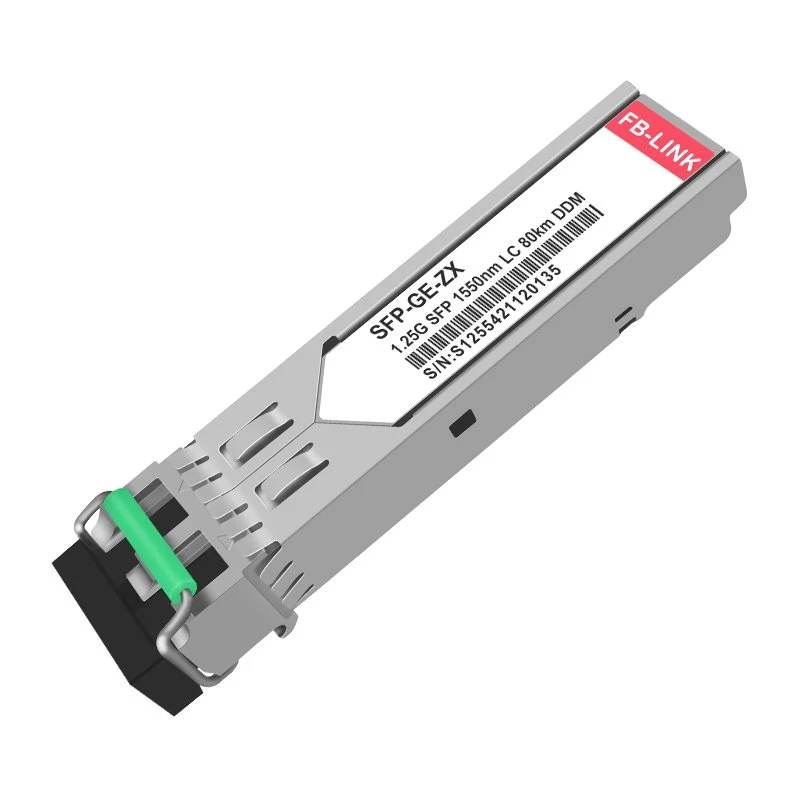


SFP GE ZX
SFP GE ZX compatible SFP transceiver supports up to 80km link lengths over LC duplex SMF fiber. Each SFP transceiver module is individually tested to be used on a series of Cisco switches, routers, servers, network interface card (NICs) etc.

- Product Introduction
Item Spotlights
● Hot-pluggable SFP form factor
● Supports 1.25Gb/s aggregate bit rate
● Power dissipation<1W
● Commercial case temperature range of -40°C to 85°
● Single 3.3V power supply
● Maximum link length of 80km on Single Mode Fiber (SMF)
● 1.25G NRZ -based 1550nm transmitter
● 1.25G NRZ retimed electrical interface
● Dual LC receptacles
● I2C management interface
● Class 1 FDA Laser Safety and RoHS Compliant
Description
| Compatible |
SFP GE ZX |
Vendor Name |
FB-LINK |
|
Form Factor |
SFP |
Max Data Rate |
1.25Gbps |
|
Wavelength |
1550nm |
Max Cable Distance |
80km |
|
Connector |
Duplex LC |
Media |
SMF |
|
TX Power |
0~5dBm |
Receiver Sensitivity |
<-24dBm |
|
Power Consumption |
≤1W |
Extinction Ratio |
>3.5dB |
|
DDM/DOM |
Supported |
Commercial Temperature Range |
0 to 70°C (32 to 158°F) |
|
Protocols |
Class 1 FDA Laser Safety and RoHS Compliant |
Warranty |
3 Years |
Products Description
1.Metropolitan Area Network/Local Area Network
2.Data storage and communication industry switches/routers/hba
3.Enterprise Networking SAN
4.High Performance Computing Cluster
5.Fibre Channel
6.InfiniBand QDR and Base Station/ BBU/ RRU
DDM

Fully compatible

Company strength

Manufacturability
Standardized and automated production equipment, stable product performance.A complete range of products, mass production, one-stop shopping to save your time.

Quality and Inspection
High-quality imported core components, each product has been through the incoming material testing signal, compatibility testing, aging, out of the warehouse and many other stringent testing procedures, quality assurance.

OEM&ODM customization
Provides customized product labeling and packaging services, module compatibility branding can be customized.

After-sales and delivery
Regular stock ships 24 hours with a 3 year warranty. Return or exchange anytime after receiving the goods with quality problems.
When building reliable, long-distance network infrastructure, selecting the right connectivity solution makes all the difference. Optical transceivers have become the backbone of modern data transmission, enabling seamless communication across vast distances while maintaining exceptional signal integrity.
What Makes 1G SFP Modules Essential for Long-Distance Connectivity
Long-haul fiber optic communication requires specialized hardware capable of maintaining signal strength over extended distances. The 1550nm wavelength technology embedded in advanced optical transceivers provides superior performance for applications requiring links up to 80 kilometers. This capability is particularly valuable for connecting geographically dispersed facilities, campus networks, or metropolitan area deployments.
The hot-pluggable design allows network administrators to upgrade or replace modules without disrupting ongoing operations. This flexibility proves invaluable in production environments where downtime translates directly to revenue loss. Combined with low power consumption under 1 watt, these modules deliver enterprise-grade performance without straining power budgets or cooling infrastructure.
Technical Specifications That Drive Performance
Operating at 1.25Gbps aggregate bit rate, modern optical transceivers support demanding applications while maintaining backward compatibility with existing infrastructure. The single 3.3V power supply requirement simplifies integration across diverse equipment manufacturers and reduces overall system complexity.
Digital Diagnostic Monitoring capabilities provide real-time visibility into transceiver health and performance metrics. Network administrators can proactively identify degrading components before they cause service interruptions. This monitoring extends to temperature readings, voltage levels, laser bias current, transmitted optical power, and received optical power.
The commercial temperature range spanning -40°C to 85°C ensures reliable operation in challenging environmental conditions. Whether deployed in climate-controlled data centers or industrial settings with temperature fluctuations, these modules maintain consistent performance.
Application Scenarios Across Industries
Enterprise networks leverage optical transceivers for backbone connectivity between distribution and core switching layers. The 80km reach eliminates the need for intermediate signal regeneration, reducing infrastructure costs and potential failure points.
Storage area networks benefit from the high-speed, low-latency characteristics of fiber optic communication. When connecting storage arrays to application servers, optical transceivers ensure data integrity and throughput necessary for transaction processing and database operations.
Internet service providers deploy these modules extensively in metro ethernet deployments. The ability to deliver gigabit speeds over single-mode fiber enables competitive service offerings while maintaining healthy profit margins on infrastructure investments.
High-performance computing clusters require predictable, low-latency interconnects. Optical transceivers fulfill this requirement while offering the scalability to expand cluster size as computational demands grow.
Compatibility Considerations for Optical Transceivers
Modern optical transceivers undergo rigorous compatibility testing with equipment from major networking vendors. This validation ensures seamless integration with switches, routers, network interface cards, and server platforms. The standardized SFP form factor promotes interoperability across product generations and manufacturers.
When evaluating compatibility, verify that your networking equipment supports the specific transceiver type and wavelength. Most enterprise-grade switches provide detailed transceiver support matrices in their documentation. Additionally, firmware updates occasionally expand compatibility with newer transceiver models.
Quality Assurance and Manufacturing Standards
Professional-grade optical transceivers incorporate imported core components selected for reliability and performance consistency. Multi-stage testing protocols validate each module before shipment, including incoming material inspection, signal integrity testing, compatibility verification, and extended burn-in periods.
Class 1 FDA laser safety certification ensures these modules meet stringent safety requirements for optical transmitters. RoHS compliance demonstrates commitment to environmental responsibility by restricting hazardous substances in manufacturing processes.
Installation and Configuration Best Practices
Before installing optical transceivers, power down the host equipment to prevent potential electrical damage. Remove the protective dust caps from both the transceiver and fiber optic cables, taking care to avoid touching the optical faces. Inspect connectors for contamination or damage using a fiber inspection microscope when available.
Insert the transceiver firmly into the SFP slot until it clicks into place. Connect the duplex LC fiber cables, ensuring proper orientation with transmit connected to receive on the far end. Power on the equipment and verify link establishment through management interfaces or LED indicators.
When configuring switch ports, most modern equipment auto-negotiates speed and duplex settings with optical transceivers. For specialized applications requiring specific parameters, manual configuration may be necessary through command-line interfaces or web management consoles.
Maintenance and Troubleshooting Guidelines
Regular inspection of optical transceivers helps prevent performance degradation. Clean fiber connectors periodically using lint-free wipes and isopropyl alcohol or specialized fiber cleaning kits. Contaminated connectors represent the most common cause of optical link failures.
Monitor DDM parameters through network management software to establish baseline performance metrics. Significant deviations from these baselines often indicate developing problems requiring attention. Common issues include elevated operating temperatures, declining received signal strength, or increased laser bias current.
When troubleshooting optical links, systematically verify each component. Test fiber continuity and cleanliness, confirm transceiver seating in SFP slots, validate configuration settings, and review DDM diagnostics. Swapping transceivers between ports helps isolate hardware failures from configuration or fiber plant issues.
Cost-Effectiveness Analysis
The economic value of optical transceivers extends beyond initial purchase price. Extended warranty coverage protects against premature failures, while return and exchange policies minimize risk for first-time buyers. The ability to purchase in volume quantities reduces per-unit costs for large deployments.
Standardized manufacturing processes and automated production equipment contribute to consistent product quality while maintaining competitive pricing. For organizations managing extensive fiber infrastructure, establishing relationships with reliable suppliers ensures consistent product availability and technical support.
Frequently Asked Questions
Can these optical transceivers work with multimode fiber installations?
These specific modules are designed for single-mode fiber applications. Using them with multimode fiber will result in poor performance or complete link failure. For multimode deployments, select transceivers specifically rated for multimode fiber at your required distance.
How do I determine if my existing fiber infrastructure supports 80km transmission?
Calculate your fiber link budget by accounting for fiber attenuation (typically 0.3-0.5 dB/km for single-mode), connector losses (0.5 dB each), and splice losses. Ensure the total loss falls within the transceiver's power budget margin. Professional fiber testing equipment provides accurate loss measurements.
What's the difference between 1310nm and 1550nm optical transceivers?
The 1550nm wavelength used in long-distance optical transceivers experiences lower attenuation in fiber compared to 1310nm, enabling greater transmission distances. For links under 10km, 1310nm modules typically offer lower cost. Beyond 40km, 1550nm becomes essential for maintaining adequate signal strength.
Can I mix different manufacturers' optical transceivers on the same fiber link?
Yes, as long as both transceivers use compatible wavelengths, fiber types, and data rates. Standards-compliant optical transceivers from different manufacturers will interoperate correctly. However, using matched pairs from the same manufacturer may simplify support and troubleshooting.
Do optical transceivers require special handling or storage procedures?
Store unused transceivers in anti-static bags within their original packaging. Maintain storage temperatures between -40°C and 85°C with low humidity. Keep protective dust caps installed on optical ports until installation to prevent contamination. Avoid touching optical surfaces, as skin oils can cause signal degradation.
How does temperature affect optical transceiver performance?
Operating temperature directly impacts laser output power and receiver sensitivity. Extreme temperatures may push modules outside their specified performance ranges. DDM monitoring helps identify temperature-related issues before they cause link failures. Ensure adequate ventilation around network equipment housing optical transceivers.
What redundancy strategies work best with optical transceivers?
Implement link aggregation across multiple fiber paths using different optical transceivers for maximum resilience. Deploy spare transceivers on-site for rapid replacement during failures. For critical applications, consider dual-homed configurations with transceivers connected to separate network infrastructure.
Can optical transceivers support speeds lower than their maximum rated capacity?
Most optical transceivers support rate adaptation to lower speeds. A 1.25Gbps module can typically operate at 100Mbps when connected to equipment configured for slower speeds. Verify this capability with specific transceiver specifications, as some models may be fixed-rate only.
Future-Proofing Your Network Infrastructure
As bandwidth demands continue growing, planning for future expansion becomes critical. While 1G optical transceivers meet current requirements for many applications, consider infrastructure cabling that supports future upgrades to 10G or higher speeds. Single-mode fiber installed today will support multiple generations of transceiver technology.
Document your transceiver installations thoroughly, including fiber strand assignments, transceiver serial numbers, installation dates, and performance baselines. This documentation proves invaluable during troubleshooting and capacity planning exercises.
The evolution of optical transceivers continues with emerging technologies like coherent optics and wavelength division multiplexing. Staying informed about these developments helps organizations make strategic infrastructure investments aligned with long-term business objectives.
Building robust, scalable network infrastructure requires careful selection of optical transceivers matched to specific application requirements. By understanding technical specifications, compatibility requirements, and best practices for deployment, network professionals can design systems that deliver reliable performance for years to come.
Hot Tags: Optical Transceivers
You Might Also Like


