





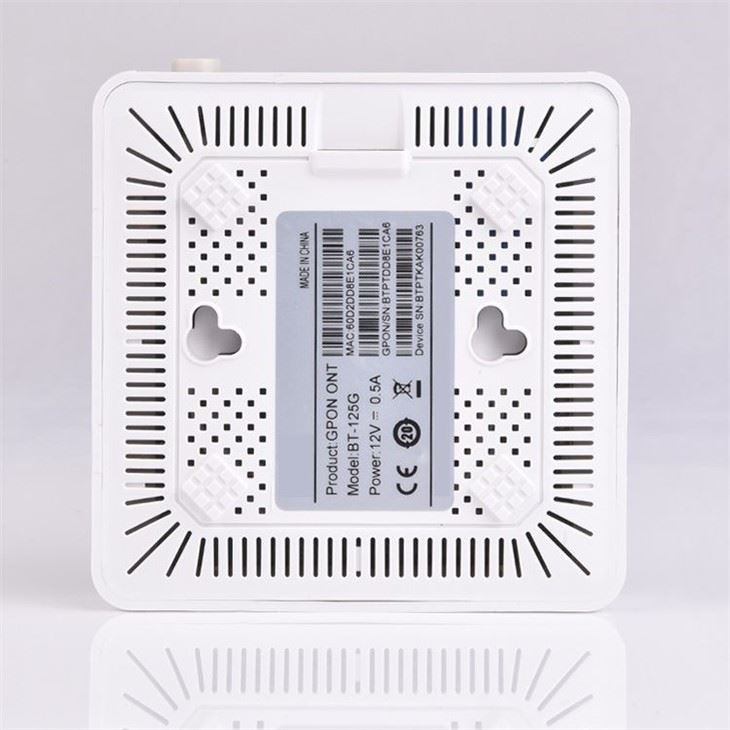

1GE XPON ONU
PON is a mature optical fiber access network technology, which integrates the advantages of low cost, high bandwidth, strong expansibility and other advantages.

- Product Introduction
ONU Product Specifications
PON represents an established optical fiber access network solution that combines numerous benefits including cost efficiency, high bandwidth capability, and excellent scalability. Utilizing passive optical architecture and point-to-multipoint topology, it addresses the limitations found in active optical networks, such as multiple failure points, complex maintenance requirements, and elevated operational expenses.
The ONU serves as an end-user terminal equipment developed independently by FB-LINK to meet these industry demands. This device features integrated Layer 2 switching capabilities. With its space-efficient and streamlined design, it operates as a high-performance, energy-efficient FTTH optical network unit. The ONU provides automatic mode switching between EPON/GPON operations and functions seamlessly within both EPON/GPON infrastructures, making it ideally suited for diverse data service applications across various operator FTTH deployment scenarios.
Item Spotlights
● GPON working mode Compliance with IEEE 802.3ah & itu-t g.984.x standard
● Chipset: Realtek 9601D
● GPON:8 T-CONTs,32 GEM Ports
● EPON working mode compliant with IEEE 802.3ah specification and OAM protocol
● Supports the WEB configuration function
● Support SFU and HGU types, can switch to use each other
● HGU type,Support PPPoE/ Static IP/ DHCP
● Layer 2 Switching, support 802.1Q VLAN, 802.1P QOS, Bandwidth Control, Spanning Tree, etc
● Layer 3 Home Gateway/CPE features with Hardware NAT, supports Route mode, etc
● Supports the configuration of Ethernet interface rates, working modes,MDI/ MDIX auto-negotiation mode, and Pause flow control
● Provides performance statistics on all Ethernet lines
● Support multicast IGMP snooping
● Supports the L2 wire speed forwarding
● Supports the AES-128 algorithm for data encryption of downlink data
Description
|
Hardware Specifications |
|
|
Size(L*W*H) |
90mm (L) ×90mm (W) ×24mm (H) |
|
Optical signal access |
EPON/GPON |
|
User interface |
1GE |
|
Indicator light |
POWER/PON/LOS/LAN |
|
Button |
Power switch Button, Reset Button |
|
Weight |
95g |
|
Power adapter input |
100V~240V AC,50Hz~60Hz |
|
PowerSupply requirement |
12V DC,0.5A |
|
Power consumption |
<6w |
|
Working temperature |
-10°C ~ +45°C |
|
Environment humidity |
5% ~ 95% (Non-condensing) |
|
PON Interface |
|
|
Module type |
SC/UPC |
|
Working wavelength |
up 1310nm,down 1490nm |
|
TX Optical power value |
0.5~4dbm |
|
RX Optical power sensitivity |
-27dBm |
|
Transmission distance |
0~20km |
|
Transmission rate |
GPON:Uplink 1.244Gbps;downlink 2.488Gbps |
|
Ethernet interface |
|
|
Interface type |
RJ45 |
|
Interface parameters |
1 x 10/100/1000Mbps auto adaptive Ethernet interfaces |
The evolution of fiber optic networks has transformed how internet service providers deliver high-speed connectivity to end users. As FTTx (Fiber to the x) deployments continue to expand globally, the demand for reliable, cost-effective optical network units has never been greater. FB-LINK's latest ONU device represents a significant advancement in FTTx technology, offering operators a versatile solution that addresses the complex challenges of modern fiber access networks.
Understanding Modern FTTx Infrastructure
FTTx technology has become the backbone of next-generation broadband networks, utilizing passive optical networks (PON) to deliver unprecedented bandwidth directly to homes and businesses. Unlike legacy active optical networks that required numerous powered components, FTTx architectures leverage passive splitters to reduce maintenance complexity and operational expenses dramatically. This fundamental shift has made fiber deployments economically viable for service providers across diverse geographic regions.
A Dual-Mode Solution for Flexible FTTx Networks
What sets this optical network unit apart is its intelligent dual-mode capability. The device seamlessly operates in both EPON and GPON modes, automatically detecting and switching between protocols based on network requirements. This flexibility proves invaluable for operators managing hybrid FTTx infrastructures or planning network migrations without replacing customer premises equipment.
Built around the reliable Realtek 9601D chipset, the unit delivers robust performance while maintaining remarkably low power consumption under 6 watts. The compact 90mm cubic design ensures easy installation in space-constrained environments, making it ideal for various FTTx deployment scenarios from residential apartments to commercial buildings.
Advanced Features Driving FTTx Performance
The ONU incorporates comprehensive Layer 2 switching capabilities essential for modern FTTx networks. Support for 802.1Q VLAN tagging enables service providers to segment traffic efficiently, while 802.1P Quality of Service ensures priority handling for latency-sensitive applications like voice and video streaming. These features are critical as FTTx networks carry increasingly diverse service types.
Security remains paramount in FTTx deployments. The device implements AES-128 encryption for downstream data protection, safeguarding subscriber information across the optical distribution network. Combined with hardware-based NAT and multiple WAN connection modes including PPPoE, DHCP, and static IP, the unit provides robust security layers suitable for both residential and enterprise FTTx applications.
Optimized for Real-World FTTx Deployments
The optical interface specifications reflect practical FTTx network requirements. With transmission distances reaching 20 kilometers and receiver sensitivity rated at -27dBm, the device accommodates various network topologies from high-density urban deployments to rural FTTx extensions. The SC/UPC connector standard ensures compatibility with existing infrastructure, minimizing deployment complexity.
IGMP snooping functionality optimizes multicast traffic handling, particularly valuable for IPTV services that have become standard offerings in FTTx service bundles. The wire-speed forwarding capability ensures that the gigabit Ethernet interface operates at full throughput, eliminating bottlenecks between the optical and electrical domains.
Simplified Management for FTTx Operations
Network operators benefit from intuitive web-based configuration interfaces that streamline provisioning and troubleshooting. Performance statistics across all interfaces provide visibility into network health, enabling proactive maintenance strategies that reduce truck rolls and improve subscriber satisfaction. The ability to switch between SFU (Single Family Unit) and HGU (Home Gateway Unit) modes allows operators to deploy identical hardware across different service tiers, simplifying inventory management in large-scale FTTx rollouts.
Why This ONU Excels in FTTx Environments
Several factors make this optical network unit particularly well-suited for contemporary FTTx networks. The automatic protocol detection eliminates configuration errors during installation, reducing activation time and training requirements for field technicians. Wide operating temperature tolerance from -10°C to 45°C ensures reliable operation in diverse climates without requiring climate-controlled enclosures.
The universal power supply accepting 100-240V AC accommodates international FTTx deployments without regional hardware variants. Visual indicators for power, PON link, loss of signal, and LAN connectivity enable rapid troubleshooting, while the physical reset button provides recovery options when remote management is unavailable.
Frequently Asked Questions About FTTx ONU Deployment
What is the difference between EPON and GPON modes in FTTx networks?
EPON (Ethernet PON) and GPON (Gigabit PON) represent two distinct FTTx standards. GPON offers higher downstream bandwidth at 2.488 Gbps compared to EPON's symmetric 1.244 Gbps, making it preferable for video-heavy services. However, EPON provides simpler Ethernet-native operation. The dual-mode capability allows operators to leverage either protocol depending on specific FTTx deployment requirements without replacing customer equipment during network upgrades.
How does passive optical network technology reduce FTTx operational costs?
Passive optical networks eliminate active components between the central office and subscriber locations in FTTx architectures. Traditional active networks required powered equipment at distribution points, creating multiple failure points and ongoing electricity costs. PON-based FTTx networks use unpowered optical splitters, dramatically reducing maintenance requirements, power consumption, and overall network operational expenses while improving reliability.
What transmission distance can this ONU support in FTTx deployments?
The optical transceiver supports distances up to 20 kilometers in FTTx networks, accommodating most access network topologies. This range covers typical residential neighborhoods, suburban areas, and even some rural FTTx extensions. The receiver sensitivity of -27dBm provides adequate link budget for various splitting ratios commonly deployed in modern FTTx architectures.
Can this device support multiple service VLANs for FTTx triple-play services?
Absolutely. The integrated Layer 2 switching with 802.1Q VLAN support enables service providers to deliver multiple services over a single FTTx connection. Internet, IPTV, and VoIP services can each operate on separate VLANs with appropriate QoS policies, ensuring service isolation and performance guarantees essential for professional FTTx service delivery.
How does the automatic mode switching benefit FTTx network operators?
Automatic EPON/GPON mode detection simplifies FTTx deployments significantly. Technicians don't need to preconfigure devices or maintain separate inventory for different network types. This capability is particularly valuable during FTTx network migrations when operators transition from one protocol to another, as the same ONU hardware automatically adapts to the available optical line terminal, reducing logistics complexity and deployment costs.
What makes this ONU suitable for both residential and business FTTx applications?
The device's dual operational modes (SFU and HGU) provide flexibility for different FTTx use cases. In SFU mode, it functions as a pure optical-to-Ethernet bridge ideal for enterprise connections where customers manage their own routing. HGU mode incorporates full home gateway features including NAT, DHCP, and routing capabilities suitable for residential FTTx subscribers requiring integrated connectivity solutions.
Hot Tags: FTTx
You Might Also Like


