





Transceiver Temperature Ratings: Industrial vs Commercial
 May 18, 2026|
 The Three Temperature Grades and What They Actually Specify
Every optical transceiver ships with a rated operating temperature range. The industry recognizes three standard grades:
| Grade | Designation | Case Temperature Range |
|---|---|---|
| Commercial | COM / C-Temp | 0°C to +70°C |
| Extended | EXT / E-Temp | −20°C to +85°C |
| Industrial | IND / I-Temp | −40°C to +85°C |
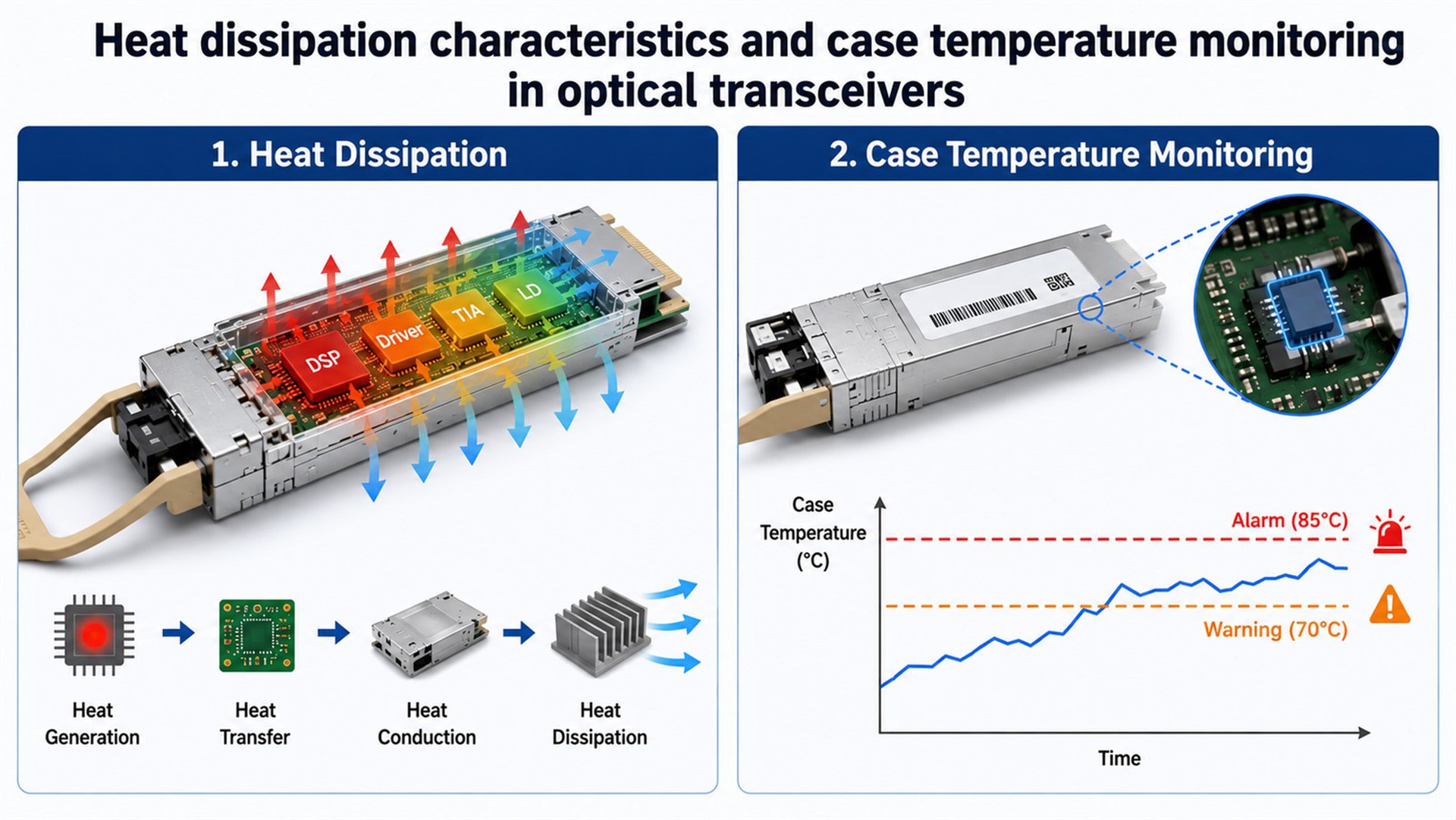
One detail that matters more than most engineers realize: these transceiver temperature ratings refer to case temperature, the outer shell of the module itself, not the ambient air temperature inside the rack or enclosure. The SFF-8472 management interface standard defines the monitoring thresholds around this case measurement, and every DOM-equipped module reports it accordingly. Storage temperature ranges, which typically span −40°C to +85°C even for commercial modules, are a separate specification and do not indicate operating capability.
There is also a wrinkle in how extended temperature gets defined. The broader industry consensus puts E-Temp at −20°C to +85°C, but some OEMs, notably Cisco, specify their extended range as −5°C to +85°C (Cisco). If your project spec simply says "extended temperature," confirm which definition your vendor is using before signing a purchase order.
C-Temp vs I-Temp: What Separates an Industrial-Grade Module From a Commercial One
On paper, the gap between commercial and industrial transceiver operating temperature is a matter of range: the bottom end drops from 0°C to −40°C. In practice, reaching that extended envelope requires changes that go far deeper than the datasheet suggests.
Industrial-rated modules use temperature-hardened semiconductor lasers. For SFP modules, Broadcom's AFCD-V61XT series is a widely adopted industrial-grade VCSEL; for 100G QSFP28 applications, its AFCD-V64XT counterpart handles the same role. The electronic driver ICs, TIAs, and oscillators must also survive the full −40°C to +85°C junction temperature range, which means they are selected and validated at the component level, not just screened at the finished-module stage. On top of the hardware, I-Temp modules integrate temperature compensation firmware that dynamically adjusts laser bias current and modulation amplitude as case temperature shifts. Without this firmware loop, transmit power drifts, the extinction ratio degrades, and bit error rates climb. In our production testing, the earliest observable sign that compensation is reaching its limit is TX bias current rising steadily in the DOM readout while TX power still holds nominal. Many engineers misread that pattern as laser aging. It is not; it is the module working harder to maintain output as thermal headroom narrows.
That compensation firmware is calibrated to work within the module's rated operating range. Once case temperature breaches the upper limit, the compensation loop itself becomes part of the problem: it increases bias current to chase falling output power, which generates more internal heat, which pushes temperature further past the boundary. This is not a graceful degradation; it is the entry point to the thermal runaway described later in this article.
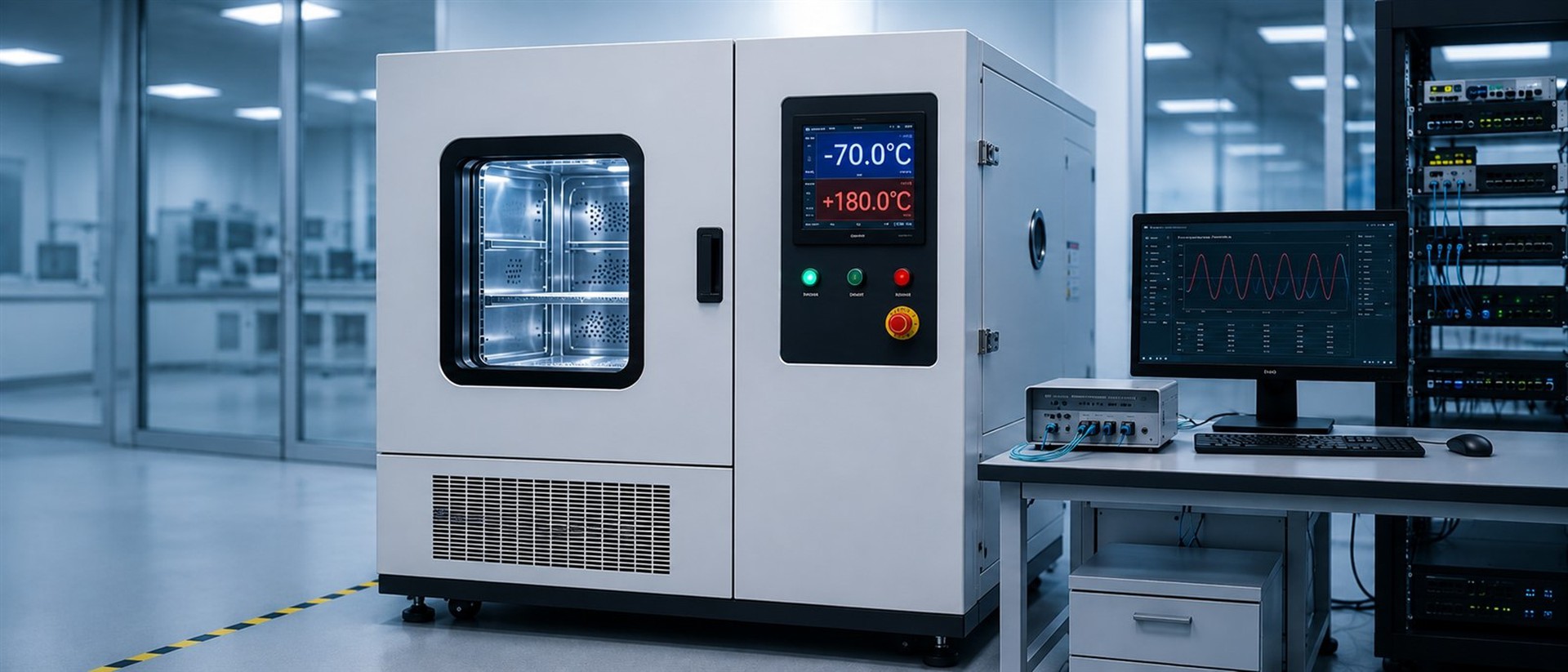
The testing regime is equally different. A commercial module undergoes aging validation at room temperature. An industrial module goes through full thermal cycling, repeated sweeps from −40°C to +85°C, while optical power, wavelength, sensitivity, and BER are measured at each extreme. This testing accounts for a significant portion of the cost premium.
Not every module labeled "industrial" was built with fully industrial-grade components from scratch. Some suppliers use a binning process: they manufacture a large batch of commercial-spec modules, then screen-test each unit across the industrial range and label the units that pass as I-Temp. The units came off the same production line with the same commercial-grade components; they just happened to test well on that day. The long-term reliability profile of a binned module versus one designed around industrial components from the ground up is meaningfully different, and the datasheet will not distinguish between the two approaches.
There is a concrete way to tell the difference. Binned modules typically lack batch-level thermal cycling test reports; the supplier can show that individual units passed a screening test, but cannot provide lot-level data with temperature-vs-optical-power curves across the full range. A supplier using fully industrial-rated internal components should be able to deliver that data within 24 hours of a request. If what comes back is a single-page "passed" certificate with no accompanying measurement curves, treat that as a warning signal.
The Case Temperature Trap: Why Your Thermal Budget for Transceiver Temperature Ratings Is Probably Wrong
This is the single most consequential mistake in outdoor transceiver deployment planning, and it surfaces in RMA data with striking consistency. In temperature-related field returns processed through FB-LINK's technical support queue, the overwhelming majority of initial failure reports describe the same symptom: intermittent link drops that appear in the afternoon and resolve after sunset. Almost none of those initial tickets mention temperature as a suspected cause; the symptoms look like a fiber issue or a switch software bug until someone pulls the DOM temperature history.
Active Cooling Delta
10–15°C
Typical delta with moderate airflow in perforated racks.
Sealed Enclosure Delta
Up to 25°C
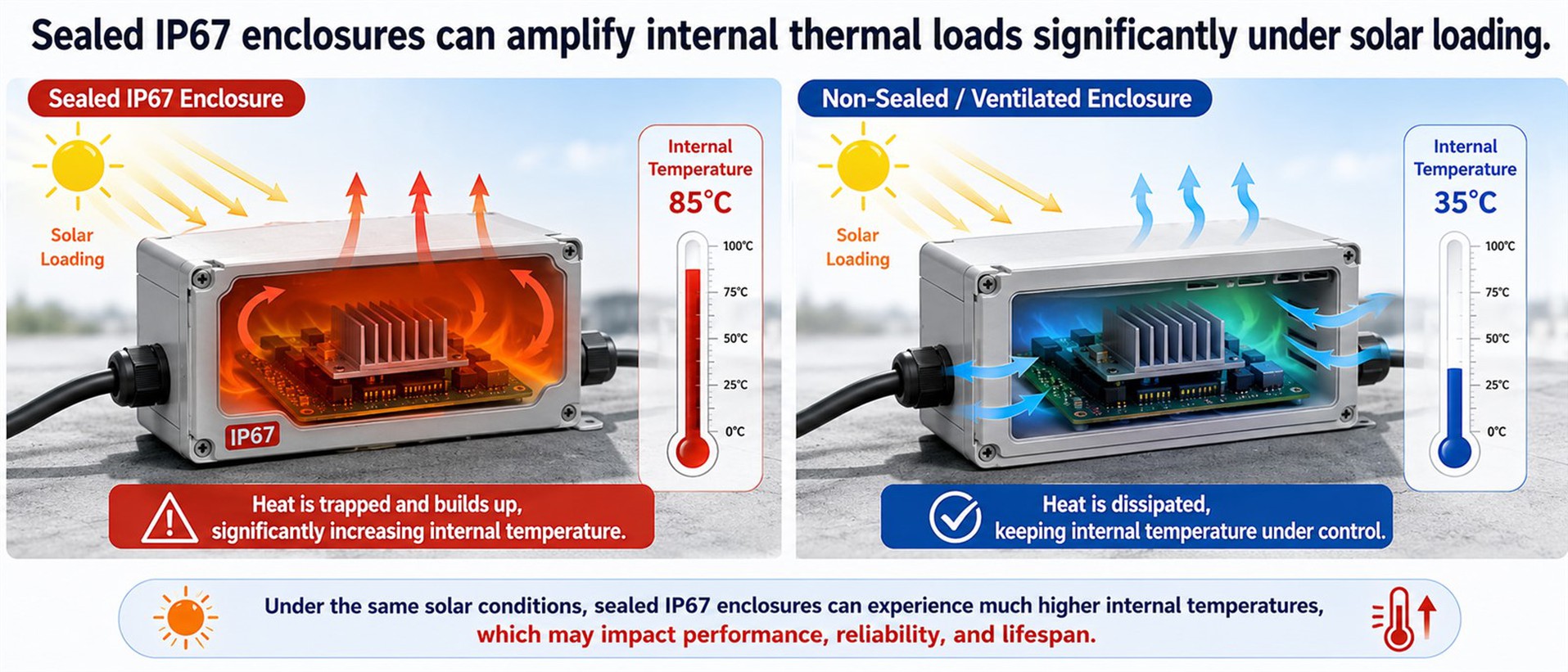
Typical delta in sealed IP67 boxes with no convection.
The underlying thermodynamics are straightforward. Inside a fanless enclosure, the case temperature of an active optical module runs substantially hotter than the surrounding air. With moderate airflow (perforated rack, internal fans), the delta is typically 10–15°C. In a sealed IP67 box with no convection, that delta can reach 25°C. Cisco's deployment guidance puts the rule of thumb at +20°C above ambient cabinet temperature (Cisco). So a site with 42°C peak ambient, inside a sealed metal enclosure in direct sunlight with solar loading adding another 15–20°C to cabinet air temperature, can push module case temperature well past 75°C. A C-Temp module's 70°C ceiling is already behind it.
The math works the other way in cold climates, too. An ambient temperature of −25°C in a remote utility substation, combined with a power cycle that leaves modules cold-soaking overnight, can drop case temperature below −30°C. At that point, many I-Temp modules will only support low-speed management-plane communication (I2C bus access) and will not carry production traffic until the case warms past approximately −30°C, a cold-start limitation that Cisco documents explicitly in its I-Temp deployment guidance but that appears in most vendor datasheets only as a footnote.
Altitude adds another variable that most selection guides ignore entirely. Convective cooling effectiveness declines meaningfully with elevation, particularly above 2,000 meters, as air density drops. A practical rule for high-altitude sites: add 5–8°C to your calculated enclosure case temperature as a conservative buffer. If the result exceeds 65°C, C-Temp should not enter the selection shortlist.
Industrial Temperature Availability by Form Factor: What You Can Actually Source
The practical challenge with specifying industrial-grade transceiver temperature ranges is that availability varies enormously by form factor and data rate. Treating I-Temp as a checkbox item does not work at every speed tier.
SFP Up to 2.67 Gbps
This is the form factor with the broadest I-Temp selection. Power consumption sits around 0.8–1.0 W for fiber models, and the thermal design of most SFP cages handles this easily even in fanless enclosures. For 1G deployments in outside-plant environments, sourcing I-Temp modules is straightforward and pricing premiums are modest. One caveat: copper RJ-45 SFPs draw 1.05–1.2 W, and that extra thermal load adds up in high-density industrial switches.
SFP+ 10 Gbps
I-Temp options exist and are reasonably available for SR and LR variants. Optical SFP+ modules draw approximately 1.3 W, which is manageable. The exception is 10GBASE-T copper SFP+, which pulls up to 2.5 W, nearly double the optical variant, and creates significant heat concentration in sealed cabinets. If your design calls for 10G copper at the edge, that thermal load needs to be front and center in your enclosure thermal modeling. To anchor the industrial SFP+ 10G temperature premium in real numbers: a 10G SFP+ SR module typically lists at around $13 for C-Temp and $19 for I-Temp, a 46% uplift. For 10G SFP+ LR, the gap is narrower: roughly $18 versus $21, or about 17%. These are representative third-party module prices; OEM-branded equivalents carry higher absolute numbers but similar percentage spreads.
QSFP+ 40 Gbps
The selection narrows sharply here. The vast majority of QSFP+ SR4 and LR4 modules ship with a 0–70°C case rating only. A few vendors offer extended-range variants at −20°C to +85°C, but full industrial −40°C to +85°C QSFP+ modules are rare and often special-order. One sourcing trap to be aware of: some modules marketed as "telco-grade" QSFP+ actually carry a narrower operating range of +10°C to +60°C, designed specifically for ETSI-standard cabinets with active climate control. In an outdoor or industrial environment, that is less protection than a standard C-Temp module provides. Do not equate "telco-grade" with "ruggedized." If your project needs 40G at industrial temperature, the more reliable path is evaluating a dual 10G SFP+ I-Temp breakout configuration, or jumping directly to a QSFP28 LR4 I-Temp SKU. The QSFP+ I-Temp sourcing path carries high procurement failure risk for the time invested.
Q28 100 Gbps
This is where the industrial temperature gap is most acute. Nearly all 100G QSFP28 modules are commercial-grade, designed for temperature-controlled data center environments. Industrial-rated QSFP28 options do exist. Coherent's FTLC1154RDPL4, for instance, is one of the few QSFP28 LR4 modules explicitly rated at −40°C to +85°C for outside-plant use, and the FTLC1155RGPL4 covers CWDM4 at the same industrial range. But these SKUs typically require 8–16 week lead times, many are build-to-order, and suppliers frequently attach NCNR (non-cancellable, non-returnable) terms. If your project timeline is shorter than that procurement window, you may not be able to source 100G I-Temp optics in time, a constraint that should be identified at the architecture stage, not the purchasing stage.
What Actually Happens When Transceiver Temperature Ratings Are Ignored
Most technical resources describe the consequences of thermal exceedance in generic terms. The failure modes are more specific than that, more expensive, and harder to diagnose than a clean hardware failure.
Failure mode 1: The first-summer shutdown.
This is the pattern that dominates temperature-related field returns. The network is commissioned in winter or spring, everything tests clean, and the project is signed off. Then July arrives, a sustained heatwave pushes ambient temperatures to 38°C, solar loading on the equipment cabinet adds another 20°C, and module case temperatures breach 70°C. C-Temp optics begin dropping links. The failures track the diurnal temperature cycle: ports go down mid-afternoon and recover after sunset. Troubleshooting burns days because the symptoms look like a fiber issue or a switch software bug, not a thermal problem, until someone finally checks DOM temperature readings. Misidentifying the correct transceiver temperature rating for an outdoor site is the root cause in most of these cases, and the actual cost includes not just the replacement modules but the diagnostic hours, the truck roll, and any SLA penalties incurred during the outage window.
Failure mode 2: Laser thermal runaway.
When a C-Temp module operates in the 70–85°C zone, its laser diode loses efficiency. The temperature compensation loop, calibrated for the rated range, cannot keep up. The module's control firmware increases laser bias current to maintain output power. Higher current generates more heat inside the module. This is not a gradual linear degradation; it is a positive feedback loop that accelerates toward either a protective shutdown or permanent loss of laser luminosity. In field data, modules that trigger protective shutdown can generally be recovered after cooling. Modules that suffer permanent luminosity loss require replacement, and the damage occurs without a DOM alert: TX power drops steeply and reaches zero within minutes. By the time a network management system registers the link as down, the laser is already unrecoverable.
Failure mode 3: DWDM wavelength drift.
In dense wavelength division multiplexing systems, laser wavelength shifts with temperature. The channel spacing in a 100-GHz DWDM grid is tight enough that a few degrees of uncompensated temperature swing can push a channel into its neighbor's passband, causing crosstalk. For QSFP28 and SFP+ modules deployed in wavelength-sensitive applications, running outside the rated thermal envelope doesn't just risk link failure; it risks corrupting adjacent channels across the entire mux.
None of these failure modes show up in a lab bench test or a pre-shipment validation. They surface only under sustained real-world thermal stress, often months after deployment.
Selecting the Right Temperature Rating for Your Deployment
Rather than defaulting to "buy industrial and don't worry about it," a more rigorous approach considers five variables. Getting this right saves money where it can be saved and prevents failures where they matter.
Map your actual thermal envelope.
Do not use annual average temperatures. Identify the extreme high and extreme low that your installation site will experience over a 10-year service life. For outdoor deployments, factor in solar loading on the enclosure, a value that varies by cabinet color, orientation, and latitude but commonly adds 15–20°C to internal air temperature on top of ambient.
Calculate case temperature, not ambient.
Apply the appropriate delta for your enclosure type. For a ventilated rack with active airflow, add 10–15°C. For a sealed IP67 cabinet, add 20–25°C. If the resulting case temperature exceeds 70°C at any point during the year, C-Temp is not viable.
Weigh criticality against cost.
A single unplanned truck roll to a remote cell site to diagnose and swap failed optics, including downtime and SLA penalties, typically exceeds the total industrial-grade premium across every module in that site's deployment. The exact comparison depends on your module count and site accessibility; our product catalog lists current pricing for both C-Temp and I-Temp variants so you can run the numbers against your own sites. A reasonable spares strategy for remote industrial deployments is 10–15% of installed module count.
Use DOM as a monitoring layer, not a substitute for proper rating.
Digital Optical Monitoring per SFF-8472 lets you track case temperature, transmit power, receive power, and laser bias current in real time through your network management platform. It is an excellent diagnostic tool and an early-warning system. It is not a replacement for selecting the correct transceiver temperature rating for outdoor or industrial environments. By the time DOM alerts you to a thermal exceedance, the module is already operating outside its design envelope.
Verify the industrial label, not just the datasheet.
The distinction between a binned module and a fully industrial-designed module matters for long-term reliability, and it is not visible on a spec sheet. Ask for batch-level thermal cycling test reports, not just a single "passed" certificate. A supplier running genuine industrial-grade validation should be able to provide temperature-vs-optical-power curves within 24 hours. If your vendor selection criteria include temperature reliability, add "thermal test data granularity" as a line item; it separates suppliers who test from those who sort.
FB-LINK's production facility, operating since 2008 with ISO 9001 certification and engineering support across 50+ countries, runs 100% lot-level thermal cycling on every I-Temp unit. Our technical support team can provide deployment-specific thermal budget calculations, module selection verification, and batch-level test reports on request.
FAQ: Transceiver Temperature Ratings
Q: Can I use a C-Temp transceiver in an outdoor enclosure?
A: No. Unless you can guarantee that the sealed enclosure's internal peak air temperature stays below 50°C year-round, C-Temp's 70°C case temperature ceiling will be breached during summer. That condition almost never holds in real outdoor IP67 cabinets. Specify E-Temp or I-Temp directly.
Q: What is the difference between case temperature and ambient temperature?
A: Transceiver temperature specs refer to the module's outer shell (case), not the surrounding air. Inside a switch or enclosure, case temperature typically exceeds ambient air by 10–25°C depending on airflow and port density.
Q: Why do industrial transceivers cost more than commercial ones?
A: Industrial modules require temperature-hardened lasers, compensation firmware, and extreme thermal cycling tests. At 10G SFP+ level, the premium ranges from about 17% (LR) to 46% (SR) over commercial equivalents, with higher absolute premiums at 100G.
Q: Can C-Temp and I-Temp transceivers interoperate on the same link?
A: Yes. Temperature rating governs environmental tolerance, not optical or electrical compatibility. Matching wavelength, data rate, and protocol is what matters for link establishment.
Q: Are industrial-temperature QSFP28 100G modules available?
A: In limited configurations. Industrial-rated QSFP28 exists primarily in LR4 and CWDM4 variants, for example Coherent's FTLC1154RDPL4 (LR4), with 8–16 week lead times and NCNR procurement terms from most suppliers.