40G QSFP+ TO 4X10G SFP+ AOC
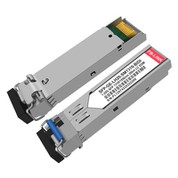
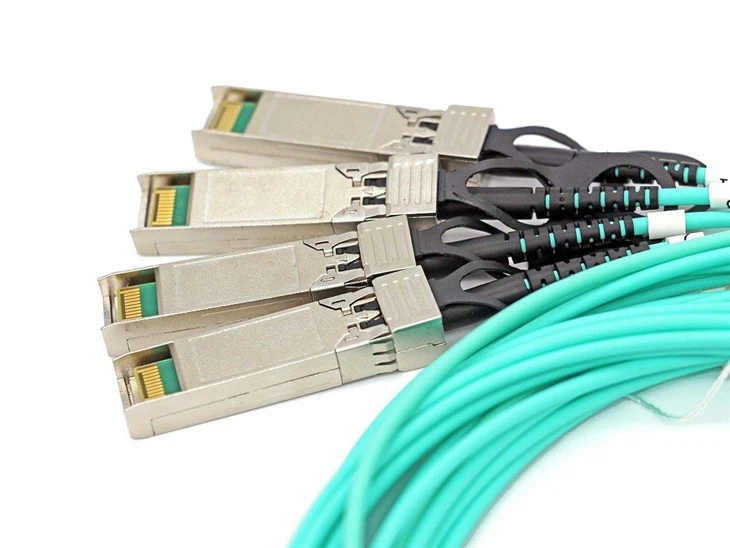
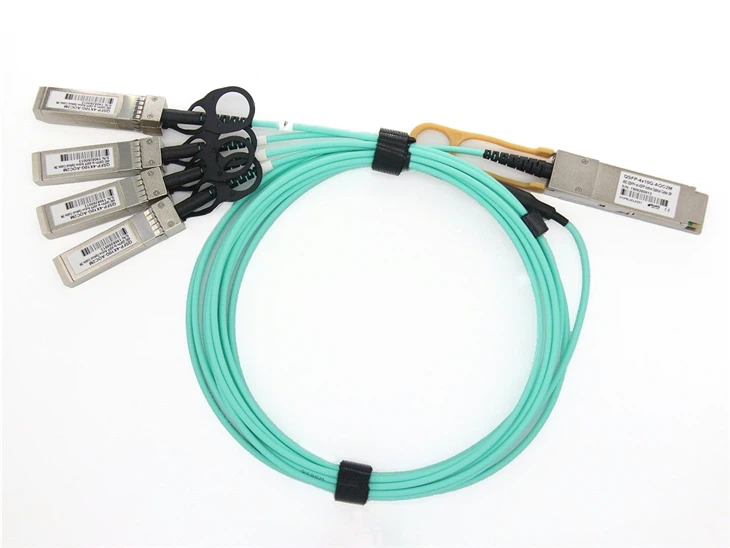
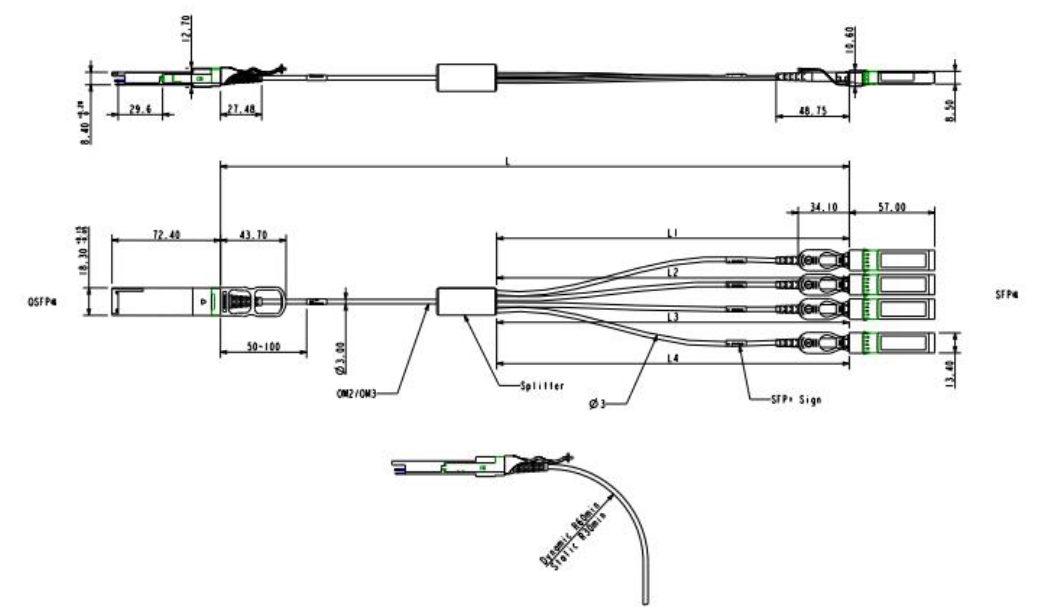
The FB-LINK 40G QSFP+ to 4x 10G SFP+ breakout Active Optical Cables (AOCs) offer IT professionals a cost-effective interconnect solution for merging 40G QSFP+ and 10G SFP+ enabled host adapters, switches and servers. For typical applications, users can install this breakout or splitter cable between an available QSFP+ port on 40GE switch and feed up to 4 upstream SFP+ enabled 10GE switches. Each cable features a single SFF-8436 compliant QSFP+ connector rated for 41.2Gb/s on one end and 4 SFF-8431 complicant SFP+ connectors rated for 10.3Gb/s each on the other end.

- Product Introduction
QSFP interface Specifications
| Parameter | Description |
| Module Form Factor | QSFP+ (Supports SFF8436/SFF8472) |
| Channel Data Rate | Rate 40Gbps |
| BER | <10-12 |
| Operating Case Temperature | 0 to + 70ºC |
| Storage Temperature | -20 to + 85ºC |
| Supply Voltage | 3.3V |
| Supply current | 180mA per end typical |
| Management Interface Serial | I2C (Supports SFF8472) |
Optical Characteristics
The following optical characteristics are defined over the Recommended Operating Environment unless otherwise specified.
|
Parameter |
Symbol |
Min |
Typical |
Max |
Unit |
Notes |
|
|
Transmitter |
|||||||
|
Centre Wavelength |
λc |
840 |
850 |
860 |
nm |
- |
|
|
RMS spectral width |
∆λ |
- |
- |
0.65 |
nm |
- |
|
|
Average launch power, each lane |
Pout |
-7.5 |
- |
2.5 |
dBm |
- |
|
|
Difference in launch power between any two lanes (OMA) |
4 |
dB |
- |
||||
|
Extinction Ratio |
ER |
3 |
- |
- |
dB |
- |
|
|
Peak power, each lane |
4 |
dBm |
- |
||||
|
ransmitter and dispersion penalty (TDP), each lane |
TDP |
3.5 |
dB |
- |
|||
|
Average launch power of OFF transmitter, each lane |
-30 |
dB |
- |
||||
|
Eye Mask coordinates: X1, X2, X3, Y1, Y2, Y3 |
SPECIFICATION VALUES 0.23, 0.34, 0.43, 0.27, 0.35, 0.4 |
Hit Ratio = 5x10⁻⁵ |
|||||
|
Receiver |
|||||||
|
Centre Wavelength |
λc |
840 |
850 |
860 |
nm |
- |
|
|
Stressed receiver sensitivity in OMA, each lane |
-5.4 |
dBm |
1 |
||||
|
Maximum Average power at receiver input, each lane |
2.4 |
dBm |
- |
||||
|
Receiver Reflectance |
-12 |
dB |
- |
||||
|
Peak power, each lane |
4 |
dBm |
- |
||||
|
LOS Assert |
-30 |
dBm |
- |
||||
|
LOS De-Assert – OMA |
-7.5 |
dBm |
- |
||||
|
LOS Hysteresis |
0.5 |
dB |
- |
||||
Note:
1.Measured with conformance test signal at TP3 for BER = 10e-12
SFP+ interface Specifications
|
Parameter |
Description |
|
Module Form Factor |
SFP+ (Supports SFF8431/SFF8432/SFF8472) |
|
Channel Data Rate |
Rate 1 to 10.3125Gbps |
|
BER |
<10-12 |
|
Operating Case Temperature |
0 to + 70ºC |
|
Storage Temperature |
-20 to + 85ºC |
|
Supply Voltage |
3.3V |
|
Supply current |
455mA maximum |
|
Management Interface Serial |
I2C (Supports SFF8472) |
Optical characteristics
The following optical characteristics are defined over the Recommended Operating Environment unless otherwise specified.
|
Parameter |
Symbol |
Min. |
Typical |
Max |
Unit |
Notes |
|
Transmitter |
||||||
|
Center Wavelength |
λt |
840 |
850 |
860 |
nm |
|
|
RMS spectral width |
Pm |
- |
- |
Note 1 |
nm |
|
|
Average Optical Power |
Pavg |
-6.5 |
- |
-1 |
dBm |
2 |
|
Extinction Ratio |
ER |
3.5 |
- |
- |
dB |
3 |
|
Transmitter Dispersion Penalty |
TDP |
- |
- |
3.9 |
dB |
|
|
Relative Intensity Noise |
Rin |
- |
- |
-128 |
dB/Hz |
12dB reflection |
|
Optical Return Loss Tolerance |
- |
- |
12 |
dB |
||
|
Receiver |
||||||
|
Center Wavelength |
λr |
840 |
850 |
860 |
nm |
|
|
Receiver Sensitivity |
Psens |
- |
- |
-11.1 |
dBm |
4 |
|
Stressed Sensitivity in OMA |
- |
- |
-7.5 |
dBm |
4 |
|
|
Los function |
Los |
-30 |
- |
-12 |
dBm |
|
|
Overload |
Pin |
- |
- |
-1.0 |
dBm |
4 |
|
Receiver Reflectance |
- |
- |
-12 |
dB |
||
AOC Cable: The Ultimate Guide to Active Optical Cable Technology
High-speed data transmission has become the backbone of modern data centers, enterprise networks, and telecommunications infrastructure. Among the various connectivity solutions available, AOC Cable technology stands out as a superior choice for organizations seeking reliable, efficient, and cost-effective networking solutions.
What Makes AOC Cable Technology Revolutionary
Active Optical Cable represents a paradigm shift in how we approach short-to-medium range data transmission. Unlike traditional copper cables that struggle with signal degradation and electromagnetic interference, AOC Cable solutions integrate optical fiber technology with electrical interfaces, creating a plug-and-play solution that combines the best of both worlds.
The magic behind AOC Cable lies in its integrated design. Each cable contains miniaturized optical transceivers directly embedded into the connector modules, eliminating the need for separate optical modules. This seamless integration means you can simply plug an AOC Cable into your switches or servers just like a copper cable, but enjoy the superior performance characteristics of fiber optic transmission.
Key Advantages of Implementing AOC Cable Solutions
Superior Signal Integrity
One of the most compelling reasons to choose AOC Cable for your infrastructure is the immunity to electromagnetic interference. Traditional copper cables act as antennas, picking up noise from surrounding equipment and power lines. AOC Cable technology completely eliminates this concern, ensuring your data arrives intact regardless of the electrical environment.
Lightweight and Flexible Design
Anyone who has worked with heavy copper cables knows the physical challenges they present. AOC Cable solutions are significantly lighter and more flexible, making installation easier and reducing strain on network equipment ports. This flexibility also allows for tighter bend radii, crucial in space-constrained server racks and network closets.
Extended Reach Without Repeaters
While copper cables typically max out around five meters for high-speed applications before requiring signal regeneration, AOC Cable can reliably transmit data over much longer distances. This extended reach capability reduces the need for additional networking equipment, simplifying your infrastructure and reducing potential failure points.
Lower Power Consumption
Energy efficiency continues to be a critical concern for data center operators. AOC Cable technology consumes less power compared to equivalent copper solutions, particularly as cable lengths increase. This reduced power consumption translates directly into lower operational costs and reduced cooling requirements.
Common Applications for AOC Cable Technology
Data Center Connectivity
Modern data centers rely heavily on AOC Cable for rack-to-rack and switch-to-server connections. The high bandwidth capabilities make them ideal for connecting storage area networks, implementing spine-leaf architectures, and building high-performance computing clusters.
Enterprise Networking
Organizations upgrading their network infrastructure increasingly turn to AOC Cable solutions for connecting network switches, aggregating multiple links, and establishing high-speed connections between network cores and distribution layers.
Broadcasting and Video Production
The broadcast industry has embraced AOC Cable technology for transmitting uncompressed video signals. The high bandwidth and reliability make them perfect for live production environments where signal integrity is non-negotiable.
Medical Imaging Systems
Healthcare facilities use AOC Cable to connect medical imaging equipment, enabling the transmission of large diagnostic files without quality degradation or delays that could impact patient care.
Understanding AOC Cable Interface Standards
The modular nature of AOC Cable means they're available in various form factors to match different network requirements. QSFP-based solutions provide high-density connectivity ideal for spine switches and aggregation points, while SFP variants offer flexibility for edge connections and server integration.
The beauty of these standardized interfaces is backward compatibility and vendor interoperability. An AOC Cable meeting industry specifications will work seamlessly with equipment from different manufacturers, protecting your infrastructure investment and providing deployment flexibility.
Selecting the Right AOC Cable for Your Needs
Bandwidth Requirements
Start by assessing your current and future bandwidth needs. AOC Cable solutions are available in various speed grades, from standard rates suitable for general networking to ultra-high-speed options for demanding applications.
Distance Considerations
While AOC Cable excels at longer distances compared to copper, different variants offer different maximum lengths. Map out your physical infrastructure to ensure the cables you select can span the required distances with appropriate margin.
Environmental Factors
Consider the operating environment where your AOC Cable will be deployed. Temperature ranges, humidity levels, and physical access constraints all influence which specific cable variant is most appropriate.
Budget and Total Cost of Ownership
While AOC Cable may have higher initial costs compared to basic copper cables, calculate the total cost of ownership including energy consumption, cooling requirements, and reduced need for additional networking equipment.
Installation Best Practices for AOC Cable
Proper handling ensures long service life and optimal performance from your AOC Cable investment. Always handle connectors carefully, avoiding touching the optical surfaces. When routing cables, respect minimum bend radius specifications to prevent optical fiber damage. Use proper cable management to prevent crushing or excessive tension on the cables.
Before deployment, test each AOC Cable to verify functionality and performance characteristics. This upfront verification catches any shipping damage or manufacturing defects before they impact your network operations.
Future-Proofing Your Infrastructure with AOC Cable
Technology evolution continues accelerating, and infrastructure investments must anticipate future requirements. AOC Cable technology positions your network for growth by providing upgrade paths that leverage existing physical infrastructure. As bandwidth requirements increase, you can often upgrade to higher-speed AOC Cable variants using the same conduits and pathways.
The industry momentum behind AOC Cable continues building, with ongoing development focused on increasing speeds, reducing costs, and extending capabilities. Organizations investing in AOC Cable today are aligning themselves with a technology trajectory that promises continued innovation and improvement.
Frequently Asked Questions About AOC Cable
What is the difference between AOC Cable and DAC Cable?
Direct Attach Copper (DAC) cables use copper conductors for data transmission, while AOC Cable employs optical fiber with integrated transceivers. AOC Cable offers longer reach, immunity to electromagnetic interference, and lower weight compared to DAC cables. Choose DAC for very short connections where cost is paramount, and AOC Cable for everything else.
Can I use AOC Cable with equipment from different manufacturers?
Yes, one of the major advantages of AOC Cable is standardization. As long as both the cable and equipment conform to the same industry specifications, they will work together regardless of manufacturer. This interoperability provides flexibility in vendor selection and simplifies procurement.
How long does an AOC Cable typically last?
With proper handling and appropriate environmental conditions, AOC Cable should provide many years of reliable service. The solid-state nature of the optical components means there are no moving parts to wear out. Most failures result from physical damage rather than component aging.
Do I need special tools to install AOC Cable?
No special tools are required. AOC Cable is designed as a plug-and-play solution. Simply insert the connectors into the appropriate ports just as you would with copper cables. However, standard fiber optic cleaning supplies are recommended for maintaining the optical surfaces.
What is the power consumption of AOC Cable compared to copper?
AOC Cable typically consumes between one and three watts per cable depending on the speed and length. This is significantly less than the power required for equivalent copper solutions, especially at longer distances where copper requires signal conditioning and regeneration.
Can AOC Cable be repaired if damaged?
Unlike traditional fiber optic cables where breaks can be spliced, AOC Cable cannot be field-repaired due to the integrated transceivers. Damaged cables must be replaced. This is another reason why proper handling and cable management are essential.
Is AOC Cable suitable for outdoor applications?
Standard AOC Cable is designed for indoor, controlled environments. If you need outdoor connectivity, look for AOC Cable variants specifically rated for outdoor use with appropriate environmental protection. Always verify the operating temperature range matches your deployment environment.
How does temperature affect AOC Cable performance?
AOC Cable is designed to operate reliably within specified temperature ranges. Extreme temperatures outside these ranges can impact the optical transceivers. Ensure your deployment environment maintains appropriate temperatures, and select cable variants rated for your specific conditions.
Making the Switch to AOC Cable
Transitioning to AOC Cable doesn't require a complete infrastructure overhaul. Many organizations adopt a phased approach, implementing AOC Cable for new installations and replacing aging copper cables opportunistically during maintenance windows. This gradual migration minimizes disruption while progressively improving network performance and reliability.
The investment in AOC Cable pays dividends through improved network performance, reduced troubleshooting time, lower energy costs, and simplified infrastructure management. As data demands continue growing, AOC Cable provides a solid foundation capable of supporting your organization's networking needs both today and into the future.
Whether you're building a new data center, upgrading existing infrastructure, or solving specific connectivity challenges, AOC Cable technology deserves serious consideration. The combination of performance, reliability, and operational benefits makes it an increasingly popular choice for demanding networking applications across industries.
Hot Tags: AOC Cable