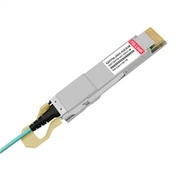
Mellanox 200G HDR QSFP56 AOC
The 200G QSFP56 AOC is compatible with Huawei, Cisco, Juniper, Arista, Mellanox, IBM, Avago and other switches.

- Product Introduction

Absolute Maximum Ratings
|
Product
|
Electrical mode |
Protocol
|
Nominal Rate |
Specifications |
Link |
|||
|
Aggregate (Gbps) |
Electrical Lanes(Gbaud) |
ppm |
High Speed Electrical |
Pre-FEC Max BER |
||||
|
200G end |
4X50
|
IEEE802.3cd |
212.5 |
26.5625 PAM4 |
±100 |
200GAUI-4 |
1E-6 for InfiniBand HDR; 2.4E-4 for 200GBASE-SR4 |
0.5~ 100m
|
|
Per 100G end |
2X50
|
IEEE802.3cd |
106.25 |
26.5625 PAM4 |
±100 |
200GAUI-4 |
||
|
Parameter |
Symbol |
Unit |
Min |
Max |
|
Case Operating Temperature |
Top |
℃ |
0 |
70 |
|
Storage Temperature Range |
Ts |
℃ |
-40 |
85 |
|
Relative Humidity |
RH |
% |
0 |
85 |
|
Power Supply Voltage |
Vcc |
V |
-0.5 |
3.6 |
Recommended Operating Conditions
|
Parameter |
Symbol |
Unit |
Min |
Typ |
Max |
|
Operating Case Temperature Range |
Tca |
oC |
0 |
/ |
70 |
|
Power Supply Voltage |
Vcc |
V |
3.135 |
3.3 |
3.465 |
Electric Ports Definition
|
Parameter |
Symbol |
Unit |
Min |
Typ |
Max |
Notes |
|
Supply Voltage |
VCC |
V |
3.135 |
3.3 |
3.465 |
|
|
Power Consumption |
Pc |
W |
|
|
4 |
200G end |
|
|
|
3 |
100G end |
|||
|
Transmitter |
||||||
|
Input Differential Impedance |
RIN |
Ω |
80 |
100 |
120 |
|
|
Single Ended Data Input Swing |
VIN |
mVp-p |
90 |
|
500 |
|
|
Transmit Disable Voltage |
VDIS |
V |
2 |
|
VCCHOST |
|
|
Transmit Enable Voltage |
VEN |
V |
VEE |
|
VEE+0.8 |
|
|
Transmit Fault Assert Voltage |
VFA |
V |
2 |
|
VCCHOST |
|
|
Transmit Fault De-Assert Voltage |
VFDA |
V |
VEE |
|
VEE+0.8 |
|
|
Receiver |
||||||
|
Single Ended Data Output Swing |
VOD |
mVp-p |
200 |
|
500 |
|
|
LOS Fault |
VLOSFT |
V |
2 |
|
VCCHOST |
|
|
LOS Normal |
VLOSNR |
V |
VEE |
|
VEE+0.8 |
|
|
Differential termination mismatch |
|
% |
|
|
10 |
|
|
IIC communication |
||||||
|
IIC Clock frequency |
- |
KHZ |
/ |
100 |
400 |
|
|
clock stretching |
- |
us |
/ |
/ |
500 |
|
Pin Description
The electrical interface to the transceiver is a 38 pins edge connector. The 38 pins provide high speed data, low speed monitoring and control signals, I2C communication, power and ground connectivity. The top and bottom views of the connector are provided below, as well as a table outlining the contact numbering, symbol and full description.

|
Pin |
Symbol |
Name/Description |
|
1 |
GND |
Ground |
|
2 |
Tx2n |
Channel 2 Transmitter Inverted Data Input |
|
3 |
Tx2p |
Channel 2 Transmitter Non-Inverted Data Input |
|
4 |
GND |
Ground |
|
5 |
Tx4n |
Channel 4 Transmitter Inverted Data Input |
|
6 |
Tx4p |
Channel 4 Transmitter Non-Inverted Data Input |
|
7 |
GND |
Ground |
|
8 |
ModSelL |
Module Select |
|
9 |
ResetL |
Module Reset |
|
10 |
Vcc Rx |
+3.3 V Power supply receiver |
|
11 |
SCL |
2-wire serial interface clock |
|
12 |
SDA |
2-wire serial interface data |
|
13 |
GND |
Ground |
|
14 |
Rx3p |
Channel 3 Receiver Non-Inverted Data Output |
|
15 |
Rx3n |
Channel 3 Receiver Inverted Data Output |
|
16 |
GND |
Ground |
|
17 |
Rx1p |
Channel 1 Receiver Non-Inverted Data Output |
|
18 |
Rx1n |
Channel 1 Receiver Inverted Data Output |
|
19 |
GND |
Ground |
|
20 |
GND |
Ground |
|
21 |
Rx2n |
Channel 2 Receiver Inverted Data Output |
|
22 |
Rx2p |
Channel 2 Receiver Non-Inverted Data Output |
|
23 |
GND |
Ground |
|
24 |
Rx4n |
Channel 4 Receiver Inverted Data Output |
|
25 |
Rx4p |
Channel 4 Receiver Non-Inverted Data Output |
|
26 |
GND |
Ground |
|
27 |
ModPrsL |
Module Present |
|
28 |
IntL |
Interrupt |
|
29 |
Vcc Tx |
+3.3 V Power supply transmitter |
|
30 |
Vcc1 |
+3.3 V Power Supply |
|
31 |
LPMode |
Low Power Mode |
|
32 |
GND |
Ground |
|
33 |
Tx3p |
Channel 3 Transmitter Non-Inverted Data Input |
|
34 |
Tx3n |
Channel 3 Transmitter Inverted Data Input |
|
35 |
GND |
Ground |
|
36 |
Tx1p |
Channel 1 Transmitter Non-Inverted Data Input |
|
37 |
Tx1n |
Channel 1 Transmitter Inverted Data Input |
|
38 |
GND |
Ground |
Active Optical Cables are revolutionizing how modern data centers and enterprise networks handle bandwidth-intensive applications. As businesses demand faster, more reliable connections, AOC Cable technology has emerged as the superior alternative to traditional copper-based solutions, offering unprecedented speed, distance, and efficiency.
What Makes AOC Cable Technology Stand Out?
Active Optical Cable technology combines the best of both worlds: the plug-and-play simplicity of copper cables with the performance advantages of fiber optics. Unlike passive copper cables that struggle with signal degradation over distance, AOC Cables maintain signal integrity across extended lengths while consuming significantly less power.
The architecture of an AOC Cable integrates optical transceivers directly into the cable assembly, eliminating the need for separate transceiver modules. This design reduces deployment complexity, lowers total cost of ownership, and delivers exceptional reliability in demanding environments.
Performance That Powers Next-Generation Networks
Modern AOC Cable solutions support cutting-edge protocols and deliver remarkable bandwidth capabilities. Advanced implementations leverage PAM4 modulation technology, enabling data rates exceeding 200 Gbps over multiple electrical lanes. This translates to aggregate speeds of 212.5 Gbps for high-performance configurations and 106.25 Gbps for scalable deployments.
The technology excels in maintaining ultra-low bit error rates, ensuring data integrity even under the most demanding workloads. With pre-FEC BER performance optimized for both IEEE 802.3 standards and InfiniBand applications, AOC Cables provide the reliability that mission-critical operations require.
Versatility Across Distance and Environment
One of the most compelling advantages of AOC Cable technology is its exceptional range. Whether you need connections spanning half a meter or extending up to 100 meters, these cables maintain consistent performance without signal boosters or repeaters. This flexibility makes them ideal for:
Data center interconnects - Linking servers, switches, and storage arrays
High-performance computing clusters - Connecting computing nodes with minimal latency
Broadcast and media production - Transmitting uncompressed video signals
Enterprise networking - Building scalable, future-proof infrastructure
Reliability in Real-World Conditions
AOC Cable solutions are engineered to perform flawlessly across a wide operational spectrum. With case operating temperatures ranging from 0°C to 70°C, these cables function reliably in climate-controlled data centers and more challenging industrial environments alike.
The robust design accommodates relative humidity levels up to 85%, ensuring consistent operation even in less-than-ideal conditions. Power supply voltage flexibility (3.135V to 3.465V) provides compatibility with diverse equipment configurations while maintaining stable performance.
Energy Efficiency That Makes a Difference
In an era where data centers consume significant energy, AOC Cable technology delivers impressive power efficiency. High-capacity 200G configurations typically operate at or below 4 watts, while scalable 100G solutions consume approximately 3 watts or less. This efficiency translates to reduced cooling requirements, lower operational costs, and a smaller environmental footprint.
The electrical interface design maximizes signal integrity while minimizing power consumption. Differential impedance matching and optimized swing voltages ensure clean signal transmission without unnecessary power draw, making AOC Cables an environmentally responsible choice.
Simplified Deployment and Management
The integrated design of AOC Cable assemblies streamlines installation and reduces potential failure points. Built-in transmit disable functionality, fault detection mechanisms, and industry-standard I2C communication enable comprehensive monitoring and management capabilities.
Clock frequencies up to 400 kHz with clock stretching support ensure reliable communication between cables and host systems, facilitating real-time diagnostics and performance optimization.
Frequently Asked Questions
Q: What is the main advantage of AOC Cable over traditional copper cables? A: AOC Cables offer superior performance over longer distances while consuming less power. Unlike copper cables that experience significant signal degradation beyond a few meters, AOC technology maintains signal integrity up to 100 meters without repeaters. They're also lighter, more flexible, and immune to electromagnetic interference.
Q: How do I know if AOC Cable technology is right for my application? A: AOC Cables are ideal when you need high-bandwidth connections exceeding 25 Gbps per lane, distances beyond 10 meters, or when power efficiency and thermal management are critical concerns. They're particularly valuable in data centers, HPC environments, and applications requiring reliable high-speed connectivity.
Q: What bandwidth options are available with AOC Cable solutions? A: Modern AOC Cables support a range of configurations from 100G to 200G and beyond. Common implementations include 2x50G electrical lanes for 100G applications and 4x50G configurations for 200G deployments, all utilizing advanced PAM4 modulation for maximum efficiency.
Q: Are AOC Cables compatible with existing network infrastructure? A: Yes, AOC Cables are designed for seamless integration with standard network equipment. They comply with IEEE 802.3 standards and support various interface types, ensuring compatibility with current switches, routers, and servers while providing a clear upgrade path for future needs.
Q: How does temperature affect AOC Cable performance? A: Quality AOC Cables are engineered to operate reliably across a wide temperature range, typically from 0°C to 70°C for operational environments. They can be safely stored in temperatures ranging from -40°C to 85°C, making them suitable for diverse deployment scenarios.
Q: What maintenance do AOC Cables require? A: One of the key benefits of AOC Cable technology is minimal maintenance requirements. The sealed optical and electrical interfaces protect against contamination, and the absence of separate transceivers eliminates common failure points. Regular visual inspection and basic cleaning of connector end faces typically suffice for long-term reliability.
Q: How do AOC Cables handle signal quality and error correction? A: Advanced AOC Cables maintain exceptionally low bit error rates through optimized optical and electrical design. Pre-FEC (Forward Error Correction) performance ensures data integrity, with BER specifications meeting or exceeding requirements for both Ethernet and InfiniBand protocols.
Q: Can AOC Cable technology scale with future bandwidth demands? A: Absolutely. The modular nature of AOC Cable technology and ongoing advances in optical components mean that today's infrastructure can evolve with growing bandwidth needs. The same physical deployment model supports progressive speed upgrades through cable replacement without infrastructure overhaul.
Building Tomorrow's Networks Today
As network demands continue to escalate, AOC Cable technology stands at the forefront of connectivity innovation. The combination of exceptional bandwidth, extended reach, energy efficiency, and simplified deployment makes these cables indispensable for organizations building infrastructure that must perform reliably today while scaling seamlessly tomorrow.
Whether you're upgrading an existing data center, designing a new high-performance computing cluster, or building enterprise network infrastructure, AOC Cable solutions deliver the performance, reliability, and value that modern applications demand. The future of high-speed connectivity is optical, active, and ready to power your most demanding workloads.
Hot Tags: AOC Cable