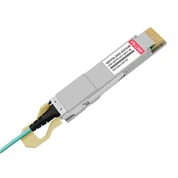
200G QSFP56 To 2x100G InfiniBand EDR AOC
200G QSFP-DD to 2x100G QSFP28 active optical cable compatible with Mellanox.

- Product Introduction
200G AOC Cable Mellanox MFA1A00-E005 Active Optical Cable InfiniBand EDR
Features
● Active optical cable with breakout from QSFP56 200G to two QSFP56 100G
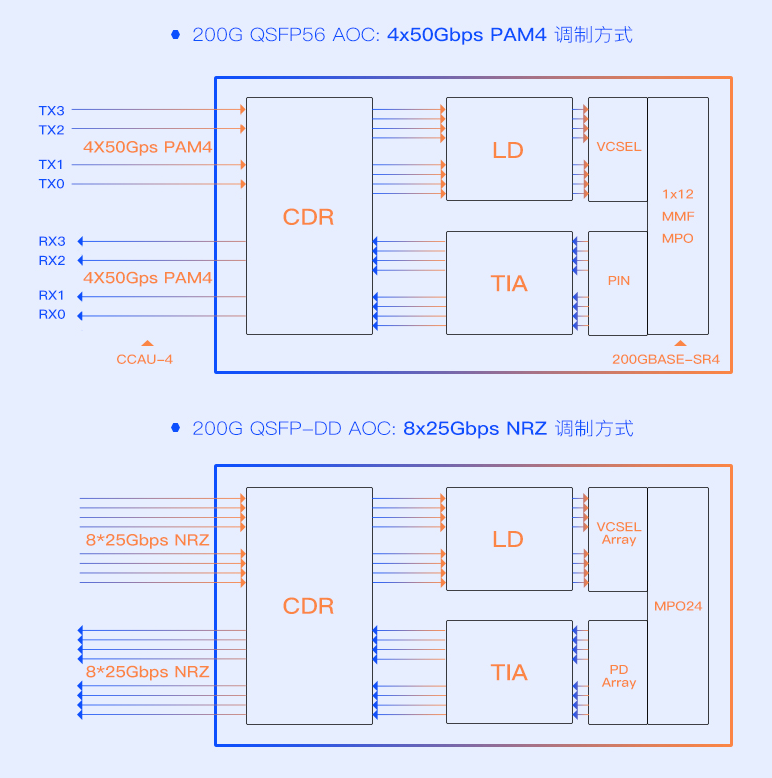
● Up to 53.125Gbps data rate per channel PAM4 modulation
● Integrated 850nm VCSEL array and PD array
● DDM function implemented
● Hot-pluggable
● Low power dissipation: : <4W on 200G end, <3W on 100G end
● Commercial operating case temperature range: 0℃ to 70 ℃
● Compliant with ROHS2.0
Applications
● Data centers and Cloud Networks
● 200G InfiniBand HDR systems
Standards
● IEEE 802.3cd
● InfiniBand 4xHDR
● SFF 8679
● CMIS4.0 or SFF8636
Absolute Maximum Ratings
|
Product
|
Electrical mode |
Protocol
|
Nominal Rate |
Specifications |
Link |
|||
|
Aggregate (Gbps) |
Electrical Lanes(Gbaud) |
ppm |
High Speed Electrical |
Pre-FEC Max BER |
||||
|
200G end |
4X50
|
IEEE802.3cd |
212.5 |
26.5625 PAM4 |
±100 |
200GAUI-4 |
1E-6 for InfiniBand HDR; 2.4E-4 for 200GBASE-SR4 |
0.5~ 100m
|
|
Per 100G end |
2X50
|
IEEE802.3cd |
106.25 |
26.5625 PAM4 |
±100 |
200GAUI-4 |
||
|
Parameter |
Symbol |
Unit |
Min |
Max |
|
Case Operating Temperature |
Top |
℃ |
0 |
70 |
|
Storage Temperature Range |
Ts |
℃ |
-40 |
85 |
|
Relative Humidity |
RH |
% |
0 |
85 |
|
Power Supply Voltage |
Vcc |
V |
-0.5 |
3.6 |
Recommended Operating Conditions
|
Parameter |
Symbol |
Unit |
Min |
Typ |
Max |
|
Operating Case Temperature Range |
Tca |
oC |
0 |
/ |
70 |
|
Power Supply Voltage |
Vcc |
V |
3.135 |
3.3 |
3.465 |
Electric Ports Definition
|
Parameter |
Symbol |
Unit |
Min |
Typ |
Max |
Notes |
|
Supply Voltage |
VCC |
V |
3.135 |
3.3 |
3.465 |
|
|
Power Consumption |
Pc |
W |
|
|
4 |
200G end |
|
|
|
3 |
100G end |
|||
|
Transmitter |
||||||
|
Input Differential Impedance |
RIN |
Ω |
80 |
100 |
120 |
|
|
Single Ended Data Input Swing |
VIN |
mVp-p |
90 |
|
500 |
|
|
Transmit Disable Voltage |
VDIS |
V |
2 |
|
VCCHOST |
|
|
Transmit Enable Voltage |
VEN |
V |
VEE |
|
VEE+0.8 |
|
|
Transmit Fault Assert Voltage |
VFA |
V |
2 |
|
VCCHOST |
|
|
Transmit Fault De-Assert Voltage |
VFDA |
V |
VEE |
|
VEE+0.8 |
|
|
Receiver |
||||||
|
Single Ended Data Output Swing |
VOD |
mVp-p |
200 |
|
500 |
|
|
LOS Fault |
VLOSFT |
V |
2 |
|
VCCHOST |
|
|
LOS Normal |
VLOSNR |
V |
VEE |
|
VEE+0.8 |
|
|
Differential termination mismatch |
|
% |
|
|
10 |
|
|
IIC communication |
||||||
|
IIC Clock frequency |
- |
KHZ |
/ |
100 |
400 |
|
|
clock stretching |
- |
us |
/ |
/ |
500 |
|
Pin Description
The electrical interface to the transceiver is a 38 pins edge connector. The 38 pins provide high speed data, low speed monitoring and control signals, I2C communication, power and ground connectivity. The top and bottom views of the connector are provided below, as well as a table outlining the contact numbering, symbol and full description.

|
Pin |
Symbol |
Name/Description |
|
1 |
GND |
Ground |
|
2 |
Tx2n |
Channel 2 Transmitter Inverted Data Input |
|
3 |
Tx2p |
Channel 2 Transmitter Non-Inverted Data Input |
|
4 |
GND |
Ground |
|
5 |
Tx4n |
Channel 4 Transmitter Inverted Data Input |
|
6 |
Tx4p |
Channel 4 Transmitter Non-Inverted Data Input |
|
7 |
GND |
Ground |
|
8 |
ModSelL |
Module Select |
|
9 |
ResetL |
Module Reset |
|
10 |
Vcc Rx |
+3.3 V Power supply receiver |
|
11 |
SCL |
2-wire serial interface clock |
|
12 |
SDA |
2-wire serial interface data |
|
13 |
GND |
Ground |
|
14 |
Rx3p |
Channel 3 Receiver Non-Inverted Data Output |
|
15 |
Rx3n |
Channel 3 Receiver Inverted Data Output |
|
16 |
GND |
Ground |
|
17 |
Rx1p |
Channel 1 Receiver Non-Inverted Data Output |
|
18 |
Rx1n |
Channel 1 Receiver Inverted Data Output |
|
19 |
GND |
Ground |
|
20 |
GND |
Ground |
|
21 |
Rx2n |
Channel 2 Receiver Inverted Data Output |
|
22 |
Rx2p |
Channel 2 Receiver Non-Inverted Data Output |
|
23 |
GND |
Ground |
|
24 |
Rx4n |
Channel 4 Receiver Inverted Data Output |
|
25 |
Rx4p |
Channel 4 Receiver Non-Inverted Data Output |
|
26 |
GND |
Ground |
|
27 |
ModPrsL |
Module Present |
|
28 |
IntL |
Interrupt |
|
29 |
Vcc Tx |
+3.3 V Power supply transmitter |
|
30 |
Vcc1 |
+3.3 V Power Supply |
|
31 |
LPMode |
Low Power Mode |
|
32 |
GND |
Ground |
|
33 |
Tx3p |
Channel 3 Transmitter Non-Inverted Data Input |
|
34 |
Tx3n |
Channel 3 Transmitter Inverted Data Input |
|
35 |
GND |
Ground |
|
36 |
Tx1p |
Channel 1 Transmitter Non-Inverted Data Input |
|
37 |
Tx1n |
Channel 1 Transmitter Inverted Data Input |
|
38 |
GND |
Ground |
Package Outline
The mechanical specifications are based on QSFP56 transceiver module specification, substituting the optical connectors with a cable connecting three ends.

What advantages does VCSEL have over other light sources?
1.small volume
2.low price
3.Single longitudinal mode output
4.The threshold current is small
5.Circular output spot
6.Easy to integrate into large area array
7.Current coupling efficiency with multimode fiber exceeds 90%
| Product name | Rate | Modulation | Power consumption | Application |
| 200G QSFP-DD AOC | 200G | NRZ | <4w | Data Center Double Density 100GBASE-SR4 Ethernet interconnect |
| 200G QSFP-DD TO 100G QSFP28 AOC |
2*100G | NRZ |
<4w <2.5w |
Data center 200G transfer 100G Ethernet branch interconnection |
| 200G QSFP-DD TO 50G QSFP28 AOC |
4*50G | NRZ |
<4w <1.5w |
Data center 200G transfer 50G branch interconnection |
| 200G QSFP56 AOC | 200G |
PAM4
NRZ |
<5w |
Data Center 200GBASE-SR4
Data Center 100GBASE-SR4 |
| 200G QSFP56 TO 50G SFP56 AOC |
4*50G | PAM4 |
<5w <1.5w |
Data center 200G transfer 50G branch interconnection |
Active optical cables are revolutionizing the way data centers and enterprise networks handle high-bandwidth applications. As businesses demand faster, more reliable connectivity solutions, AOC Cable technology has emerged as a game-changing alternative to traditional copper cabling systems.
What Makes AOC Cable Solutions Superior?
An AOC Cable combines electrical-to-optical conversion with fiber optic transmission in a single, integrated assembly. Unlike passive copper cables that suffer from signal degradation over distance, these innovative cables maintain signal integrity across extended runs while consuming less power and generating minimal heat.
The technology behind AOC Cable products leverages advanced PAM4 modulation schemes, enabling data rates up to 212.5 Gbps aggregate bandwidth. This makes them ideal for next-generation applications including 200G Ethernet, InfiniBand HDR, and high-performance computing clusters.
Key Advantages of Deploying AOC Cable Infrastructure
Exceptional Distance Performance
Traditional copper cables face severe limitations beyond 5-7 meters at high speeds. AOC Cable solutions effortlessly span distances up to 100 meters without signal repeaters or regeneration equipment. This extended reach dramatically simplifies data center architecture and reduces infrastructure complexity.
Energy Efficiency and Thermal Management
Power consumption remains a critical concern in modern data centers. AOC Cable assemblies typically consume 3-4 watts per connection-significantly less than comparable active copper solutions. Lower power draw translates directly to reduced cooling requirements and operational costs.
Lightweight and Flexible Design
Anyone who's managed dense cable bundles knows the struggle. AOC Cable products weigh a fraction of equivalent copper alternatives, making installation easier and improving airflow in server racks. The reduced bend radius allows for cleaner cable management and better aesthetics.
Future-Proof Scalability
Investing in AOC Cable infrastructure prepares your network for tomorrow's demands. With support for IEEE 802.3cd standards and compatibility with multiple protocols, these cables adapt seamlessly as your bandwidth requirements grow.
Critical Applications for AOC Cable Deployment
Data Center Interconnects
Modern hyperscale facilities rely on AOC Cable technology to connect top-of-rack switches, spine-leaf architectures, and storage arrays. The combination of high bandwidth, low latency, and extended reach makes them indispensable for contemporary data center designs.
High-Performance Computing
Research institutions and financial trading platforms require absolute reliability. AOC Cable solutions deliver consistent performance with bit error rates meeting stringent requirements-1E-6 for InfiniBand HDR applications and 2.4E-4 for 200GBASE-SR4 implementations.
Broadcast and Media Production
4K, 8K, and uncompressed video workflows demand enormous bandwidth. AOC Cable technology provides the headroom needed for real-time video processing, live event production, and post-production facilities.
Enterprise Core Networks
Forward-thinking organizations deploy AOC Cable solutions to build robust, high-capacity backbone networks. The cables' immunity to electromagnetic interference ensures reliable operation even in electrically noisy environments.
Technical Considerations for AOC Cable Selection
When evaluating AOC Cable options, several factors warrant careful consideration. Operating temperature range affects deployment locations-most solutions function reliably from 0°C to 70°C. Power supply requirements typically center around 3.3V with tight tolerance specifications.
Connector compatibility deserves attention. Whether you need AOC Cable assemblies with QSFP56, QSFP28, or SFP28 interfaces, ensuring proper mechanical and electrical compatibility with existing infrastructure prevents costly mistakes.
Protocol support varies across AOC Cable products. Verify that your chosen solution supports your specific application-whether that's 200G Ethernet, InfiniBand EDR/HDR, or proprietary protocols.
Installation Best Practices
Proper AOC Cable deployment maximizes performance and longevity. Always verify that installation environments fall within specified temperature and humidity ranges. Avoid exceeding minimum bend radius specifications, which can stress internal fiber optic elements.
When routing AOC Cable assemblies, maintain separation from high-voltage power cables to prevent potential interference with control signals. Use appropriate cable management accessories designed for optical assemblies rather than forcing cables into inadequate pathways.
Frequently Asked Questions About AOC Cable
Q: How does an AOC Cable differ from a DAC (Direct Attach Copper) cable?
A: AOC Cable uses fiber optic technology with integrated transceivers, enabling much longer distances (up to 100m) compared to DAC cables which are typically limited to 7 meters. AOC solutions also consume less power and weigh significantly less than copper alternatives.
Q: Can I use AOC Cable in outdoor environments?
A: Standard AOC Cable products are designed for controlled indoor environments with operating temperatures between 0-70°C. For outdoor deployments, you'll need ruggedized versions with extended temperature ratings and environmental protection.
Q: What's the typical lifespan of an AOC Cable?
A: Quality AOC Cable assemblies typically provide 5-10 years of reliable service when operated within specifications. The absence of moving parts and solid-state optical components contribute to excellent long-term reliability.
Q: Are AOC Cable products compatible with existing network equipment?
A: Most AOC Cable solutions feature standard MSA-compliant connectors (QSFP, SFP, etc.) and are designed for plug-and-play compatibility with major switch and server manufacturers. Always verify protocol compatibility for your specific application.
Q: How do I troubleshoot a malfunctioning AOC Cable?
A: Start by inspecting connectors for contamination or damage. Verify that link partners are properly configured and that the AOC Cable is receiving adequate power (typically 3.3V). Check for physical damage along the cable length and ensure you're not exceeding maximum distance specifications.
Q: What maintenance does AOC Cable require?
A: AOC Cable assemblies are largely maintenance-free. Periodically inspect connectors for dust or contamination, clean with appropriate optical cleaning supplies when necessary, and verify that cables aren't subjected to excessive stress or sharp bends.
Q: Can AOC Cable support bidirectional data transmission?
A: Yes, AOC Cable products support full-duplex operation with simultaneous transmit and receive capabilities. The integrated transceivers handle bidirectional communication over separate fiber strands within the cable assembly.
Q: What's the maximum bandwidth I can achieve with AOC Cable?
A: Current AOC Cable technology supports aggregate bandwidths exceeding 200 Gbps, with 400G and 800G solutions becoming increasingly available. The actual bandwidth depends on your specific cable model and network infrastructure capabilities.
Making the Right Choice
Selecting the appropriate AOC Cable solution requires balancing technical requirements against budget constraints. While these cables command a premium over passive alternatives, the operational benefits-reduced power consumption, extended distance capability, and simplified installation-often justify the investment within months.
As network bandwidth demands continue their exponential growth, AOC Cable technology positions organizations for success. Whether upgrading existing infrastructure or building new facilities, these innovative cables deliver the performance, reliability, and scalability that modern applications demand.
Hot Tags: AOC Cable