





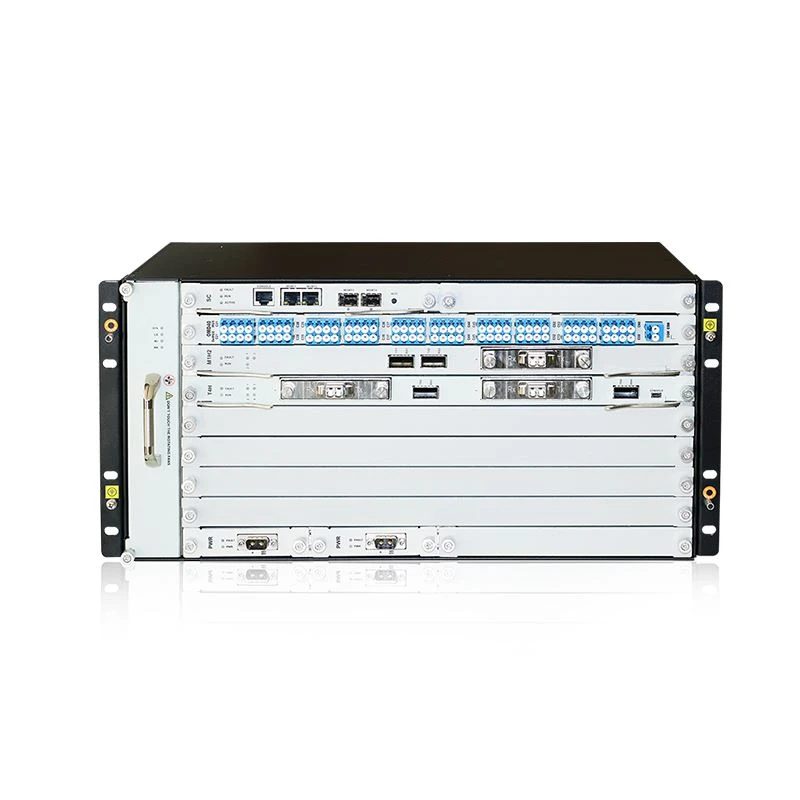


5U DWDM Frame
FBL2800-V 5U DWDM Frame is a 10G/100G/200G high-capacity OTN transport system, mainly used in backbone network, metropolitan area network and data center interconnected transmissions.

- Product Introduction
5U DWDM Frame
FBL2800-V 5U DWDM Frame is a 10G/100G/200G high-capacity OTN transport system, mainly used in backbone network, metropolitan area network and data center interconnected transmissions. It supports large bandwidth granularity multiplexing, OADM, electrical layer cross connection, multi service mapping and 10G/100G/200G transmission. It is applied to build an end-to-end OTN/WDM backbone transmission solution.
FBL2800-V has high integration, which supports 7 complete slots (supports any OTN service card), or 14 semi slots (supports WDM, OA and OLP card), or Complete/Semi combination configuration. It supports cross connection between neighbor slot, 1+1 backup for control and power cards, distributed electronic cross connection through backplane, flexible data services combination of OTN and SDH, super FEC error correction, over 1200 kilometers 100G/200G without OEO relay transmission. It is applied for complex networking, easy to deploy, supports centralized network management system.It supports SNMP-based network management system, which has a friendly user interface and is easy to operate.
Item Spotlights
● Flexible networking,compact size,super scalability.
● Works with CWDM/DWDM/EDFA/OLPS/OTAP multi interface modules.
● Supports multi data rates on SDH/SONET/POS/EPON/GPON/CPRI/SAN/ETHERNET.
● Supports singe fiber unilateral, single fiber bi-directional,dual fiber bi-directional chain/star/ring interconnection.
● MSA compliant, works with single mode(1310nm/1550nm),multi mode(850nm/1310nm),RJ45,OADM,add/drop wavelength en route.
● Supports SNMP unified network management platform,CLI,Web,NetRiver.
● Supports 1+1 power back up,hot pluggable, AC or DC.
Description
|
Characteristics |
Description |
|
Slot capacity |
2 semi slots for 1+1 system control and 2 semi slots for 1+1 power supply card |
|
Line Side Interface |
OTU2/2e / OTU4 / OTUC2 |
|
Client Side Interface |
GE/FE, 10GE LAN/WAN, 40GE, 100GE |
|
Power Supply |
Support 1+1 backup DC power supply; |
|
Power Consumption |
Max.1100W |
|
Dimension(W*H*D) |
444.5mm * 222mm * 241.5mm |
|
Environment |
Working temperature: 0℃~40℃; |
Application

Wavelength division multiplexing technology has revolutionized optical networks, and the DWDM Muxponder stands at the forefront of this transformation. As network demands continue to escalate, organizations need reliable, scalable solutions that can handle high-capacity data transmission across metropolitan, regional, and long-haul networks.
Understanding DWDM Muxponder Technology
A DWDM Muxponder combines the functionality of multiple network elements into a single, efficient platform. This sophisticated equipment serves triple duty as a transponder, repeater, and regenerator, offering unparalleled flexibility for optical network deployments. By consolidating multiple optical signals onto a single fiber infrastructure, it dramatically reduces operational costs while maximizing bandwidth utilization.
The technology enables seamless conversion between various optical and electrical formats, making it an indispensable tool for service providers and enterprises managing complex network architectures. With transparent bi-directional forwarding capabilities, these systems ensure that data flows smoothly regardless of the underlying transmission medium.
Core Capabilities That Set DWDM Muxponders Apart
Modern DWDM Muxponder platforms deliver exceptional versatility through support for multiple service types. These systems accommodate everything from Gigabit Ethernet to advanced Fiber Channel protocols, handling data rates spanning from sub-gigabit speeds up to 11.3 Gbps. This broad compatibility ensures that organizations can deploy a single platform across diverse network segments.
The hot-swappable interface design provides operational flexibility that network administrators value. Standard MSA-compliant pluggable transceivers enable rapid deployment and service upgrades without disrupting existing traffic. This modularity also simplifies inventory management and reduces spare part requirements.
Wavelength flexibility represents another critical advantage. Support for both CWDM and DWDM wavelength grids means that network planners can optimize fiber utilization based on specific distance and capacity requirements. DWDM implementations particularly benefit from dense channel spacing options, with support for up to 96 channels in the C-band spectrum.
Real-World Applications Driving Network Evolution
DWDM Muxponder technology addresses multiple deployment scenarios that modern networks demand. Metropolitan Ethernet services benefit from the equipment's ability to extend 10 Gigabit connectivity across extended distances without signal degradation. Service providers leverage this capability to deliver high-bandwidth connections to enterprise customers while maintaining service quality guarantees.
Cable landing stations represent another crucial application area. These critical infrastructure points require robust wavelength conversion and signal regeneration to bridge submarine cable systems with terrestrial networks. The DWDM Muxponder's electrical regeneration capabilities ensure that long-haul transmissions maintain signal integrity across transoceanic distances.
Data center interconnect scenarios also benefit significantly from this technology. As organizations distribute workloads across multiple facilities, the need for high-capacity, low-latency connections becomes paramount. A well-designed DWDM Muxponder deployment enables seamless data replication and resource sharing between geographically dispersed data centers.
Enhanced Management and Monitoring Capabilities
Network visibility has become essential for maintaining service quality and troubleshooting issues proactively. Advanced DWDM Muxponder platforms incorporate comprehensive monitoring features that provide real-time insight into optical performance parameters. Administrators can track transmit and receive power levels, temperature readings, and alarm conditions through centralized management software.
This monitoring capability extends beyond basic operational parameters. Sophisticated platforms offer trend analysis and predictive maintenance alerts, enabling network teams to address potential issues before they impact service delivery. Remote management functionality further enhances operational efficiency by eliminating the need for truck rolls to distant network sites.
Technical Architecture for Optimal Performance
The modular architecture of modern DWDM Muxponder systems provides scalability that aligns with network growth patterns. Individual channel cards occupy minimal chassis space, allowing high-density deployments in space-constrained central offices and colocation facilities. Power efficiency considerations further enhance the value proposition, with typical consumption levels supporting green network initiatives.
Reliability engineering ensures that these systems meet carrier-grade availability requirements. Mean time between failure specifications exceeding 100,000 hours demonstrate the robust design philosophy that underlies these platforms. This reliability translates directly into reduced maintenance costs and improved service availability for end users.
Strategic Advantages for Network Operators
Deploying DWDM Muxponder technology delivers tangible business benefits beyond technical capabilities. Fiber infrastructure represents a significant capital investment, and maximizing the utilization of existing fiber plants directly impacts return on investment. By enabling multiple services to share common fiber resources, these systems extend the useful life of deployed infrastructure.
Service agility represents another strategic advantage. Network operators can rapidly provision new wavelength services to meet customer demands without lengthy fiber installation projects. This responsiveness creates competitive differentiation in markets where time-to-service matters.
Future-proofing considerations also favor DWDM Muxponder deployments. As service requirements evolve and new protocols emerge, the transparent transport capabilities ensure that networks can adapt without wholesale equipment replacement. This investment protection provides financial predictability for multi-year network planning cycles.
Frequently Asked Questions
What distinguishes a DWDM Muxponder from a traditional transponder?
A DWDM Muxponder integrates multiple transponder functions into a single platform, supporting multiple channels simultaneously. While traditional transponders handle single-wavelength conversion, a muxponder manages multiple wavelengths concurrently, consolidating equipment and reducing operational complexity. This integration delivers superior port density and reduced power consumption compared to deploying individual transponder units.
Can DWDM Muxponder equipment support mixed service types simultaneously?
Yes, advanced DWDM Muxponder platforms support transparent transmission of diverse service types across the same infrastructure. The equipment can simultaneously carry Ethernet, Fiber Channel, SDH/SONET, and other protocols without requiring service-specific configurations. This protocol-agnostic approach simplifies network design and enables efficient multi-service delivery.
How does wavelength electrical regeneration improve transmission performance?
Electrical regeneration reconstructs optical signals by converting them to the electrical domain, processing them to remove noise and distortion, and then generating fresh optical output. This 3R regeneration (reamplification, reshaping, retiming) extends transmission distances beyond the reach of purely optical amplification, making it essential for ultra-long-haul networks and degraded fiber infrastructure.
What management capabilities should organizations expect from modern DWDM Muxponder systems?
Comprehensive network management systems provide real-time monitoring of optical power levels, alarm conditions, environmental parameters, and performance metrics. Advanced platforms support SNMP integration with existing network management tools, enabling centralized visibility across multi-vendor environments. Remote configuration and firmware update capabilities further streamline operations.
How do organizations determine the appropriate channel count for their DWDM Muxponder deployment?
Channel count selection depends on current service requirements and projected growth. Analyzing existing traffic patterns, forecasting bandwidth demand, and considering available fiber resources helps determine optimal capacity. Most organizations deploy systems with 25-50% excess capacity to accommodate unexpected growth and maintain service flexibility without requiring premature upgrades.
What distance limitations apply to DWDM Muxponder deployments?
Transmission distances depend on multiple factors including fiber quality, chromatic dispersion characteristics, and power budget considerations. With electrical regeneration, DWDM Muxponder systems can extend signals across hundreds of kilometers. Metro deployments typically cover 80-120km, while long-haul configurations with appropriate amplification can span 600km or more between regeneration points.
Hot Tags: DWDM
You Might Also Like


