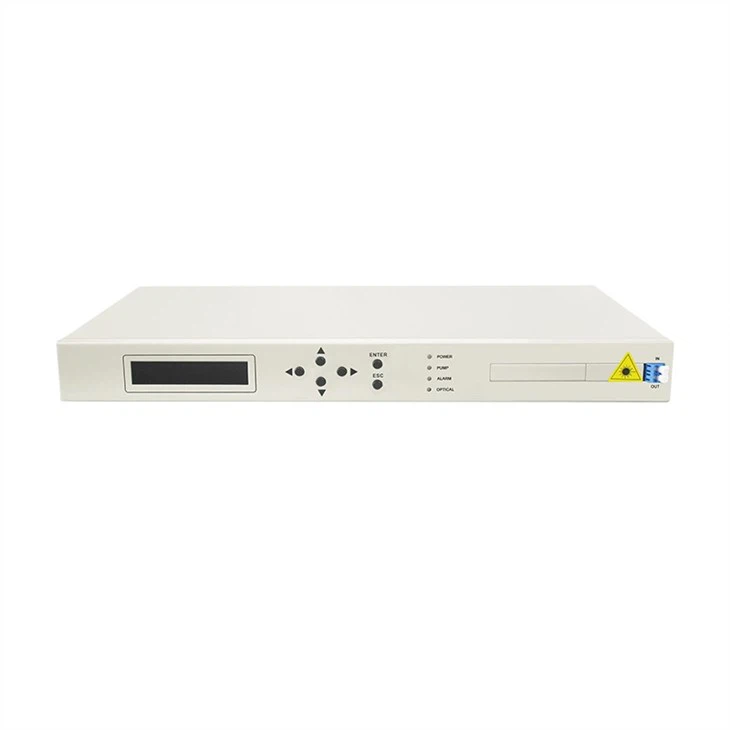
EDFA LA Optical Amplifier
Fiber amplifier technology is in the fiber core of the doped can produce laser rare earth elements, through the laser to provide DC excitation, so that through the optical signal to be amplified.

- Product Introduction
Item Spotlights
● Supports optical amplification of C-band DWDM system.
● Supports amplification of optional OSC signal input.
● Max saturated output +15dB, Minimum input -25dB.
● Unified SNMP network management platform,CLI,Web,NetRiver.
● It can monitor:PUMP drive current,PUMP power output,PUMP switch,PUMP temperature,input power,output power,module temperature.
● It can configure PUMP switch,AGC mode and APC mode.
● Supports optical monitoring port(MON).
Description
|
Product Name |
Line amplifier(LA) |
||||
|
Parameter |
Min |
Typ |
Max |
Unit |
|
|
Operating Wavelength |
16 Channel |
1546 |
1550 |
1561 |
nm |
|
32 Channel |
1535 |
|
1562 |
||
|
48 Channel |
1528 |
|
1568 |
||
|
Input power |
-25 |
|
-15 |
dBm |
|
|
Gain |
14 |
25 |
33 |
|
|
|
Output power |
|
|
15 |
dBm |
|
|
Gain flatness |
|
0.6 |
1.5 |
dB |
|
|
Input/output Isolation |
30 |
|
|
dB |
|
|
Output Pump leakage |
|
|
-30 |
dBm |
|
|
Input/output return loss |
45 |
|
|
dB |
|
|
polarization dependent loss |
|
|
0.5 |
dB |
|
|
Polarization mode dispersion |
|
|
0.5 |
ps |
|
|
Noise figure |
|
5.0 |
|
dB |
|
|
Operating Temperature |
-5 |
|
55 |
℃ |
|
|
Humidity |
5 |
|
95 |
% |
|
|
Storage Temperature |
-40 |
|
85 |
℃ |
|
|
power consumption |
|
|
30 |
W |
|
|
Power |
-48V DC AND 220V AC |
V |
|||
|
Interface |
FC/UPC or others |
|
|||
|
Dimension |
(W x L x H) 482.6x245x43.6 |
mm |
|||
Understanding Line Amplifiers: The Backbone of Modern DWDM Networks
Optical networks have revolutionized long-distance communication, and at the heart of these systems lies a critical component that ensures signals travel hundreds or thousands of kilometers without degradation. DWDM (Dense Wavelength Division Multiplexing) technology has become the industry standard for maximizing fiber optic capacity, but its success depends entirely on sophisticated amplification equipment that maintains signal integrity across the C-band spectrum.
Why DWDM Systems Require Specialized Amplification
When multiple wavelength channels traverse optical fiber simultaneously, signal attenuation becomes a primary challenge. DWDM architectures multiplex dozens of channels onto a single fiber strand, with each channel carrying critical data. Without proper amplification at strategic points, these signals would degrade beyond recognition before reaching their destination.
Modern line amplifiers serve as regeneration points throughout DWDM infrastructures, boosting optical signals without converting them to electrical format. This all-optical approach eliminates conversion bottlenecks and enables truly high-speed transmission across metropolitan and long-haul networks.
Key Capabilities That Define Professional-Grade Equipment
The most effective amplification solutions for DWDM deployments share several essential characteristics. First, they must accommodate the full range of channel densities that network operators deploy – from 16-channel systems suitable for enterprise applications to 48-channel configurations that maximize capacity on premium routes.
Flexibility in gain control separates professional equipment from basic alternatives. Automatic Gain Control (AGC) mode maintains consistent amplification regardless of input fluctuations, while Automatic Power Control (APC) mode ensures stable output levels. This dual-mode capability allows operators to optimize performance based on network topology and traffic patterns.
Comprehensive monitoring capabilities have become non-negotiable in modern DWDM networks. Real-time visibility into pump laser performance, input and output power levels, and thermal conditions enables proactive maintenance and rapid troubleshooting. The ability to track these parameters through multiple management interfaces – SNMP, command-line, and web-based consoles – ensures compatibility with diverse operational workflows.
Optical Performance Specifications That Matter
When evaluating amplification equipment for DWDM applications, several technical parameters directly impact network performance. The dynamic range between minimum input and maximum output defines operational flexibility. Equipment capable of handling very low input signals while delivering substantial output power provides greater placement options within network designs.
Gain flatness across the amplification spectrum becomes increasingly critical as channel counts rise. Even minor variations in gain across different wavelengths can accumulate through cascaded amplifier stages, eventually requiring expensive gain equalization equipment. Superior designs maintain tight control over gain variation, typically under one decibel across the entire operating range.
Noise figure directly affects signal quality in multi-span DWDM systems. Lower noise figures preserve optical signal-to-noise ratio (OSNR), enabling longer transmission distances or higher modulation formats. Professional-grade line amplifiers achieve noise figures around five decibels, striking an optimal balance between gain and noise performance.
Integration with Optical Supervisory Channels
Many DWDM networks employ Optical Supervisory Channel (OSC) signals for network management and monitoring. These out-of-band channels carry critical information about network status, alarm conditions, and configuration data. Advanced line amplifiers can simultaneously amplify OSC signals along with payload channels, simplifying network architecture and reducing equipment requirements.
The ability to monitor amplified signals through dedicated tap ports provides another layer of operational visibility. These monitoring ports enable spectrum analyzers and optical channel monitors to verify channel power levels and detect anomalies without interrupting live traffic.
Environmental Resilience for Diverse Deployments
DWDM equipment often operates in challenging environments, from climate-controlled data centers to outdoor cabinets exposed to temperature extremes. Robust thermal management ensures reliable operation across wide temperature ranges, while low power consumption reduces cooling requirements and operational costs.
Dual power supply options – both DC and AC – accommodate different deployment scenarios. Telecommunications facilities typically provide DC power distribution, while enterprise environments often rely on standard AC power. Equipment supporting both input types simplifies procurement and installation across varied network segments.
Management Platform Versatility
Network operations teams work with diverse management systems, from simple command-line interfaces to sophisticated network management platforms. Comprehensive SNMP support enables integration with industry-standard monitoring tools, while web-based interfaces provide quick access for troubleshooting and configuration adjustments. Some platforms even support proprietary management systems for operators preferring specialized tools.
The ability to remotely enable or disable pump lasers, adjust operating modes, and retrieve performance metrics reduces truck rolls and accelerates problem resolution. This remote management capability has become essential as DWDM networks extend into remote locations where on-site technical expertise may be limited.
Application Scenarios Across Network Segments
Different network segments demand different amplification strategies. In metropolitan DWDM networks, where span distances rarely exceed 80 kilometers, line amplifiers compensate for fiber loss and enable flexible wavelength add-drop functionality. The moderate gain requirements in metro applications allow operators to prioritize noise performance over raw output power.
Long-haul DWDM systems present more demanding requirements. Spans extending beyond 100 kilometers require higher gain levels and careful attention to OSNR accumulation. Line amplifiers in these networks must deliver consistent performance while maintaining low noise figures across all channels. Cascading multiple amplifier stages across continental distances demands exceptional reliability from each component.
Submarine cable systems represent the most extreme application for DWDM amplification. While specialized amplifiers designed for underwater deployment differ from terrestrial equipment, the fundamental principles remain consistent – maintaining signal quality across extraordinary distances through carefully engineered optical amplification.
Frequently Asked Questions
What is the difference between DWDM line amplifiers and other optical amplifiers?
Line amplifiers specifically serve mid-span amplification roles in DWDM systems, positioned between transmitters and receivers to compensate for fiber loss. Booster amplifiers increase power immediately after transmission equipment, while pre-amplifiers boost signals just before receivers. Line amplifiers must balance gain, noise figure, and output power to maintain signal quality across multiple cascaded stages.
How many line amplifiers does a typical DWDM network require?
The number depends on several factors: total route distance, fiber type and quality, channel count, modulation format, and required bit error rate. As a general guideline, standard single-mode fiber requires amplification approximately every 80-100 kilometers for long-haul DWDM systems. Metropolitan networks with shorter spans may require fewer amplification points, while ultra-long-haul systems may need amplifiers every 40-60 kilometers.
Can DWDM line amplifiers support mixed channel configurations?
Yes, modern line amplifiers handle various channel plans within their supported wavelength range. Whether deploying 16, 32, or 48 channels, the amplifier provides gain across the populated spectrum. However, optimal performance requires appropriate channel loading – operating with very few channels in equipment designed for higher channel counts may result in suboptimal gain flatness.
What maintenance do DWDM line amplifiers typically require?
These devices are largely maintenance-free during normal operation. The primary maintenance activities include monitoring performance parameters through management interfaces, verifying alarm thresholds remain appropriate, and ensuring adequate cooling in equipment enclosures. Pump laser modules have operational lifetimes exceeding 100,000 hours, though eventual replacement represents the most significant maintenance activity.
How does temperature affect line amplifier performance?
Optical amplification involves physical processes sensitive to temperature variations. However, professional equipment includes thermal management features that maintain stable performance across specified operating ranges. Internal temperature sensors enable proactive monitoring, triggering alarms if conditions exceed safe thresholds. Proper installation in temperature-controlled environments or adequately cooled outdoor cabinets ensures reliable operation.
What is the significance of gain flatness in DWDM applications?
Gain flatness describes how uniformly an amplifier boosts different wavelengths. In DWDM systems carrying dozens of channels, even small differences in per-channel gain accumulate through multiple amplifier stages. If one wavelength receives slightly more gain than others at each amplification point, it may eventually overload receivers or interfere with adjacent channels. Tight gain flatness specifications ensure all channels receive similar treatment throughout the network.
Can line amplifiers compensate for fiber impairments beyond attenuation?
Line amplifiers primarily address signal attenuation, restoring optical power levels to compensate for fiber loss. They do not correct chromatic dispersion, polarization mode dispersion, or nonlinear effects. DWDM networks typically employ dispersion compensation modules, coherent detection, or digital signal processing to address these additional impairments. Proper network design considers all transmission limitations, not just attenuation.
What role does input/output isolation play in amplifier performance?
Isolation specifications indicate how effectively the amplifier prevents back-reflection and maintains signal directionality. High isolation values prevent reflected signals from interfering with upstream equipment or causing unwanted feedback within the amplifier itself. This becomes particularly important in DWDM networks where multiple channels must coexist without cross-talk or interference.
Selecting the Right Amplification Solution
Successful DWDM network deployment requires careful equipment selection based on specific operational requirements. Consider the anticipated channel count, existing and planned, to ensure adequate spectral coverage. Evaluate management platform compatibility to enable seamless integration with existing operational systems. Assess environmental conditions at planned installation sites to verify equipment specifications align with real-world constraints.
The investment in quality amplification equipment pays dividends through reliable network operation, simplified troubleshooting, and reduced operational expenses. While initial costs may seem significant, the total cost of ownership over multi-year deployments favors solutions with comprehensive monitoring, flexible control options, and robust performance specifications.
As data traffic continues its exponential growth, DWDM networks will expand in both geographic reach and capacity density. Line amplifiers that deliver exceptional performance today while accommodating future upgrades provide the foundation for sustainable network evolution. Choosing equipment with these characteristics ensures your optical infrastructure remains competitive and capable for years to come.
Hot Tags: dwdm