





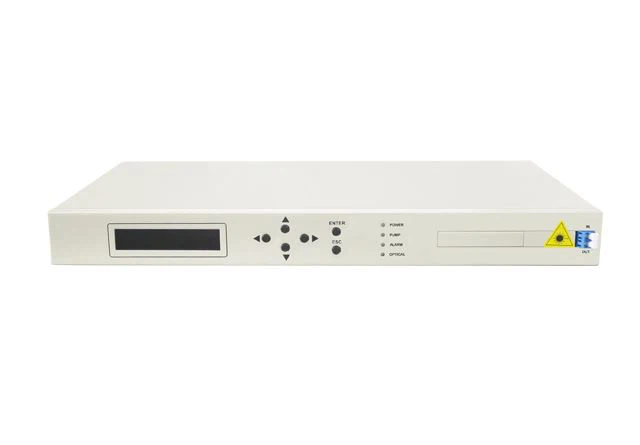
EDFA PA Optical Amplifier
The main role of EDFA in the optical fiber communication system is to extend the relay distance. When it is combined with wavelength division multiplexing technology and optical soliton technology, it can achieve ultra large capacity and ultra long distance transmission.

- Product Introduction
Item Spotlights
● Supports optical amplification of C-band DWDM system.
● Supports amplification of optional OSC signal input.
● Max saturated output +23dB, Minimum input -35dB.
● Booster amplification,Line amplification,Pre-amplification.
● Unified SNMP network management platform,CLI,Web,NetRiver.
● It can monitor:PUMP drive current,PUMP power output,PUMP switch,PUMP temperature,input power,output power,module temperature.
● It can configure PUMP switch,AGC mode and APC mode.
● Supports optical monitoring port(MON).
Description
|
Product Name |
Preapmlifier(PA) |
||||
|
Parameter |
Min |
Typ |
Max |
Unit |
|
|
Operating Wavelength |
16 Channel |
1546 |
1550 |
1561 |
nm |
|
32 Channel |
1535 |
|
1562 |
||
|
48 Channel |
1528 |
|
1568 |
||
|
Input power |
-30 |
|
5 |
dBm |
|
|
Gain |
14 |
25 |
30 |
|
|
|
Output power |
|
|
13 |
dBm |
|
|
Input optical power threshold |
-30 |
|
-40 |
dBm |
|
|
Noise figure |
|
5.0 |
|
dB |
|
|
Gain flatness |
|
0.6 |
1.5 |
dB |
|
|
Input/output Isolation |
30 |
|
|
dB |
|
|
Output Pump leakage |
|
|
-30 |
dBm |
|
|
Input/output return loss |
45 |
|
|
dB |
|
|
polarization dependent loss |
|
|
0.5 |
dB |
|
|
Polarization mode dispersion |
|
|
0.5 |
ps |
|
|
Operating Temperature |
-5 |
|
55 |
℃ |
|
|
Humidity |
5 |
|
95 |
% |
|
|
Storage Temperature |
-40 |
|
85 |
℃ |
|
|
Power consumption |
|
|
30 |
W |
|
|
Power |
-48V DC AND 220V AC |
V |
|||
|
Interface |
FC/UPC or others |
|
|||
|
Dimension |
(W x L x H) 482.6x245x43.6 |
mm |
|||
Optical networks have become the backbone of modern telecommunications, and Dense Wavelength Division Multiplexing (DWDM) technology stands at the forefront of high-capacity data transmission. Among the critical components that ensure optimal DWDM system performance, preamplifiers play an indispensable role in maintaining signal integrity across long-haul and metro networks.
What Makes DWDM Preamplifiers Essential?
DWDM systems transport multiple wavelengths of light simultaneously through a single optical fiber, dramatically increasing bandwidth capacity. However, as optical signals traverse fiber spans, they experience attenuation and degradation. This is where preamplifiers become mission-critical components, strategically positioned to boost weakened signals before they reach detection equipment.
The preamplifier serves as the first line of defense against signal loss in DWDM architectures. By amplifying incoming optical signals at the earliest possible stage, these devices ensure that downstream components receive sufficient power levels for accurate data recovery. This amplification occurs in the C-band spectrum, which encompasses the wavelength range most commonly used in DWDM deployments.
Core Capabilities of Modern DWDM Optical Amplifiers
Advanced preamplifiers designed for DWDM networks offer remarkable flexibility in deployment scenarios. These devices excel in three primary amplification roles: pre-amplification before receivers, line amplification for mid-span signal boosting, and booster amplification after transmitters. This versatility allows network designers to optimize amplifier placement based on specific link budgets and topology requirements.
The ability to handle weak input signals represents a crucial advantage in DWDM infrastructure. Modern preamplifiers can effectively process extremely low power levels, making them suitable for ultra-long-haul applications where signals have undergone significant attenuation. Simultaneously, these devices deliver substantial gain while maintaining low noise characteristics, preserving the signal-to-noise ratio that determines overall system performance.
Channel Capacity and DWDM Scalability
Today's DWDM networks demand amplification solutions that support varying channel counts. Preamplifiers engineered for dense wavelength systems accommodate configurations ranging from standard channel counts to highly dense deployments. This scalability ensures that network operators can expand capacity without replacing existing amplification infrastructure.
The wavelength range coverage provided by these amplifiers spans the entire C-band spectrum utilized in commercial DWDM systems. This broad operational window enables compatibility with diverse DWDM equipment manufacturers and facilitates network upgrades as transmission technology evolves.
Intelligent Network Management for DWDM Systems
Comprehensive network management capabilities distinguish professional-grade DWDM amplifiers from basic optical components. Unified management platforms supporting SNMP protocols, command-line interfaces, and web-based dashboards provide operators with granular visibility into amplifier performance. This management integration proves essential for large-scale DWDM deployments spanning multiple sites.
Real-time monitoring extends to critical operational parameters including pump laser conditions, optical power levels at input and output ports, and thermal characteristics. Such detailed telemetry enables proactive maintenance strategies, reducing the risk of service-affecting failures in production DWDM networks. The ability to configure amplifier operating modes remotely streamlines network operations and minimizes the need for technician dispatch.
Operating Modes: AGC and APC in DWDM Applications
DWDM preamplifiers typically support two fundamental operating modes that address different network scenarios. Automatic Gain Control (AGC) mode maintains constant gain regardless of input power fluctuations, making it ideal for networks with variable channel loading. This mode ensures that each wavelength receives proportional amplification even as channels are added or removed from the DWDM system.
Automatic Power Control (APC) mode, conversely, maintains constant output power levels. This configuration proves valuable in point-to-point DWDM links where maintaining specific power budgets at receiving equipment takes precedence. Network engineers select between these modes based on system design requirements and operational priorities.
Optical Performance Metrics That Matter
Several key performance indicators determine preamplifier suitability for demanding DWDM applications. Noise figure remains paramount, as lower values indicate better signal-to-noise ratio preservation. Gain flatness across the operational wavelength range ensures that all DWDM channels receive uniform amplification, preventing power imbalances that could degrade system margins.
Polarization-dependent loss and polarization mode dispersion represent additional considerations in high-performance DWDM networks. Minimal values for these parameters ensure that signal quality remains consistent regardless of the polarization state of incoming light, a critical factor in coherent DWDM transmission systems.
Environmental Reliability for Critical Infrastructure
DWDM networks often operate in challenging environmental conditions, from controlled data centers to outdoor cabinet installations. Professional-grade preamplifiers incorporate robust thermal management to ensure stable operation across wide temperature ranges. This environmental resilience proves essential for carrier-grade reliability standards.
Power supply flexibility accommodates diverse deployment scenarios, with support for both DC and AC input voltages. This versatility simplifies integration into existing telecommunications infrastructure while providing redundancy options for mission-critical DWDM installations.
Monitoring Capabilities for Proactive Operations
Built-in optical monitoring ports enable non-intrusive signal analysis without disrupting live DWDM traffic. These monitoring interfaces allow engineers to measure signal quality, perform troubleshooting, and validate system performance using external test equipment. Such capabilities prove invaluable during network commissioning and ongoing maintenance activities.
The comprehensive monitoring portfolio extends beyond basic power measurements to include detailed pump laser diagnostics. This visibility into amplifier health parameters facilitates predictive maintenance strategies that prevent unexpected failures in production DWDM networks.
Frequently Asked Questions About DWDM Preamplifiers
What is the primary difference between a DWDM preamplifier and a booster amplifier?
A DWDM preamplifier is positioned immediately before receiving equipment to amplify weak signals that have traveled through fiber spans, improving receiver sensitivity. Booster amplifiers, in contrast, are placed after transmitters to increase signal power before long-haul transmission. While both serve DWDM systems, their placement and optimization differ based on whether they handle weak or strong input signals.
How does a preamplifier improve DWDM system reach?
Preamplifiers extend DWDM system reach by recovering attenuated signals before they reach detection thresholds. By providing substantial gain at the receiving end, these devices effectively increase the power budget available for fiber spans, allowing longer distances between regeneration points. This capability reduces the number of intermediate sites required in long-haul DWDM networks.
Can DWDM preamplifiers support different channel counts on the same hardware?
Modern DWDM preamplifiers typically support operation across the entire C-band spectrum, accommodating various channel counts without hardware modifications. The same amplifier can function effectively whether the DWDM system carries sixteen, thirty-two, or more channels, provided the total input power remains within operational specifications. This flexibility simplifies inventory management and enables network expansion.
Why is noise figure important in DWDM preamplifier selection?
Noise figure directly impacts the optical signal-to-noise ratio in DWDM systems. Lower noise figures mean the preamplifier adds less noise during amplification, preserving signal quality. In cascaded amplifier chains common in DWDM networks, the noise figure of the first amplifier (often the preamplifier) has the most significant impact on overall system performance, making it a critical selection criterion.
What advantage does AGC mode offer in dynamic DWDM networks?
Automatic Gain Control mode maintains consistent gain regardless of input power variations, which commonly occur when DWDM channels are added or removed. This stability prevents surviving channels from experiencing power surges or drops during network reconfigurations. AGC mode is particularly valuable in reconfigurable optical add-drop multiplexer (ROADM) networks where wavelength routing changes dynamically.
How does optical supervision channel (OSC) support enhance DWDM management?
OSC amplification capability allows preamplifiers to boost management and monitoring traffic transmitted outside the primary DWDM signal band. This separate channel carries network management data, performance monitoring information, and protection switching commands without consuming revenue-generating wavelength capacity. Amplifying the OSC ensures reliable management connectivity across extended DWDM network spans.
What environmental factors affect DWDM preamplifier performance?
Temperature variations represent the primary environmental concern for DWDM preamplifiers. Excessive heat can affect pump laser efficiency and alter gain characteristics, while extreme cold may impact component reliability. Professional-grade units incorporate thermal management systems and operate reliably across industrial temperature ranges. Humidity control also matters in preventing condensation that could damage optical components.
How do return loss specifications protect DWDM systems?
High return loss values indicate that preamplifiers reflect minimal optical power back toward the source. Reflected signals can interfere with transmitter operation and create unwanted resonances in DWDM systems. Superior return loss specifications ensure that amplified spontaneous emission and signal reflections remain negligible, maintaining system stability and preventing crosstalk between wavelengths.
Hot Tags: dwdm


