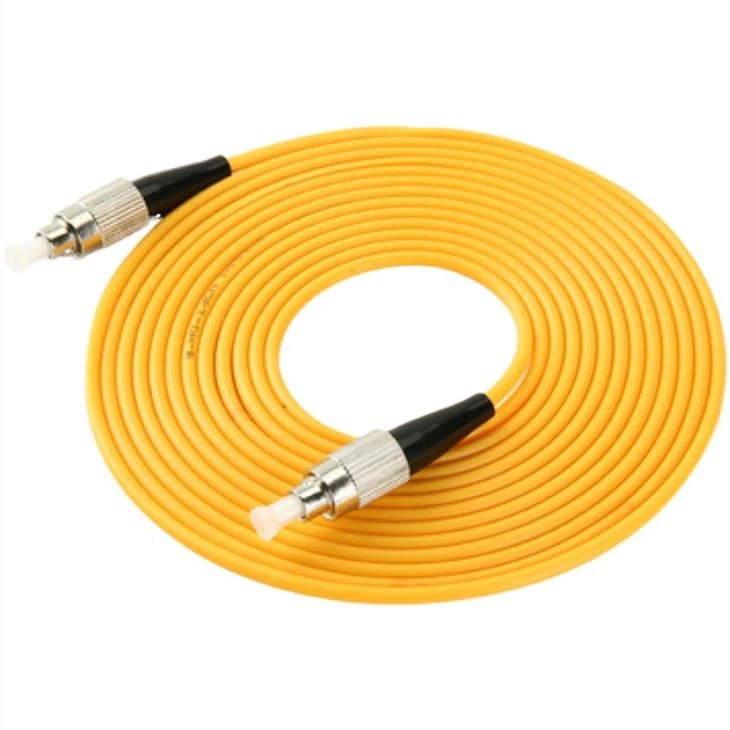

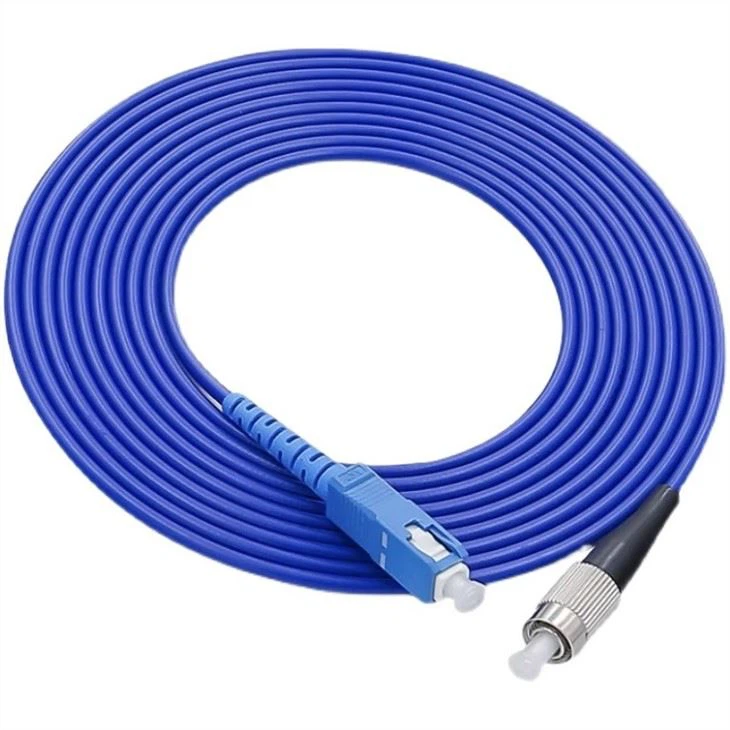
FC Fiber Optic Patchcord
The 9/125μm OS2 single mode bend insensitive fiber optic cable is less attenuation when bent or twisted compared with traditional optical fiber cables and this will make the installation and maintenance of the fiber optic cables more efficient.

- Product Introduction
Product Highlights
● PVC (Riser) Flame-retardant Jacket
● Grade A Precision Zirconia Ferrule Connectors Ensure Low Loss
● G.657.A1 Bend Insensitive Fiber & 10mm Min. Bend Radius
● Optical Testing Ensures Network Performance
● Compliant to TIA-604 (FOCIS)
Specifications
| Connector Type | FC/UPC | Fiber Grade | G.657.A1 (Compatible with G.652.D) |
| Fiber Mode | 9/125um | Wavelength | 1310/1550nm |
| Insertion Loss | ≤0.3dB | Return Loss | ≥50dB |
| Min Bend Radius(Fiber Core) | 10mm | Min. Bend Radius(Fiber Cable) | 10/5D (Dynamic/Static) |
| Attenuation at 1310nm | 0.36dB/km | Attenuation at 1550nm | 0.22 dB/km |
| Fiber Count | Simplex | Cable Diameter | 2.0mm,3.0mm |
| Cable Jacket | PVC | Polarity | A (Tx) to B (Rx) |
| Operating Temperature | -20~70℃ | Storage Temperature | -40~80°C |
High-speed data transmission has become the backbone of modern digital infrastructure. As businesses and data centers demand faster, more reliable connections, the fiber optic patchcord has emerged as an essential component for achieving optimal network performance. These precision-engineered cables bridge the gap between networking equipment, ensuring seamless data flow across complex systems.
What Makes a Quality Fiber Optic Patchcord?
A fiber optic patchcord, also known as a fiber patch cable or fiber jumper, serves as the critical link between optical devices in your network infrastructure. Unlike traditional copper cables that transmit electrical signals, these advanced cables use light pulses to carry data through ultra-thin glass or plastic fibers, enabling significantly higher bandwidth and longer transmission distances.
The quality of your fiber optic patchcord directly impacts network reliability. Premium cables feature precision-manufactured connectors, bend-insensitive fiber cores, and robust jacketing materials that protect against environmental factors. When selecting cables for mission-critical applications, understanding these quality markers ensures your investment delivers long-term value.
The Evolution of Bend-Insensitive Technology
Traditional optical cables suffered from signal loss when bent during installation or routine maintenance. Modern fiber optic patchcord solutions incorporate bend-insensitive technology that maintains signal integrity even under stress. This advancement has revolutionized how network administrators approach cable management, particularly in space-constrained environments.
The latest fiber specifications allow for tighter bend radii without compromising performance. This flexibility proves invaluable in data center hot aisles, telecommunications closets, and server racks where every millimeter of space matters. Network designers can now create more efficient layouts while maintaining optimal signal quality.
Applications Across Industries
The versatility of fiber optic patchcord technology extends across numerous sectors. Enterprise networks rely on these cables to connect switches, routers, and servers in corporate data centers. Telecommunications providers use them as essential infrastructure components for delivering high-speed internet and voice services to customers.
Cloud storage facilities depend on dense fiber deployments to manage massive data volumes. Financial institutions require the low-latency characteristics of fiber connections for high-frequency trading systems. Healthcare networks utilize fiber's immunity to electromagnetic interference for reliable medical imaging and records systems. Educational institutions benefit from scalable fiber infrastructure that supports growing digital learning demands.
Single-Mode vs. Multimode: Understanding the Difference
When evaluating fiber optic patchcord options, understanding the distinction between single-mode and multimode fiber proves crucial. Single-mode cables use a narrow fiber core that allows only one light mode to propagate, making them ideal for long-distance transmissions. These cables typically support distances from several kilometers to over 40 kilometers depending on wavelength and equipment specifications.
Multimode cables feature larger core diameters that permit multiple light modes, making them cost-effective for shorter runs within buildings or campus environments. The choice between single-mode and multimode fiber optic patchcord solutions depends on your specific distance requirements, budget constraints, and future scalability needs.
Connector Types and Compatibility
The connector interface on your fiber optic patchcord determines how it connects to network equipment. FC (Ferrule Connector) types use a threaded coupling mechanism that provides excellent durability and stability, making them popular in telecommunications and measurement equipment. SC (Subscriber Connector) features a push-pull design for quick connections in dense installations.
LC (Lucent Connector) offers a compact form factor ideal for high-density applications, while ST (Straight Tip) connectors use a bayonet mount common in legacy systems. Understanding connector compatibility ensures seamless integration with existing infrastructure and prevents costly installation delays.
Installation Best Practices
Proper installation maximizes the performance and longevity of your fiber optic patchcord infrastructure. Always inspect connector end-faces before making connections, as even microscopic contamination can cause significant signal loss. Use appropriate cleaning tools designed specifically for optical connectors rather than improvising with household materials.
Avoid exceeding manufacturer-specified bend radii during installation and cable routing. While modern bend-insensitive fibers offer improved flexibility, respecting minimum bend specifications prevents long-term degradation. Label all fiber optic patchcord connections clearly to simplify future troubleshooting and maintenance activities.
Testing and Quality Assurance
Professional-grade fiber optic patchcord products undergo rigorous testing to verify performance parameters. Insertion loss measurements confirm that signals pass through connectors with minimal attenuation. Return loss testing ensures that reflected light remains within acceptable limits, preventing interference with transmitted signals.
Comprehensive quality assurance includes visual inspection of connector geometry, verification of fiber core alignment, and environmental stress testing. These procedures guarantee that cables meet industry standards and perform reliably throughout their operational lifespan.
Future-Proofing Your Network Infrastructure
Investing in high-quality fiber optic patchcord technology provides a foundation for future network upgrades. Today's fiber infrastructure readily supports multi-generational Ethernet standards, from legacy 1G connections through current 100G deployments and beyond. This scalability protects your investment as bandwidth demands continue growing.
Network planning should account for emerging technologies like 400G and 800G Ethernet, which rely on the same fiber infrastructure used by current systems. Selecting cables that meet or exceed current specifications ensures compatibility with future equipment upgrades without requiring complete infrastructure replacement.
Frequently Asked Questions
Q: How long can a fiber optic patchcord reliably transmit data?
A: Transmission distance depends on fiber type, wavelength, and equipment specifications. Single-mode fiber cables can transmit data over multiple kilometers, with some configurations supporting distances exceeding 40 kilometers. Multimode cables typically handle shorter distances, usually up to 550 meters for standard applications, though high-bandwidth versions may have shorter maximum runs.
Q: What's the difference between UPC and APC connectors?
A: UPC (Ultra Physical Contact) connectors feature a flat, polished end-face that creates a perpendicular connection. APC (Angled Physical Contact) connectors have an 8-degree angled polish that reduces back-reflection. APC connectors provide superior return loss performance, making them preferred for high-bandwidth and long-distance applications, though they're only compatible with other APC connectors.
Q: Can I use fiber optic patchcords outdoors?
A: While standard indoor-rated cables suit controlled environments, outdoor applications require cables with specialized jacketing materials. Outdoor-rated fiber optic patchcords feature UV-resistant jackets, enhanced moisture protection, and sometimes armored construction for burial applications. Always verify the cable's environmental rating matches your installation requirements.
Q: How do I clean fiber optic patchcord connectors?
A: Use purpose-designed fiber optic cleaning tools, never improvised materials. Dry cleaning with lint-free wipes and specialized cleaning sticks works for light contamination. For heavier soiling, use fiber-specific cleaning fluid with appropriate wipes. Always inspect connectors with a fiber microscope after cleaning to verify cleanliness before making connections.
Q: What causes signal loss in fiber optic patchcords?
A: Signal loss (attenuation) occurs from several sources: connector interface quality, fiber bending beyond specifications, contamination on connector end-faces, physical damage to the fiber core, and inherent fiber material properties. Proper handling, regular cleaning, and adherence to installation guidelines minimize these losses.
Q: Are all fiber optic patchcords compatible with PoE (Power over Ethernet)?
A: Fiber optic cables transmit only optical signals, not electrical power. PoE delivers electrical power over copper Ethernet cables. For powered fiber applications, you'll need media converters at each end that receive PoE over copper, convert the signal to optical for fiber transmission, then convert back to powered copper at the destination.
Q: How often should I replace fiber optic patchcords?
A: Quality fiber optic patchcords don't have a fixed replacement schedule. Regular inspection and testing determine when replacement becomes necessary. Signs requiring replacement include visible connector damage, consistently high insertion loss measurements, physical cable damage, or when connectors no longer meet cleanliness standards after multiple cleaning attempts.
Q: Can I mix different fiber types in the same network?
A: While technically possible with appropriate media converters, mixing single-mode and multimode fiber in the same network segment isn't recommended. Each type requires specific transceivers and has different performance characteristics. Plan fiber infrastructure consistently within each network segment, using the appropriate type for the application's distance and bandwidth requirements.
Hot Tags: Fiber Optic Patchcord