





Transceiver Coding Compatibility: OEM vs Third-Party
 May 20, 2026|
 Why Coding Exists, and Why It Costs You More Than You Think
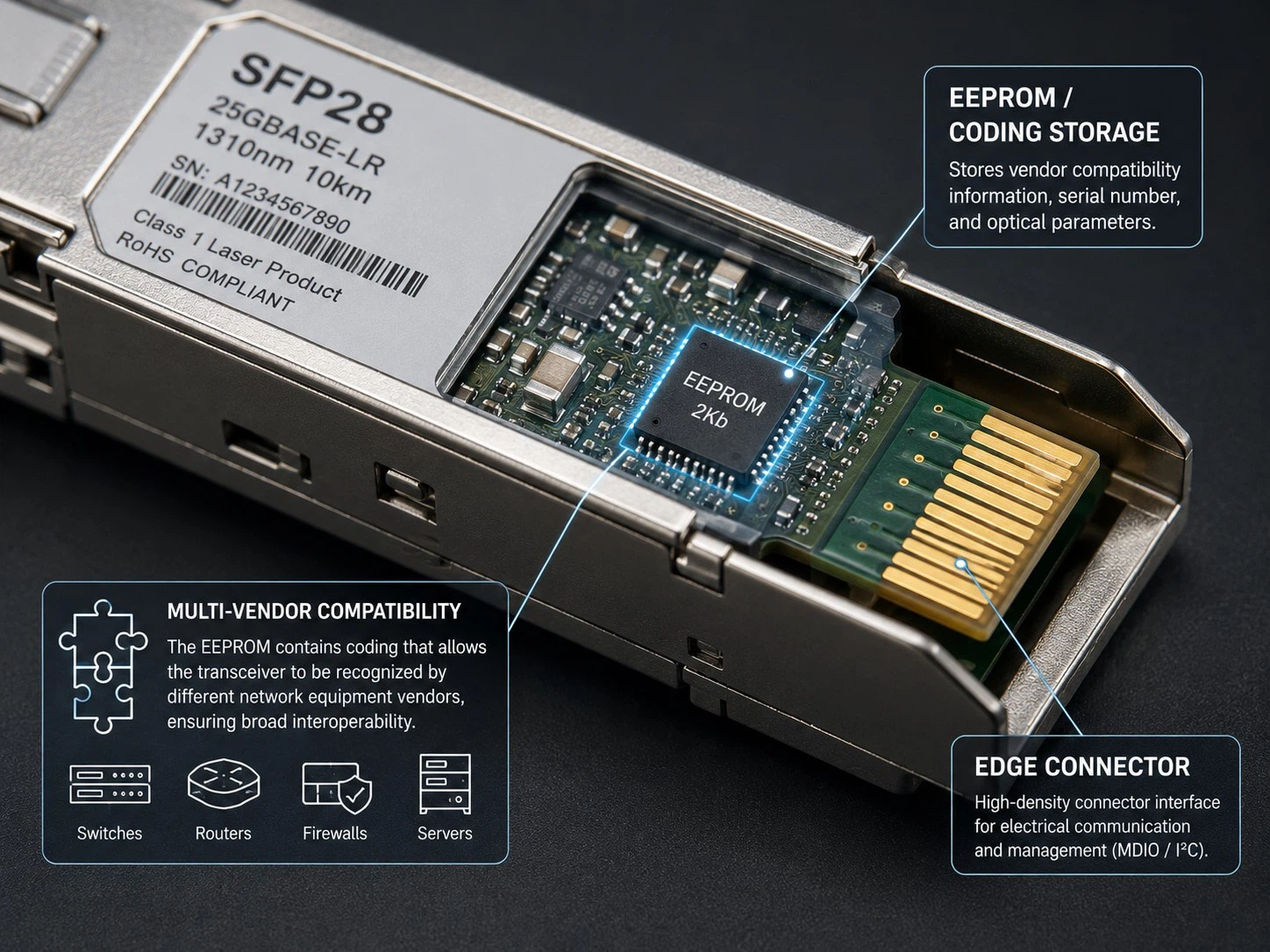
Every optical transceiver ships with an EEPROM chip that stores a digital identity: vendor name, part number, serial number, supported wavelengths, and diagnostic thresholds. When you insert a module into a Cisco, Arista, or Juniper switch, the host reads that EEPROM over an I²C bus and decides, in milliseconds, whether to enable the port or shut it down. That decision is why transceiver coding compatibility determines more about your deployment outcome than any spec sheet will. But the way each vendor implements that decision varies enough to change your procurement strategy, and that is where most comparison guides stop short.
The Multi-Source Agreement (MSA) standardizes the optical and electrical interface. Two modules built to MSA spec are functionally identical at the physical layer. MSA does not standardize the firmware handshake between module and host. Each equipment vendor writes proprietary identifiers into specific EEPROM memory addresses, and when a host switch reads an unrecognized code at boot, it may suppress DDM telemetry, log persistent warnings, or disable the port entirely. This gap between standard compliance and host acceptance is the playing field for transceiver coding compatibility in enterprise networks.
OEM-branded modules carry a price premium typically ranging from 300% to over 500% compared to third-party alternatives built on identical hardware, based on our pricing analysis across comparable SKUs. The third-party optical transceiver market reached an estimated $3.1 billion in 2025 and is growing above 10% CAGR (Research and Markets), which tells you how many procurement teams have decided the premium is not justified. Yet industry testing shows roughly 23% of third-party modules fail to initialize without vendor-specific coding, even when they meet every optical and electrical spec. Platform strictness, firmware lifecycle risk, and supplier coding capability are the three variables that determine the outcome, each examined below in the order they typically surface during a deployment.
How EEPROM Coding Actually Works: SFF-8472, SFF-8636, and CMIS
The coding standards that govern how a transceiver identifies itself to a host have evolved through three generations, and the complexity gap between them is structural, not incremental.
SFF-8472
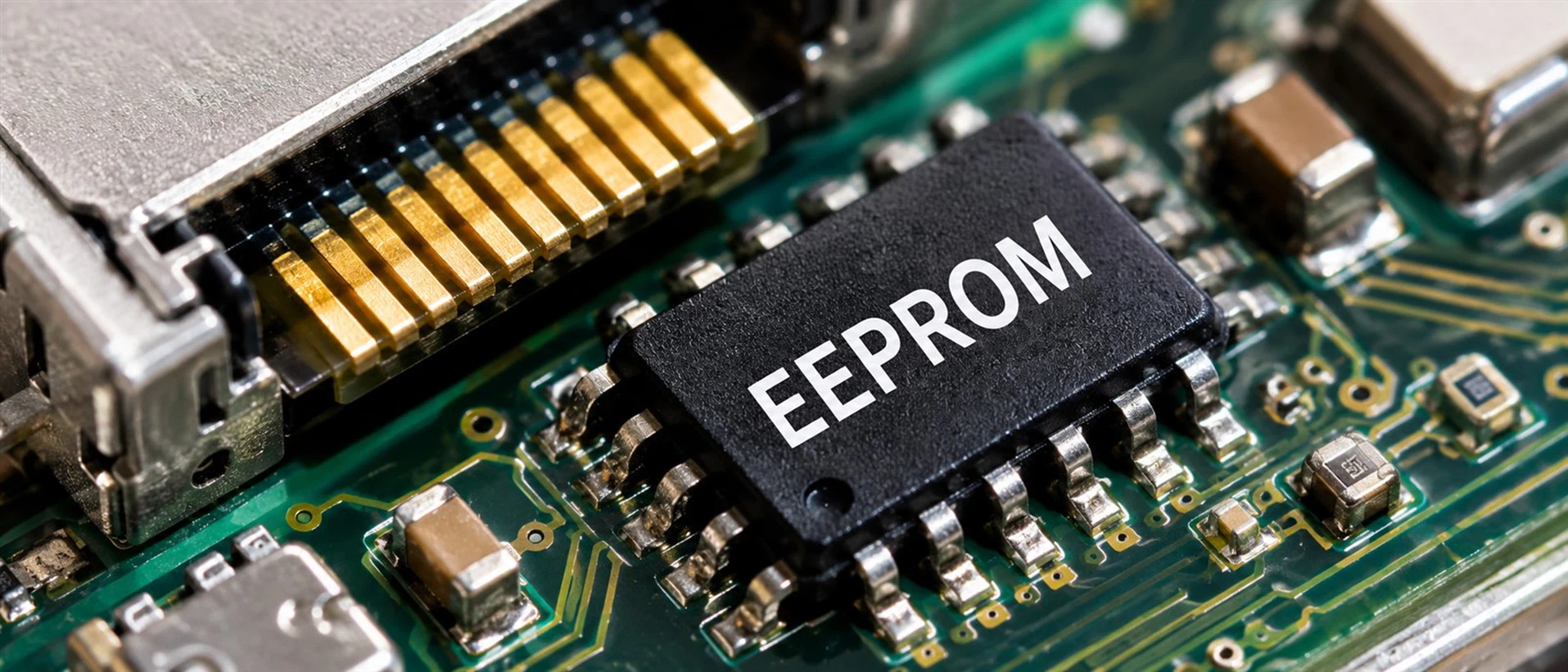
SFF-8472 covers SFP, SFP+, and SFP28 modules. The memory map is relatively flat: two I²C addresses (A0h and A2h) store identification data, calibration constants, and real-time diagnostic fields. Vendor-specific coding under SFF-8472 mainly involves writing the correct vendor name, OUI, part number, and a valid checksum into bytes 0–95 at address A0h. Get those fields right, and most hosts will accept the module. Get them wrong, and you see the familiar "unsupported transceiver" log entry.
SFF-8636
SFF-8636 expanded the memory map for QSFP+ and QSFP28 modules, adding paged upper memory, multi-lane diagnostic fields, and more granular control bytes for power class and TX disable per lane. The coding surface area is larger, and vendor-specific checks now extend into optional pages where some hosts look for extended compliance codes or custom feature flags. Ensuring transceiver coding compatibility for QSFP28 across platforms like Arista and Juniper requires matching not just identity fields but also the application advertisement codes that tell the host what line rates and FEC modes the module supports.
CMIS (Common Management Interface Specification)
CMIS (Common Management Interface Specification), now at revision 5.x, governs QSFP-DD and OSFP modules at 400G and 800G. This is where coding complexity takes a genuine jump. CMIS introduces application selection (AppSel) registers, power class state machines, module-level firmware versioning, and multi-lane configuration maps. A coding error in a CMIS module does not just cause a port rejection. It can cause breakout ports to fail enumeration, FEC mode mismatches that produce high post-FEC bit error rates, or thermal threshold misreporting that triggers false alarms.
Here is what that looks like in practice: on a QSFP-DD module coded as Power Class 7, an incorrect power class byte triggers the host's thermal/power gating logic before the port even attempts to link up. The fault presents identically to a dead module. No link LED, no log entry beyond "module not initialized." Separating a coding error from an optics failure at that point requires pulling the EEPROM dump manually and comparing it against the host's expected values. If your supplier cannot do that analysis, you are replacing functional hardware for no reason. This is why transceiver coding compatibility for CMIS modules demands a different tier of supplier validation than legacy SFP deployments ever required.
Vendor-by-Vendor: How Strict Is the Coding Check?
Not all equipment vendors enforce EEPROM coding checks for third-party SFP modules coded as Cisco compatible, or Arista, or Juniper, the same way. The difference in strictness is significant enough to change your procurement strategy depending on which platforms you run.
| Vendor | Strictness Level | Validation Mechanism | CLI Workaround Available? | Warranty Position on Third-Party Modules |
|---|---|---|---|---|
| Cisco (Catalyst / Nexus) | High | VSCC (Vendor Specific Checksum Code), Quality ID, firmware whitelist | Yes on most platforms (service unsupported-transceiver), but not on Catalyst 2960L (LAN Lite) or C1000 series | Will not void switch warranty solely due to third-party optics; TAC may require removal during troubleshooting (Cisco Warranty Policy) |
| Arista | Medium | Checks vendor ID and compliance codes; generally more permissive with MSA-compliant modules | Typically not needed for properly coded modules | Based on our deployment experience: flexible; third-party modules widely used in hyperscale environments |
| Juniper | Variable | QFX5100/QFX5200 typically log warnings only; PTX series in recent Junos releases hard-blocks CMIS modules with unrecognized vendor IDs. Confirm platform model and Junos version before procurement. | Mixed, platform-dependent | Based on field reports: may log warnings but generally does not disable ports for correctly coded modules |
| Huawei (CE series) | Medium-High | Proprietary EEPROM checks; stricter on carrier-grade platforms | Limited | Varies by region and contract terms |
| NVIDIA / Mellanox | Medium | Sensitive to FEC mode, application codes, and power class; particularly strict on breakout and RoCE configurations | N/A (NIC-side, not switch CLI) | Separate from switch vendor warranty |
The Cisco column deserves particular attention. The service unsupported-transceiver command works on most Catalyst and Nexus platforms, but there are exceptions that will cost you deployment time if you do not catch them early. On the Catalyst C1000 series and the 2960L with LAN Lite licensing, the command is not available. If you are deploying on those platforms, the coding itself must pass the host's whitelist check. There is no CLI fallback. This is the kind of platform-specific detail that separates a reliable supplier from one that sells you a generic "Cisco-compatible" module and leaves you to troubleshoot.
One more nuance: the same physical hardware running RoCE traffic versus pure Ethernet may enforce different FEC and application code expectations on a Mellanox ConnectX NIC. If your supplier's coding profile was validated for Ethernet switching but your deployment is a storage fabric, the coding needs to account for RoCE-specific host checks, not the Ethernet defaults. Verifying transceiver coding compatibility across mixed vendor and protocol environments is not optional; it is the point where generic "compatible" labels fail.
Transceiver Compatibility After Firmware Updates: The Risk No One Warns You About
Here is a scenario that plays out more often than anyone publishes case studies about: a third-party module runs without issues for months. You upgrade the switch firmware to patch a security vulnerability. The next morning, your monitoring system flags dozens of ports showing "unsupported transceiver" errors. The modules have not changed. The coding has not changed. The host's validation logic has.

Switch vendors periodically tighten EEPROM validation in new firmware releases. In one case we tracked internally, a NX-OS minor release introduced a stricter checksum verification for QSFP28 modules, invalidating third-party units that had run without incident for 18 months on the prior version. The modules were optically perfect. The coding image was one field short of the new requirement.
The operational consequence is that transceiver coding compatibility is not a one-time validation. It is a lifecycle commitment. Suppliers who treat coding as a first-class deliverable maintain per-platform coding images, track firmware release notes from Cisco, Arista, and Juniper, and proactively re-validate when a major OS update ships. Suppliers who treat coding as a checkbox at the factory gate leave you exposed every time you upgrade.
There is a related failure mode that is even harder to diagnose. Two modules with the same supplier part number, ordered six months apart, may ship with different EEPROM coding images because the supplier updated their coding database between batches. One module works in your Arista 7060CX. The other, ordered as a replenishment, does not. The hardware is identical. The coding image revision is different. Unless your supplier documents and tracks image versions the way a software company tracks firmware releases, you have no way to troubleshoot this without pulling EEPROM dumps yourself.
OEM vs Third-Party: Where the Line Falls
Three variables determine the outcome: platform coding strictness, link criticality, and your supplier's coding lifecycle capability. Here is how to weight each.
Where OEM modules remain the lower-risk choice. Extended-reach links beyond 40km where optical margin is thin and any performance variance at temperature corners can push BER past threshold. We do not recommend third-party modules on these links unless the supplier provides an optical margin report tested on your specific fiber span, not a generic datasheet value. That is not a supplier preference issue; it is optical physics. Platforms with extremely strict or inconsistent coding enforcement, such as Cisco Catalyst C1000 series or Juniper PTX with recent Junos versions, where a coding failure means a hard port shutdown with no workaround. Links covered under active TAC support contracts where any friction during a P1 outage is unacceptable.
Where third-party coded modules are the pragmatic choice. Access-layer and distribution-layer links deploying hundreds or thousands of 10G/25G modules where the OEM vs third-party transceiver coding compatibility cost differential is measured in six or seven figures. Data center leaf-spine fabrics using short-reach optics (SR, DR) where optical margin is generous and the coding challenge is well-characterized. Multi-vendor environments spanning Cisco, Arista, and Huawei where a supplier maintaining coded profiles across all three platforms simplifies procurement. One logistics operator replaced OEM 10G modules across seven facilities with third-party MSA-compliant alternatives and cut transceiver spend by roughly $2.1 million on top of an existing channel discount, because the coding was validated per-platform before deployment.
For 400G QSFP-DD and above, the supplier's CMIS coding capability is a more important selection criterion than the brand on the label. If your supplier cannot produce an AppSel validation report for your target host and firmware version, do not deploy their modules at 400G+. The coding complexity at these data rates is high enough that an incompetent supplier creates more risk than the OEM premium eliminates.
What to Demand from Your Supplier's Coding Process
If you source third-party optics, and at current price differentials most operators do for at least a portion of their deployments, the supplier's coding process determines whether your cost savings convert to operational risk. Here is what to evaluate when selecting an optical module coding partner for multi-vendor network environments.
| Evaluation Criterion | What Good Looks Like | Red Flag |
|---|---|---|
| Per-platform coding images | Separate coding profiles maintained for each target host (e.g., Cisco Nexus 93180YC-FX3 on NX-OS 10.3.x) | "Compatible with Cisco" as a single generic claim |
| Interoperability test evidence | Written test reports showing link-up, DDM accuracy, and traffic stability on your specific switch model and firmware | "MSA-compliant" cited as proof of compatibility |
| Firmware change tracking | Proactive re-validation when Cisco / Arista / Juniper release major OS updates | No mention of firmware lifecycle |
| Burn-in testing | 24–72 hour burn-in with traffic at temperature before shipment | Visual inspection or power-on test only |
| Dual-coded DAC/AOC support | Ability to code each end of a direct attach cable for different vendors (e.g., Side-A Cisco, Side-B NVIDIA) | Only single-vendor coding available |
| Coding image version tracking | Each module's coding image version documented and traceable by serial number | No image revision tracking between batches |
The burn-in duration matters more than most buyers realize. A module that links up and passes traffic at room temperature for five minutes may develop intermittent FEC errors at elevated temperatures after hours of operation. A 24-hour minimum burn-in at operating temperature catches the marginal units that a quick bench test misses.
Our compatibility lab maintains live test beds across Cisco Nexus 9300/9500, Arista 7050CX3/7060CX2, Juniper QFX5200, and Huawei CE6870. Every SKU release goes through PRBS31 pre/post-FEC BER validation at rated temperature, DDM telemetry verification against host threshold expectations, and hot-swap cycling to confirm port state recovery. We provide custom EEPROM coding at no additional charge, because coding is not an afterthought in this business. It is the deliverable that determines whether our modules work in your network or become expensive paperweights.
For PRBS31 results and coding image version history for your specific platform, contact our engineering team. Specify your host switch model and NOS version in the request. If your current supplier cannot pass this checklist, change suppliers before your next firmware upgrade cycle. The switching cost is recoverable. A production outage during a firmware upgrade is not.
FAQ: Transceiver Coding Compatibility
Q: Will using a third-party transceiver with compatible coding void my switch warranty?
A: No. Equipment manufacturers cannot void a switch warranty solely because a third-party module is installed. Cisco's own warranty documentation states that support continues unless the fault is directly attributable to the non-Cisco component. TAC may ask you to swap in an OEM module during troubleshooting, but the warranty itself remains intact.
Q: Why does my switch show "unsupported transceiver" even though the module physically fits?
A: The host reads the module's EEPROM at insertion and checks vendor identity, compliance codes, and capability fields against an internal whitelist. A physical fit confirms form factor compatibility; host acceptance requires correct EEPROM coding for that specific platform and firmware version.
Q: Can a firmware upgrade break transceiver coding compatibility that was previously working?
A: Yes. Switch OS updates can introduce stricter EEPROM validation checks, causing previously accepted modules to fail. This is why coding lifecycle support from your supplier, not just initial validation, is a critical procurement criterion.
Q: What is the difference between SFF-8472 and CMIS coding?
A: SFF-8472 covers SFP-family modules with a relatively simple identification and diagnostic memory map. CMIS governs QSFP-DD and OSFP modules at 400G/800G, adding application selection, power class state machines, and multi-lane configuration, making coding errors more consequential and validation more complex.
Q: How do I verify transceiver coding compatibility before a large-scale deployment?
A: Request pre-coded samples for your specific switch model and firmware version. Run a 24–72 hour burn-in with real traffic at temperature. Verify DDM/DOM telemetry accuracy against expected thresholds. Confirm that your supplier maintains per-platform coding images and tracks host firmware changes. For platform-specific validation, contact our engineering team for a free compatibility assessment.