

400G CFP2 Coherent Multiplexing Transponder
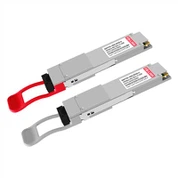
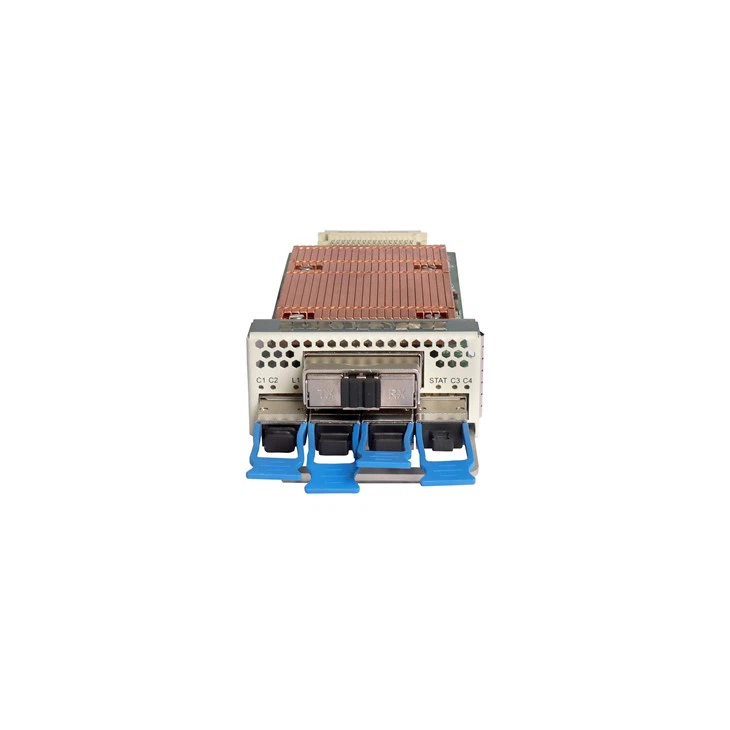
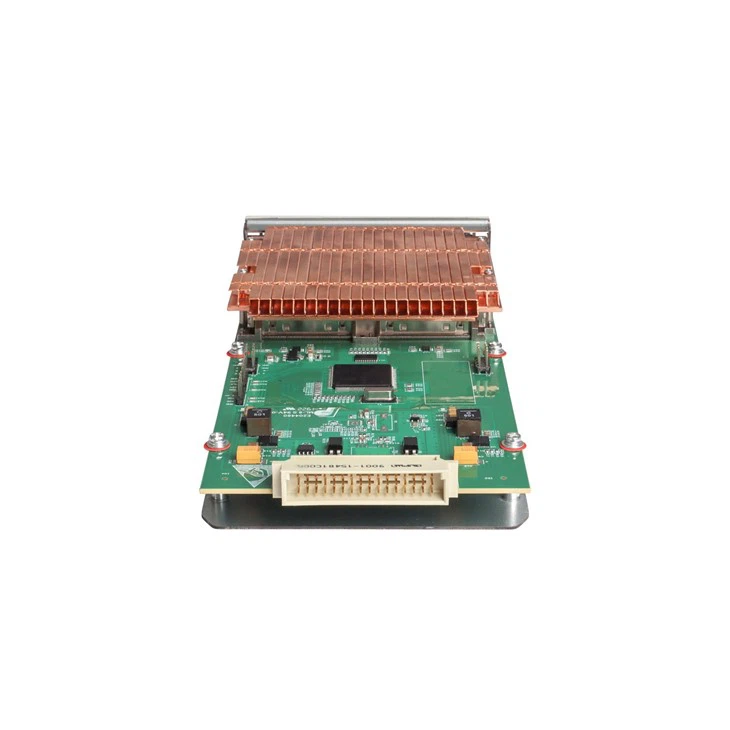
400G CFP2 Coherent Multiplexing Transponder for fiber optic link 400G service access board, can achieve 4 * QSFP28 100G conversion CFP2 400G, CFP2 coherent optical module wavelength adjustable, with DWDM multiplexer / demultiplexer to achieve wavelength-division multiplexing transmission, in order to solve the problem of fiber optic resources, fiber optic lines with high loss of transmission line to provide quality solutions.

- Product Introduction
400G CFP2 Coherent Single Wavelength Multiplexing Transponder
DCI Product Features
● Single board supports 4*100G to 400G coherent transmission, which can realize single 400G line side transmission.
● Wavelength adjustable, supports up to 400G 64-wave, 100G/200G 96-wave.
● Flexible coherent modulation technology: DP-16QAM, DP-8QAM, DP-QPSK.
● Multiple FEC error correction technologies: oFEC, CFEC, SCFEC, SDFEC.
● Supports flexible service access: 100GE, 100GE KR4, OTU4 and 100G FlexE.
● Support perfect performance monitoring and statistics function.
● Support Ethernet RMON performance statistics, LLDP monitoring, constellation diagram monitoring, DM delay and PRBS detection function, OTN PM and SM performance statistics and other functions.
● Supports high-precision board-level temperature, voltage, current and power consumption real-time monitoring.
● Supports multiple module interface types on client side: 100G SR4/CWDM4/LR4/PSM4.
● Support unified network management platform, network management methods SNMP, CLI, Web, NMS (graphical interface) and Netconf/Yang model interface.
DCI Application Scenarios
● Government and data center connectivity
● Banks, credit card companies and other financial institutes
● Cloud providers and ISP backbone
● Utilities and essential infrastructure
● Feeder of encrypted services to existing OTN
● Managed encrypted wavelength services offered by service providers
● Internal data center secured connectivity
Product Specification
| Technical Feature | Description |
| Occupied Slots Number | Occupy one slot |
| Client-side interface | Each service card supports four pluggable QSFP28 based 100G client ports, in total sixteen 100G client ports per chassis. |
| Line-side interface | Each service card supports one pluggable 400G CFP2 DCO coherent modules, in total four 400G line-side ports. |
| Line-side signal and multiplexing structure | 400G: OCh <-> OTUC4 <->ODUC4 <-> ODU4 |
| Client-side signal and mapping method | 100G <-> ODU4 |
| Line-side modulation format | 400G: 16QAM |
| FEC mode | 400G: SD-FEC |
The explosive growth of cloud computing, streaming services, and digital transformation has created unprecedented demand for high-capacity data center interconnect solutions. Organizations spanning financial services, telecommunications, and enterprise sectors are turning to advanced DCI technology to bridge the gap between geographically distributed data centers while maintaining ultra-low latency and maximum bandwidth efficiency.
Modern DCI infrastructure has evolved far beyond simple point-to-point connections. Next-generation coherent optical transmission systems now deliver 400 Gbps capacity over single wavelengths, fundamentally changing how enterprises architect their network infrastructure. These advanced DCI platforms leverage sophisticated digital signal processing and flexible modulation schemes to maximize spectral efficiency while minimizing operational complexity.
The Technology Behind Advanced DCI Systems
Coherent optical DCI solutions represent a quantum leap in transmission capability. By employing dual-polarization modulation formats including 16QAM, 8QAM, and QPSK, these systems adapt to varying distance and capacity requirements. The intelligent selection of modulation format enables network operators to optimize the critical balance between reach and throughput - essential for DCI applications where every kilometer and every gigabit matters.
Forward error correction technology plays a pivotal role in ensuring reliable DCI performance. Advanced FEC algorithms including soft-decision FEC provide exceptional optical signal-to-noise ratio gains, enabling transmission over extended distances without regeneration. This capability proves particularly valuable for metro and regional DCI deployments where intermediate amplification sites may be impractical or cost-prohibitive.
The wavelength multiplexing architecture of modern DCI equipment delivers remarkable scalability. Supporting dense wavelength division multiplexing with up to 96 channels, these platforms enable massive aggregate capacity over existing fiber infrastructure. This wavelength flexibility allows DCI networks to grow organically as bandwidth demands increase, protecting capital investments while accommodating future expansion.
Operational Advantages of Coherent DCI Infrastructure
Service flexibility stands as a cornerstone benefit of contemporary DCI platforms. Supporting multiple client interface standards including 100 Gigabit Ethernet, OTU4, and FlexE, these systems integrate seamlessly into diverse network environments. This multi-protocol capability eliminates the need for external conversion equipment, reducing power consumption, rack space, and potential failure points in critical DCI links.
Comprehensive performance monitoring capabilities embedded within modern DCI equipment provide unprecedented visibility into network health. Real-time constellation diagram analysis, chromatic dispersion monitoring, and bit error rate testing enable proactive identification of degradation before service impact occurs. For mission-critical DCI applications connecting financial trading platforms or healthcare data repositories, this predictive maintenance capability translates directly to improved availability.
The compact form factor of integrated coherent DCI solutions delivers substantial benefits in space-constrained data center environments. Single-slot designs that aggregate multiple 100G client services onto 400G line-side transmission optimize valuable rack real estate. This density advantage becomes increasingly important as data centers struggle to accommodate exponential traffic growth within fixed physical footprints.
Strategic DCI Deployment Scenarios
Financial institutions leverage high-capacity DCI technology to interconnect trading platforms, disaster recovery sites, and regulatory compliance archives. The deterministic low latency of direct optical DCI connections proves essential for high-frequency trading applications where microseconds determine profitability. Enhanced security features including native encryption capabilities address stringent regulatory requirements for financial data protection across DCI links.
Government agencies and critical infrastructure operators deploy DCI solutions to maintain connectivity between geographically distributed facilities while ensuring data sovereignty. The ability to establish private optical wavelength services over dark fiber or leased wavelengths enables these organizations to maintain complete control over sensitive information traversing DCI networks.
Cloud service providers utilize scalable DCI infrastructure to interconnect availability zones and deliver seamless multi-region redundancy. The flexible bandwidth allocation capabilities of modern coherent DCI platforms allow cloud operators to dynamically adjust capacity between data centers based on real-time demand patterns, optimizing resource utilization across their infrastructure.
Enterprise organizations increasingly adopt DCI technology to connect private data centers with public cloud on-ramps. These hybrid DCI architectures enable workload portability and disaster recovery strategies that span both on-premises and cloud environments. The standards-based interfaces of contemporary DCI equipment ensure interoperability across diverse infrastructure components.
Management and Automation Capabilities
Modern DCI platforms embrace software-defined networking principles through comprehensive management interfaces. Support for NETCONF/YANG data models enables programmatic configuration and monitoring, essential for large-scale DCI deployments spanning dozens or hundreds of wavelengths. This API-driven approach facilitates integration with orchestration platforms and network automation workflows.
Granular performance statistics available through DCI management systems provide critical inputs for capacity planning and optimization. Detailed metrics covering optical signal quality, forward error correction overhead, and client-side traffic patterns enable network engineers to make data-driven decisions about DCI infrastructure evolution.
Future-Proofing DCI Investments
The migration path toward 800G and beyond coherent DCI technology begins with today's 400G deployments. Wavelength-flexible platforms designed with upgrade capabilities protect infrastructure investments as transmission standards evolve. Organizations can deploy current-generation DCI equipment confident that future capacity expansion won't require complete system replacement.
Interoperability considerations remain paramount when selecting DCI solutions for multi-vendor network environments. Adherence to industry standards for both optical transmission and network management ensures that DCI infrastructure integrates smoothly with existing equipment while preserving options for future vendor diversification.
Frequently Asked Questions About DCI Technology
What is the difference between DCI and traditional WAN connectivity?
DCI specifically refers to high-capacity optical connections between data centers, typically utilizing coherent transmission technology and wavelength division multiplexing. Unlike traditional WAN services that aggregate multiple customer connections over shared infrastructure, DCI provides dedicated, high-bandwidth point-to-point connectivity optimized for massive data transfer between data center facilities. DCI solutions prioritize ultra-low latency, predictable performance, and scalable capacity - characteristics essential for modern distributed computing architectures.
How does coherent technology improve DCI performance?
Coherent optical transmission employed in advanced DCI systems uses sophisticated modulation of both amplitude and phase of light, combined with dual polarization, to encode significantly more data per symbol compared to traditional intensity-modulated direct-detection systems. This approach, coupled with digital signal processing and advanced error correction, enables DCI links to achieve 400G or higher capacity over extended distances while maintaining excellent optical signal quality. The result is fewer wavelengths required for equivalent capacity, reducing infrastructure costs and complexity.
What distance limitations apply to 400G DCI links?
The achievable distance for 400G coherent DCI transmission depends on several factors including modulation format, fiber quality, and acceptable optical signal-to-noise ratio. Using 16QAM modulation with soft-decision FEC, typical metro DCI applications can span 80-120 kilometers. By switching to QPSK modulation formats, DCI links can extend to 500 kilometers or beyond, though with reduced spectral efficiency. This flexibility allows network planners to optimize DCI configurations for specific geographic requirements.
Can DCI infrastructure support multiple data center interconnection topologies?
Modern DCI platforms support diverse network topologies including point-to-point, ring, and mesh configurations. Wavelength-selective switching and flexible spectrum allocation enable creation of complex DCI networks where any data center can communicate with any other facility. This topology flexibility proves particularly valuable for distributed cloud architectures and disaster recovery scenarios requiring multiple independent failure domains in DCI design.
What security considerations are important for DCI deployments?
DCI links carrying sensitive enterprise or government data require robust security measures. Many contemporary DCI platforms incorporate hardware-based encryption operating at line rate without performance penalty. Additional security layers include secure management interfaces, role-based access control, and comprehensive audit logging. For maximum security, DCI wavelengths can traverse dedicated dark fiber rather than shared wavelength services, ensuring complete physical layer isolation.
How does DCI technology integrate with existing OTN networks?
Advanced DCI equipment provides native OTN framing and mapping capabilities, enabling seamless integration with existing optical transport network infrastructure. Client services can be mapped into ODU containers for transport across OTN networks, while DCI platforms can also serve as edge elements feeding wavelengths into ROADM-based OTN cores. This interoperability allows phased migration strategies where DCI capacity augments rather than replaces existing transport infrastructure.
What factors determine the total cost of ownership for DCI infrastructure?
DCI total cost of ownership encompasses initial equipment acquisition, optical fiber or wavelength leasing, power consumption, cooling requirements, and ongoing maintenance. High-density coherent DCI platforms reduce costs through minimized rack space, reduced power per transported bit, and simplified operational management. Organizations should evaluate DCI solutions holistically, considering both capital and operational expenses across the expected infrastructure lifecycle of 5-7 years.
Hot Tags: dci
You Might Also Like