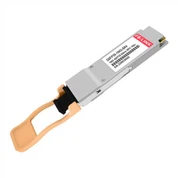
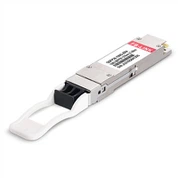
100G BIDI
The QSFP28 transceiver provides 100GBase BIDI throughput up to 20km over single-mode fiber (SMF) using a wavelength of 1310nmTx/1280nmRx via an LC connector.

- Product Introduction
Product Highlights
● QSFP28 MSA package with simplex LC connector
● Interoperable with IEEE 802.3cu
● Lane signaling rate 53.125GBd with PAM4
● High speed I/O electrical interface
● Two Wire Serial Interface with Digital Diagnostic Monitoring
● Operating case temperature range 0°C to +70°C
● Support KP4 FEC inside the module and KP4 FEC shutdown
● Reaches up to 20km on SMF
● Maximum power consumption 4.5W
● 3.3V power supply voltage
● compliant to RoHS2.0
● Class 1 Las
Products Description
|
Compatible |
100G BIDI |
Vendor Name |
FB-LINK |
|
Form Factor |
QSFP28 |
Max Data Rate |
103.1Gbps |
|
Wavelength |
1280/1310nm |
Max Cable Distance |
20KM |
|
Connector |
Simplex LC |
Media |
SMF |
|
Transmitter Type |
DFB |
Receiver Type |
PIN |
|
TX Power |
-4.3~4.5dBm |
Receiver Sensitivity |
<-14.5dBm |
|
Powerbudget |
13dB |
Receiver Overload |
4.5dBm |
|
Power Consumption |
≤5W |
Extinction Ratio |
>4dB |
|
DDM/DOM |
Supported |
Commercial Temperature Range |
0 to 70°C (32 to 158°F) |
|
Protocols |
QSFP28 MSA |
Warranty |
3 Years |
Product image

Product compatibility

Product Selection

Network infrastructure continues to evolve at breakneck speed, and optical transceivers have emerged as critical components powering everything from data centers to telecommunications networks. These sophisticated devices convert electrical signals into optical signals and vice versa, enabling high-bandwidth data transmission over fiber optic cables with remarkable efficiency and reliability.
What Makes Optical Transceivers Essential for Network Performance
Optical transceivers serve as the bridge between electronic network equipment and fiber optic cabling infrastructure. Unlike traditional copper-based solutions, these modules leverage the power of light to transmit data across vast distances without signal degradation. Modern optical transceivers support data rates reaching beyond 100Gbps, making them indispensable for bandwidth-intensive applications.
The technology behind optical transceivers has matured significantly, with bidirectional (BIDI) variants offering unique advantages. By transmitting and receiving on different wavelengths through a single fiber strand, BIDI optical transceivers reduce infrastructure costs while maintaining exceptional performance characteristics.
Key Applications Driving Optical Transceiver Adoption
Data center interconnects represent one of the fastest-growing applications for optical transceivers. As cloud computing and big data analytics demand ever-increasing bandwidth, these modules provide the scalability necessary to meet future requirements. Enterprise networks, metropolitan area networks, and telecommunications backbone infrastructure all rely heavily on optical transceivers to maintain seamless connectivity.
The evolution toward 5G networks has further accelerated demand for high-performance optical transceivers. These devices enable the low-latency, high-bandwidth connections required for next-generation wireless infrastructure, supporting everything from enhanced mobile broadband to mission-critical IoT applications.
Technical Considerations When Selecting Optical Transceivers
Several factors determine the optimal optical transceiver for specific deployment scenarios. Transmission distance requirements directly influence module selection-solutions capable of reaching 20 kilometers over single-mode fiber suit metropolitan applications, while shorter-reach variants excel in data center environments.
Power consumption has become increasingly important as network operators seek to reduce operational costs and environmental impact. Modern optical transceivers balance performance with energy efficiency, typically consuming between 3.5 and 5 watts while delivering exceptional throughput.
Form factor compatibility ensures seamless integration with existing network equipment. The QSFP28 standard has gained widespread adoption, offering hot-swappable functionality and supporting multiple protocols within a compact footprint. This versatility makes optical transceivers future-proof investments that can adapt to evolving network architectures.
Advanced Features Enhancing Optical Transceiver Reliability
Forward error correction (FEC) capabilities built into optical transceivers improve signal integrity across challenging transmission paths. Advanced modulation schemes like PAM4 enable higher data rates within existing infrastructure, effectively doubling capacity without requiring complete network overhauls.
Digital diagnostic monitoring (DDM) functionality provides real-time visibility into optical transceiver performance metrics. Network administrators can proactively identify potential issues before they impact service quality, minimizing downtime and streamlining troubleshooting processes.
Temperature tolerance determines where optical transceivers can be deployed. Commercial-grade modules operating across 0°C to 70°C handle most data center and enterprise environments, while extended-temperature variants serve harsh outdoor installations.
Industry Standards and Compliance
Interoperability remains paramount in multi-vendor environments. Leading optical transceivers comply with IEEE standards and Multi-Source Agreement (MSA) specifications, ensuring compatibility across diverse network equipment from different manufacturers. This standardization protects infrastructure investments while providing deployment flexibility.
Safety certifications including laser class designations guarantee optical transceivers meet stringent requirements for human safety and environmental protection. RoHS compliance confirms the absence of hazardous materials, aligning with global sustainability initiatives and regulatory mandates.
Installation and Maintenance Best Practices
Proper handling of optical transceivers extends their operational lifespan and maintains performance. Fiber end-face cleanliness critically impacts signal quality-contamination causes insertion loss and potential module damage. Using appropriate cleaning tools and following manufacturer guidelines prevents common installation issues.
Optical transceivers benefit from regular monitoring through built-in diagnostic capabilities. Tracking parameters like optical power levels, temperature, and voltage helps identify degradation trends before they cause failures. Many organizations implement automated monitoring systems that alert staff to anomalies requiring investigation.
Cost-Benefit Analysis for Optical Transceiver Deployment
While optical transceivers represent significant initial investment, their long-term value proposition proves compelling. Reduced cable infrastructure requirements, especially with BIDI technology, lower installation costs. The superior bandwidth capacity of optical transceivers delays the need for costly network upgrades, improving return on investment.
Energy efficiency gains translate directly to reduced operational expenses. Though individual optical transceivers consume modest power, cumulative savings across large deployments become substantial. Additionally, the reliability of optical transceivers minimizes maintenance costs and network downtime that impact business continuity.
Future Trends Shaping Optical Transceiver Development
The industry continues pushing bandwidth boundaries with 400G and 800G optical transceivers entering mainstream deployment. These ultra-high-speed modules employ sophisticated technologies like coherent detection and advanced DSP to achieve unprecedented performance levels.
Silicon photonics represents another transformative development, promising to reduce optical transceiver costs while improving power efficiency. By integrating optical components directly onto silicon chips, manufacturers can leverage semiconductor industry economies of scale.
Artificial intelligence and machine learning are being integrated into optical transceiver management systems. These technologies enable predictive maintenance, automated optimization, and intelligent traffic routing that maximize network efficiency without manual intervention.
Frequently Asked Questions About Optical Transceivers
Q: What is the difference between single-mode and multi-mode optical transceivers?
Single-mode optical transceivers transmit light through smaller fiber cores using laser sources, enabling longer transmission distances up to tens of kilometers. Multi-mode variants use LED or VCSEL sources with larger fiber cores, suited for shorter distances typically under 500 meters but at lower cost points.
Q: How do I know if optical transceivers are compatible with my network equipment?
Check that the form factor (such as QSFP28, SFP+, or CFP) matches your switch or router ports. Verify the supported protocols and data rates align with your requirements. Most enterprise equipment supports MSA-compliant modules from multiple vendors, though it's wise to consult compatibility matrices.
Q: Can optical transceivers be used interchangeably between different vendors' equipment?
Yes, provided they follow industry standards like IEEE specifications and MSA guidelines. However, some manufacturers implement proprietary features or coding that may require vendor-specific modules. Third-party compatible optical transceivers often offer cost savings while maintaining full functionality.
Q: What causes optical transceiver failure and how can it be prevented?
Common failure causes include physical damage, contaminated fiber connections, excessive temperature, and electrical issues. Prevention strategies include proper handling during installation, regular cleaning of fiber connections, ensuring adequate cooling, and using surge protection. Monitoring diagnostic parameters helps identify problems early.
Q: How long do optical transceivers typically last?
Quality optical transceivers typically offer mean time between failures (MTBF) exceeding 300,000 hours under normal operating conditions. Most manufacturers provide warranties ranging from one to five years. Actual lifespan depends on environmental factors, usage patterns, and maintenance quality.
Q: What is digital diagnostic monitoring (DDM) and why is it important?
DDM allows optical transceivers to report real-time operational parameters including temperature, voltage, laser bias current, transmitted optical power, and received optical power. This visibility enables proactive maintenance, rapid troubleshooting, and performance optimization without specialized test equipment.
Q: Are higher data rate optical transceivers always better?
Not necessarily. While higher-rate optical transceivers provide more bandwidth, they cost more and may consume additional power. The optimal choice balances current needs with future growth projections. Overprovisioning can waste budget, while underprovisioning necessitates premature upgrades.
Q: What does BIDI technology mean for optical transceivers?
BIDI (bidirectional) optical transceivers transmit and receive on different wavelengths through a single fiber strand rather than requiring separate transmit and receive fibers. This reduces fiber infrastructure requirements by half, lowering installation costs and simplifying cable management, particularly valuable in fiber-constrained environments.
Hot Tags: Optical Transceivers
You Might Also Like